Mind Map Overal Idea Content Speed Notes Quick Coverage Light is the natural agent that stimulates sight and makes things visible. Light is reflected from all surfaces. It is a form of energy. Reflection of Light: Bouncing back of light after striking any surface such as a rough surface, Smooth surfce, shiny surface or polished readmore
Mind Map
Overal Idea
Content
Speed Notes
Quick Coverage
Light is the natural agent that stimulates sight and makes things visible. Light is reflected from all surfaces. It is a form of energy.
Reflection of Light: Bouncing back of light after striking any surface such as a rough surface, Smooth surfce, shiny surface or polished surface, into the same medium, is called reflection of light. (Scroll down till end of the page)
Study Tools
Audio, Visual & Digital Content
luminous objects: Objects that give out light on their own are called luminous objects.
Examples: Flame, Sun, Glowing bulb
Non-luminous objects: Objects that do not give out light on their own are called non-luminous objects.
Examples: Rocks, Plasic Toys, Walls of room.
The Non – Luuminous objects, reflect light that falls on them.
When the reflected light enters into our eyes from the objects we could see them.
Types of Reflection: (i) Regular Reflection: When a beam of parallel light rays is incident on a smooth and plane surface, the reflected rays will also be parallel. This type of reflection is called Regular Reflection.
The reflection from a plane mirror is an example of regular reflection.
(ii) Diffused or Irregular Reflection: When a parallel beam of light is incident upon a rough or uneven surface, it is reflected in many directions due to presence of irregularities on that.
multiple reflections: If a reflected light ray is reflected again on being incident on another surface, it is termed as multiple reflections.
Multiple reflections are used in periscope, kaleidoscope etc.
Periscopes are used in submarines, war tanks and by soldiers in bunkers to see objects.
In a kaleidoscope, beautiful patterns are formed due to multiple reflections.
Laws of reflection of light:
(i) The angle of incidence is equal to the angle of reflection.
(ii) Incident ray, reflected ray and the normal drawn at the point of incidence to the reflecting surface, lie in the same plane.
Lateral inversion: Lateral inversion is the effect produced by a plane mirror in reversing images from left to right.
Example: Our left hand will appear as right and vice versa.
Characteristics of the image formed by a plane mirror
Size the image formed by a plane mirror is equal to the siz of the object.
The image formed by the plane mirror is left-right inverted.
The image formed by the plane mirror erect and virtual formed behind the mirror.
Since the distance of the object in front of the mirror two mirrors inclined to each other give multiple images.
Sunlight: Sunlight, called white light, consists of seven colours.
dispersion: Splitting of light into its constituent colours is known as dispersion.
Human Eye:
A normal eye can see nearby and distant objects clearly.
Visually challenged persons can read and write using Braille system.
Visually challenged persons develop their other senses more sharply to improve their interaction with their environment.
Parts of Human Eye: (i) Cornea: Transparent bulge on the front surface of the eyeball which protects the eye andhelps in refraction of light.
(ii) Iris: Coloured diaphragm behind the cornea which controls the amount of light entering the eye.
(iii) Pupil: Dark hole in the middle of iris through which light enters the eye. (iv) Eye lens: Transparent, crystalline structure behind pupil and iris. (v) Ciliary muscles: Hole the eye lens in position and control the focal length of the eye lens.
(vi) Retina: Surface of the rear part of the eyeball where the light entering the eye is focused.
(vii) Rods and Cones: Rod cells respond to the brightness of light while cone cells.
Mind Map Overal Idea Content Speed Notes Quick Coverage Rational numbers are closed under the operations of addition, subtraction and multiplication, But not in division. (Scroll down till end of the page) Study Tools Audio, Visual & Digital Content The operations addition and multiplication are(i) commutative for rational numbers. (ii) associative for rational numbers. The readmore
Mind Map
Overal Idea
Content
Speed Notes
Quick Coverage
Rational numbers are closed under the operations of addition, subtraction and multiplication, But not in division. (Scroll down till end of the page)
Study Tools
Audio, Visual & Digital Content
The operations addition and multiplication are (i) commutative for rational numbers.
(ii) associative for rational numbers.
The rational number 0 is the additive identity for rational numbers.
The additive inverse of the rational number a/b is -a/b and vice- versa.
The reciprocal or multiplicative inverse of the rational number is if a/b is c/d if (a/b)(c/d) =1
Distributive property of rational numbers:
For all rational numbers a, b and c, a(b + c) = ab + ac and a(b – c) = ab – ac.
Rational numbers can be represented on a number line.
Between any two given rational numbers there are countless rational numbers.
The idea of mean helps us to find rational numbers between two rational numbers.
Positive Rationals: Numerator and Denominator both are either positive or negative.
Example: 2/3, -4/-5
Positive Rationals: Numerator and Denominator both are either positive or negative.
Mind Map Overal Idea Content Speed Notes Quick Coverage Linear Equation in One variable: The expressions which form the equation that contain single variable and the highest power of the variable in the equation is one. (Scroll down till end of the page) Study Tools Audio, Visual & Digital Content Linear Equations in One Variable readmore
Mind Map
Overal Idea
Content
Speed Notes
Quick Coverage
Linear Equation in One variable: The expressions which form the equation that contain single variable and the highest power of the variable in the equation is one. (Scroll down till end of the page)
Study Tools
Audio, Visual & Digital Content
Linear Equations in One Variable
An algebraic equation is an equality involving variables. It says that the value of the expression on one side of the equality sign is equal to the value of the expression on the other side.
The equations we study in Classes VI, VII and VIII are linear equations in one variable. In such equations, the expressions which form the equation contain only one variable. Further, the equations are linear, i.e., the highest power of the variable appearing in the equation is 1.
A linear equation may have for its solution any rational number.
An equation may have linear expressions on both sides. Equations that we studied in Classes VI and VII had just a number on one side of the equation.
Just as numbers, variables can, also, be transposed from one side of the equation to the other.
Occasionally, the expressions forming equations have to be simplified before we can solve them by usual methods. Some equations may not even be linear to begin with, but they can be brought to a linear form by multiplying both sides of the equation by a suitable expression.
The utility of linear equations is in their diverse applications; different problems on numbers, ages, perimeters, combination of currency notes, and so on can be solved
Mind Map Overal Idea Content Speed Notes Quick Coverage A quadrilateral has 10 parts – 4 sides, 4 angles and 2 diagonals. Five measurements can determine a quadrilateral uniquely. (Scroll down till end of the page) Study Tools Audio, Visual & Digital Content Practical Geometry Five measurements can determine a quadrilateral uniquely. A quadrilateral can readmore
A quadrilateral has 10 parts – 4 sides, 4 angles and 2 diagonals. Five measurements can determine a quadrilateral uniquely. (Scroll down till end of the page)
Study Tools
Audio, Visual & Digital Content
Practical Geometry
Five measurements can determine a quadrilateral uniquely.
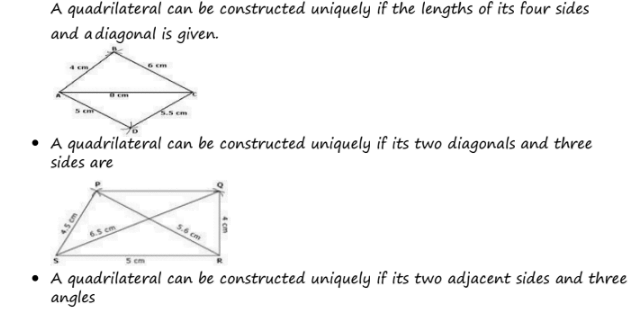
A quadrilateral can be constructed uniquely if the lengths of its four sides and a diagonal is given.
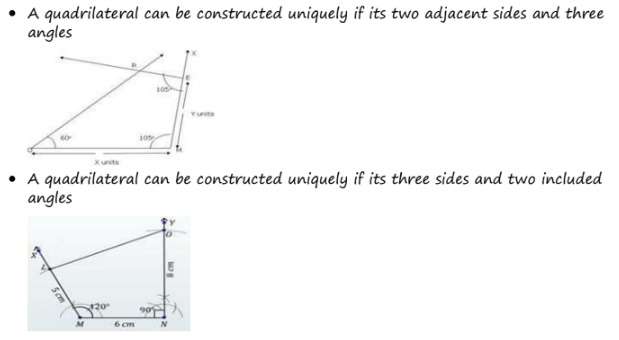
A quadrilateral can be constructed uniquely if its two diagonals and three sides are
known.
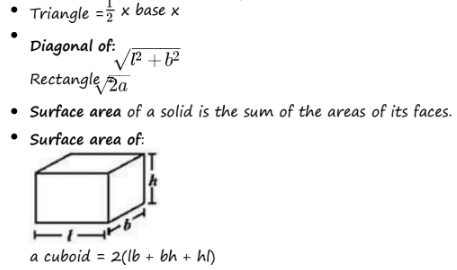
A quadrilateral can be constructed uniquely if its two adjacent sides and three angles
are known.
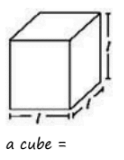
A quadrilateral can be constructed uniquely if its three sides and two included angles
Mind Map Overal Idea Content Speed Notes Quick Coverage Data Handling: Deals with the process of collecting data, presenting it and getting result. Data mostly available to us in an unorganised form is called raw data. (Scroll down till end of the page) Study Tools Audio, Visual & Digital Content Grouped data can be presented readmore
Mind Map
Overal Idea
Content
Speed Notes
Quick Coverage
Data Handling: Deals with the process of collecting data, presenting it and getting result.
Data mostly available to us in an unorganised form is called raw data. (Scroll down till end of the page)
Study Tools
Audio, Visual & Digital Content
Grouped data can be presented using histogram. Histogram is a type of bar diagram, where the class intervals are shown on the horizontal axis and the heights of the bars show the frequency of the class interval. Also, there is no gap between the bars as there is no gap between the class intervals.
In order to draw meaningful inferences from any data, we need to organise the data systematically.
Frequency gives the number of times that a particular entry occurs.
Raw data can be ‘grouped’ and presented systematically through ‘grouped frequency distribution’.
Statistics: The science which deals with the collection, presentation, analysis and interpretation of numerical data.
Observation: Each entry (number) in raw data.
Range: The difference between the lowest and the highest observation in a given data.
Array: Arranging raw data in ascending or descending order of magnitude. Data can also presented using circle graph or pie chart. A circle graph shows the relationship between a whole and its part.
There are certain experiments whose outcomes have an equal chance of occurring. A random experiment is one whose outcome cannot be predicted exactly in advance. Outcomes of an experiment are equally likely if each has the same chance of occurring.
Frequency: The number of times a particular observation occurs in the given data.
Class Interval: A group in which the raw data is condensed.
(i) Continuous: The upper limit of a class interval coincides with the lower limit of the next class.
Mind Map Overal Idea Content Speed Notes Quick Coverage Square: Number obtained when a number is multiplied by itself. It is the number raised to the power 2. 22 = 2 x 2=4(square of 2 is 4). If a natural number m can be expressed as n2, where n is also a natural number, then readmore
Mind Map
Overal Idea
Content
Speed Notes
Quick Coverage
Square: Number obtained when a number is multiplied by itself. It is the number raised to the power 2. 22 = 2 x 2=4(square of 2 is 4).
If a natural number m can be expressed as n2, where n is also a natural number, then m is a square number.(Scroll down till end of the page)
Study Tools
Audio, Visual & Digital Content
All square numbers end with 0, 1, 4, 5, 6 or 9 at unit’s place. Square numbers can only have even number of zeros at the end. Square root is the inverse operation of square.
There are two integral square roots of a perfect square number.
Positive square root of a number is denoted by the symbol For example, 32=9 gives
Perfect Square or Square number: It is the square of some natural number. If m=n2, then m is a perfect square number where m and n are natural numbers. Example: 1=1 x 1=12, 4=2 x 2=22.
Properties of Square number:
A number ending in 2, 3, 7 or 8 is never a perfect square. Example: 152, 1028, 6593 etc.
A number ending in 0, 1, 4, 5, 6 or 9 may not necessarily be a square number. Example: 20, 31, 24, etc.
Square of even numbers are even. Example: 22 = 4, 42=16 etc.
Square of odd numbers are odd. Example: 52 = 25, 92 = 81, etc.
A number ending in an odd number of zeroes cannot be a perferct square. Example: 10, 1000, 900000, etc.
The difference of squares of two consecutive natural number is equal to their sum. (n + 1)2– n2 = n+1+n. Example: 42 – 32 =4 + 3=7. 122– 112 =12+11 =23, etc.
A triplet (m, n, p) of three natural numbers m, n and p is called Pythagorean
Mind Map Overal Idea Content Speed Notes Quick Coverage Cube number: Number obtained when a number is multiplied by itself three times. 23 = 2 x 2 x 2 = 8, 33 = 3 x 3 x 3=27, etc. Numbers like 1729, 4104, 13832, are known as Hardy – Ramanujan Numbers. They can be expressed readmore
Mind Map
Overal Idea
Content
Speed Notes
Quick Coverage
Cube number: Number obtained when a number is multiplied by itself three times. 23 = 2 x 2 x 2 = 8, 33 = 3 x 3 x 3=27, etc.
Numbers like 1729, 4104, 13832, are known as Hardy – Ramanujan Numbers. They
can be expressed as sum of two cubes in two different ways. (Scroll down till the end of the page).
Study Tools
Numbers obtained when a number is multiplied by itself three times are known as cube numbers. For example 1, 8, 27, … etc.
If in the prime factorisation of any number each factor appears three times, then the
number is a perfect cube.
The symbol
denotes cube root. For example
Perfect Cube: A natural number is said to be a perfect cube if it is the cube of some natural number. Example: 8 is perfect cube, because there is a natural number 2 such that 8 = 23, but 18 is not a perfect cube, because there is no natural number whose cube is 18.
The cube of a negative number is always negative.
Properties of Cube of Number:
Cubes of even number are even.
Cubes of odd numbers are odd.
The sum of the cubes of first n natural numbers is equal to the square of their sum.
Cubes of the numbers ending with the digits 0, 1, 4, 5, 6 and 9 end with digits 0, 1, 4, 5, 6 and 9 respectively.
Cube of the number ending in 2 ends in 8 and cube of the number ending in 8 ends in 2.
Cube of the number ending in 3 ends in 7 and cube of the number ending in 7
Mind Map Overal Idea Content Speed Notes Quick Coverage Ratio: Comparing by division is called ratio. Quantities written in ratio have the sameunit. Ratio has no unit. (Scroll down till end of the page) Study Tools Audio, Visual & Digital Content Equality of two ratios is called proportion. Product of extremes = Product of meansPercentage: readmore
Equality of two ratios is called proportion. Product of extremes = Product of means Percentage: Percentage means for every hundred. The result of any division in whichthe divisor is 100 is a percentage. The divisor is denoted by a special symbol %, read as percent. Profit and Loss: (i) Cost Price (CP): The amount for which an article is bought. (ii) Selling Price (SP): The amount for which an article is sold. Additional expenses made after buying an article are included in the cost price and are known as overhead expenses. These may include expenses like amount spent onrepairs, labour charges, transportation, etc. Discount is a reduction given on marked price. Discount = Marked Price – Sale Price. Discount can be calculated when discount percentage is given. Discount
Mind Map Overal Idea Content Speed Notes Quick Coverage Expressions are formed from variables and constants. Constant: A symbol having a fixed numerical value. Example: 2,, 2.1, etc. (Scroll down till end of the page) Study Tools Audio, Visual & Digital Content Variable: A symbol which takes various numerical values. Example: x, y, z, etc. readmore
Mind Map
Overal Idea
Content
Speed Notes
Quick Coverage
Expressions are formed from variables and constants.
Constant: A symbol having a fixed numerical value.
Example: 2,, 2.1, etc. (Scroll down till end of the page)
Study Tools
Audio, Visual & Digital Content
Variable: A symbol which takes various numerical values. Example: x, y, z, etc.
Algebric Expression: A combination of constants and variables connected by the sign
+, -, and is called algebraic expression.
Terms are added to form expressions.
Terms themselves are formed as product of factors.
Expressions that contain exactly one, two and three terms are called monomials, binomials and trinomials respectively.
In general, any expression containing one or more terms with non-zero coefficients (and with variables having non- negative exponents) is called a polynomial.
Like terms are formed from the same variables and the powers of these variables are the same, too.
Coefficients of like terms need not be the same.
While adding (or subtracting) polynomials, first look for like terms and add (or subtract) them; then handle the unlike terms.
There are number of situations in which we need to multiply algebraic expressions: for example, in finding area of a rectangle, the sides of which are given as expressions.
Monomial: An expression containing only one term. Example: -3, 4x, 3xy, etc.
Binomial: An expression containing two terms. Example: 2x-3, 4x+3y, xy-4, etc.,
Polynomial: In general, any expression containing one or more terms with non-zero coefficients (and with variables having non-negative exponents).
A polynomial may contain any number of terms, one or more than one.
A monomial multiplied by a monomial always gives a monomial.
Multiplication of a Polynomial and a monomial:
While multiplying a polynomial by a monomial, we multiply every term in the polynomial by the mononomial.
Trinomial: An expression containing three terms.
Example:
3x+2y+5z, etc.
In carrying out the multiplication of a polynomial by a binomial (or trinomial), we multiply term by term, i.e., every term of the polynomial is multiplied by every term in the binomial (or trinomial).
Note that in such multiplication, we may get terms in the product which are like and have to be combined.
An identity is an equality, which is true for all values of the variables in the equality.
On the other hand, an equation is true only for certain values of its variables.
An equation is not an identity.
The following are the standard identities:
(a + b)2 = a2 + 2ab + b2
(a – b)2 = a2 – 2ab +b2
(a + b)(a – b) = a2 – b2
(x + a) (x + b) = x2 + (a + b) x + ab
The above four identities are useful in carrying out squares and products of algebraic expressions.
They also allow easy alternative methods to calculate products of numbers and so on.
Coefficients: In the term of an expression any of the factors with the sign of the term is called the coefficient of the product of the other factors.
Terms: Various parts of an algebraic expression which are separated by + and – signs. Example: The expression 4x + 5 has two terms 4x and 5.
Constant Term: A term of expression having no lateral factor.
Like term: The term having the same literal factors. Example 2xy and -4xy are like terms.
(iii) Unlike term: The terms having different literal factors.
Example:
are unlike terms.
and 3xy
Factors: Each term in an algebraic expression is a product of one or more number (s) and/or literals. These number (s) and/or literal (s) are known as the factor of that term. A constant factor is called numerical factor, while a variable factor is known as
a literal factor. The term 4x is the product of its factors 4 and x.
Mind Map Overal Idea Content Speed Notes Quick Coverage Perimeter: Length of boundary of a simple closed figure. Perimeter of Rectangle = 2(l +b)Perimeter of Square = 4aPerimeter of Parallelogram = 2(sum of two adjacent sides)Area: The measure of region enclosed in a simple closed figure. Area of a trapezium = half of the sum readmore
Mind Map
Overal Idea
Content
Speed Notes
Quick Coverage
Perimeter: Length of boundary of a simple closed figure.
Perimeter of Rectangle = 2(l +b) Perimeter of Square = 4a Perimeter of Parallelogram = 2(sum of two adjacent sides) Area: The measure of region enclosed in a simple closed figure.
Area of a trapezium = half of the sum of the lengths of parallel sides × perpendiculardistance between them.
Area of a rhombus = half the product of its diagonals. (Scroll down till end of the page)
Mind Map Overal Idea Content Speed Notes Quick Coverage Numbers with exponents obey the following laws of exponents. Very small numbers can be expressed in standard form using negative exponents. (Scroll down till end of the page) Study Tools Audio, Visual & Digital Content Use of Exponents to Express Small Number in Standard form: (iii) readmore
Mind Map
Overal Idea
Content
Speed Notes
Quick Coverage
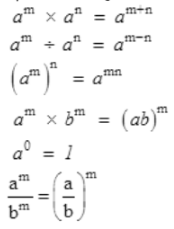
Numbers with exponents obey the following laws of exponents.
Very small numbers can be expressed in standard form using negative exponents. (Scroll down till end of the page)
Study Tools
Audio, Visual & Digital Content
Use of Exponents to Express Small Number in Standard form:
Very large and very small numbers can be expressed in standard form.
Standard form is also called scientific notation form.
(iii) A number written as number such that is said to be in standard form if m is a decimal and n is either a positive or a negative integer.
Examples: 150,000,000,000 = 1.5 x 10¹¹.
Exponential notation is a powerful way to express repeated multiplication of the same number.
For any non-zero rational number ‘a’ and a natural number n, the product a x a x a x x a(n times) = an.
It is known as the nth power of ‘a’ and is read as ‘a’ raised to the power n’.
The rational number a is called the base and n is called exponent.
Mind Map Overal Idea Content Speed Notes Quick Coverage Variations: If the values of two quantities depend on each other in such a way that a change in one causes corresponding change in the other, then the two quantities are said to be in variation. (Scroll down till end of the page) Study Tools Audio, readmore
Mind Map
Overal Idea
Content
Speed Notes
Quick Coverage
Variations: If the values of two quantities depend on each other in such a way that a change in one causes corresponding change in the other, then the two quantities are said to be in variation. (Scroll down till end of the page)
Study Tools
Audio, Visual & Digital Content
Direct Variation or Direct Proportion:
Extra:
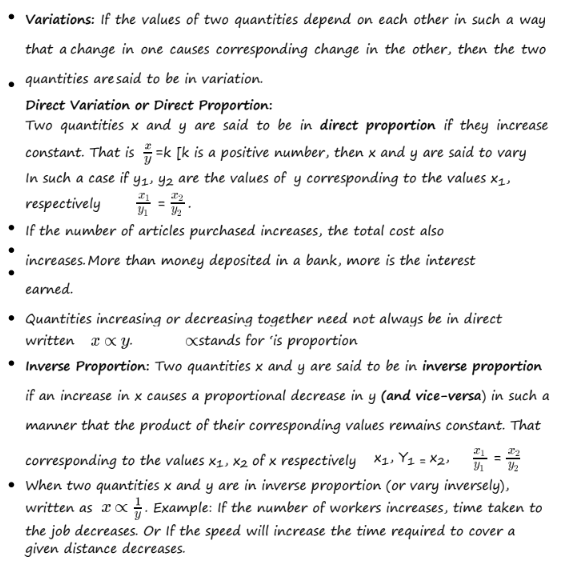
Two quantities x and y are said to be in direct proportion if they increase (decrease) together in such a manner that the ratio of their corresponding values remains
constant. That is if
=k [k is a positive number, then x and y are said to vary directly.
In such a case if y1, y2 are the values of y corresponding to the values x1, x of x
respectively then = .
If the number of articles purchased increases, the total cost also increases. More than money deposited in a bank, more is the interest earned.
Quantities increasing or decreasing together need not always be in direct proportion, same in the case of inverse proportion.
When two quantities x and y are in direct proportion (or vary directly), they are
written as
. Symbol
stands for ‘is proportion to’.
Inverse Proportion: Two quantities x and y are said to be in inverse proportion if an increase in x causes a proportional decrease in y (and vice-versa) in such a manner that the product of their corresponding values remains constant. That is, if xy
= k, then x and y are said to vary inversely. In this case if y1, y2 are the values of y
corresponding to the values x1, x2 of x respectively then
x1, Y1 = x2, y2 or
=
When two quantities x and y are in inverse proportion (or vary inversely), they are
written as x
. Example: If the number of workers increases, time taken to finish
the job decreases. Or If the speed will increase the time required to cover a given distance decreases.
Mind Map Overal Idea Content Speed Notes Quick Coverage Factorisation: Representation of an algebraic expression as the product of two or more expressions is called factorization. Each such expression is called a factor of the given algebraic expression. (Scroll down till end of the page) Study Tools Audio, Visual & Digital Content When we factorise readmore
Mind Map
Overal Idea
Content
Speed Notes
Quick Coverage
Factorisation: Representation of an algebraic expression as the product of two or more expressions is called factorization. Each such expression is called a factor of the given algebraic expression. (Scroll down till end of the page)
Study Tools
Audio, Visual & Digital Content
When we factorise an expression, we write it as a product of factors. These factors may be numbers, algebraic variables or algebraic expressions.
An irreducible factor is a factor which cannot be expressed further as a product of factors.
A systematic way of factorising an expression is the common factor method. It consists of three steps:
Write each term of the expression as a product of irreducible factors
Look for and separate the common factors and
Combine the remaining factors in each term in accordance with the distributive law.
Sometimes, all the terms in a given expression do not have a common factor; but the terms can be grouped in such a way that all the terms in each group have a common factor. When we do this, there emerges a common factor across all the groups leading to the required factorisation of the expression. This is the method of regrouping.
In factorisation by regrouping, we should remember that any regrouping (i.e., rearrangement) of the terms in the given expression may not lead to factorisation. We must observe the expression and come out with the desired regrouping by trial and error.
A number of expressions to be factorised are of the form or can be put into the form: a2 + 2ab + b2, a2 – 2ab + b2, a2 – b2 and x2 + (a + b)x + ab. These expressions can be easily factorised using Identities I, II, III and IV
a2 + 2ab + b2 = (a + b)2
a2 – 2ab + b2 = (a – b)2
a2 – b2 = (a + b) (a – b)
Factorisation
x2 + (a + b)x + ab = (x + a)(x + b)
In expressions which have factors of the type (x + a) (x + b), remember the numerical term gives ab.
Its factors, a and b, should be so chosen that their sum, with signs taken care of, is the coefficient of x.
We know that in the case of numbers, division is the inverse of multiplication. This idea is applicable also to the division of algebraic expressions.
In the case of division of a polynomial by a monomial, we may carry out the division either by dividing each term of the polynomial by the monomial or by the common factor method.
In the case of division of a polynomial by a polynomial, we cannot proceed by dividing each term in the dividend polynomial by the divisor polynomial. Instead, we factorise both the polynomials and cancel their common factors.
In the case of divisions of algebraic expressions that we studied in this chapter, we have Dividend = Divisor × Quotient.
In general, however, the relation is Dividend = Divisor × Quotient + Remainder
Thus, we have considered in the present chapter only those divisions in which the remainder is zero.
There are many errors students commonly make when solving algebra exercises.
Mind Map Overal Idea Content Speed Notes Quick Coverage Graphical presentation of data is easier to understand. A bar graph is used to show comparison among categories. A pie graph is used to compare parts of a whole. A Histogram is a bar graph that shows data in intervals. (Scroll down till end of the readmore
Mind Map
Overal Idea
Content
Speed Notes
Quick Coverage
Graphical presentation of data is easier to understand.
A bar graph is used to show comparison among categories.
A pie graph is used to compare parts of a whole.
A Histogram is a bar graph that shows data in intervals. (Scroll down till end of the page)
Study Tools
Audio, Visual & Digital Content
Introduction to Graphs
A line graph displays data that changes continuously over periods of time. A line graph which is a whole unbroken line is called a linear graph.
For fixing a point on the graph sheet we need, x-coordinate and y-coordinate.
The relation between dependent variable and
through a graph.
independent variable is shown
A Bar Graph: A pictorial representation of numerical data in the form of bars (rectangles) of uniform width with equal spacing. The length (or height) of each bar
represents the given number.
A Pie Graph: A pie graph is used to compare parts of a whole. The various
observations or components are represented by the sectors of the circle.
A Histogram: Histogram is a type of bar diagram, where the class intervals are shown on the horizontal axis and the heights of the bars (rectangles) show the frequency of the class interval, but there is no gap between the bars as there is no gap between the
class intervals.
Linear Graph: A line graph in which all the line segments form a part of a single line. Coordinates: A point in Cartesian plane is represented by an ordered pair of numbers.
Ordered Pair: A pair of numbers written in specified order.
Mind Map Overal Idea Content Speed Notes Quick Coverage Matter: 1. Characteristics of Matter Particles Anything (Physical Material not emotions, feelings etc.) which has mass and volume (occupy space) is called matter. We feel the presence of matter by one or more of our five sense organs. Matter is made up of particles. (Scroll down readmore
Mind Map
Overal Idea
Content
Speed Notes
Quick Coverage
Matter:
1. Characteristics of Matter Particles
Anything (Physical Material not emotions, feelings etc.) which has mass and volume (occupy space) is called matter.
We feel the presence of matter by one or more of our five sense organs.
Matter is made up of particles. (Scroll down till end of the page)
Study Tools
Audio, Visual & Digital Content
Particles:
Particles are very small in size. Therefore we cannot see particles with our naked eye.
Characteristics of the particles of matter:
(1) All matter (elements or compounds) consists of very small particles which can exist independently and are called particles.
(ii) The particles of matter are in a state of continuous motion and possess kinetic energy.
(iii) There are intermolecular spaces in between the particles (molecules) of matter.
(iv) The particles (molecules) of matter attract each other with a force called intermolecular force.
Intermolecular force is maximum in solids and least in the gases.
These material particles can be touched, moved by changing temperature or attracted by decreasing or increasing forces of attraction or repulsion.
2. States of Matter
Matter exists in three different physical states namely solid, liquid and gas.
One substance such as water can exist in all the three states such as, ice in solid state, water in liquid state and steam or vapours in gaseous state.
The state of matter depends on temperature, forces of attraction between their constituent particles etc.
3. Interconversion of Matter
All these three different states of matter are interconvertible depending upon temperature and pressure.
The state of matter can be changed by changing temperature or pressure.
Due to change in temperature and pressure there will be a change in inter-particle space as well as force between them, resulting in change in physical state.
Examples:
Applying pressure and reducing temperature can liquefy gases.
Solid CO₂ gets converted directly to a gaseous state on decrease of pressure to 1 atmosphere without changing into a liquid state. Due to this fact solid CO₂ is also known as DRY ICE.
4. Plasma: It is the fourth state of matter consisting of super energetic and super excited particles. These particles are in the form of ionised gases.
Examples:
The plasma in stars is formed due to high temperature.
Glowing plasma formed in fluorescent tubes and neon sign bulbs.
These devices contain inert gases which get ionised due to the passage of electric current. The colour of the glowing plasma depends upon the nature of the gas.
5. Sublimation: The process in which a solid state directly changes into a gaseous state on heating or vice-versa on cooling.
6. Melting or Fusion: The process of changing a solid into a liquid state by absorbing heat at a constant temperature is known as Melting or Fusion.
7. Freezing or Solidification: The process of changing a liquid into solid state by losing heat at a constant temperature is known as Freezing or Solidification.
8. Condensation: The process of changing a gas into a liquid state by giving out heat at constant temperature is known as Condensation .
Boiling or Vaporisation : The process of changing a liquid into a gaseous state by absorbing heat at constant temperature is known as Boiling or Vaporisation .
Boiling is a bulk phenomenon. Particles from the bulk (whole) of the liquid change into a vapour state.
Evaporation: The phenomenon of changing the physical state from liquid to vapour, at any temperature is called evaporation.
Evaporation is a surface phenomenon. Particles from the surface gain required energy to overcome the forces of attraction present in the liquid and change into the vapour state.
The rate of evaporation depends upon the surface area exposed to the atmosphere, the temperature, the humidity and the wind speed.
Evaporation causes cooling.
Evaporation takes place at all temperatures, below the boiling point of a liquid
Factors affecting evaporation:
• Rate of evaporation increases with increase in surface area.
• Rate of evaporation increases with increase in temperature.
• Rate of evaporation increases with decrease in Humidity.
• Rate of evaporation increases with increase in wind speed.
Latent heat of boiling or Latent heat of Vaporisation: Latent heat of boiling or Latent heat of Vaporisationis the heat energy required to change 1 kg of a liquid to gas at atmospheric pressure at its boiling point.
Kelvin is the SI unit of temperature.
0°C = 273.16 K.
For convenience, we take 0°C = 273 K after rounding off the decimal.
To change a temperature on the Kelvin scale to the Celsius scale you have to subtract 273 from the given temperature, and to convert a temperature on the Celsius scale to the Kelvin scale you have to add 273 to the given temperature.
Conversion Formula: t°C = (t+273) K
Boiling point or Vaporisation point: Boiling point or Vaporisation point is the fixed temperature at which a liquid converts into a gaseous state at atmospheric pressure.
Melting point or Fusion point: Melting point or Fusion point is the temperature at which a solid starts converting into a liquid state at atmospheric pressure.
Evaporation Causes cooling: During evaporation the particles at the surface of the liquid gain energy from the surroundings and change into vapour.. Therefore Evaporation Causes cooling effect.
Sponge can be compressed although it is solid: Sponge contains minute holes in which air is trapped.So when it is pressed, the air gets expelled and the sponge gets compressed. Also,the material of the sponge is not rigid.
Temperature does not change during change of state: The temperature remains constant at its melting and boiling points (during change of state) until all the substance melts or boils.
Because the heat supplied is continuously used up in changing the state of the substance by overcoming the force of attraction between the particles.
There is no increase in the kinetic energy of the particles and thus, temperature does not change.
This heat energy absorbed without showing any rise in temperature is given the name latent heat of fusion/latent heat of vaporisation.
Effect of pressure on physical state of a substance:
If pressure is applied, melting point decreases and boiling point increases
When pressure is increased, the particles come closer and the force of attraction increases between them and this results in a change of state.
Example: When high pressure is applied to a gas by reducing its temperature, the particles of gas come close and get converted to a liquid. This is also known as liquefaction.
The amount of heat energy required in changing a 1 kg of solid into liquid at atmospheric pressure and its melting point is known as the latent heat of fusion.
[ Lice = 80 cal/g = 3.34 × 10⁵ J/kg].
• The amount of heat which is required to convert 1 kg of the liquid (at its boiling point) to vapours of gas without any change in temperature is known as latent heat of vaporisation.
[Lwater =540 cal/g= 22.5 × 10⁵ J/kg].
• The amount of heat absorbed or liberated , Q = mL.
• The specific heat is the amount of heat per unit mass required to raise the temperature by one degree Celsius.
• Q = m.s. t, where m = mass of the body, s = specific heat of the body and t is temperature difference and m.s is called thermal capacity.
• Change of liquid into vapours at any temperature below the boiling point.
Takes the latent heat from the body. Thus, the body cools when evaporation takes place.
Evaporation:
(1) Evaporation is a slow process.
(ii) Evaporation takes place at the surface mass of the liquid.
(iii) Evaporation takes place at all temperatures.
(iv) The substance becomes cool due to evapora- tion process.
(v) Heat is absorbed from the surroundings due to Evaporation. Absorption of heat from the surroundings causes cooling effect.
Boiling:
(1) Boiling is a rapid process.
(ii) Boiling takes place throughout the mass of a liquid.
(iii) Boiling takes place at a definite temperature called the boil- ing point.
(iv) The substance remains hot during the boiling process.
(v) Heat is required from an external source such as a burner for boiling to take place.
Scales of temperature
• Three scales are commonly used for measuring temperature, namely, the Celsius scale, the Fahrenheit scale and the Kelvin scale.
• The relation between the Celsius and the Kelvin scale can be expressed as:
C + 273 = K
• The relation between the Celsius and the Fahrenheit scale can be expressed as follows.
Property
Solid
Liquid
Gas
Inter particle space
Very less
Larger than solid butlesser than gas
Very large
Inter particle force
Very strong
Weaker than solidbut stronger than gas
Very weak
Nature (Rigidity)
Very hard and rigid
Fluid
Highly fluid
Compressibility
Negligible
Very small
Highly compressible
Shape
Definite shape
Indefiniteshape
Indefinite Shape
Volume
Definite Volume
Indefinite shape
Indefinite volume
Density
high
Less than solid
Very low
Kinetic energy
low
high
Very high
Diffusion
Negligible
Slow
Very high
Specific Heat
11.8 NATURAL PHENOMENA AND CONSEQUENCES OF HIGH SPECIFIC HEAT CAPACITY OF WATER
Some consequences of high specific heat capacity of water are given below.
(i) The climate near the seashore is moderate :
The specific heat capacity of water is very high (= 1000 cal kg-1 °C-1 or 4200 J kg-1 K-¹). It is about five times as high as that of sand. Hence the heat energy required for the same rise in temperature by a certain mass of water will be nearly five times that required by the same mass of sand.
Similarly, a certain mass of water will give out nearly five times more heat energy than that given by sand of the same mass for the same fall in temperature.
As such, sand (or earth) gets heated or cooled more rapidly as compared to water under similar conditions.
Thus, a large difference in temperature is developed between the land and the sea due to which land and sea breezes are formed”. These breezes make the climate near the seashore moderate.
(ii) Hot water bottles are used for fomentation: The reason is that water does not cool quickly due to its large specific heat capacity, so a hot water bottle provides heat energy for fomentation for a long time.
(iii) Water is used as an effective coolant: By allowing water to flow in pipes around the heated parts of a machine, heat energy from such parts is removed (e.g. radiators in car and generator are filled with water). Water in pipes extracts more heat from surroundings without much rise in its temperature because of its large specific heat capacity.
(iv) In cold countries, water is used as a heat reservoir for wine and juice bottles to avoid their freezing: The reason is that water due to its high specific heat capacity can impart a large amount of heat before reaching up to the freezing temperature. Hence bottles kept in water remain warm and they do not freeze even when the surrounding temperature falls considerably.
(v) Farmers fill their fields with water to protect the crops from frost: In the absence of water, if on a cold winter night, the atmospheric temperature falls below 0°C, the water in the fine capillaries of plants will freeze, so the veins will burst due to the increase in volume of water on freezing. As a result, plants will die and the crop will be destroyed. In order to save crop on such cold nights, farmers fill their fields with water because water has a high specific heat capacity, so it does not allow the temperature in the surrounding area of plants to fall up to 0°C.
(vi) All plants and animals have a high content of water in their bodies: All plants and animals have nearly 80% to 90% of water in their bodies so it helps in maintaining the body temperature nearly same in all seasons due to high specific heat capacity of water.
SOME EXAMPLES OF HIGH AND LOW THERMAL CAPACITY
(1) The base of a cooking pan is made thick : By making the base of the cooking pan thick, its thermal capacity becomes large and it imparts sufficient heat energy at a low temperature to the food for its proper cooking. Further it keeps the food warm for a long time, after cooking.
(2) The base of an electric iron is made thick and heavy: By doing so, the thermal capacity of the base becomes large and it remains hot for a long duration even after switching off the current.
(3) The vessel used for measurement of heat (i.e., calorimeter) is made of thin sheet of copper:
The reason is that the specific heat capacity of copper is low and by making the vessel thin, its thermal capacity becomes low so that it takes a negligible amount of heat from its contents to attain the temperature of the contents.
Mind Map Overal Idea Content Speed Notes Quick Coverage Matter: Anything that occupies space is called matter. Example: Air, water, rock etc., Matter exists in our surroundings in both pure and impure forms. (Scroll down till end of the page) Study Tools Audio, Visual & Digital Content Mixture: A mixture is a matter that contains readmore
Mind Map
Overal Idea
Content
Speed Notes
Quick Coverage
Matter: Anything that occupies space is called matter.
Example: Air, water, rock etc.,
Matter exists in our surroundings in both pure and impure forms. (Scroll down till end of the page)
Study Tools
Audio, Visual & Digital Content
Mixture: A mixture is a matter that contains more than one pure substance in any ratio/proportion.
A mixture is an impure form of matter.
Example:
Water in milk, lemon juice, Ginger Garlic paste, etc.,
The mixture may or may not be separated into its constituent particles by physical processes.
Substance: A matter that cannot be separated into its constituent particles by any physical process is known as a substance.
Example:
Solution: A homogeneous mixture of two or more substances is called a solution.
Example:
Tea, sugar, and common salt are dissolved in water.
Alloy: A homogeneous mixture of metals is called an alloy.
Properties of the Solution:
A solution is a homogeneous mixture
Particles are extremely small, not visible to the naked eye
The light path is invisible in solution.
Solute particles cannot be separated by filtration
Concentration of solution: The concentration of a solution is the amount of solute present in a given quantity of the solution.
Unsaturated and Saturated Solutions: a solution in which a larger quantity of solute can be dissolved without raising its temperature, is called an unsaturated solution.
• A solution in which no more solute can be dissolved at a certain temperature, is called a saturated solution.
Solubility: The maximum amount of a solute that can be dissolved in 100 grams of a solvent at a specified temperature is known as the solubility of the solute in that solvent.
Suspension: a heterogeneous mixture of solids and liquids where the solid particles are suspended throughout the medium.
Example: Mixture of chalk powder and water
Properties of Suspension
• Particles are visible to the naked eye
• Light path in a suspension is visible
• Particles settle down
Colloidal Solution: Colloidal Solution Is a heterogeneous mixture, but appears to be homogeneous.
Examples: Milk, soap lather, soda water, pumice stone, rubber, bread, fog, cloud, insecticide spray, butter, etc.
Properties of colloidal solutions
• Heterogeneous mixture
• Particle size is small, not visible to the naked eye
• Light path can be visible;
• Particles do not settle down
• Substances cannot be separated by filtration
Tyndall Effect: Scattering of light beam by suspended particles in the solution.
Physical and Chemical changes:
Physical and change: The changes in which no new substances are formed are called physical changes.
Chemical change: The changes in which new substances are formed are called chemical changes.
SEPARATION OF MIXTURES
The method of separation depends on both the type of mixture and the physical properties of its constituents.
These are :
(i) The physical state of the constituents.
(ii) The differences in the physical properties
of the constituents, such as:
(a) boiling point
(b) melting point
(c) density
(d) magnetic properties
(e) ability to sublime
(f) volatility
(g) solubility in various solvents.
• Evaporation: Used for separating mixtures of volatile solvents and non-volatile solutes.
Working Principle:
One component should be non-volatile. It may or may not be soluble in water.
Example: Separating salt from its solution
• Centrifugation used for separating components based on the difference in their weights.
Working Principle:
Difference in the densities of two liquids.
Example: Separating mixtures of cream from milk
• Separating Funnel: Used for separating two or more immiscible liquids.
Working Principle:
Immiscible liquids with different densities get separated into different layers if they are in the same container.
Example: Separating oil and water
Sublimation:
Sublimation is the process of converting a solid into vapour and returning it to the solid state without passing through the liquid state.
Sublimation is used to separate sublimable solids from their mixtures.
Working Principle:
One of the components can be sublime.
Example: Separating ammonium chloride from a mixture
Chromatography:
The process of separating the different dissolved constituents of a mixture by their adsorption (adsorption refers to the collection of one substance on the surface of another substance.) over an appropriate adsorbing material is called chromatography.
Chromatography is used to separate those solutes that dissolve in the same solvent.
Working Principle:
Adsorption/partition
Example: Separating the components of a dye
Distillation:
Distillation is the process of heating a liquid to convert it into vapours and then condensing the vapours back into a liquid.
Distillation is used to separate two miscible liquids that boil without decomposition.
Working Principle:
One component should be a soluble solid in a liquid.
Example: Separating a mixture of acetone and water
Fractional distillation
Fractional distillation is a process that involves the distillation and collection of fractions or different liquids boiling at different temperatures.
Fractional distillation is used to separate a mixture of liquids when their boiling temperatures differ by less than 25 K.
Example: Separating different components of petroleum
Crystallization: Used to separate pure solids from a solution by forming crystals.
Working Principle:
A solid dissolved in a liquid is separated by evaporating the solvent completely by heating the mixture.
Example: Obtaining pure crystals of copper sulphate from an impure sample.
Differences Between Mixture And Compound
Property
Mixture
Compound
Nature
When two or more elements or compounds or both are mixed together, such that they do not combine chemically, a mixture is formed.
When two or more elements unitechemically, a compound is formed.
Structure
Mixtures are generally heterogeneous. However, some mixtures can be homogeneous.
Compounds are always homogeneous.
Composition
In case of mixtures their constituents can be present in any ratio, i.e., mixtures havevariable composition.
In case of compounds, the constituents arepresent in a fixed ratio by weight.
Properties
The constituents of a mixture retain theirindividual chemical and physical properties.
The properties of a compound are entirelydifferent from the properties of itsconstituents
Separation of constituents
The constituents of a mixture can beseparated by applying physical methods likesolubility, filtration, evaporation, distillation,use of magnet, etc.
The constituents of a compound cannot beseparated by applying physical methods.However, constituents of a compound can beseparated by chemical means.
Energy change
There may or may not be energy changeduring the formation of mixture.
During the formation of a compound eitherthe energy is absorbed or given out.
Mind Map Overal Idea Content Speed Notes Quick Coverage Atoms are the basic building blocks of matter. Different kinds of matter contain different kinds of atoms present in them. Protons were discovered by Ernest Rutherford, in his famous gold foil experiment. Electrons were discovered by J.J. Thomson, in his cathode ray tube experiment. Neutrons were readmore
Mind Map
Overal Idea
Content
Speed Notes
Quick Coverage
Atoms are the basic building blocks of matter.
Different kinds of matter contain different kinds of atoms present in them.
Protons were discovered by Ernest Rutherford, in his famous gold foil experiment.
Electrons were discovered by J.J. Thomson, in his cathode ray tube experiment.
Neutrons were discovered by James Chadwick. (Scroll down till end of the page)
Study Tools
Audio, Visual & Digital Content
Laws of Chemical Combination: Antoine Laurent Lavoisier, is known as ‘Father of Modern Chemistry.
Lavoisier put forward the law of conservation of mass, which laid the foundation of chemical sciences.
Law of Conservation of Mass: Law of Conservation of Mass states that, “mass is neither created nor destroyed in a chemical reaction.
In other words, the mass of the reactants must be equal to the mass of products.
Law of Constant Proportions or Definite Composition:Law of Constant Proportions or Definite Composition states that, in a pure chemical substance, the elements are always present in definite proportions by mass.
Dalton’s Atomic Theory:
(i) Every element is composed of extremely small particles called atoms.
(ii) Atoms of a given element are identical, both in mass and properties.
(iiii) Different chemical elements have different kinds of atoms; in particular, their atoms have different masses.
(iv) The atoms neither be created nor be destroyed or transformed into atoms of other elements.
(v) Compounds are formed when atoms of different elements combine with each other in small whole number ratios.
(vi) The relative number and kinds of atoms in a given compound are constant.
Drawbacks of Dalton’s Atomic Theory:
(i) According to modern theory, an atom is not the ultimate indivisible particle of matter. Today, we know that atoms are divisible, they are themselves made-up of particles (protons, electrons, neutrons,etc.).
(i) In the case of isotopes of an element, the assumption that the atoms of the same element have the same mass does not hold good.
Atom: It is the smallest particle of an element that maintains its chemical identity throughout all chemical and physical changes.
The smallest unit of a substance which can exist independently is called a molecule.
Atomicity: It is defined as the number of atoms present in a molecule of an element or a compound.
Mono atomic: Molecule having only one atom is called mono atomic,
e.g., He, Ne, Ar.
Diatomic: Molecules made-up of two atoms are called diatomic, e.g., H₂, Cl₂, O₂, N2.
Triatomic: Molecules made-up of three atoms, called triatomic.
e.g., O3, H₂O, NO2.
Tetraatomic : Molecules made-up of four atoms, called tetra atomic.
e.g., P4, NH3, SO3
Polyatomic: Molecules made-up of five or more atoms, called polyatomic/
e.g., CH4.
Polyatomic: Any molecule which is made-up of more than four atoms is called polyatomic,
e.g., Sg.
Relative Atomic Mass: It is defined as the number of times one atom of an element is heavier than
(1/12)th of the mass of an atom of Carbon – 12.
Relative Atomic Mass (RAM) = Mass of an atom of an element/
¹/12 th mass of C-12
Molecular Mass: The molecular mass of a substance is the sum of the atomic masses of all atoms in a molecule of a substance,
e.g., molecular mass of water is 18 u.
The mole (or mol) is the SI unit of the amount of a substance. One mole is equal to the amount of substance that contains as many elementary units as there are atoms in 12 g of the carbon-12 isotope.
The elementary units may be atoms, molecules, ions, radicals, electrons, etc., and must be specified.
This number is called Avogadro’s number (No) or Avogadro’s constant
[NA = 6.0221367 x 10²³]. Generally,
Avogadro’s Number is rounded to 6.022 x 10²³.
For better understanding we can compare avogadro number with a dozen as:
One dozen oranges contain 12 oranges, similarly, 1 mole of hydrogen atoms contain 6.022 x 10²³ H atoms.
H₂O = 2 x H + 1 × O
= 2 x 1+1 x 16 = 2+16
= 18 amu or u.
By : 1 mole of a compound has a mass equal to its relative molecular mass expressed in grams.
1 mole = 6.022 × 10²³ number
= Relative mass in grams.
A molecule is the smallest particle of an element or a compound capable of independent existence under ordinary conditions. It shows all the properties of the substance.
A chemical formula of a compound shows its constituent elements and the number of atoms of each combining element.
Clusters of atoms that act as an ion are called polyatomic ions. They carry a fixed charge on them.
The chemical formula of a molecular compound is determined by the valency of each element.
In ionic compounds, the charge on each ion is used to determine the chemical formula of the compound.
Scientists use the relative atomic mass scale to compare the masses of different atoms of elements. Atoms of carbon-12 isotopes are assigned a relative atomic mass of 12 and the relative masses of all other atoms are obtained by comparison with the mass of a carbon-12 atom.
The Avogadro constant 6.022 × 10²³ is defined as the number of atoms in exactly 12 g of carbon-12.
The mole is the amount of substance that contains the same number of particles (atoms/ions/ molecules/formula units, etc.) as there are atoms in exactly 12g of carbon-12. Mass of 1 mole of a substance is called its molar mass.
The relative atomic mass of the atom of an element is the average mass of the atom as compared to 1/12th mass of one carbon-12 atom.
Hint: We know that chemical formulas can also be written using a criss-cross method. In the criss-cross method, the numerical value of the ion charge of the two atoms is crossed over, which becomes the subscript of the other ion. Using this technique, we will write the chemical formula of the given compounds.
Complete step by step answer:
Let’s us discuss about the given compound as,
A.Magnesium chloride
We have to remember that the atomic number of Magnesium is 12 and has a valency of 2.
It means it has two electrons in the outermost shell for bonding.
The atomic number of chlorine is 17 and has 7 electrons in the outermost shell.
It means it just needs one more atom for bonding.
Hence, we will use atoms of chlorine to bond with one atom of magnesium.
We can apply the criss-cross method for this compound as,
Therefore, the chemical formula of magnesium chloride is MgCl2
B.Calcium oxide
We have to know that the atomic number of calcium is 20 and has a valency of 2, it means it has 2 two atoms in the outermost shell for bonding.
The atomic number of Oxygen is 8
8 and has a valency of 2, it has 6 atoms in the outermost shell, it needs 2 more to complete the octet.
Hence, we need one calcium atom to bond with one oxygen atom.
We can apply the criss-cross method for this compound as,
Therefore, the chemical formula of magnesium chloride is CaO
C. Copper nitrate
We have to know that the atomic number of copper is 29 and has two atoms in the outermost shell for bonding. While a nitrate molecule has only one valence electron.
We need 2 nitrate molecules to satisfy the valency of 1 copper atom.
We can apply the criss-cross method for this compound as,
Therefore, the chemical formula of magnesium chloride is
Cu(NO3)2
D.Aluminium chloride
We have to know that the atomic number of aluminium is 13 and has a valency of 3 atoms and chlorine atom has a valency of 1. Since it has 7 electrons in the outermost shell.
Thus, we need 3 chlorine atoms to satisfy the valency of 1 aluminium atom.
We can apply the criss-cross method for this compound as,
Therefore, the chemical formula of magnesium chloride is AlCl3.
E.Potassium nitrate
We have to remember that the atomic number of potassium is 19 and has a valency of 1 and nitrate also has a valency of 1, since it needs one more atom to complete its octet. Hence, we need only one molecule of nitrate for one atom of potassium.
We can apply the criss-cross method for this compound as,
Therefore, the chemical formula of magnesium chloride is KNO3.
Note: As we know that the criss-cross method is the most efficient way to write the correct chemical formula of the molecule. It is generally used for finding out the formula of a bonding of a metal with a non-metal to form ionic bonds. Signs of the two ions are dropped, the ion value is crossed which becomes the subscript of the crossed atoms.
Mind Map Overal Idea Content Speed Notes Quick Coverage Atoms are the basic building blocks of matter. Different kinds of matter contain different kinds of atoms present in them. Protons were discovered by Ernest Rutherford, in his famous gold foil experiment. Electrons were discovered by J.J. Thomson, in his cathode ray tube experiment. Neutrons were readmore
Mind Map
Overal Idea
Content
Speed Notes
Quick Coverage
Atoms are the basic building blocks of matter.
Different kinds of matter contain different kinds of atoms present in them.
Protons were discovered by Ernest Rutherford, in his famous gold foil experiment.
Electrons were discovered by J.J. Thomson, in his cathode ray tube experiment.
Neutrons were discovered by James Chadwick. (Scroll down till end of the page)
Study Tools
Audio, Visual & Digital Content
Charged Particles in Matter
Whenever we rub two objects together, they become electrically charged.
This is because atoms contain charged particles in them.
Therefore, atoms can be divided further into particles i.e proton, electron and neutron.
Atoms consist of an equal number of protons and electrons.
Protons exist in the interiors of the atom and electrons exist in the exteriors of the atom. Therefore, electrons can be removed from an atom.
Since electrons exist in the exteriors of the atom they can be removed from an atom.
Dalton’s Atomic Theory
The postulates of the atomic theory by John Dalton
The matter is made up of tiny particles called Atoms that cannot be divided.
Atoms are never formed or destroyed during a chemical reaction.
Atoms of an element exhibit the same nature.
Atoms of the same element have equal size, mass and they exhibit similar chemical properties.
Atoms of different elements exhibit variant chemical properties.
Atoms form compounds by combining in a ratio of whole numbers.
A compound contains molecules in which a constant number and types of atoms are present.
Failure of Dalton’s Atomic Theory
Dalton suggested that atoms can neither be created nor destroyed and are indivisible.
But the discovery of electrons and protons in atoms disproved this aspect of Dalton’s theory.
Thomson’s Model of an Atom
According to J.J. Thomson, the structure of an atom can be compared to Christmas pudding.
According to this model the electrons are present inside a positive sphere.
An atom is composed of a positively charged sphere in which electrons are embedded.
Atoms are neutral as the positive and negative charges are equal in number.
Rutherford’s Model of an Atom
Rutherford’s Experiment
Rutherford experimented by passing alpha rays through a thin gold foil.
He expected that the gold atoms would deflect the Alpha particles.
Observations
Inferences
Alpha particles which had high speed moved straight through the gold foil
Atom contains a lot of empty space
Some particles got diverted a by small angles
Positive charges in the atom are not occupying much of its space
Only one out of 12000 particles bounced back
The positive charges are concentrated over a particular area of the atom.
Based on his experiment Rutherford gave the nuclear model of an atom as the following.
Rutherford’s Atomic Model
Rutherford’s Atomic Model is known as Planetary Atomic Model and Nuclear Atomic Model.
According to Rutherford’s Atomic Model:
Atoms contain a lot of unoccupied space
The center of the atom is highly positive , Rutherford named it as nucleus
The atom contains an equal amount of positive and negative charges.
Nucleus of Atom
The nucleus is located at the center of the atom.
All the mass of the atom is because of the nucleus.
The electrons revolve around the nucleus in circular parts which called Orbits
The size of an atomic nucleus is much smaller than its atom.
Drawbacks of the Nuclear Atomic Model
The Rutherford’s Atomic Model failed to explain how an atom remains stable despite having positive and negative charges present in it.
Maxwell’s theory of radiation if any charged particle moves in a circular motion it radiates energy.
So, if electrons move in a circular motion around the nucleus they should radiate some energy as a result this decreases at the speed of the electrons. As a result, they would fall into the nucleus and the nucleus should collapse because of its high positive charge.
But it is not happening because the matter is not collapsing.
Nucleons: The subatomic particles present in the nucleus are collectively called Nucleons. Protons and Neutrons are nucleons.
Bohr’s Model of an Atom
Bohr Atomic Model states as the following:
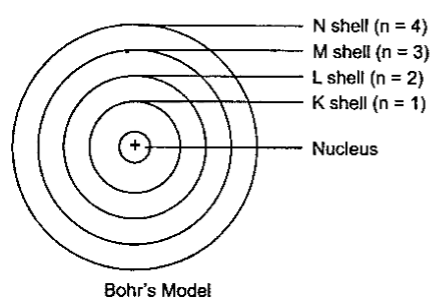
Electrons revolve around the nucleus in particular circular paths, called orbits.
The electrons do not emit any energy while moving in their orbits.
The orbits are also called Energy Levels.
Energy Levels or Orbits are represented by using letters or numbers as shown in the figure.
Neutron:
J. Chadwick discovered Neutron, a subatomic particle of an atom.
Neutron carries no charge.
Subatomic Particles of Atom
Electrons
Electron carry a negative charge
Protons
Protons carry a positive charge
Neutrons
Neutrons are neutral
Electronic Configuration:The distribution of electrons in different shells or orbits is called Electronic Configuration.
If Orbit number = n
Then number of electrons present in an Orbit = 2n2
So, for n =1
Maximum electrons present in shell – K = 2 * (1)2 = 2
The outermost shell can contain at most 8 electrons.
The shells in an atom are filled in sequence.
Thus, until the inner shells of an atom are filled completely the outer shells cannot contain any electrons.
Valency
Valence Electrons – Electrons existing in the outermost orbit of an atom are called Valence Electrons.
The atoms which have completely filled the outermost shell are not very active chemically.
The valency of an atom or the combining capacity of an atom is given by the number of elements present in the outermost shell.
For Example, Helium contains two electrons in its outermost shell which means its valency is two. In other words, it can share two electrons to form a chemical bond with another element.
What happens when the outermost shell contains a number of electrons that are close to its maximum capacity?
Valency in such cases is generated by subtracting the number of electrons present in the outermost orbit from octet (8). For example, oxygen contains 6 electrons in its outermost shell. Its valency is calculated as: 8 – 6 = 2. This means oxygen needs two electrons to form a bond with another element.
Representation Element:
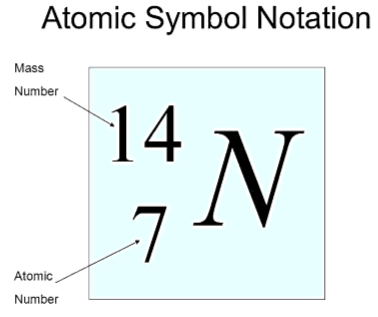
Atomic Number of an Element
Atomic Number (Z) = Number of protons in an atom
Mass Number of an Element
Mass Number = Number of protons + Number of neutrons
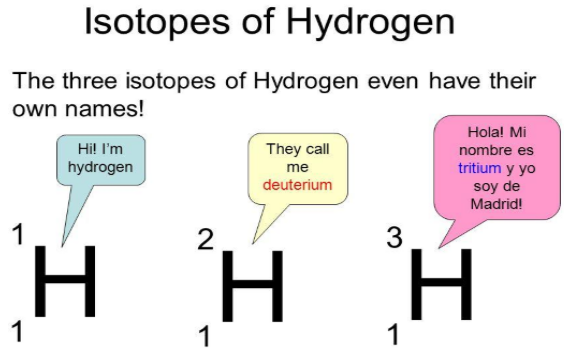
Isotopes
The atoms of an element can exist in several forms having similar atomic numbers but varying mass numbers.
Isotopes are pure substances.
Isotopes have a similar chemical nature.
Isotopes have distinct physical characteristics.
Use of Isotopes:
1. The fuel of Nuclear Reactor – Isotope of Uranium
2. Treatment of Cancer – Isotope of Cobalt
3. Treatment of Goiter – Isotope of Iodine
Example: Consider two atomic species namely U and V. Are they isotopes?
U
V
Protons
5
5
Neutrons
5
6
Mass Number
5 + 5 = 10
5 + 6 = 11
Atomic Number
5
5
From the above example, we can infer that U and V are isotopes because their atomic number is the same.
Isobars
The atoms of several elements can have a similar mass number but distinct atomic masses. Such elements are called Isobars.
Mind Map Overal Idea Content Speed Notes Quick Coverage What are Living organisms made up of?All living organisms are made up of cells. Cell is the basic structural and functional unit of complex organisms. History of cell: Cells were first discovered by Robert Hooke in 1665 with the help of a primitive microscope. Leeuwenhoek, in readmore
Mind Map
Overal Idea
Content
Speed Notes
Quick Coverage
What are Living organisms made up of? All living organisms are made up of cells. Cell is the basic structural and functional unit of complex organisms.
History of cell:
Cells were first discovered by Robert Hooke in 1665 with the help of a primitive microscope. Leeuwenhoek, in 1674, with the improved microscope, discovered free-living cells in pond water for the first time. (Scroll down till end of the page)
Study Tools
Audio, Visual & Digital Content
Robert Brown in 1831 discovered the nucleus in the cell.
Purkinje in 1839 coined the term ‘protoplasm‘ for the fluid part of the cell.
Schleiden in 1838 and Schwann in 1839 proposed the cell theory which stated that all plants and animals are composed of cells.
Rudolf Virchow in 1855 further expanded the cell theory by suggesting that all cells arise from pre-existing cells.
The invention of magnifying lenses led to the discovery of the microscopic world.
Unicellular organisms are the organisms in which a single cell performs all the functions like nutrition, respiration, excretion and reproduction.
Example: Amoeba, Chlamydomonas, Paramecium and Bacteria possess single cells constituting the whole organism. Multicellular organisms are the organisms which possess many cells to perform different functions.
Multicellular organisms represent themselves as a member of a group of cells or as an individual.
individual.
Example: Fungi, plants and animals have many cells that group together to form tissues.
Every multi cellular organism has come from a single cell. All cells thus come from pre existing cell.
Some organisms can also have cells of different kinds.
The shape and size of cell are related to the specific function they perform.
Some cells change their shapes.
Example: Amoeba. In some cases the cell shape could be more or less fixed and the peculiar for a particular type of cell.
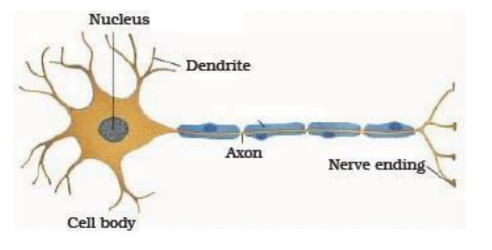
Example: Nerve cells. Each living cell has the capacity to perform certain basic functions that are characteristic of all living forms.
There is a division of labour in multicellular organism such as human beings.
This means that different parts of the human body perform different functions.
Similarly division of labour is also seen within a single cell. In fact each such cell has got certain specific components within it known as cell organelles. Each kind of cell organelle performs a special function.
A cell is able to live and perform all its functions because of these organelles.
These organelles together constitute the basic unit called the cell. What is a cell made up of? What is the structural organization of a cell? Every cell would have three features- plasma membrane, nucleus and cytoplasm.
All activities inside the cell and interactions of the cell with its environment are possible due to these features. Plasma membrane or cell membrane: This is the outermost covering of the cell that separates the contents of the cell from its external environment. It is flexible and made up of organic molecules called lipids and proteins.
The flexibility of the cell membrane also enables the cell to engulf in food and other material from its external environment. Such processes are known as endocytosis.
Example: Amoeba It allows the movement of some substances into and out of the cell.
It also prevents movement of some other materials.
Therefore it is called a selectively permeable membrane. Movement of substances through this semi-permeable membrane can be by the process of diffusion, osmosis etc.
Difference between diffusion and osmosis
If we put an animal cell or a plant cell into a hypotonic solution the cell is likely to swell up.
The cell will stay in the same size if it kept it in isotonic solution.
If the solution is hypertonic then the cell will shrink. Unicellular fresh water organism and most plants tend to gain water through osmosis.
Cell wall: It is present only in plant cells. The cell wall is composed of cellulose and is permeable. It separates the contents of the cell from the surroundings. It gives shape and protection to the cell. Cell walls permit the cells of plants, fungi and bacteria to withstand very dilute external media without bursting.
Plasmolysis: It is the process in which cells lose water in a hypertonic solution.
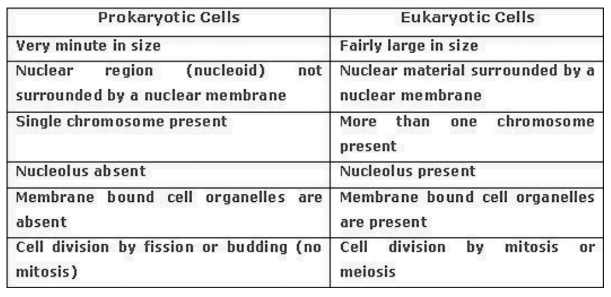
Nucleus: The nucleus has a double layered covering called nuclear membrane. The nuclear membrane has pores which allow the transfer of material from inside to outside. The nucleus contains chromosomes which are composed of Deoxyribonucleic acid (DNA) and proteins. Nucleus controls all the activities of the cell. As the nucleus carries genetic information in the form of DNA, it plays a major role in cell division and cell development. The functional segments of DNA are called genes. Nucleus plays an important role in protein synthesis and transmission of characters from one generation to another generation. It plays a central role in cellular reproduction. In some organisms nuclear membrane is absent and nuclear region contains only nucleic acids called nucleoid. Such organisms called prokaryotes. Eg. Bacteria. are called eukaryotes. Organisms with cells having a nuclear membrane
Cytoplasm:
The cytoplasm is the fluid content inside the plasma membrane. It is a jelly like viscous substance occupying entire cell except the nucleus. It also contains many specialized cell organelles that perform a specific function for the cell.
Cell organelles: Cell organelles include endoplasmic reticulum, Ribosomes, Golgi apparatus, Mitochondria, Plastids, Lysosomes, and Vacuoles. They are important because they carry out some very crucial functions in cells.
Endoplasmic reticulum (ER): The ER is a large network of membrane bound tubes and sheets. It serves as channels for the transport of materials especially proteins between various organs of the cytoplasm or between the cytoplasm and nucleus. It also functions as a cytoplasmic framework providing a surface for some of the biochemical activities of the cell. There are two types of ER- Rough endoplasmic reticulum and smooth endoplasmic reticulum.
RER: These are rough at surface and are associated with ribosomes. These are responsible for the synthesis of proteins. SER: These are smooth at surface and are not associated with ribosomes. It helps in the manufacture of fat molecules or lipids. It also plays a crucial role in detoxifying many poisons and drugs.
Membrane biogenesis: Some of the proteins and lipids synthesized by EF help in building the cell membrane. This process is known as membrane biogenesis.
Golgi Apparatus: These cell organelles are named after the biologist, Camillo Golgi, who first described it. The Golgi consists of a stack of membrane-bound cisternae. These membranes often have connections with the membranes of ER and therefore constitute another portion of a complex cellular membrane system. Its functions include the storage, modification and packaging of products in vesicles. It is also involved in the formation of lysosomes.
Lysososmes: Lysosomes are membranous sacs filled with enzymes. These enzymes are made by RER. They are a kind of waste disposal system of the cell. They help to keep the cell clean by digesting any foreign material as well as worn out cell organelles. Lysosomes contain hydrolytic enzymes which are capable of digesting cellular macromolecules. When the cell gets damaged, the lysosome may burst and its enzymes may digest thecell itself. Hence, lysosomes are called as ‘suicidal bags’.
Mitochondria: These are cellular organelles termed as ‘power houses of the cells’. These are bounded by a double membrane. The outer membrane is smooth while the inner membrane is thrown into folds called as cristae. The cristae increase the area of cellular respiration. Mitochondria releases energy in the form of ATP molecules. ATP is known as the “energy currency of the cell”. Mitochondria have its own DNA DNA ribosomes and are able to make some of their own proteins.
Plastids:
Plastids are present only in plant cells. These are of two types- chromoplasts (coloured plastids) and leucoplasts (white or colourless plastids). Plastid contains pigment called chlorophyll are known as chloroplasts. These are important for photosynthesis in plants. Chromoplasts are the organelles which provide bright colours to the plant structures like buds, flowers etc.
Leucoplasts: are the organelles which store starch, oils and protein granules. Plastids consist of numerous membrane layers embedded in a material called the stroma. Plastids also have their own DNA and ribosomes.
Vacuoles: Vacuoles are membrane bound compartments present in both plant and animal cells. These are storage sacs for solid or liquid contents. These are small sized in animal cells while bigger in plant cell. In plant cells vacuoles are full of sap and provide turgidity and rigidity to the cell. These organelles store water, waste products, and substances like amino acids, sugars and proteins. In some unicellular organisms specialized vacuoles also play important roles in expelling excess water and some wastes from the cell. Difference between plant cells and animal cells
Mind Map Overal Idea Content Speed Notes Quick Coverage Are plants and Animals made of same types of tissues?Plants are stationary, and hence are provided with some tissues made up of dead cells, which provide mechanical strength. They have to withstand unfavourable conditions like strong winds, storms, floods etc. Animals on other hand move around readmore
Mind Map
Overal Idea
Content
Speed Notes
Quick Coverage
Are plants and Animals made of same types of tissues? Plants are stationary, and hence are provided with some tissues made up of dead cells, which provide mechanical strength. They have to withstand unfavourable conditions like strong winds, storms, floods etc. Animals on other hand move around in search of food, mates, shelter. (Scroll down till end of the page)
Study Tools
Audio, Visual & Digital Content
They consume more energy as compared to plants. Most of the tissues they contain are living.
Cell growth in animas is more uniform.
The structural organisation of organs and organ systems is far more specialized and localised in complex animals than even in very complex plants.
Plant tissues:
Meristematic Tissue: The growth of plants occurs only in certain specific regions. This is because the dividing tissue also known as meristematic tissue is the region where they are present, meristematic tissues are classified as apical, lateral and intercalary. Apical meristem is present at the apical or growing tips of stems and roots. Apical meristem increases the length of the plant. Lateral meristem is present in the radial portion of the stem or root. Lateral meristem increases the girth of the plant.
Intercalary meristem occurs at the base of the leaves or at the internodes. Intercalary meristem increases the length of the internode. Permanent Tissue Old meristematic cells lose the capacity to divide and transform into permanent tissues.
This process of taking up a permanent shape, size, and function is called differentiation. These are cells which have lost their capacity to divide but are specified to provide strength, flexibility and elasticity to the plant. These tissues can be further classified into simple permanent, complex permanent and special tissues. Simple permanent can be categorized into parenchyma, collenchyma and sclerenchyma based on their function. Parenchyma- they are live cells. They are usually loosely packed. This tissue provides support to plants and also stores food. In some situations it contains chlorophyll and performs photosynthesis and then it is called chlorenchyma. Parenchyma which contains large air cavities in aquatic plants is called aerenchyma. The aerenchyma helps in buoyancy. Collenchyma – These are elongated living cells with small intercellular spaces. Their cell walls are made up of cellulose and pectin. Collenchyma occurs in the peripheral regions of stems and leaves to provide mechanical support and flexibility in plants. Sclerenchyma – These are long, dead cells with a deposit of lignin in their cell wall. They have no intercellular spaces. Sclerenchyma occurs around the vascular tissues in stems, in the veins of leaves, and in the hard covering of seeds and nuts. They provide strength to the plant.
Epidermis aids in protection against loss of water, mechanical injury and invasion by parasitic fungi. Since it has a protective role to play, cells of epidermal tissue form a continuous layer without intercellular spaces. Epidermis of the leaf contains small pores called stomata. These are necessary for gases exchange and transpiration. Cork – This is the outer protective tissue which replaces the epidermal cells in older roots and stems. Cork cells are dead and lack intercellular spaces. Their cell walls are thickened by suberin which makes them impermeable to water and gas molecules.
Complex permanent tissue: Complex permanent tissue comprises of conducting tissues called xylem and phloem. Xylem is useful in transport of water and soluble substances. Xylem consists of tracheids, vessels, fibres and xylem parenchyma. Transport of minerals and water is unidirectional in xylem. Phloem is useful in transport of food molecules. Phloem comprises of sieve tubes, sieve cells, companion cells, phloem fibres and phloem parenchyma. Phloem is unlike xylem in that materials can move in both directions in it.
Animal Tissues:
These are the tissues present only in animals. Different types of animal tissues are epithelial tissue, connective tissue, muscle tissue and nervous tissue.
Epithelial Tissue: Epithelial tissue forms a lining all over the body of the organism. It protects the inner lying parts.
It is also secretory in function to secrete sebum and excrete wastes along with sweat.
Sometimes it is absorptive in nature. Epithelial tissues act like a barrier to keep the different body systems separate. These are tightly packed and form a continuous sheet without intercellular spaces.
Squamous epithelium has flat and thin cells with no intercellular spaces.
Squamous epithelium provides is found in the outer layer of the skin, lining the cavities of blood vessels, lung alveoli, lining of oesophagus and the lining of the mouth. Stratified epithelium has epithelial cells lined up one over another. It is found in the epidermis of the skin.
It helps to prevent wear and tear of tissue. Columnar epithelium consists of cylindrical cells. It is found in the lining of the stomach and intestines, and facilitates the movement across the epithelial barrier.
Columnar epithelial tissue with cilia is known as ciliated epithelium. These cilia push the mucus forward into the nasal tract to clear it. Cuboidal epithelium consists of cubical cells. It is found in the lining of the kidney tubules, salivary glands and thyroid glands, where it provides mechanical support. Glandular epithelium consists of modified columnar cells, and is found in the sweat glands and tear glands to produce secretions.
Connective tissue : Connective tissues are fibrous in nature.
They include blood, bone, ligament, cartilage, areolar and adipose tissues.
These help in binding other tissues together. They also provide support to other tissues.
Blood has plasma and blood cells.
The blood cells suspended in the plasma include RBC’s, WBC’s and platelets.
Blood flows within blood vessels, and transports gases, digested food, hormones and waste materials to different parts of the body. Bone cells are embedded in a hard matrix composed of calcium and phosphorus compounds.
Bones anchor the muscles and support the main organs of the body. Two bones can be connected to each other by another type of connective tissue called ligament. Ligaments are tough and elastic. They provide strength and flexibility. Tendons connect muscles to bones and are another type of connective tissue. Tendons are tough and non-elastic, and provide great strength and limited flexibility. Cartilage has widely spaced cells suspended in a matrix of proteins and sugars. It is found in the nose, ears, and the rings of the trachea to give flexibility. Areolar connective tissue is found between the skin and muscles, around blood vessels and nerves and in the bone marrow. It helps in repair of tissues. Adipose tissue contains cells filled with fat globules. It is found below the skin and acts as an insulator.
Muscular Tissue: Muscle tissues consists of elongated cells also called muscle fibres.
This tissue is responsible for movement.
Muscles contain special proteins called contractile proteins which contract and relax to cause movement.
These are elastic in nature they have tensile strength.
These muscles can be voluntary or involuntary in function. Muscular tissues are of three kinds namely striated muscles, unstriated muscles and cardiac muscles. Striated muscle cells are long, cylindrical, unbranched and multinucleate.
These are voluntary muscles.
Smooth muscles or involuntary muscles are found in the iris of the eye, in ureters and in the bronchi of the lungs.
These are also called unstriated muscles. The cells are long with pointed ends and uninucleate.
Hear muscles or cardiac muscles are cylindrical, branched and uninucleate.
Nervous Tissue Nervous tissues are found in the brain, spinal cord and nerves.
Nervous tissue is the tissue which works in coordinating the organs of the body by generating impulses.
It is made up of special cells called as neurons.
Each neuron consists of a cell body, which contains a nucleus, cytoplasm, called cyton, from which long thin hair like parts arise.
Usually each neuron has a single long part, called the axon, and many short branched parts called dendrites.
Mind Map Overal Idea Content Speed Notes Quick Coverage Rest And Motion The terms Rest and Motion are relative. Motion: An object is said to be in motion when its position changes with time. Rest: An object is said to be at rest when its position does not change with respect to a reference point readmore
Mind Map
Overal Idea
Content
Speed Notes
Quick Coverage
Rest And Motion
The terms Rest and Motion are relative.
Motion: An object is said to be in motion when its position changes with time.
Rest: An object is said to be at rest when its position does not change with respect to a reference point with time.
A specific point with respect to which we describe the location of an object is called a reference point. (Scroll down till end of the page)
Study Tools
Audio, Visual & Digital Content
Distance and Displacement
Distance:The total length of path covered by an object is said to be the distance travelled by it.
Displacement: Gap between the initial and final positions of an object is said to be its displacement. Or
The length of a line segment that joins the initial and final positions of an object is known as the displacement.
Difference Between Displacement and Displacement
Distance
Displacement
Distance is defined as the total length of the path travelled by an object to go from one point to another.
Displacement is defined as the length of the line segment that joins the initial and final positions of an object.
Since distance has only magnitude and its direction cannot be specified always, it is a scalar quantity.
Since displacement has magnitude and it is specified in a direction from initial position to final position, it is a vector quantity.
Distance can only have positive values.
Displacement can have both positive and negative values.
Distance depends on the length of the path travelled.
Displacement depends only on the initial and final point regardless of the path travelled.
Difference Between Displacement and Displacement
Speed And VelocitySpeed
Speed: The distance travelled by an object in unit time is referred to as speed.
Its S.I unit is m/s.
In general speed refers to average speed.
Average speed: For non-uniform motion, the average speed of an object is obtained by dividing the total distance travelled by an object by the total time taken.
For a uniform motion, the average speed of an object is equal to its instantaneous speed throughout the path.
Velocity
Average Velocity or Velocity : For a uniform motion in a straight path, the average velocity is equal to its instantaneous velocity throughout the path.
Velocity of an object is equal to the instantaneous velocity of an object.
Differences Between Speed and Velocity
SPEED
VELOCITY
It is defined as the rate of change of distance.
It is defined as the rate of change of net displacement.
It is a scalar quantity.
It is a vector quantity.
It can never be negative or zero.
It can be negative,zero or positive.
Speed is velocity without direction.
Velocity is directed speed.
Speed may or may not be equal to velocity.
A body may possess different velocities but the same speed.
Speed never decreases with time. For a moving body,
Velocity can decrease with time. For a moving body , it can be zero.
Speed is never zero.
Velocity can be zero.
Speed in SI is measured in ms-1
Velocity in SI, is measured in ms-1
Differences Between Speed and Velocity
Uniform And Non-Uniform motion
Uniform motion or non accelerated motion: When an object covers equal distances in equal intervals of time, it is said to be in uniform motion. Uniform motion is a non-accelerated motion.
Non-uniform motion or accelerated motion: Motions where objects cover unequal distances in equal intervals of time. Uniform motion is an accelerated motion.
Acceleration
Acceleration: Change in the velocity of an object per unit time.
Graphical representation of motions
(i) Distance-time graph
For a distance-time graph, time is taken on x-axis and distance is taken on the y-axis.
[Note: All independent quantities are taken along the x-axis and dependent quantities are taken along the y-axis.]
(ii)Velocity-time graph
Equation of motion by graphical methods
Derivation Of Equations Of Motion
Equations of motion can be derived by two methods. They are (i) Graphical Method. (ii) Algebraic Method
Derivation of The Equations of Motion By Algebraic Method:
(a) Velocity-time relation:
Derivation of S = ut + ½ at2
(ii) The equation for position-time relation:
Derivation of v2 – u2 = 2as
(iii) Equation for position-velocity relation:
Conclusions From a Distance – Time Graph
Uniform Circular Motion
When a body moves in a circular path with uniform speed, its motion is called uniform circular motion.
Mind Map Overal Idea Content Speed Notes Quick Coverage Force : Push or pull is called Force. Example: We push or pull to open a door. (Scroll down till end of the page) Study Tools Audio, Visual & Digital Content Effects of Force Net or Resultant Force: Resultant Force or Net Force acts on a readmore
Mind Map
Overal Idea
Content
Speed Notes
Quick Coverage
Force : Push or pull is called Force.
Example:
We push or pull to open a door. (Scroll down till end of the page)
Study Tools
Audio, Visual & Digital Content
Effects of Force
Force can change the shape and size of an object.
Force can move a stationary object.
Force can change the speed of a body.
Force can stop a moving body.
Force can change the direction of a moving object.
Net or Resultant Force:
Resultant Force or Net Force acts on a body if two or more forces act on it at the same time. Resultant Force or Net Force on a body is defined as the net effective force due to the multiple forces acting on it simultaneously.
Based on Net force, Forces are classified into two types as:
(A) Balanced forces
(B) Unbalanced forces
(A) Balanced Forces
• If the resultant of applied forces is equal to zero, the forces are called balanced forces.
• Balanced forces do not cause any change in state of an object.
• Balanced forces can change the shape and size of an object.
For example, when forces are applied from both sides over a balloon, the size and shape of the balloon is changed.
(B) Unbalanced Forces
• If the resultant of applied forces are greater than zero, the forces are called unbalanced forces.
• Unbalanced forces can do the following :
* Move a stationary object
* Increase the speed of a moving object
* Decrease the speed of a moving object
* Stop a moving object
* Change the shape and size of an object
Laws of Motion :
Galileo Galilei :
Galileo Galilei was the first to say that objects move with a constant speed when no forces act on them.
That is, if there is no unbalanced force acting on the object, the object moves forever with a constant speed without changing its direction.
In other words, if an object is moving on a frictionless path and no other force is acting upon it, the object moves forever with a constant speed without changing its direction.
Galileo’s Experiment:
Galileo’s thought experiment considered rolling balls on inclined planes in the absence of friction or other resistant forces.
Galileo arranged two inclined planes opposite to each other as shown.
He rolls down the ball from the first inclined plane to climb the second inclined plane.
Galileo observations:
Galileo observed that:
The ball rolling down the first inclined plane comes to rest after climbing a certain height on the second inclined plane.
The speed acquired by the ball moving down a plane from a height is sufficient to enable it to reach the same height when climbing up another plane at a different inclination .
As the angle decreases, the body should travel a greater distance.
From these observations, Galileo hypothesized as:
if the force acting on the ball is only gravitational force, the height reached by the ball must be equal to the height from which it was rolled.
When the inclinations of the two planes are the same, the distance travelled by the sphere while rolling down is equal to the distance travelled by it while climbing up.
Now, if the inclination of the second plane is decreased slowly, then the sphere needs to travel over longer distances to reach the same height.
If the second plane is made horizontal, then the sphere must travel forever trying to reach the required height.
This is the case when there is no unbalanced force acting on it.
From his experiments Galileo proposed that the body could travel indefinitely far as , contrary to the Aristotelian notion of the natural tendency of an object to remain at rest unless acted upon by an external force.
Therefore, Galileo can be credited with introducing the concept of inertia, later exploited by Newton.
However, in reality, frictional forces bring the sphere to rest after it travels over a finite distance.
After further study, Newton, in his first law of motion, stated that all objects resist a change in their natural state of motion.
This tendency of resisting any change in the natural state of motion is called “inertia”.
Newton’s Laws of Motion:
Newton studied the ideas of Galileo and gave the three laws of motion. These laws are popular as Newton’s laws of motion.
Newton’s First Law of Motion (Law of Inertia):
Any object remains in the state of rest or in the state of uniform motion along a straight line, until it is compelled to change its state by applying an external force.
Newton’s First Law of Motion in Everyday Life:
(a) A person standing in a bus falls backward when the bus starts suddenly.
This happens because the person and bus both are at rest while the bus is not moving, but as the bus starts moving, an external force is acted by the bus on the legs of the person. This external force moves legs along with the bus. But the rest of his body has the tendency to remain in rest known as inertia of rest. Because of this, the person falls backward; if he is not alert.
(b) A person standing in a moving bus falls forward if the driver applies brakes suddenly. This happens because when the bus is moving, the person standing in it is also in motion along with the bus. But when the driver applies brakes the speed of the bus decreases suddenly or the bus comes to a state of rest suddenly, in this condition the legs of the person which are in contact with the bus come to rest while the rest of his body have the tendency to remain in motion. Because this person falls forward if he is not alert.
(c) Before hanging the wet clothes over the laundry line, usually many jerks are given to the clothes to get them dried quickly. Because of jerks, droplets of water from the pores of the cloth fall on the ground and the reduced amount of water
in clothes dries them quickly. This happens because when suddenly clothes are made in motion by giving jerks, the water droplets in it have the tendency to remain in rest and they are separated from clothes and fall on the ground.
(d) When the pile of coins on the carrom-board is hit by a striker, the coin only at the bottom moves away leaving the rest of the pile of coins at the same place. This happens because when the pile is struck with a striker, the coin at
the bottom comes in motion while rest of the coin in the pile has the tendency to remain in the rest and they vertically falls the carrom-board
and remain at the same place.
Momentum
Momentum of an object at state of rest is zero :
Let an object with mass ‘m’ be at rest.
Since, object is at rest, its velocity, v = 0
We know that
Momentum, p is equal to the product of mass, m and velocity, v = 0
⇒ p = m × 0 = 0
Thus, the momentum of an object in the rest i.e., non-moving, is equal to zero.
Unit of momentum :
SI unit of mass = kg
SI unit of velocity = meter per second i.e., m/s
We know that Momentum (p) = m × v
⇒ p = kg × m/s
Or ⇒ p = kg m/s
Therefore, SI unit of momentum = kg m/s
Impulse and Impulsive Force
If a cricketer catches a ball he moves his hand back while catching the ball. He does this to reduce the impact, due to the force of the ball on his hand. An object in motion has momentum. Momentum is defined as the product of mass and velocity of an object.
The momentum of the object at the starting of the time interval is called the initial momentum and the momentum of the object at the end of the time interval is called the final momentum. The rate of change of momentum of an object is directly proportional to the applied force.
Newton’s second law quantifies the force on an object. The magnitude of force is given by the equation,
F = ma, where ‘m’ is the mass of the object and ‘a’ is its acceleration. The CGS unit of force is dyne and the SI unit is newton (N).
A large amount of force acting on an object for a short interval of time is called impulse or impulsive force. Numerically impulse is the product of force and time. Impulse of an object is equal to the change in momentum of the object.
Impulse and Impulsive Force
The momentum of an object is the product of its mass and velocity. The force acting on a body causes a change in its momentum. In fact, according to Newton’s second law of motion, the rate of change in the momentum of a body is equal to the net external force acting on it.
Another useful quantity that we come across is “impulse”. “Impulse” is the product of the net external force acting on a body and the time for which the force is acted.
If a force “F” acts on a body for “t” seconds, then Impulse I = Ft.
In fact, this is also equal to the change in the momentum of the body. It means that due to the application of force, if the momentum of a body changes from “P” to “P ‘ ”, then impulse,I = P ‘ – P.
For the same change in momentum, a small force can be made to act for a long period of time, or a large force can be made to act for a short period of time. A fielder in a cricket match uses the first method while catching the ball. He pulls his hand down along with the ball to decrease the impact of the ball on his hands.
In a cricket match, when a batsman hits a ball for a six, he applies a large force on the ball for a very short duration. Such large forces acting for a short time and producing a definite change in momentum are called “impulsive forces”.
Newton’s Second Law of Motion
Newton’s Second Law of Motion states that, the rate of change in momentum of an object is proportional to applied unbalanced force in the direction of force.
Mathematical expression:
State and derive newton’s second law of Motion
Statement: Newton’s second law of motion states that the rate of change of momentum of an object is Proportional to the applied unbalanced force in the direction of force.
Derivation of Newton’s second law of motion:
Suppose an object of mass, m is moving along a straight line with an initial velocity, u.
It is uniformly accelerated to velocity, v in time, t by the application of a constant force, F throughout the time t.
⇒Initial momentum of the object, p1 = mu
⇒Final momentum, p2 = mv
⇒Change in momentum = p2 – p1
⇒The change in momentum = mv – mu
⇒The change in momentum = m × (v – u)
⇒The rate of change of momentum = m(v -u)t
⇒ m (v -u)t
According to Newton’s Second Law of Motion,
Applied force α Rate of change in motion
⇒ F m (v -u)t
F=km (v -u)t = kma —————————- (i)
Here, k is a constant of proportionality and
(v -u)t is the rate of change of velocity, which equals acceleration, a.
The SI units of mass and acceleration are kg and m s-2 respectively.
The unit of force is so chosen that the value of the constant, K becomes one For this.
One unit of force is defined as the amount that produces acceleration
of 1 m s-2 in an object of 1 kg mass.
That is,
1 unit of force = k × (1 kg) × (1 m s-2).
Thus, the value of k becomes 1. From Eq. (iii)
F = ma ————————————-
The unit of force is kg m s-2 or newton, with the symbol N.
Newton’s Third Law of Motion
To every action there is an equal and opposite reaction.
Applications:
(i) Walking is enabled by 3rd law.
(ii) A boat moves back when we deboard it.
(iii) A gun recoils.
Rowing of a boat.
Law of Conservation of Momentum
Law of conservation of momentum states that, if two or more bodies collide, the sum of the initial momentum is equal to the sum of the final momentum.
Or
Law of conservation of momentum states that the sum (total) of the individual momentums of the colliding bodies just before the collision is equal to the sum (total) of the individual momentums of the colliding bodies after the collision
Derivation of Law of Conservation of Momentum From Newton’s Third Law of Motion.
Answer:
For a system of bodies ( two or more bodies ), the total vector sum of momenta of all the bodies due to the mutual action and reaction remain unchanged as long as no external force is acted on the system.
Consider two bodies A and B of the masses m1, m2 moving with the initial velocities u1, u2 respectively.
For a system, let, these masses collide and their velocities after collision are v1, v2 respectively.
If ‘A’ applies a F on B for a time, t;
‘B’ applies a force –F on A for time t [according to Newton’s third law of motion].
Then,
Therefore, the sum of momentum before impact is equal to the sum of the momenta after the impact represents the law of conservation of momentum.
Mind Map Overal Idea Content Speed Notes Quick Coverage Content Study Tools Content … Key Terms Topic Terminology Term: Important Tables Topic Terminology Term: Assessments Test Your Learning readmore
Mind Map Overal Idea Content Speed Notes Quick Coverage Content : (Scroll down till end of the page) Study Tools Audio, Visual & Digital Content Content … Key Terms Topic Terminology Term Important Tables Table: . Assessments Test Your Learning readmore