Wrong shortcode initialized
0 votes, 0 avg

Report a question

A Pie Chart is a circular graph that represents data as slices of a pie. Each slice shows a part of the whole, and the size of each slice is proportional to the quantity it represents.
Imagine you surveyed 50 students about their favorite fruits. The results are:
Total students:
$$
10 + 15 + 20 + 5 = 50
$$
Now, calculate each category’s angle:
Now, draw the pie chart and label each section accordingly!
✅ A pie chart always adds up to 100% $$(or (360^\circ))$$
✅ It is best used when comparing parts of a whole
✅ Too many categories can make it hard to read.
Mind Map Overal Idea Content:….. Speed Notes Quick Coverage Content : (Scroll down till end of the page) Study Tools Audio Visual & Digital Content Content … Key Terms Topic Terminology Term Important Tables Table: Assessment Tools Assign | Assess | Analyse Quick Quiz Objective Assessment Question Bank (Worksheet) Worksheet for Practice readmore
Overal Idea
Content:…..
Quick Coverage
Content : (Scroll down till end of the page)
Audio Visual & Digital Content
Content …
Topic Terminology
Term
Table:
Assign | Assess | Analyse
Objective Assessment
Worksheet for Practice

Assign | Assess | Analyse
Objective Assessment
Practice Questions & Answered Practice Questions & Answered Practice Questions & Answered Practice Questions & Answered Practice Questions & Answered Practice Questions & Answered Practice Questions & Answered Practice Questions & Answered
Back To Learn
Go Back To Learn Again
Speed Notes Quick Coverage Content Study Tools Content … Quick Quiz Objective Assessment At Your Paece. readmore
Overal Idea
Content
Quick Coverage
Content
Content …
Topic Terminology
Term:
Topic Terminology
Term:
Test Your Learning
[wp_file_manager_admin]
Test & Enrich
Notes For Quick Recap
Whole Numbers The numbers 1,2, 3, ……which we use for counting are known as natural numbers. If you add 1 to a natural number, we get its successor. If you subtract 1 from a natural number, you get its predecessor. (Scroll down to continue …)
Audio, Visual & Digital Content
Integers
Integers are the set of whole numbers that include positive numbers, negative numbers, and zero. The set of integers can be represented as: Integers={…,−3,−2,−1,0,1,2,3,…}Integers={…,−3,−2,−1,0,1,2,3,…}
Understanding integers and their properties is fundamental in mathematics. They play a critical role in various areas, including algebra, number theory, and real-world applications. Mastery of integer operations is essential for higher-level mathematics.
Topic Level Resources
Select A Topic
Topic:
Select Another Chapter
[display-posts category=”CBSE 6 – Mathematics – Study – Premium” posts_per_page=”25″]
Personalised Assessments
5×40
10+20
150/3
\(x^2\)
\(x^2\)
\(x^2\)
\(x^2\)
Find the roots of \\(x^2 – 5x + 6 = 0\\)
If one root of \\(2x^2 + 3x – 5 = 0\\) is \\(x = 1\\), find the other root using the relation \\(\alpha\beta = \\frac{c}{a}\\)
Find the roots of \\(x^2 – 5x + 6 = 0\\)
If one root of \\(2x^2 + 3x – 5 = 0\\) is \\(x = 1\\), find the other root using the relation \\(\alpha\beta = \\frac{c}{a}\\)
Find the roots of \\(x^2 – 5x + 6 = 0\\)
If one root of \\(2x^2 + 3x – 5 = 0\\) is \\(x = 1\\), find the other root using the relation \\(\alpha\beta = \\frac{c}{a}\\)
Find the roots of \\(x^2 – 5x + 6 = 0\\)
If one root of \\(2x^2 + 3x – 5 = 0\\) is \\(x = 1\\), find the other root using the relation \\(\alpha\beta = \\frac{c}{a}\\)
Find the roots of \\(x^2 – 5x + 6 = 0\\)
If one root of \\(2x^2 + 3x – 5 = 0\\) is \\(x = 1\\), find the other root using the relation \\(\alpha\beta = \\frac{c}{a}\\)
Find the roots of \\(x^2 – 5x + 6 = 0\\)
If one root of \\(2x^2 + 3x – 5 = 0\\) is \\(x = 1\\), find the other root using the relation \\(\alpha\beta = \\frac{c}{a}\\)
Find the roots of \\(x^2 – 5x + 6 = 0\\)
(A) \\(x = 2, 3\\)
(B) \\(x = -2, -3\\)
(C) \\(x = 1, 6\\)
If one root of \\(2x^2 + 3x – 5 = 0\\) is \\(x = 1\\), find the other root using the relation \\(\alpha\beta = \\frac{c}{a}\\)
(A) \\(x = -\frac{5}{2}\\)
(B) \\(x = 2\\)
(C) \\(x = -2\\)
Find the roots of \(x^2 – 5x + 6 = 0\)
Options:
A. \(x = 2, 3\)
B. \(x = -2, -3\)
C. \(x = 1, 6\)
D. \(x = -1, -6\)
The roots of \(x^2 + 4x + 4 = 0\) are
Options:
A. Equal and real
B. Distinct and real
C. Imaginary
D. None of these
For what value of \(k\) does \(x^2 + kx + 9 = 0\) have equal roots?
Options:
A. \(k = 6\)
B. \(k = -6\)
C. \(k = 3\)
D. \(k = -3\)
Solve \( x^2 – 4x + 3 = 0 \)
A. \( x = 1, 3 \)
B. \( x = 2, 3 \)
C. \( x = -1, -3 \)
D. \( x = 3, 4 \)
If \( x^2 + 6x + 9 = 0 \), then the roots are:
A. \( x = 3, 3 \)
B. \( x = -3, -3 \)
C. \( x = -3, 3 \)
D. \( x = 9, -9 \)
The standard form of a quadratic equation is:
A. \( ax^3 + bx + c = 0 \)
B. \( ax^2 + bx + c = 0 \)
C. \( ax + b = 0 \)
D. \( a^2x + b = 0 \)
Solve \( x^2 – 5x + 6 = 0 \) by splitting the middle term.
A. x = 1, 6
B. x = 2, 3
C. x = 3, 4
D. x = 1, 2
The standard form of a quadratic equation is:
A. \( ax^3 + bx + c = 0 \)
B. \( ax^2 + bx + c = 0 \)
C. \( ax + b = 0 \)
D. \( a^2x + b = 0 \)
Identify coefficients a, b, c in \( 3x^2 – 5x + 2 = 0 \)
A. a=3, b=-5, c=2
B. a=2, b=-5, c=3
C. a=-3, b=5, c=2
D. a=3, b=5, c=-2
Solve \( x^2 – 7x + 10 = 0 \) by factorization.
A. x=2,5
B. x=3,4
C. x=1,10
D. x=5,7
Find roots of \( x^2 – 4x – 5 = 0 \) using quadratic formula.
A. x=5, -1
B. x=4, -5
C. x=5, 1
D. x=2, -5
Find nature of roots of \( x^2 + 4x + 5 = 0 \).
A. Real & Equal
B. Real & Distinct
C. Imaginary
D. Zero
If product of two consecutive integers is 132, find the numbers.
A. 10, 11
B. 11, 12
C. 12, 13
D. 13, 14
Form the quadratic equation whose roots are 2 and 3.
A. \( x^2 – 5x + 6 = 0 \)
B. \( x^2 – 6x + 5 = 0 \)
C. \( x^2 + 5x + 6 = 0 \)
D. \( x^2 – 2x – 3 = 0 \)
If roots are 2 and 3, find their sum and product.
A. Sum=5, Product=6
B. Sum=6, Product=5
C. Sum=1, Product=6
D. Sum=5, Product=3
For equation \( 2x^2 + 5x + 3 = 0 \, verify ( frac{-b}{a} = text{sum of roots} ).
A. True
B. False
C. Partially True
D. None
If one root of \( kx^2 + 5x + 1 = 0 \) is ( -1 ), find k.
A. 2
B. 3
C. 4
D. 5
The standard form of a quadratic equation is:
A. \( ax^3 + bx + c = 0 \)
B. \( ax^2 + bx + c = 0 \)
C. \( ax + b = 0 \)
D. \( a^2x + b = 0 \)
Identify coefficients a, b, c in \( 3x^2 – 5x + 2 = 0 \)
A. a=3, b=-5, c=2
B. a=2, b=-5, c=3
C. a=-3, b=5, c=2
D. a=3, b=5, c=-2
Solve \( x^2 – 7x + 10 = 0 \) by factorization.
A. x=2,5
B. x=3,4
C. x=1,10
D. x=5,7
Find roots of \( x^2 – 4x – 5 = 0 \) using quadratic formula.
A. x=5, -1
B. x=4, -5
C. x=5, 1
D. x=2, -5
Find nature of roots of \( x^2 + 4x + 5 = 0 \).
A. Real & Equal
B. Real & Distinct
C. Imaginary
D. Zero
If product of two consecutive integers is 132, find the numbers.
A. 10, 11
B. 11, 12
C. 12, 13
D. 13, 14
Form the quadratic equation whose roots are 2 and 3.
A. \( x^2 – 5x + 6 = 0 \)
B. \( x^2 – 6x + 5 = 0 \)
C. \( x^2 + 5x + 6 = 0 \)
D. \( x^2 – 2x – 3 = 0 \)
If roots are 2 and 3, find their sum and product.
A. Sum=5, Product=6
B. Sum=6, Product=5
C. Sum=1, Product=6
D. Sum=5, Product=3
For equation \( 2x^2 + 5x + 3 = 0 \, verify ( frac{-b}{a} = text{sum of roots} ).
A. True
B. False
C. Partially True
D. None
If one root of \( kx^2 + 5x + 1 = 0 \) is ( -1 ), find k.
A. 2
B. 3
C. 4
D. 5
| Balance the equation: \( H_2 + O_2 \rightarrow H_2O \) A. \( H_2 + O_2 \rightarrow H_2O \) B. \( 2H_2 + O_2 \rightarrow 2H_2O \) C. \( H_2 + 2O_2 \rightarrow H_2O \) D. \( 2H_2 + 2O_2 \rightarrow 2H_2O \) |
Private or Shared Question testing
TRM Ownership Test
TRM Final Ownership Test
Copy –
TRM Final Ownership Test
New Testing for Equations: \(x^2 + y^2 = z^2\)
New Testing for Equations: \(x^2 + y^2 = z^2\)
Question New Equation Test:\( x^2+y^2=z^2 \)
\[ x^2+y^2=z^2 \]
\[ x^2+y^2=z^2 \]\( x^2+y^2=z^2 \)
What is Einstein’s formula?
Check equation: x=\frac{-b\pm\sqrt{b^2-4ac}}{2a}
There are no questions attached yet.
[jitsi-meet-wp name=”Example Meeting” width=”1080″ height=”720″/]
[mhub-jitsi-meeting-list]
[wp_file_manager id=’a610a7ed7fed74ec14d59ad1f688254b’ title=’New Folder – N’]

[xoo_el_action type=”login” display=”button” text=”Login” change_to=”logout” redirect_to=”same”]
Test & Enrich
Notes For Quick Recap
Audio, Visual & Digital Content
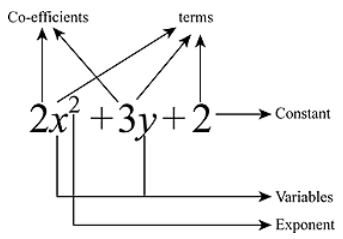
A polynomial is an algebraic expression that includes constants, variables, and exponents. It is the expression in which the variables have only positive integral powers.
1. 4x3 + 3x2 + x +3 is a polynomial in variable x.
2. 4x2 + 3x-1 – 4 is not a polynomial as it has negative power.
3. 3x3/2 + 2x – 3 is not a polynomial, since it power is not an integer.
.
If there is only one variable in the expression, then this is called the polynomial in one variable.
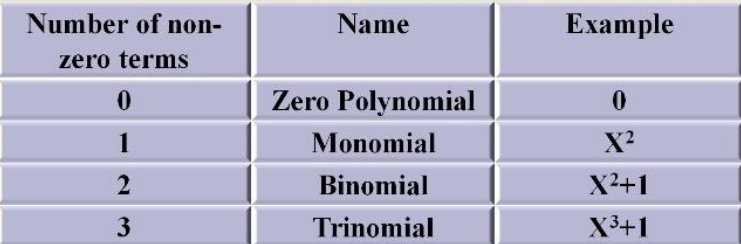
Types of polynomials on the basis of the number of terms
Types of polynomials on the basis of the number of degrees
The highest value of the power of the variable in the polynomial is the degree of the polynomial.

If p(x) is a polynomial, then the number ‘a’ will be the zero of the polynomial with p(a) = 0. We can find the zero of the polynomial by equating it to zero.
The given polynomial is p(x) = x – 4
To find the zero of the polynomial, we will equate it to zero.
x – 4 = 0
x = 4
p(4) = x – 4 = 4 – 4 = 0
This shows that if we place 4 in place of x, we get the value of the polynomial as zero. So 4 is the zero of this polynomial. And also, we are getting the value 4 by equating the polynomial with 0.
So 4 is the zero of the polynomial or the root of the polynomial.
The root of the polynomial is basically the x-intercept of the polynomial.
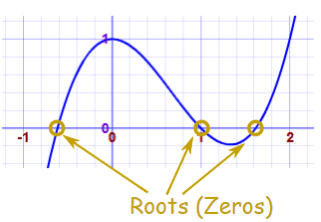
If the polynomial has one root, it will intersect the x-axis at one point only, and if it has two roots, it will intersect at two points, and so on.
Find p (1) for the polynomial p (t) = t2 – t + 1
p (1) = (1)2 – 1 + 1
= 1 – 1 + 1
= 1
We know the property of division which follows in the basic division, i.e.
Dividend = (Divisor × Quotient) + Remainder
This follows the division of polynomials.
If p(x) and g(x) are two polynomials in which the degrees of p(x) ≥ degree of g(x) and g(x) ≠ 0 are given, then we can get the q(x) and r(x) so that:
P(x) = g(x) q(x) + r(x),
where r(x) = 0 or degree of r(x) < degree of g(x).
It says that p(x) divided by g(x), gives q(x) as a quotient and r(x) as a remainder.
Let’s understand it with an example

We can see that ‘x’ is common in the above polynomial, so we can write it as

Hence, 3x2 + x + 1 and x the factors of 3x3 + x2 + x.
Divide x2 – 3x -10 by 2 + x
Step 1: Write the dividend and divisor in descending order, i.e., in the standard form. x2 – 3x -10 and x + 2
Divide the first term of the dividend with the first term of the divisor.
x2/x = x this will be the first term of the quotient.
Step 2: Now multiply the divisor by this term of the quotient and subtract it from the dividend.

Step 3: Now the remainder is our new dividend, so we will repeat the process again by dividing the dividend by the divisor.
Step 4: – (5x/x) = – 5
Step 5:

The remainder is zero.
Hence x2 – 3x – 10 = (x + 2)(x – 5) + 0
Dividend = (Divisor × Quotient) + Remainder
The Remainder Theorem says that if p(x) is any polynomial of degree greater than or equal to one and let ‘t’ be any real number and p (x) is divided by the linear polynomial x – t, then the remainder is p(t).
As we know,
P(x) = g(x) q(x) + r(x)
If p(x) is divided by (x-t) then
If x = t
P (t) = (t – t). q (t) + r = 0
To find the remainder or to check the multiple of the polynomial, we can use the remainder theorem.
What is the remainder if a4 + a3 – 2a2 + a + 1 is divided by a – 1.
P(x) = a4 + a3 – 2a2 + a + 1
To find the zero of (a – 1), we need to equate it to zero.
a -1 = 0
a = 1
p (1) = (1)4 + (1)3 – 2(1)2 + (1) + 1
= 1 + 1 – 2 + 1 + 1
= 2
So by using the remainder theorem, we can easily find the remainder after the division of the polynomial.
The factor theorem says that if p(y) is a polynomial with degree n≥1 and t is a real number, then
Check whether g(x) = x – 3 is the factor of p(x) = x3 – 4x2 + x + 6 using the factor theorem.
According to the factor theorem, if x – 3 is the factor of p(x), then p(3) = 0, as the root of x – 3 is 3.
P (3) = (3)3 – 4(3)2 + (3) + 6
= 27 – 36 + 3 + 6 = 0
Hence, g (x) is the factor of p (x).
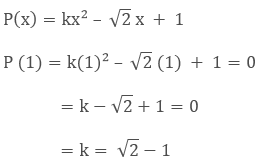
Find the value of k, if x – 1 is a factor of p(x) = kx2 – √2x + 1
As x -1 is the factor, p(1) = 0
Factorization can be done by three methods
1. By taking out the common factor
If we have to factorise x2 –x then we can do it by taking x common.
x(x – 1) so that x and x-1 are the factors of x2 – x.
2. By grouping
ab + bc + ax + cx = (ab + bc) + (ax + cx)
= b(a + c) + x(a + c)
= (a + c)(b + x)
3. By splitting the middle term
x2 + bx + c = x2 + (p + q) + pq
= (x + p)(x + q)
This shows that we have to split the middle term in such a way that the sum of the two terms is equal to ‘b’ and the product is equal to ‘c’.
Factorize 6x2 + 17x + 5 by splitting the middle term.
If we can find two numbers p and q such that p + q = 17 and pq = 6 × 5 = 30, then we can get the factors.
Some of the factors of 30 are 1 and 30, 2 and 15, 3 and 10, 5 and 6, out of which 2 and 15 is the pair which gives p + q = 17.
6x2 + 17x + 5 =6 x2 + (2 + 15) x + 5
= 6 x2 + 2x + 15x + 5
= 2 x (3x + 1) + 5(3x + 1)
= (3x + 1) (2x + 5)
| Algebraic Identities |
| 1. (x + y)2 = x2 + 2xy + y2 |
| 2. (x – y)2 = x2 – 2xy + y2 |
| 3. (x + y) (x – y) = x2 – y2 |
| 4. (x + a) (x + b) = x2 + (a + b)x + ab |
| 5. (x + y + z)2 = x2 + y2 + z2 + 2xy + 2yz + 2zx |
| 6. (x + y)3 = x3 + y3 + 3xy(x + y) = x3+ y3 + 3x2y + 3xy2 |
| 7. (x – y)3 = x3– y3 – 3xy(x – y) = x3 – y3 – 3x2y + 3xy2 |
| 8. x3 + y3 = (x + y)(x2 – xy + y2) |
| 9. x3 – y3 = (x – y)(x2 + xy + y2) |
| 10. x3 + y3 + z3 – 3xyz = (x + y + z)(x2 + y2 + z2 – xy – yz – zx) x3 + y3 + z3 = 3xyz if x + y + z = 0 |
Factorize 8x3 + 27y3 + 36x2y + 54xy2
The given expression can be written as
= (2x)3 + (3y)3 + 3(4x2) (3y) + 3(2x) (9y2)
= (2x)3 + (3y)3 + 3(2x)2(3y) + 3(2x)(3y)2
= (2x + 3y)3 (Using Identity VI)
= (2x + 3y) (2x + 3y) (2x + 3y) are the factors.
Factorize 4x2 + y2 + z2 – 4xy – 2yz + 4xz.
4x2 + y2 + z2 – 4xy – 2yz + 4xz = (2x)2 + (–y)2 + (z)2 + 2(2x) (-y)+ 2(–y)(z) + 2(2x)(z)
= [2x + (- y) + z]2 (Using Identity V)
= (2x – y + z)2 = (2x – y + z) (2x – y + z)
Topic Level Resources
Select A Topic
Topic:
Select Another Chapter
[display-posts category=”CBSE 9 – Mathematics – Study – Premium” order=”ASC” posts_per_page=”25″]
Personalised Assessments