Level: Chapter

Chapter Level Content

  • Mensuration | Study

  • MOTION | Study

  • Motion and Time | Assess

  • Motion and Time | Study

  • Perimeter and Area | Assess

  • Perimeter and Area | Assess

  • Perimeter and Area | Study

  • Perimeter and Area | Study

  • Reproduction in Plants | Assess

  • Mensuration | Study

    Mind Map Overal Idea Content Speed Notes Quick Coverage Perimeter: Length of boundary of a simple closed figure. Perimeter of Rectangle = 2(l +b)Perimeter of Square = 4aPerimeter of Parallelogram = 2(sum of two adjacent sides)Area: The measure of region enclosed in a simple closed figure. Area of a trapezium = half of the sum readmore

    Mind Map

    Overal Idea

    Content

    Speed Notes

    Quick Coverage

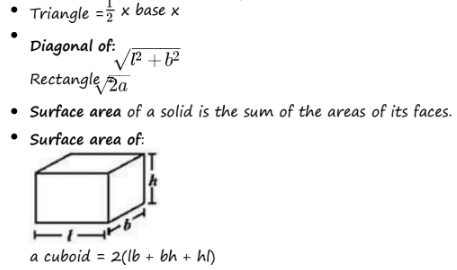
    Perimeter: Length of boundary of a simple closed figure.

    Perimeter of Rectangle = 2(l +b)
    Perimeter of Square = 4a
    Perimeter of Parallelogram = 2(sum of two adjacent sides)
    Area: The measure of region enclosed in a simple closed figure.

    Area of a trapezium = half of the sum of the lengths of parallel sides × perpendiculardistance between them.

    Area of a rhombus = half the product of its diagonals. (Scroll down till end of the page)

    Study Tools

    Audio, Visual & Digital Content
    Hindi Version

    Key Terms

    Topic Terminology

    Term

    Important Tables

    Table:

    .

    Thumbnail - Study, Assess, Interact
    Advanced Tools For Study Assess Interact
    • MOTION | Study

      Mind Map Overal Idea Content Speed Notes Quick Coverage Rest And Motion The terms Rest and Motion are relative. Motion: An object is said to be in motion when its position changes with time. Rest: An object is said to be at rest when its position does not change with respect to a reference point readmore

      Mind Map

      Overal Idea

      Content

      Speed Notes

      Quick Coverage

      Rest And Motion

      The terms Rest and Motion are relative.

      Motion: An object is said to be in motion when its position changes with time.

      Rest: An object is said to be at rest when its position does not change with respect to a reference point with time.

      A specific point with respect to which we describe the location of an object is called a reference point. (Scroll down till end of the page)

      Study Tools

      Audio, Visual & Digital Content
      Distance and Displacement

      • Distance: The total length of path covered by an object is said to be the distance travelled by it.
      • Displacement: Gap between the initial and final positions of an object is said to be its displacement. Or
      • The length of a line segment that joins the initial and final positions of an object is known as the displacement.

      Difference Between Displacement and Displacement

      DistanceDisplacement
      Distance is defined as the total length of the path travelled by an object to go from one point to another.Displacement is defined as the  length of the line segment that joins the initial and final positions of an object.
      Since distance has only magnitude and its direction cannot be specified always, it  is a scalar quantity.Since displacement has magnitude and it  is specified in a direction  from initial position to final position, it is a vector quantity.
      Distance can only have positive values.Displacement can have both positive and negative values.
      Distance depends on the length of the path travelled.Displacement depends only on the initial and final point regardless of the path travelled.
      Difference Between Displacement and Displacement

      Speed And Velocity Speed

      • Speed: The distance travelled by an object in unit time is referred to as speed. 
      • Its S.I unit is m/s. 
      • In general speed refers to average speed.
      • Average speed: For non-uniform motion, the average speed of an object is obtained by dividing the total distance travelled by an object by the total time taken.

      motion-cbse-notes-class-9-science-1

      • For a uniform motion, the average speed of an object is equal to its instantaneous speed throughout the path.

      Velocity

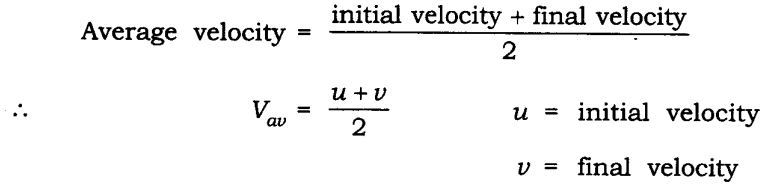
      • Average Velocity or Velocity : For a uniform motion in a straight path, the average velocity is equal to its instantaneous velocity throughout the path.


      motion-cbse-notes-class-9-science-2

      • Velocity of an object is equal to the instantaneous velocity of an object.

      Differences Between Speed and Velocity

                        SPEED                VELOCITY
      It is defined as the rate of change of distance.It is defined as the rate of change of net displacement.
      It is a scalar quantity.It is a vector quantity.
      It can never be negative or zero.It can be negative,zero or positive.
      Speed is velocity without direction.Velocity is directed speed.
      Speed may or may not be equal to velocity.A body may possess different velocities but the same speed.
      Speed never decreases with time. For a moving body,Velocity can decrease with time. For a moving body , it can be zero.
      Speed is never zero.Velocity can be zero.
      Speed in SI is measured in ms-1Velocity in SI, is measured in ms-1
      Differences Between Speed and Velocity

      Uniform And Non-Uniform motion

      • Uniform motion or non accelerated motion: When an object covers equal distances in equal intervals of time, it is said to be in uniform motion. Uniform motion is a non-accelerated motion.
      • Non-uniform motion or accelerated motion: Motions where objects cover unequal distances in equal intervals of time. Uniform motion is an accelerated motion.

      Acceleration

      Acceleration: Change in the velocity of an object per unit time.


      motion-cbse-notes-class-9-science-3

      Graphical representation of motions

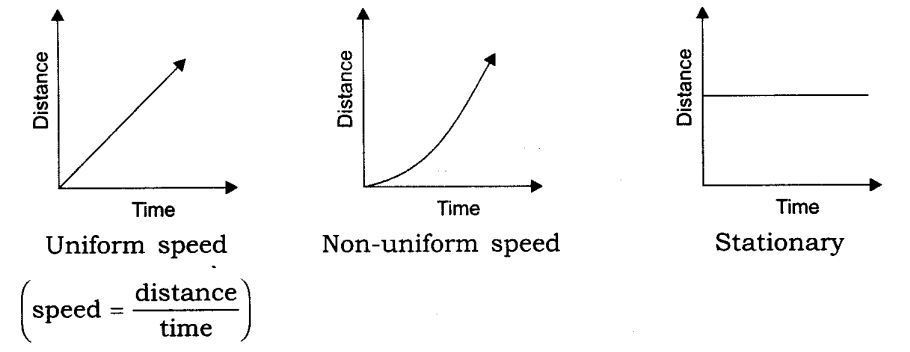
      (i) Distance-time graph

      For a distance-time graph, time is taken on x-axis and distance is taken on the y-axis.


      motion-cbse-notes-class-9-science-4

      [Note: All independent quantities are taken along the x-axis and dependent quantities are taken along the y-axis.]


      motion-cbse-notes-class-9-science-5

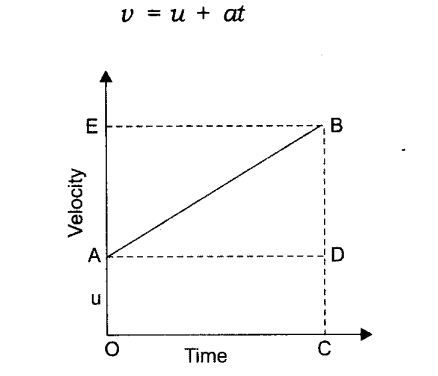
      (ii) Velocity-time graph

      Equation of motion by graphical methods

      Derivation Of Equations Of Motion

      Equations of motion can be derived by two methods. They are (i) Graphical Method. (ii) Algebraic Method

      Derivation of The Equations of Motion By Algebraic Method:

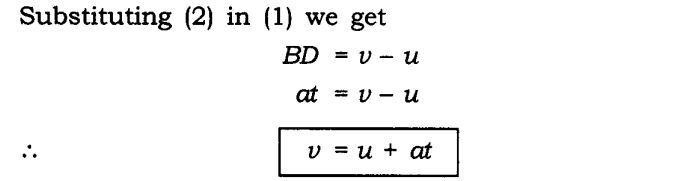
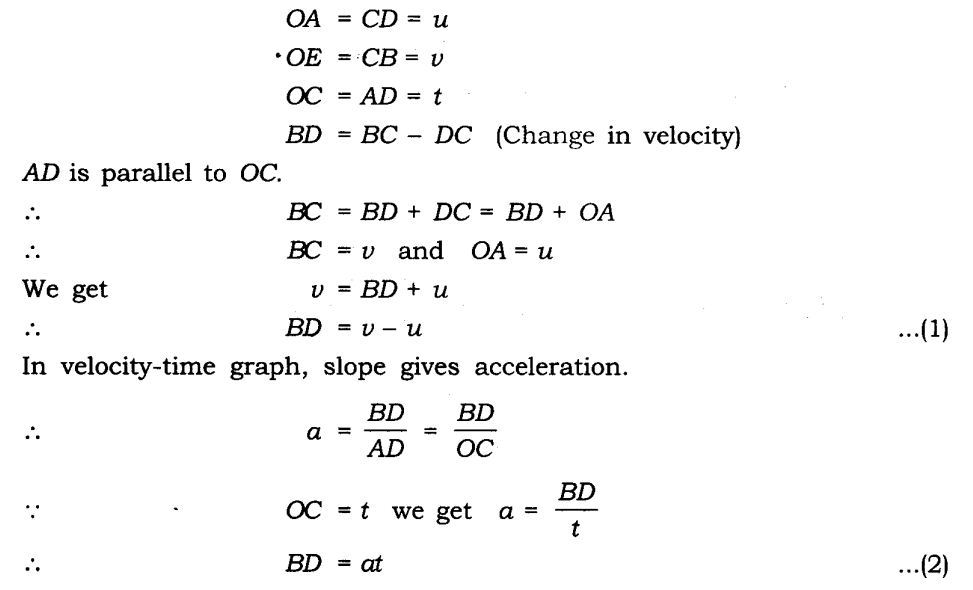
      (a) Velocity-time relation:


      motion-cbse-notes-class-9-science-6


      motion-cbse-notes-class-9-science-8

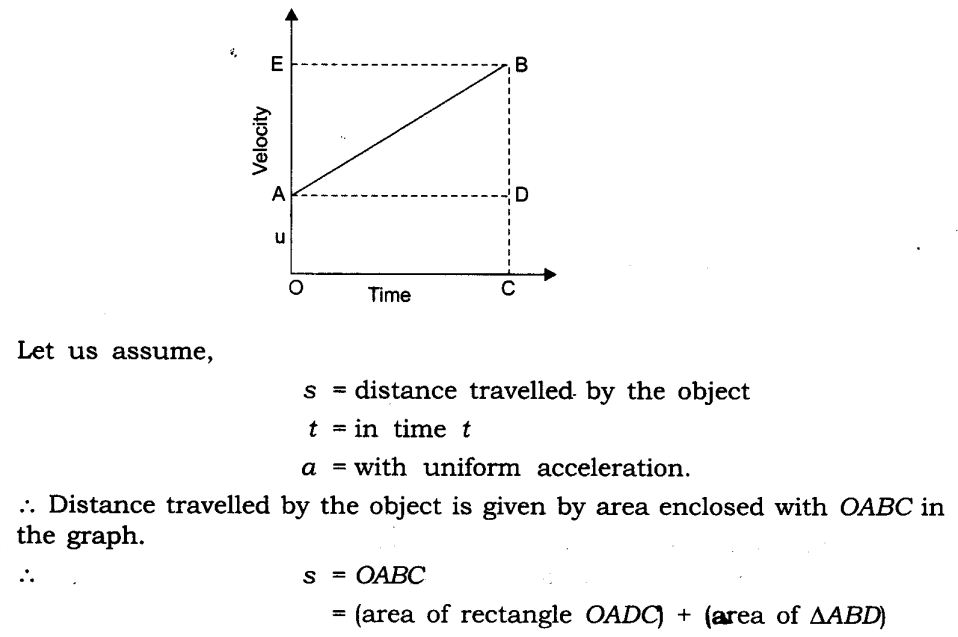
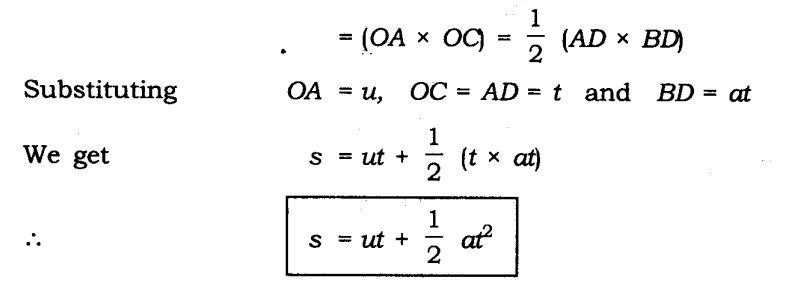
      Derivation of S = ut + ½ at2

      (ii) The equation for position-time relation:

      motion-cbse-notes-class-9-science-9
      motion-cbse-notes-class-9-science-10motion-cbse-notes-class-9-science-7

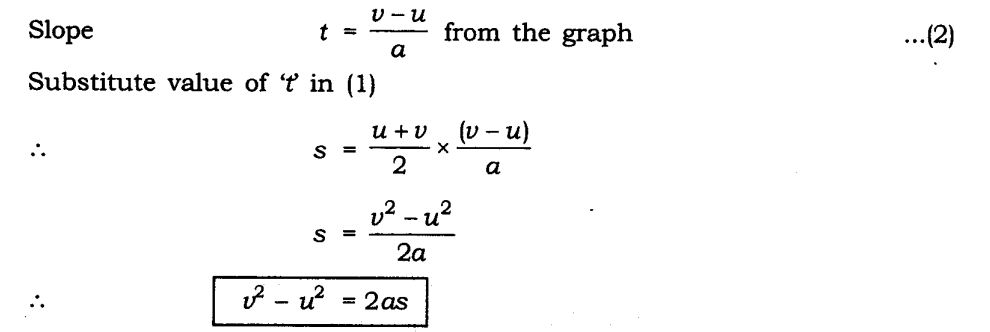
      Derivation of v2 – u2  = 2as

      (iii) Equation for position-velocity relation:


      motion-cbse-notes-class-9-science-11

      motion-cbse-notes-class-9-science-12

      Conclusions From a Distance – Time Graph


      Uniform Circular Motion

      When a body moves in a circular path with uniform speed, its motion is called uniform circular motion.

      Hindi Version

      Key Terms

      Topic Terminology

      Term

      Important Tables

      Table:

      .

      Thumbnail - Study, Assess, Interact
      Advanced Tools For Study Assess Interact
      • Motion and Time | Assess

        Assessment Tools

        Assign | Assess | Analyse

        Question Bank

        List Of Questions With Key, Aswers & Solutions

        Re – Learn

        Go Back To Learn Again

        • Motion and Time | Study

          Mind Map Overal Idea Content Speed Notes Quick Coverage Motion: The action or process of moving or being moved. The distance moved by an object in a unit time is called its speed. Speed of objects help us to decide which one is moving faster than the other. The speed of an object is the readmore

          Mind Map

          Overal Idea

          Content

          Speed Notes

          Quick Coverage

          Motion: The action or process of moving or being moved.

          The distance moved by an object in a unit time is called its speed.

          Speed of objects help us to decide which one is moving faster than the other.

          The speed of an object is the distance travelled divided by the time taken to cover that distance.

          Its basic unit is mere per second (m/s). (Scroll down till end of the page)

          Study Tools

          Audio, Visual & Digital Content
          Periodic events are used for the measurement of time.

          Periodic motion of a pendulum has been used to make clocks and watches.

          Motion of objects can be presented in pictorial form by their distance-time graphs.

          The distance-time graph for the motion of an object moving with a constant speed is a straight line.

          Uniform Motion ANd Non – Uniform Motion:

          1. Uniform motion: An object moving with a constant speed is said to be in uniform motion. The average speed is the same as the actual speed.
          2. Non-Uniform motion: If the speed of a moving object keeps changing, the object is said to be in non-uniform motion.

          Speed: It is the distance covered by an object in a unit time.

          Speed = Total distance/ Total Time

          Basic unit of speed is m/s.

          Distance-Time Graph: Motion of objects can be presented in pictorial form by their distance-time graphs.

          The distance-time graph for the motion of an object moving with a constant speed is a straight line.

          Hindi Version

          Key Terms

          Topic Terminology

          Term

          Important Tables

          Table:

          .

          Thumbnail - Study, Assess, Interact
          Advanced Tools For Study Assess Interact
          • Perimeter and Area | Assess

            Assessment Tools

            Assign | Assess | Analyse

            Question Bank

            List Of Questions With Key, Aswers & Solutions

            Re – Learn

            Go Back To Learn Again

            • Perimeter and Area | Assess

              Assessment Tools

              Assign | Assess | Analyse

              Question Bank

              List Of Questions With Key, Aswers & Solutions

              Re – Learn

              Go Back To Learn Again

              • Perimeter and Area | Study

                Mind Map Overal Idea Content Speed Notes Quick Coverage Perimeter is the distance around a closed figure whereasarea is the part of plane occupied by the closedfigure. Area is the measure of the part of plane or regionenclosed by it. (Scroll down till end of the page) Study Tools Audio, Visual & Digital Content We readmore

                Mind Map

                Overal Idea

                Content

                Speed Notes

                Quick Coverage

                Perimeter is the distance around a closed figure whereasarea is the part of plane occupied by the closedfigure.

                Area is the measure of the part of plane or regionenclosed by it. (Scroll down till end of the page)

                Study Tools

                Audio, Visual & Digital Content

                We have learnt how to find perimeter and area of a squareand rectangle earlierclass.

                They are:

                (a) Perimeter of a square = 4 × side

                (b) Perimeter of a rectangle = 2 × (length + breadth)

                (c) Area of a square = side × side

                (d) Area of a rectangle = length × breadth Areaof a parallelogram = base × height

                Hindi Version

                Key Terms

                Topic Terminology

                Term

                Important Tables

                Table:

                .

                Thumbnail - Study, Assess, Interact
                Advanced Tools For Study Assess Interact
                • Perimeter and Area | Study

                  Mind Map Overal Idea Content Speed Notes Quick Coverage Content : (Scroll down till end of the page) Study Tools Audio, Visual & Digital Content Content … Key Terms Topic Terminology Term Important Tables Table: . Assessments Test Your Learning readmore
                  Mind Map

                  Overal Idea

                  Content

                  Speed Notes

                  Quick Coverage

                  Content : (Scroll down till end of the page)

                  Study Tools

                  Audio, Visual & Digital Content

                  Content …

                  Key Terms

                  Topic Terminology

                  Term

                  Important Tables

                  Table:

                  .

                  Thumbnail - Study, Assess, Interact
                  Advanced Tools For Study Assess Interact
                  • Reproduction in Plants | Assess

                    Assessment Tools

                    Assign | Assess | Analyse

                    Question Bank

                    List Of Questions With Key, Aswers & Solutions

                    Re – Learn

                    Go Back To Learn Again

                    wpChatIcon
                      wpChatIcon
                      error: Content is protected !!
                      Scan the code
                      Verified by MonsterInsights