Level: Chapter

Chapter Level Content

  • MATTER IN OUR SURROUNDINGS | Study

  • REACHING THE AGE OF ADOLESCENCE | Assess

  • REACHING THE AGE OF ADOLESCENCE | Study

  • Respiration in Organisms | Assess

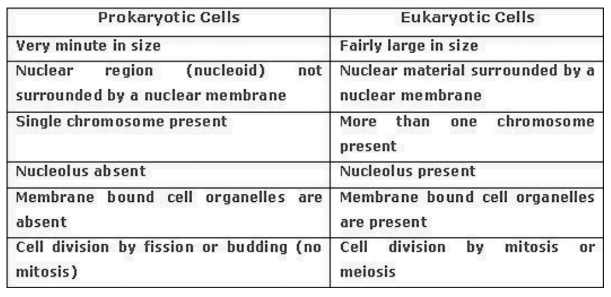
  • THE FUNDAMENTAL UNIT OF LIFE | Study

  • TISSUES | Assess

  • Transportation in Animals and Plants | Study

  • TRIANGLES | Study

  • CONSERVATION OF PLANTS AND ANIMALS | Study

  • MATTER IN OUR SURROUNDINGS | Study

    Mind Map Overal Idea Content Speed Notes Quick Coverage Matter: 1. Characteristics of Matter Particles Anything (Physical Material not emotions, feelings etc.) which has mass and volume (occupy space) is called matter.  We feel the presence of matter by one or more of our five sense organs. Matter is made up of particles. (Scroll down readmore

    Mind Map

    Overal Idea

    Content

    Speed Notes

    Quick Coverage

    Matter:

    1. Characteristics of Matter Particles

    Anything (Physical Material not emotions, feelings etc.) which has mass and volume (occupy space) is called matter

    We feel the presence of matter by one or more of our five sense organs.

    Matter is made up of particles. (Scroll down till end of the page)

    Study Tools

    Audio, Visual & Digital Content

    Particles:

    Particles are very small in size. Therefore we cannot see particles with our naked eye. 

    Characteristics of the particles of matter

    (1) All matter (elements or compounds) consists of very small particles which can exist independently and are called particles. 

    (ii) The particles of matter are in a state of continuous motion and possess kinetic energy. 

    (iii) There are intermolecular spaces in between the particles (molecules) of matter.

    (iv) The particles (molecules) of matter attract each other with a force called intermolecular force. 

    Intermolecular force is maximum in solids and least in the gases.

    These material particles can be touched, moved by changing temperature or attracted by decreasing or increasing forces of attraction or repulsion.

    2. States of Matter

    Matter exists in three different physical states namely solid, liquid and gas.

    One substance such as water can exist in all the three states such as, ice in solid state, water in liquid state and steam or vapours in gaseous state.

    The state of matter depends on temperature, forces of attraction between their constituent particles etc.

    3. Interconversion of Matter

    All these three different states of matter are interconvertible depending upon temperature and pressure.

    The state of matter can be changed by changing temperature or pressure. 

    Due to change in temperature and pressure there will be a change in inter-particle space as well as force between them, resulting in change in physical state.

    Examples: 

    • Applying pressure and reducing temperature can liquefy gases.
    • Solid CO₂ gets converted directly to a gaseous state on decrease of pressure to 1 atmosphere without changing into a liquid state. Due to this fact solid CO₂ is also known as DRY ICE.

    4. Plasma: It is the fourth state of matter consisting of super energetic and super excited particles. These particles are in the form of ionised gases.

    Examples:

    • The plasma in stars is formed due to high temperature. 
    • Glowing plasma formed in fluorescent tubes and neon sign bulbs.

    These devices contain inert gases which get ionised due to the passage of electric current. The colour of the glowing plasma depends upon the nature of the gas.

    5. Sublimation: The process in which a solid state directly changes into a gaseous state on heating or vice-versa on cooling.

    6. Melting or Fusion: The process of changing a solid into a liquid state by absorbing heat at a constant temperature is known as Melting or Fusion

    7. Freezing or Solidification: The process of changing a liquid into solid state by losing heat at a constant temperature is known as Freezing or Solidification.

    8. Condensation: The process of changing a gas into a liquid state by giving out heat at constant temperature is known as Condensation .

    Boiling or Vaporisation : The process of changing a liquid into a gaseous state by absorbing heat at constant temperature  is known as Boiling or Vaporisation .

    Boiling is a bulk phenomenon. Particles from the bulk (whole) of the liquid change into a vapour state.

    Evaporation: The phenomenon of changing the physical state from liquid to vapour, at any temperature is called evaporation.

    Evaporation is a surface phenomenon. Particles from the surface gain required energy to overcome the forces of attraction present in the liquid and change into the vapour state.

    The rate of evaporation depends upon the surface area exposed to the atmosphere, the temperature, the humidity and the wind speed.

    Evaporation causes cooling.

    Evaporation takes place at all temperatures, below the boiling point of a liquid

    Factors affecting evaporation:

    • Rate of evaporation increases with increase in surface area.

    • Rate of evaporation increases with increase in temperature.

    • Rate of evaporation increases with decrease in Humidity.

    • Rate of evaporation increases with increase in wind speed.

    Latent heat of boiling or Latent heat of Vaporisation: Latent heat of boiling or Latent heat of Vaporisation is the heat energy required to change 1 kg of a liquid to gas at atmospheric pressure at its boiling point.

    Kelvin is the SI unit of temperature. 

    0°C = 273.16 K. 

    For convenience, we take 0°C = 273 K after rounding off the decimal. 

    To change a temperature on the Kelvin scale to the Celsius scale you have to subtract 273 from the given temperature, and to convert a temperature on the Celsius scale to the Kelvin scale you have to add 273 to the given temperature.

    Conversion Formula: t°C = (t+273) K

    Boiling point or Vaporisation point: Boiling point or Vaporisation point is the fixed temperature at which a liquid converts into a gaseous state at atmospheric pressure.

    Melting point or Fusion point: Melting point or Fusion point is the temperature at which a solid starts converting into a liquid state at atmospheric pressure.

    Evaporation Causes cooling: During evaporation the particles at the surface of the liquid gain energy from the surroundings and change into vapour.. Therefore Evaporation Causes cooling effect.

    Sponge can be compressed although it is solid: Sponge contains minute holes in which air is trapped.So when it is pressed, the air gets expelled and the sponge gets compressed. Also,the material of the sponge is not rigid. 

    Temperature does not change during change of state: The temperature remains constant at its melting and boiling points (during change of state) until all the substance melts or boils.

    Because the heat supplied is continuously used up in changing the state of the substance by overcoming the force of attraction between the particles.

    There is no increase in the kinetic energy of the particles and thus, temperature does not change. 

    This heat energy absorbed without showing any rise in temperature is given the name latent heat of fusion/latent heat of vaporisation.

    Effect of pressure on physical state of a substance: 

    If pressure is applied, melting point decreases and boiling point increases

    When pressure is increased, the particles come closer and the force of attraction increases between them and this results in a change of state. 

    Example: When high pressure is applied to a gas by reducing its temperature, the particles of gas come close and get converted to a liquid. This is also known as liquefaction.

    The amount of heat energy required in changing a 1 kg of solid into liquid at atmospheric pressure and its melting point is known as the latent heat of fusion.

    [ Lice = 80 cal/g = 3.34 × 10⁵ J/kg].

    • The amount of heat which is required to convert 1 kg of the liquid (at its boiling point) to vapours of gas without any change in temperature is known as latent heat of vaporisation.

     [Lwater =540 cal/g= 22.5 × 10⁵ J/kg].

    • The amount of heat absorbed or liberated , Q = mL.

     • The specific heat is the amount of heat per unit mass required to raise the temperature by one degree Celsius.

    • Q = m.s. t, where m = mass of the body, s = specific heat of the body and t is temperature difference and m.s is called thermal capacity.

    Change of liquid into vapours at any temperature below the boiling point.

    Takes the latent heat from the body. Thus, the body cools when evaporation takes place.

    Evaporation:

    (1) Evaporation is a slow process.

    (ii) Evaporation takes place at the surface mass of the liquid.

    (iii) Evaporation takes place at all temperatures.

    (iv) The substance becomes cool due to evapora- tion process.

    (v) Heat is absorbed from the surroundings due to Evaporation. Absorption of heat from the surroundings causes cooling effect.

    Boiling:

    (1) Boiling is a rapid process.

    (ii) Boiling takes place throughout the mass of a liquid.

    (iii) Boiling takes place at a definite temperature called the boil- ing point.

    (iv) The substance remains hot during the boiling process.

    (v) Heat is required from an external source such as a burner for boiling to take place. 

    Scales of temperature

    • Three scales are commonly used for measuring temperature, namely, the Celsius scale, the Fahrenheit scale and the Kelvin scale.

    • The relation between the Celsius and the Kelvin scale can be expressed as:

    C + 273 = K

    • The relation between the Celsius and the Fahrenheit scale can be expressed as follows.

    PropertySolidLiquidGas
    Inter particle space  Very lessLarger than solid butlesser than gasVery large
    Inter particle force Very strong Weaker than solidbut stronger than gas Very weak
    Nature (Rigidity)Very hard and rigidFluidHighly fluid
    CompressibilityNegligibleVery smallHighly compressible
    ShapeDefinite shapeIndefiniteshape Indefinite  Shape 
    Volume Definite VolumeIndefinite shape Indefinite  volume
    DensityhighLess than solidVery low
    Kinetic energylowhighVery high
    DiffusionNegligibleSlowVery high

    Specific Heat

    11.8 NATURAL PHENOMENA AND CONSEQUENCES OF HIGH SPECIFIC HEAT CAPACITY OF WATER

    Some consequences of high specific heat capacity of water are given below.

    (i) The climate near the seashore is moderate :

    The specific heat capacity of water is very high (= 1000 cal kg-1 °C-1 or 4200 J kg-1 K-¹). It is about five times as high as that of sand. Hence the heat energy required for the same rise in temperature by a certain mass of water will be nearly five times that required by the same mass of sand. 

    Similarly, a certain mass of water will give out nearly five times more heat energy than that given by sand of the same mass for the same fall in temperature. 

    As such, sand (or earth) gets heated or cooled more rapidly as compared to water under similar conditions. 

    Thus, a large difference in temperature is developed between the land and the sea due to which land and sea breezes are formed”. These breezes make the climate near the seashore moderate.

    (ii) Hot water bottles are used for fomentation: The reason is that water does not cool quickly due to its large specific heat capacity, so a hot water bottle provides heat energy for fomentation for a long time.

    (iii) Water is used as an effective coolant: By allowing water to flow in pipes around the heated parts of a machine, heat energy from such parts is removed (e.g. radiators in car and generator are filled with water). Water in pipes extracts more heat from surroundings without much rise in its temperature because of its large specific heat capacity.

    (iv) In cold countries, water is used as a heat reservoir for wine and juice bottles to avoid their freezing: The reason is that water due to its high specific heat capacity can impart a large amount of heat before reaching up to the freezing temperature. Hence bottles kept in water remain warm and they do not freeze even when the surrounding temperature falls considerably.

    (v) Farmers fill their fields with water to protect the crops from frost: In the absence of water, if on a cold winter night, the atmospheric temperature falls below 0°C, the water in the fine capillaries of plants will freeze, so the veins will burst due to the increase in volume of water on freezing. As a result, plants will die and the crop will be destroyed. In order to save crop on such cold nights, farmers fill their fields with water because water has a high specific heat capacity, so it does not allow the temperature in the surrounding area of plants to fall up to 0°C.

    (vi) All plants and animals have a high content of water in their bodies: All plants and animals have nearly 80% to 90% of water in their bodies so it helps in maintaining the body temperature nearly same in all seasons due to high specific heat capacity of water.

    SOME EXAMPLES OF HIGH AND LOW THERMAL CAPACITY

    (1) The base of a cooking pan is made thick : By making the base of the cooking pan thick, its thermal capacity becomes large and it imparts sufficient heat energy at a low temperature to the food for its proper cooking. Further it keeps the food warm for a long time, after cooking.

    (2) The base of an electric iron is made thick and heavy: By doing so, the thermal capacity of the base becomes large and it remains hot for a long duration even after switching off the current.

    (3) The vessel used for measurement of heat (i.e., calorimeter) is made of thin sheet of copper:

    The reason is that the specific heat capacity of copper is low and by making the vessel thin, its thermal capacity becomes low so that it takes a negligible amount of heat from its contents to attain the temperature of the contents.

    Hindi Version

    Key Terms

    Topic Terminology

    Term

    Important Tables

    Table:

    .

    Thumbnail - Study, Assess, Interact
    Advanced Tools For Study Assess Interact
    • REACHING THE AGE OF ADOLESCENCE | Assess

      Assessment Tools

      Assign | Assess | Analyse

      Question Bank

      List Of Questions With Key, Aswers & Solutions

      Re – Learn

      Go Back To Learn Again

      • REACHING THE AGE OF ADOLESCENCE | Study

        Mind Map Overal Idea Content Speed Notes Quick Coverage Humans become capable of reproduction after puberty. Puberty sets in between the ages of 11 years and 19 years. These children are called adolescents. The onset of puberty brings about growth of the reproductive organs. Hairs grow at various places on the body. Breasts develop in readmore

        Mind Map

        Overal Idea

        Content

        Speed Notes

        Quick Coverage

        Humans become capable of reproduction after puberty. Puberty sets in between the ages of 11 years and 19 years. These children are called adolescents.

        The onset of puberty brings about growth of the reproductive organs. Hairs grow at various places on the body.

        Breasts develop in girls.

        Facial hair (moustache and beard) appear in boys.

        Voice of boys become hoarse as voice box enlarges during adolescence.

        Children gain height during adolescence.

        Puberty: It is the time when sex organs begin to work.

        It brings about growth in reproductive organs and changes in the body.

        Puberty starts at the beginning of adolescence. (Scroll down till end of the page)

        Study Tools

        Audio, Visual & Digital Content

        Reaching the age of Adolescence

        The onset of puberty starts much earlier in girls, between 8 and 13 years of age, whereas it starts between 10 and 14 years of
        age in boys and lasts upto 2 to 4 years.

        Changes during Puberty:
        (i) Increase in Height: The bones of the legs and arms elongate and the individual becomes tall and lanky.

        (ii) Changes in Body Shape: In boys, the body becomes more muscular, the shoulder becomes wider.

        In girls, the body shows curves in certain parts and the region below the waist become wider and broader.

        (iii) Change in Voice: In boys, the voice becomes hoarse and heavy due to the extra growth of larynx (voice box).

        In girls, the voice becomes high pitched and shriller.

        (iv) Sweat and sebaceous glands: They become more active and secrete more.

        (v) Emotional aspects develop.

        Periodic cycle of 28 days. The onset of puberty and maturity of reproductive parts are controlled by hormones.

        Hormones are secretions of endocrine glands which pour them directly into the blood stream.

        Pituitary gland secretes hormones which include growth hormone and hormones that make other glands such as the testes, ovaries, thyroids and adrenals, secrete hormones.

        Pancreas secretes insulin, thyroid produces thyroxin and adrenals produce adrenalin.

        Testosterone is the male hormone and estrogens, the female hormone.

        The uterine wall in females prepares itself to receive the developing fertilised egg.

        Menstruation: In case there isno fertilisation, the thickened lining of the uterine wall breaks down and goes out of the body along with blood.This is called menstruation.

        Sperm and Ovum fuses together to form a zygote.

        Sex chromosomes in sperms determine the baby’s gender. Humans have 23 pairs of chromosomes in each cell.

        A pair of chromosome forms the sex chromosomes. Males carry XY and females carry XX chromosomes.

        If a sperm carrying X fertilises the ovum with X chromosome, then the resulting baby is a girl.

        If a sperm carrying Y chromosome fertilises the ovum with X chromosome, then the resulting baby is a boy.

        Hence, males are responsible for the gender of the newly formed babies, Not Women.

        Reproductive Health:
        It is important to eat balanced food and maintain personal hygiene during adolescence.

        Cleaning of private parts is important to prevent possible infections.

        The activity of sweat glands increases in puberty and releases bad odour from the body.

        Thus frequent bathing is necessary. Physical exercise keeps the body fit and healthy as it releases lot of sweat.

        Peer pressure is best addressed by self-confidence and a healthy lifestyle.

        Hindi Version

        Key Terms

        Topic Terminology

        Term

        Important Tables

        Table:

        .

        Thumbnail - Study, Assess, Interact
        Advanced Tools For Study Assess Interact
        • Respiration in Organisms | Assess

          Assessment Tools

          Assign | Assess | Analyse

          Question Bank

          List Of Questions With Key, Aswers & Solutions

          Re – Learn

          Go Back To Learn Again

          • THE FUNDAMENTAL UNIT OF LIFE | Study

            Mind Map Overal Idea Content Speed Notes Quick Coverage What are Living organisms made up of?All living organisms are made up of cells. Cell is the basic structural and functional unit of complex organisms. History of cell: Cells were first discovered by Robert Hooke in 1665 with the help of a primitive microscope. Leeuwenhoek, in readmore

            Mind Map

            Overal Idea

            Content

            Speed Notes

            Quick Coverage

            What are Living organisms made up of?
            All living organisms are made up of cells. Cell is the basic structural and functional unit of complex organisms.

            History of cell:

            Cells were first discovered by Robert Hooke in 1665 with the help of a primitive microscope. Leeuwenhoek, in 1674, with the improved microscope, discovered free-living cells in pond water for the first time. (Scroll down till end of the page)

            Study Tools

            Audio, Visual & Digital Content

            Hindi Version

            Key Terms

            Topic Terminology

            Term

            Important Tables

            Table:

            .

            Thumbnail - Study, Assess, Interact
            Advanced Tools For Study Assess Interact
            • TISSUES | Assess

              Assessment Tools

              Assign | Assess | Analyse

              Question Bank

              List Of Questions With Key, Aswers & Solutions

              Re – Learn

              Go Back To Learn Again

              • Transportation in Animals and Plants | Study

                Mind Map Overal Idea Content Speed Notes Quick Coverage In most of the animals the blood that circulates in the body distributes food and oxygen to different cells of the body. It also carries waste products from different parts of the body for excretion. Circulatory system consists of the heart and blood vessels. In humans, readmore

                Mind Map

                Overal Idea

                Content

                Speed Notes

                Quick Coverage

                In most of the animals the blood that circulates in the body distributes food and oxygen to different cells of the body.

                It also carries waste products from different parts of the body for excretion.

                Circulatory system consists of the heart and blood vessels.

                In humans, blood flows through arteries and veins and the heart acts as a pumping organ. (Scroll down till end of the page)

                Study Tools

                Audio, Visual & Digital Content

                Blood is the fluid which flows in blood vessels.

                It transport substance like digested food from the small intestine to the other parts of the body.

                Blood consists of plasma, RBC, WBC and platelets.

                Blood is red due to the presence of a red pigment, haemoglobin which binds with oxygen and transport oxygen to various parts.

                Heart rate:The human heart beats about 70 to 80 times per minute in an adult person. This is called heart rate.

                Arteries carry blood from the heart to all parts of the body.

                Veins carry blood from all parts of the body back to the heart.

                excretion: Removal of waste products from the body is called excretion.

                Excretory system of humans consists of two kidneys, two ureters, a urinary bladder, and urethra.

                Salts and urea are removed along with water as sweat.

                Fish excrete waste substances such as ammonia which directly dissolve in water.

                Birds, insects and lizard excrete uric acid in semi-solid form.

                Transportation in plants :

                Water and mineral nutrients are absorbed by roots from the soil.

                xylem: Nutrients are transported along with water to the entire plant via the vascular tissue called xylem.

                phloem: The vascular tissue for the transport of food to the various parts of the plant is phloem.

                A lot of water is lost by plants in the form of vapour through stomata during transpiration.

                Transpiration generates a force which pulls up water absorbed by the roots from the soil, to reach the stem and leaves.

                Hindi Version

                Key Terms

                Topic Terminology

                Term

                Important Tables

                Table:

                .

                Thumbnail - Study, Assess, Interact
                Advanced Tools For Study Assess Interact
                • TRIANGLES | Study

                  Mind Map Overal Idea Content Speed Notes Quick Coverage Similar Geometric Figures: Two geometric figures which are the same in shape, such that one is simply a copy of the other on a smaller scale or a larger scale, are called similar geometric figures. Two geometric figures are said to be similar if and only readmore

                  Mind Map

                  Overal Idea

                  Content

                  Speed Notes

                  Quick Coverage

                  Similar Geometric Figures:

                  Two geometric figures which are the same in shape, such that one is simply a copy of the other on a smaller scale or a larger scale, are called similar geometric figures.

                  Two geometric figures are said to be similar if and only if they have the same shape but not necessarily the same size. Two congruent geometric figures are always similar but converse may or may not be true. (Scroll down till end of the page)

                  Study Tools

                  Audio, Visual & Digital Content

                  Similar Polygons: Two polygons of the same number of sides are similar, if

                  (i) their corresponding angles are equal and

                  (ii) their corresponding sides are in proportion or their corresponding sides are in the same ratio.

                  The same ratio of the corresponding sides is referred to as the representative fraction or the scale factor for the polygons.

                  Similar Triangles :

                  Two triangles are said to be similar,

                  if (i) their corresponding angles are equal and

                  ii) their corresponding sides are in proportion (are in the same ratio).

                  Basic Proportionality Theorem (or Thales Theorem) : 1

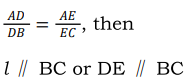
                  If a line is drawn parallel to one side of a triangle intersecting the other two sides, then it divides the two sides in the same ratio. Or If a line is drawn parallel to one side of a triangle, intersecting the other two sides in distinct points, the other two sides are divided in the same ratio i .e.. If in ∆ABC, l∥ BC, intersecting in D and E. then

                  Converse of Basic Proportionality Theorem :

                  If a line divides any two sides of a triangle in the sameratio, the line is parallel to the third side i.e.

                  In ∆ABC, if l intersects AB in D and AC in E, such that:

                  Criteria for Similarity of Triangles:

                  Two triangles are said to be similar, if

                  (i) their corresponding angles are equal and (ii) their corresponding sides are in proportion (or are in the same ratio).

                  2 (i) AA or AAA Similarity Criterion : If two angles of one triangle are equal to two corresponding angles of another triangle, then the triangles are similar. If two angles of one triangle are respectively equal to the two angles of another triangle, then the third angles of the two triangles are necessarily equal, because the sum of three angles of a triangle is always 180 0 .

                  (ii) SAS Similarity Criterion : If one angle of a triangle is equal to one angle of another triangle and the sides including these angles are in the same ratio, then the two triangles are similar. Or If two sides of a triangle are proportional to two corresponding sides of another triangle and the angles included between them are equal, then the triangles are similar.

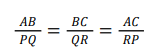
                  iii) SSS Similarity Criterion : If in two triangles, sides of one triangle are proportional (or are in the same ratio) to the sides of the other triangle, then the triangles are similar. If ∆ABC~ ∆PQR by any one similarity criterion, then ∠A=∠P, ∠B=∠Q, ∠C=∠R and

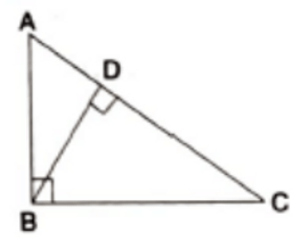
                  i.e., A and P, B and Q, C and R are the corresponding vertices, also AB and PQ. BC and QR. CA and RP are the corresponding sides. 3 Areas of Similar Triangles: The ratio of the areas of two similar triangles is equal to the square of the ratio of their corresponding sides. – The ratio of the areas of two similar triangles is equal to the square of the ratio of their corresponding medians. – The ratio of the areas of two similar triangles is equal to the ratio of the squares of their corresponding altitudes. – The ratio of the areas of two similar triangles is equal to the ratio of the squares of their corresponding angle bisectors. Pythagoras Theorem : In a right triangle, the square of the hypotenuse is equal to the sum of the squares of the other two sides. Converse of Pythagoras Theorem : In a triangle, if the square of one side is equal to the sum of the squares of the other two sides, then the angle opposite the first side is a right angle. If a perpendicular is drawn from the vertex of the right angle of a right triangle to the hypotenuse, the triangles on each side of the perpendicular are similar to the whole triangle and similar to each other i .e ..

                  If in ∆ABC, ∠B=90^0 and BD ⊥ AC, then (i) ∆ADB ~ ∆ABC (ii) ∆BDC ~ ∆ABC (iii) ∆ADB ~ ∆BDC

                  Hindi Version

                  Key Terms

                  Topic Terminology

                  Term

                  Important Tables

                  Table:

                  .

                  Thumbnail - Study, Assess, Interact
                  Advanced Tools For Study Assess Interact
                  • CONSERVATION OF PLANTS AND ANIMALS | Study

                    Mind Map Overal Idea Content Speed Notes Quick Coverage Biodiversity: Occurrence of innumerable types of organisms and the whole range of their varieties (biotypes) adapted to different climates, environments and areas. Wildlife sanctuary, national park and bio-sphere reserve are names given to the areas meant for conservation and preservation of forest and wild animals. (Scroll readmore

                    Mind Map

                    Overal Idea

                    Content

                    Speed Notes

                    Quick Coverage

                    Biodiversity: Occurrence of innumerable types of organisms and the whole range of their varieties (biotypes) adapted to different climates, environments and areas. Wildlife sanctuary, national park and bio-sphere reserve are names given to the areas meant for conservation and preservation of forest and wild animals. (Scroll down till end of the page)

                    Study Tools

                    Audio, Visual & Digital Content

                    Biodiversity refers to the variety of living organisms in a specific area.

                    Plants and animals of a particular area are known as the flora and fauna of that area.

                    Endemic species are found only in a particular area.

                    Endangered species are those which are facing the danger of extinction.

                    Red Data Book contains a record of endangered species.

                    Migration is the phenomenon of movement of a species from its own habitat to some other habitat for a particular time period every year for a specific purpose like breeding.

                    We should save, reuse and recycle paper to save trees, energy and water.

                    Reforestation is the restocking of destroyed forests by planting new trees.

                    Flora: Different types of plants belonging to an area.

                    Example: Silver ferns, sal, teak, mango, etc.

                    Fauna: All animals found in an area.

                    Example: dog, frog, insects, bull, jackal, etc.

                    Endemic Species: Species of plants and animals found exclusively in a particular area.

                    These are not naturally found anywhere else.

                    Extinct Species: Species of plants and animals which have already been lost.

                    Type of Threatened Species:

                    (ii) Vulnerable Species: A vulnerable species is a species of animals or plants which are likely to become endangered unless something changes.

                    Example: Chinkara deerand black buck, golden langur, etc
                    (iii) Rare Species: Species whose population are originally small and scattered in the National Parks: Protective areas reserved exclusively for the betterment of the wildlife. These are established at the approval of legislature.

                    Example: Hazaribagh National Park in Jharkhand, Desert National Park in Rajasthan.

                    Sanctuaries: Hunting prohibited areas set up by government are known as sanctuaries. These are only for the protection of wild animals.

                    Example: Jaldapara in Madarihat (West Bengal), Keoladeo Ghana in Bharatpur (Rajasthan)
                    igration: The regular, periodic, two way movements of birds and some animals from their place of residence to some other place along well defined routes. It is linked to seasonal factors, breeding, shortage of foods, etc.

                    The sanctuary is known for the migratory birds

                    Hindi Version

                    Key Terms

                    Topic Terminology

                    Term

                    Important Tables

                    Table:

                    .

                    Thumbnail - Study, Assess, Interact
                    Advanced Tools For Study Assess Interact
                    wpChatIcon
                      wpChatIcon
                      error: Content is protected !!
                      Scan the code
                      Verified by MonsterInsights