Mind Map Overal Idea Content Speed Notes Quick Coverage Graphical presentation of data is easier to understand. A bar graph is used to show comparison among categories. A pie graph is used to compare parts of a whole. A Histogram is a bar graph that shows data in intervals. (Scroll down till end of the… readmore
Mind Map
Overal Idea
Content
Speed Notes
Quick Coverage
Graphical presentation of data is easier to understand.
A bar graph is used to show comparison among categories.
A pie graph is used to compare parts of a whole.
A Histogram is a bar graph that shows data in intervals. (Scroll down till end of the page)
Study Tools
Audio, Visual & Digital Content
Introduction to Graphs
A line graph displays data that changes continuously over periods of time. A line graph which is a whole unbroken line is called a linear graph.
For fixing a point on the graph sheet we need, x-coordinate and y-coordinate.
The relation between dependent variable and
through a graph.
independent variable is shown
A Bar Graph: A pictorial representation of numerical data in the form of bars (rectangles) of uniform width with equal spacing. The length (or height) of each bar
represents the given number.
A Pie Graph: A pie graph is used to compare parts of a whole. The various
observations or components are represented by the sectors of the circle.
A Histogram: Histogram is a type of bar diagram, where the class intervals are shown on the horizontal axis and the heights of the bars (rectangles) show the frequency of the class interval, but there is no gap between the bars as there is no gap between the
class intervals.
Linear Graph: A line graph in which all the line segments form a part of a single line. Coordinates: A point in Cartesian plane is represented by an ordered pair of numbers.
Ordered Pair: A pair of numbers written in specified order.
Mind Map Overal Idea Content Speed Notes Quick Coverage Elements are classified as metals and non-metals based on different properties. The properties of metals and non-metals are given in the form of table below- Metals Non-metals Metals are lustrous, that is, they have a property to shine. They are not lustrous, that is, they do… readmore
Mind Map
Overal Idea
Content
Speed Notes
Quick Coverage
Elements are classified as metals and non-metals based on different properties. The properties of metals and non-metals are given in the form of table below-
Metals
Non-metals
Metals are lustrous, that is, they have a property to shine.
They are not lustrous, that is, they do not have shining surface. except, graphite and iodine
All metals exist as solids except mercury which is liquid at room temperature.
They are generally soft, except diamond.
They can be drawn into wires, this is known as Ductility.
They are non-ductile.
Metals can be converted into sheets, this is known as Malleability, except mercury
They are non-malleable
They are good conductors of electricity and heat. Except Lead and mercury.
They are poor conductors of electricity and heat. Exception-graphite is good conductor of electricity
They have high density and high melting point. Exception-sodium and potassium have low melting points
They have low density compared to metals and low melting point except Diamond which has high melting point
Study Tools
Audio, Visual & Digital Content
Elements are classified as metals and non-metals based on different properties. The properties of metals and non-metals are given in the form of table below-
Metals
Non-metals
Metals are lustrous, that is, they have a property to shine.
They are not lustrous, that is, they do not have shining surface. except, graphite and iodine
All metals exist as solids except mercury which is liquid at room temperature.
They are generally soft, except diamond.
They can be drawn into wires, this is known as Ductility.
They are non-ductile.
Metals can be converted into sheets, this is known as Malleability, except mercury
They are non-malleable
They are good conductors of electricity and heat. Except Lead and mercury.
They are poor conductors of electricity and heat. Exception-graphite is good conductor of electricity
They have high density and high melting point. Exception-sodium and potassium have low melting points
They have low density compared to metals and low melting point except Diamond which has high melting point
Chemical Properties of Metals
Metals react with air or oxygen to form metal oxide.
For Example, Copper reacts with oxygen to form copper oxide.
Metal + O2 → Metal oxide
2Cu + O2 → 2CuO
4Al + 3O2 → 2Al2O3
Oxides of metals can react with both acids and bases to produce salt and water. Such oxides are known as Amphoteric Oxides.
Al2O3 + 6HCl → 2AlCl3 + H2O
Metals also reacts with water to form metal oxide. Metal oxide in turn can react with water to form metal hydroxide. For Example
2Na + 2H2O → 2NaOH + 1H2
2Al + 3H2O → Al2O3 + 3H2
Metals also reacts with dilute acids to form salt and hydrogen. For example, magnesium reacts with dilute hydrochloric acid to form magnesium chloride and hydrogen.
Metal + Acid → Metal Salt + Hydrogen
Mg + 2HCl → MgCl2 + H2
Chemical Properties of Nonmetals
Non-metals react with oxygen to form non-metal oxide.
Non-metal + Oxygen → Non-metal oxide
C + O2 → CO2
Non-metals do not react with water and acids to evolve hydrogen gas.
Non-metals can react with salt solution; more reactive elements will displace the less reactive non-metal.
2 NaBr (aq) + Cl2(aq) → 2NaCl (aq) + Br2 (aq)
Non-metals can also react with hydrogen to form hydrides.
H2(g) + S(l) → H2S(g)
Reactivity Series
The series in which metals are arranged in the decreasing order of reactivity, it is known as Reactivity Series.
Fig.1. Reactivity Series
Ionic Compounds
Compounds formed due to the transfer of electrons from a metal to a non-metal are known as Ionic Compounds.
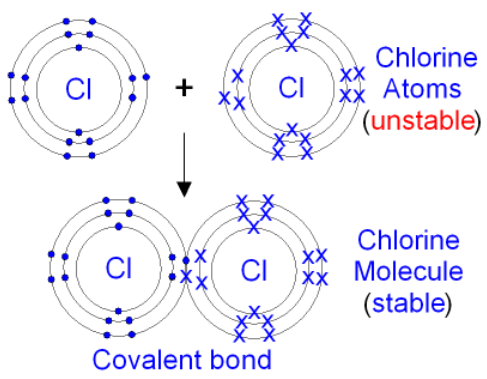
Covalent Bond
Bond formed by sharing of electrons between the two atoms. They share their valence electrons to gain stability.
Properties of Ionic Compounds
They are generally hard and solid.
They have a high melting and boiling point.
They are soluble in water but insoluble in inorganic solvents such as ether etc.
They are conductors of electricity in molten and solution state.
Occurrence of Metals
Elements or compounds which occur naturally in earth crust are known as Minerals. Minerals from which pure metals can be extracted are known as Mineral Ores.
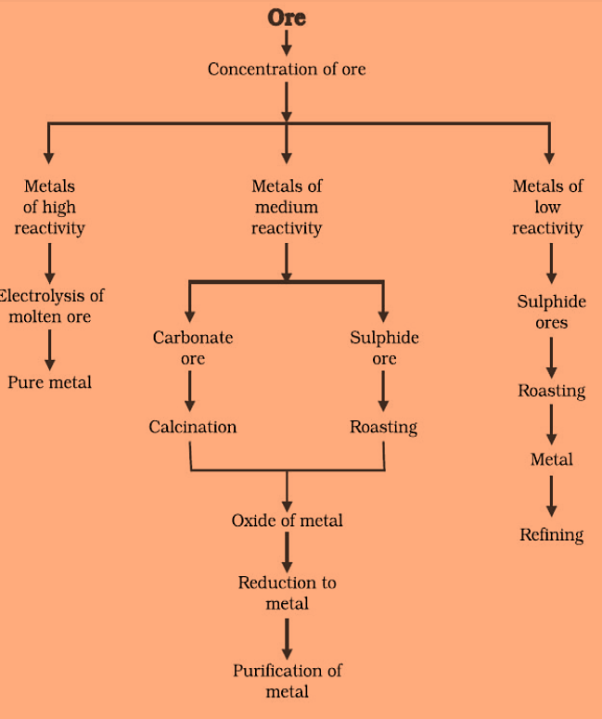
Extraction of pure metals from its ores/steps for extraction of metals from its ore
The first step is enrichment of the ore.
Second step includes extraction of metals
Third steps involve refining of metal
Gangue – Ores contain different impurities in it such as sand, soil etc. These impurities are known as Gangue.
Extracting Metals which are low in activity series
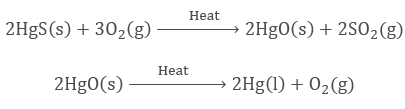
Metals which are low in activity series are unreactive. The oxides of such metals can be reduced to metals by heating alone. For Example, Cinnabar (HgS)
Extracting Metals in the middle of the Activity Series
These metals are moderately reactive. They exists as sulphides or carbonates in nature. Before reduction, metal sulphides and carbonates must be converted into metal oxides. Sulphide ores are converted into oxides by heating strongly in presence of excess air, this is known as Roasting. Carbonate ores are converted into oxides by heating in limited air. This is known as Calcination.
Roasting
Calcination
Reduction-metal oxides can be reduced to metals using reducing agent such as such as Carbon.
Extracting metals towards the top of the activity series
The metals are highly reactive. They cannot be obtained by heating. For Example, Sodium, magnesium and calcium are obtained by the electrolysis of their molten chlorides.
At cathode Na+ + e– → Na
At anode 2Cl– → Cl2 + 2e–
Refining of Metals
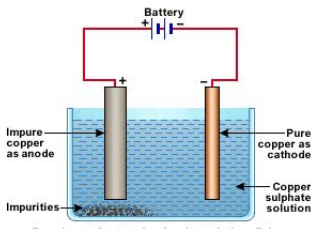
Refining of impure metal is done using electrolytic refining. Impure copper is used as anode and strip of pure copper is used as Cathode. Acidified copper sulphate is used as electrolyte. When electric current is passed through this, impure metal from the anode gets deposited in the electrolyte solution, whereas pure metal from the electrolyte is deposited at cathode.
Deposition of insoluble residue formed from the dissolution of anode during commercial electrolysis.
Electrolytic refining
Corrosion
Metals when exposed to moist air for a long period of time, they become corroded. This is known as Corrosion. For Example, Silver reacts with moist air and becomes black in colour due to silver sulphide coating.
Iron + oxygen → Iron (III) oxide
Fe + O 2 → Fe2O3
Prevention of Corrosion
Rusting of iron can be prevented by oiling, galvanising, painting, greasing etc.
To protect steel and iron from rusting, a thin layer of zinc is coated on them, this is known as Galvanization.
Alloy
Mixture of two or more metals or metal and non-metal is known as Alloy. For Example,
Mind Map Overal Idea Content Speed Notes Quick Coverage Content : (Scroll down till end of the page) Study Tools Audio, Visual & Digital Content Content … Key Terms Topic Terminology Term Important Tables Table: . Assessments Test Your Learning readmore