Testing Chapter
Level: Class | Subject
Class Level Content Of A Subject
Introduction to Graphs | Assess
Assessment Tools
Assign | Assess | Analyse
Quick Quiz
Objective Assessment
Question Bank
List Of Questions With Key, Aswers & Solutions
Back To Learn
Re – Learn
Go Back To Learn Again
NUMBER SYSTEMS | Study
Mind Map Overal Idea Content Speed Notes Quick Coverage Introduction to Natural Numbers Non-negative counting numbers excluding zero are called Natural Numbers. N = 1, 2, 3, 4, 5, ………. Whole Numbers All natural numbers including zero are called Whole Numbers. W = 0, 1, 2, 3, 4, 5, ……………. (Scroll down till end of… readmore
Mind Map
Overal Idea
Content
Speed Notes
Quick Coverage
Introduction to Natural Numbers
Non-negative counting numbers excluding zero are called Natural Numbers.
N = 1, 2, 3, 4, 5, ……….
Whole Numbers
All natural numbers including zero are called Whole Numbers.
W = 0, 1, 2, 3, 4, 5, ……………. (Scroll down till end of the page)
Study Tools
Audio, Visual & Digital Content
Integers
All natural numbers, negative numbers and 0, together are called Integers.
Z = – 3, – 2, – 1, 0, 1, 2, 3, 4, …………..
Rational Numbers
The number ‘a’ is called Rational if it can be written in the form of r/s where ‘r’ and ‘s’ are integers and s ≠ 0,
Q = 2/3, 3/5, etc. all are rational numbers.
How to find a rational number between two given numbers?
To find the rational number between two given numbers ‘a’ and ‘b’.

Example:
Find 2 rational numbers between 4 and 5.
Solution:
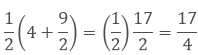
To find the rational number between 4 and 5
To find another number we will follow the same process again.
Hence the two rational numbers between 4 and 5 are 9/2 and 17/4.
Remark: There could be unlimited rational numbers between any two rational numbers.
Irrational Numbers
The number ‘a’ which cannot be written in the form of p/q is called irrational, where p and q are integers and q ≠ 0 or you can say that the numbers which are not rational are called Irrational Numbers.
Example – √7, √11 etc.
Real Numbers
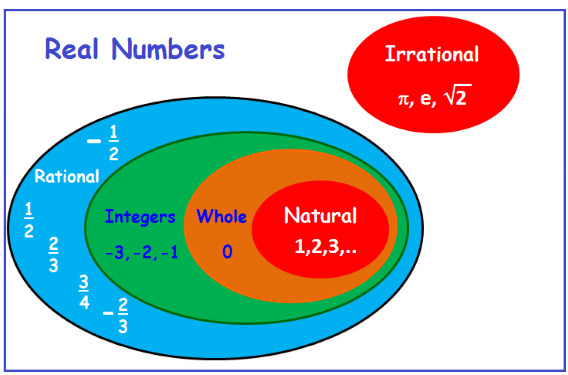
All numbers including both rational and irrational numbers are called Real Numbers.
R = – 2, – (2/3), 0, 3 and √2
Real Numbers and their Decimal Expansions
1. Rational Numbers
If the rational number is in the form of a/b then by dividing a by b we can get two situations.
a. If the remainder becomes zero
While dividing if we get zero as the remainder after some steps then the decimal expansion of such a number is called terminating.
Example:
7/8 = 0.875
b. If the remainder does not become zero
While dividing if the decimal expansion continues and not becomes zero then it is called non-terminating or repeating expansion.
Example:
1/3 = 0.3333….
Hence, the decimal expansion of rational numbers could be terminating or non-terminating recurring and vice-versa.
2. Irrational Numbers
If we do the decimal expansion of an irrational number then it would be non –terminating non-recurring and vice-versa. i. e. the remainder does not become zero and also not repeated.
Example:
π = 3.141592653589793238……
Representing Real Numbers on the Number Line
To represent the real numbers on the number line we use the process of successive magnification in which we visualise the numbers through a magnifying glass on the number line.
Example:
Step 1: The number lies between 4 and 5, so we divide it into 10 equal parts. Now for the first decimal place, we will mark the number between 4.2 and 4.3.
Step 2: Now we will divide it into 10 equal parts again. The second decimal place will be between 4.26 and 4.27.
Step 3: Now we will again divide it into 10 equal parts. The third decimal place will be between 4.262 and 4.263.
Step 4: By doing the same process again we will mark the point at 4.2626.
Operations on Real Numbers
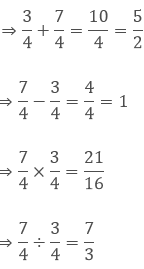
1. The sum, difference, product and quotient of two rational numbers will be rational.
Example:
2. If we add or subtract a rational number with an irrational number then the outcome will be irrational.
Example:
If 5 is a rational number and √7 is an irrational number then 5 + √7 and 5 – √7 are irrational numbers.
3. If we multiply or divide a non-zero rational number with an irrational number then also the outcome will be irrational.
Example:
If 7 is a rational number and √5 is an irrational number then 7√7 and 7/√5 are irrational numbers.
4. The sum, difference, product and quotient of two irrational numbers could be rational or irrational.
Example:
Finding Roots of a Positive Real Number ‘x’ geometrically and mark it on the Number Line
To find √x geometrically
1. First of all, mark the distance x unit from point A on the line so that AB = x unit.
2. From B mark a point C with the distance of 1 unit, so that BC = 1 unit.
3. Take the midpoint of AC and mark it as O. Then take OC as the radius and draw a semicircle.
4. From the point B draw a perpendicular BD which intersects the semicircle at point D.
The length of BD = √x.
To mark the position of √x on the number line, we will take AC as the number line, with B as zero. So C is point 1 on the number line.
Now we will take B as the centre and BD as the radius, and draw the arc on the number line at point E.
Now E is √x on the number line.
Identities Related to Square Roots
If p and q are two positive real numbers
Examples:
1. Simplify

We will use the identity
2. Simplify

We will use the identity
Rationalising the Denominator
Rationalize the denominator means to convert the denominator containing square root term into a rational number by finding the equivalent fraction of the given fraction.
For which we can use the identities of the real numbers.
Example:
Rationalise the denominator of 7/(7- √3).
Solution:
We will use the identity
 here.
here.Laws of Exponents for Real Numbers
If we have a and b as the base and m and n as the exponents, then
1. am × an =am+n
2. (am)n = amn
4. am bm = (ab)m
5. a0 = 1
6. a1 = a
7. 1/an = a-n
- Let a > 0 be a real number and n a positive integer.
- Let a > 0 be a real number. Let m and n be integers such that m and n have no common factors other than 1, and n > 0. Then,
Example:
Simplify the expression (2x3y4) (3xy5)2.
Solution:
Here we will use the law of exponents
am × an =am+n and (am)n = amn
(2x3y4)(3xy5)2
(2x3y4)(3 2 x 2 y10)
18. x3. x2. y4. y10
18. x3+2. y4+10
18x5y14
Hindi Version Key Terms
Topic Terminology
Term
Important Tables
Table:
.
Assessments
Test Your Learning

Advanced Tools For Study Assess Interact Our Environment | Assess
Assessment Tools
Assign | Assess | Analyse
Quick Quiz
Objective Assessment
Question Bank
List Of Questions With Key, Aswers & Solutions
Back To Learn
Re – Learn
Go Back To Learn Again
The Other Side of Zero | Study
Mind Map Overal Idea Content Speed Notes Quick Coverage Content : (Scroll down till end of the page) Study Tools Audio, Visual & Digital Content Content … Key Terms Topic Terminology Term Important Tables Table: . Assessments Test Your Learning readmore
Mind Map
Overal Idea
Content
Speed Notes
Quick Coverage
Content : (Scroll down till end of the page)
Study Tools
Audio, Visual & Digital Content
Content …
Key Terms
Topic Terminology
Term
Important Tables
Table:
.
Assessments
Test Your Learning
Advanced Tools For Study Assess Interact Visualising Solid Shapes | Study
Mind Map Overal Idea Content Speed Notes Quick Coverage The circle, thesquare, the rectangle, the quadrilateral and the triangle are examples of plane figures; the cube, the cuboid, the sphere, the cylinder, the cone and the pyramid areexamples of solid shapes. (Scroll down till end of the page) Study Tools Audio, Visual & Digital Content… readmore
Mind Map
Overal Idea
Content
Speed Notes
Quick Coverage
The circle, thesquare, the rectangle, the quadrilateral and the triangle are examples of plane figures; the cube, the cuboid, the sphere, the cylinder, the cone and the pyramid areexamples of solid shapes. (Scroll down till end of the page)
Study Tools
Audio, Visual & Digital Content
Plane figures areof two-dimensions (2-D) and the solid shapes are of three- dimensions (3-D). The corners of a solid shape are called its vertices; theline segments ofits skeleton areits edges; and itsflat surfaces areits faces. A net is a skeleton-outline of a solid that can be folded to make it. The same solid can haveseveral types ofnets. Solid shapes can be drawn on a flat surface (like paper) realistically. We call this 2-D representation of a 3-Dsolid. Two types ofsketches of asolid are possible: (a) An oblique sketch does nothave proportional lengths. Still it conveys all important aspects of the appearance of the solid. (b) An isometric sketch is drawn on an isometric dot paper, a sample of which isgiven at theend of thisbook. In an isometric sketch of the solidthe measurements kept proportional. Visualising solidshapesis a veryuseful skill. Youshould be ableto see ‘hidden’ parts of thesolid shape. Different sections of a solid can be viewed in many ways: (a) One way is to viewby cutting or slicing the shape, whichwould result in the cross- section of thesolid. (b) Another way isby observing a 2-D shadow of a 3-Dshape. (c) A third wayis to lookat the shapefrom different angles; the front-view, theside- view and thetop view canprovide a lotof information aboutthe shape observed.
19. When a grouping symbol preceded by ‘ sign is removed or inserted, thenthe sign of eachterm of thecorresponding expression ischanged (from ‘ + ‘ to ‘−’ and from‘− ‘ to + ‘).
Hindi Version Key Terms
Topic Terminology
Term
Important Tables
Table:
.
Assessments
Test Your Learning
Advanced Tools For Study Assess Interact Wastewater Story | Assess
Assessment Tools
Assign | Assess | Analyse
Quick Quiz
Objective Assessment
Question Bank
List Of Questions With Key, Aswers & Solutions
Back To Learn
Re – Learn
Go Back To Learn Again










 here.
here.