Assessment Tools
Assign | Assess | Analyse
Quick Quiz
Objective Assessment
Question Bank
List Of Questions With Key, Aswers & Solutions
Back To Learn
Re – Learn
Go Back To Learn Again
Board Level
Assign | Assess | Analyse
Objective Assessment
List Of Questions With Key, Aswers & Solutions
Back To Learn
Go Back To Learn Again
Mind Map Overal Idea Content Speed Notes Quick Coverage Content : (Scroll down till end of the page) Study Tools Audio, Visual & Digital Content Speed Notes Notes For Quick Recap Study Tools Audio, Visual & Digital Content Pre-Requisites Circle: Circle is a round shaped figure has no corners or edges. A circle is the readmore
Overal Idea
Content
Quick Coverage
Content : (Scroll down till end of the page)
Audio, Visual & Digital Content
Notes For Quick Recap
Audio, Visual & Digital Content

Circle:
Circle is a round shaped figure has no corners or edges.
A circle is the locus of all points in a plane which are at constant distance
(called radius) from a fixed point (called centre). A circle with centre O and radius r is denoted by C (O, r).
Radius:
A line segement that joins the centre and circumference or boundary of the circles is called the radius of the circles.
A line segement that divides the circle into two halves is called he diameter of the circle.
Diameter = 2x radius
Radius = Diameter/2
Chord:
A line segment joining any two points on a circle. The largest chord of a circle is a diameter.
Position of A point With Respect To a Circle:
In a plane a point P can lie either inside, or on the circle or outside the given circle.
Position of A Line With Respect to A Circle
If a circle C(O, r) and a straight line ‘l’ are in the same plane, then only three possibilities are there. These are :
Outside The Circle:
(i) The line ‘l’ does not intersect the circle at all. The line ‘l’ is called a non-intersecting line with respect to the circle.
Inside of the Circle – Secant To A Circle:
The line ‘ l ‘ intersects the circle in two distinct points say A and B. The line which intersects the circle in two distinct points is called a secant line.
Touching The Circle – Tangent To Circle:
A tangent to a circle is a special case of the secant when the two end points of the corresponding chord are coincide.
That is the line ‘ l ‘ touches the circle in only one point. Such a line which touches the circle only in one point is called a tangent line.
Tangent To Circle :
Etimology of Tangent:
The word ‘tangent’ comes from the Latin word ‘tangere’, which means to touch and was introduced by the Danish mathematician Thomas Fincke in 1583.
Tangent is a line that intersects the circle in exactly one point.
A tangent to a circle is the limiting position of a secant when its two points of intersection with the circle coincide.
The common point of the circle and the tangent is called the point of contact.
In other words the point, at which the tangent touches the circle is called
the point of contact.
Number of Tangents From A Point To Circle:
Number of tangents to a circle from a point (say P) depends upon the position of the point P.
(a)
When point ‘P’ lies outside the circle: There are only two lines, which touch the circle in one point only, all the remaining lines either intersect in two points or do not intersect the, circle. Hence, there are only two tangents from point P to the circle.
(b)
When point ‘ P ‘ lies on the circle : There is only one line which touches the circle in one point, all other lines meet the circle in more than one point. Hence, there is one and only one tangent to the circle through the point P lies on the circle.
(c)
When point ‘ P ‘ lies inside the circle: Every line passing through the point P (lies inside the circle) intersect the circle in two points. Hence, there is no tangent through the point P lies inside the circle
There is only one tangent at a point on the circumference of the circle.
Point of contact is the common point of the tangent and the circle.
The tangent at any point of a circle is perpendicular to the radius through the point of
contact.
Theorems :
(i) Tangent-Radius Theorem
The line perpendicular to the tangent and passing through the point of contact, is known as the normal.
Statement: The tangent at any point of a circle is perpendicular to the radius through the point of contact.
The converse of above theorem is also true.
Theorem :
The tangents at any point of a circle is perpendicular to the radius through the point of contact. Or At the point of contact the angle between radius and tangents to a circle is 90^0 .
Theorem :
The length of tangents drawn from an external point to a circle are equal.
Important Results:
If two circles touch internally or externally, the point of contact lies on the straight line through the two centres.
The tangent at any point of a circle is perpendicular to the radius through the point of contact.
The length of the tangents drawn from an external point to a circle are equal.
PT =PT’ =
The distances between two parallel tangents drawn to a circle is equal to the diameter of the circle.
Facts:
In two concentric circles, the chord of the larger circle, which touches the smaller circle, is bisected at the point of contact.
More Points To Remember !
There is no tangent to a circle passing through a point lying inside the circle.
At any point on the circle there can be one and only one tangent.
The tangent at any point of a circle is perpendicular to the radius through the point of contact.
There are exactly two tangents to a circle through a point outside the circle.
The length of the segment of the tangent from the external point P and the point of contact with the circle is called the length of the tangent.
The lengths of the tangents drawn from an external point to a circle are equal.
The line containing the radius through the point of contact of tangent is called the normal to the circle at the point.
There is no tangent to the circle passing through a point lying inside the cirele.
There are exactly two tangents to a cirele through a point lying outside the circle
The length of the segment of the tangent from the external point and the point of contact
with the circle is called the length of the tangent.
The length of tangents drawn from an external point to a circle are equal.
Topic Terminology
Term
Table:
.
Test Your Learning

Assign | Assess | Analyse
Objective Assessment
List Of Questions With Key, Aswers & Solutions
Back To Learn
Go Back To Learn Again
Mind Map Overal Idea Content Speed Notes Quick Coverage Flow of electrons through a conductor. It is convenient to represent electric components by symbols. Using these, an electric circuit can be represented by a circuit diagram. When an electric current flows through a wire, the wire gets heated. It is the heating effect of current. readmore
Overal Idea
Content
Quick Coverage
Flow of electrons through a conductor.
It is convenient to represent electric components by symbols.
Using these, an electric circuit can be represented by a circuit diagram.
When an electric current flows through a wire, the wire gets heated.
It is the heating effect of current. This effect has many applications. (Scroll down till end of the page)
Audio, Visual & Digital Content
Wires made from some special materials melt quickly and break when large electric currents are passed through them.
These materials are used for making electric fuses which prevent fires and damage to electric appliances.
When an electric current flows through a wire, it behaves like a magnet.
Electric Circuit: A complete pathway of the flow of electric current.
Component of Electric Circuit: Component of electric circuit are following :
Cell: Provides energy for the current to flow.
Bulb: Lights ups when an electric current flows through it.
Switch: Keeps the circuit off or on.
Connecting wires: Help to conduct the electric current and complete the circuit.
1.Heating Effect: The wire gets hot when an electric current passes through it.
This is the heating effect of the electric current.
Electric heater contains a coil of wire called element which becomes red hot when current passes through it.
The amount of heat produced in a wire depends on its material, length and thickness.
Fuse: It is a safety device which prevents damage to electric circuit.
It is made by inserting a short wire into porcelain or insulating material.
MCB: Stands for Miniature Circuit Breakers. These are switches which automatically turn off when current in a circuit exceeds the safe limit.
Effects of Electric Current:
Electric Current and its Effects
2. Magnetic Effect: When electric current passes through a wire, it behaves like a magnet. This is the magnetic effect of the electric current. This was first observed by Hans Christian Oersted.
A current carrying coil of an insulated wire wrapped around a piece of iron is called an electromagnet.
Electromagnet: An electromagnet is a coil of wire wound on a soft iron core, used to separate magnetic material from the junk. Doctors use tiny electromagnets to take out small pieces of magnetic material that have accidentally fallen in the eye.
Many toys also have electromagnets inside them.
Topic Terminology
Term
Table:
.
Test Your Learning
Mind Map Overal Idea Content Speed Notes Quick Coverage Numbers with exponents obey the following laws of exponents. Very small numbers can be expressed in standard form using negative exponents. (Scroll down till end of the page) Study Tools Audio, Visual & Digital Content Use of Exponents to Express Small Number in Standard form: (iii) readmore
Overal Idea
Content
Quick Coverage
Numbers with exponents obey the following laws of exponents.
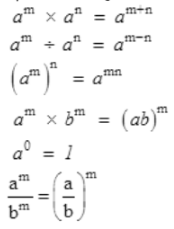
Very small numbers can be expressed in standard form using negative exponents. (Scroll down till end of the page)
Audio, Visual & Digital Content
Use of Exponents to Express Small Number in Standard form:
(iii) A number written as number such that is said to be in standard form if m is a decimal and n is either a positive or a negative integer.
Examples: 150,000,000,000 = 1.5 x 10¹¹.
Exponential notation is a powerful way to express repeated multiplication of the same number.
For any non-zero rational number ‘a’ and a natural number n, the product a x a x a x x a(n times) = an.
It is known as the nth power of ‘a’ and is read as ‘a’ raised to the power n’.
The rational number a is called the base and n is called exponent.
Topic Terminology
Term
Table:
.
Test Your Learning
Mind Map Overal Idea Content Speed Notes Quick Coverage Force : Push or pull is called Force. Example: We push or pull to open a door. (Scroll down till end of the page) Study Tools Audio, Visual & Digital Content Effects of Force Net or Resultant Force: Resultant Force or Net Force acts on a readmore
Overal Idea
Content
Quick Coverage
Force : Push or pull is called Force.
Example:
We push or pull to open a door. (Scroll down till end of the page)
Audio, Visual & Digital Content
Effects of Force
Net or Resultant Force:
Resultant Force or Net Force acts on a body if two or more forces act on it at the same time. Resultant Force or Net Force on a body is defined as the net effective force due to the multiple forces acting on it simultaneously.
Based on Net force, Forces are classified into two types as:
(A) Balanced forces
(B) Unbalanced forces
(A) Balanced Forces
• If the resultant of applied forces is equal to zero, the forces are called balanced forces.
• Balanced forces do not cause any change in state of an object.
• Balanced forces can change the shape and size of an object.
For example, when forces are applied from both sides over a balloon, the size and shape of the balloon is changed.
(B) Unbalanced Forces
• If the resultant of applied forces are greater than zero, the forces are called unbalanced forces.
• Unbalanced forces can do the following :
* Move a stationary object
* Increase the speed of a moving object
* Decrease the speed of a moving object
* Stop a moving object
* Change the shape and size of an object
Laws of Motion :
Galileo Galilei :
Galileo Galilei was the first to say that objects move with a constant speed when no forces act on them.
That is, if there is no unbalanced force acting on the object, the object moves forever with a constant speed without changing its direction.
In other words, if an object is moving on a frictionless path and no other force is acting upon it, the object moves forever with a constant speed without changing its direction.
Galileo’s Experiment:
Galileo’s thought experiment considered rolling balls on inclined planes in the absence of friction or other resistant forces.
Galileo arranged two inclined planes opposite to each other as shown.
He rolls down the ball from the first inclined plane to climb the second inclined plane.
Galileo observations:
Galileo observed that:
From these observations, Galileo hypothesized as:
This is the case when there is no unbalanced force acting on it.
From his experiments Galileo proposed that the body could travel indefinitely far as , contrary to the Aristotelian notion of the natural tendency of an object to remain at rest unless acted upon by an external force.
Therefore, Galileo can be credited with introducing the concept of inertia, later exploited by Newton.
However, in reality, frictional forces bring the sphere to rest after it travels over a finite distance.
After further study, Newton, in his first law of motion, stated that all objects resist a change in their natural state of motion.
This tendency of resisting any change in the natural state of motion is called “inertia”.
Newton’s Laws of Motion:
Newton studied the ideas of Galileo and gave the three laws of motion. These laws are popular as Newton’s laws of motion.
Newton’s First Law of Motion (Law of Inertia):
Any object remains in the state of rest or in the state of uniform motion along a straight line, until it is compelled to change its state by applying an external force.
Newton’s First Law of Motion in Everyday Life:
(a) A person standing in a bus falls backward when the bus starts suddenly.
This happens because the person and bus both are at rest while the bus is not moving, but as the bus starts moving, an external force is acted by the bus on the legs of the person. This external force moves legs along with the bus. But the rest of his body has the tendency to remain in rest known as inertia of rest. Because of this, the person falls backward; if he is not alert.
(b) A person standing in a moving bus falls forward if the driver applies brakes suddenly. This happens because when the bus is moving, the person standing in it is also in motion along with the bus. But when the driver applies brakes the speed of the bus decreases suddenly or the bus comes to a state of rest suddenly, in this condition the legs of the person which are in contact with the bus come to rest while the rest of his body have the tendency to remain in motion. Because this person falls forward if he is not alert.
(c) Before hanging the wet clothes over the laundry line, usually many jerks are given to the clothes to get them dried quickly. Because of jerks, droplets of water from the pores of the cloth fall on the ground and the reduced amount of water
in clothes dries them quickly. This happens because when suddenly clothes are made in motion by giving jerks, the water droplets in it have the tendency to remain in rest and they are separated from clothes and fall on the ground.
(d) When the pile of coins on the carrom-board is hit by a striker, the coin only at the bottom moves away leaving the rest of the pile of coins at the same place. This happens because when the pile is struck with a striker, the coin at
the bottom comes in motion while rest of the coin in the pile has the tendency to remain in the rest and they vertically falls the carrom-board
and remain at the same place.
Momentum
Momentum of an object at state of rest is zero :
Let an object with mass ‘m’ be at rest.
Since, object is at rest, its velocity, v = 0
We know that
Momentum, p is equal to the product of mass, m and velocity, v = 0
⇒ p = m × 0 = 0
Thus, the momentum of an object in the rest i.e., non-moving, is equal to zero.
Unit of momentum :
SI unit of mass = kg
SI unit of velocity = meter per second i.e., m/s
We know that Momentum (p) = m × v
⇒ p = kg × m/s
Or ⇒ p = kg m/s
Therefore, SI unit of momentum = kg m/s
Impulse and Impulsive Force
If a cricketer catches a ball he moves his hand back while catching the ball. He does this to reduce the impact, due to the force of the ball on his hand. An object in motion has momentum. Momentum is defined as the product of mass and velocity of an object.
The momentum of the object at the starting of the time interval is called the initial momentum and the momentum of the object at the end of the time interval is called the final momentum. The rate of change of momentum of an object is directly proportional to the applied force.
Newton’s second law quantifies the force on an object. The magnitude of force is given by the equation,
F = ma, where ‘m’ is the mass of the object and ‘a’ is its acceleration. The CGS unit of force is dyne and the SI unit is newton (N).
A large amount of force acting on an object for a short interval of time is called impulse or impulsive force. Numerically impulse is the product of force and time. Impulse of an object is equal to the change in momentum of the object.
Impulse and Impulsive Force
The momentum of an object is the product of its mass and velocity. The force acting on a body causes a change in its momentum. In fact, according to Newton’s second law of motion, the rate of change in the momentum of a body is equal to the net external force acting on it.
Another useful quantity that we come across is “impulse”. “Impulse” is the product of the net external force acting on a body and the time for which the force is acted.
If a force “F” acts on a body for “t” seconds, then Impulse I = Ft.
In fact, this is also equal to the change in the momentum of the body. It means that due to the application of force, if the momentum of a body changes from “P” to “P ‘ ”, then impulse,I = P ‘ – P.
For the same change in momentum, a small force can be made to act for a long period of time, or a large force can be made to act for a short period of time. A fielder in a cricket match uses the first method while catching the ball. He pulls his hand down along with the ball to decrease the impact of the ball on his hands.
In a cricket match, when a batsman hits a ball for a six, he applies a large force on the ball for a very short duration. Such large forces acting for a short time and producing a definite change in momentum are called “impulsive forces”.
Newton’s Second Law of Motion
Newton’s Second Law of Motion states that, the rate of change in momentum of an object is proportional to applied unbalanced force in the direction of force.
Mathematical expression:
State and derive newton’s second law of Motion
Statement: Newton’s second law of motion states that the rate of change of momentum of an object is Proportional to the applied unbalanced force in the direction of force.
Derivation of Newton’s second law of motion:
Suppose an object of mass, m is moving along a straight line with an initial velocity, u.
It is uniformly accelerated to velocity, v in time, t by the application of a constant force, F throughout the time t.
⇒Initial momentum of the object, p1 = mu
⇒Final momentum, p2 = mv
⇒Change in momentum = p2 – p1
⇒The change in momentum = mv – mu
⇒The change in momentum = m × (v – u)
⇒The rate of change of momentum = m(v -u)t
⇒ m (v -u)t
According to Newton’s Second Law of Motion,
Applied force α Rate of change in motion
⇒ F m (v -u)t
F=km (v -u)t = kma —————————- (i)
Here, k is a constant of proportionality and
(v -u)t is the rate of change of velocity, which equals acceleration, a.
The SI units of mass and acceleration are kg and m s-2 respectively.
The unit of force is so chosen that the value of the constant, K becomes one For this.
One unit of force is defined as the amount that produces acceleration
of 1 m s-2 in an object of 1 kg mass.
That is,
1 unit of force = k × (1 kg) × (1 m s-2).
Thus, the value of k becomes 1. From Eq. (iii)
F = ma ————————————-
The unit of force is kg m s-2 or newton, with the symbol N.
Newton’s Third Law of Motion
To every action there is an equal and opposite reaction.
Applications:
(i) Walking is enabled by 3rd law.
(ii) A boat moves back when we deboard it.
(iii) A gun recoils.
Law of Conservation of Momentum
Law of conservation of momentum states that, if two or more bodies collide, the sum of the initial momentum is equal to the sum of the final momentum.
Or
Law of conservation of momentum states that the sum (total) of the individual momentums of the colliding bodies just before the collision is equal to the sum (total) of the individual momentums of the colliding bodies after the collision
Derivation of Law of Conservation of Momentum From Newton’s Third Law of Motion.
Answer:

For a system of bodies ( two or more bodies ), the total vector sum of momenta of all the bodies due to the mutual action and reaction remain unchanged as long as no external force is acted on the system.
Consider two bodies A and B of the masses m1, m2 moving with the initial velocities u1, u2 respectively.
For a system, let, these masses collide and their velocities after collision are v1, v2 respectively.
If ‘A’ applies a F on B for a time, t;
‘B’ applies a force –F on A for time t [according to Newton’s third law of motion].
Then,
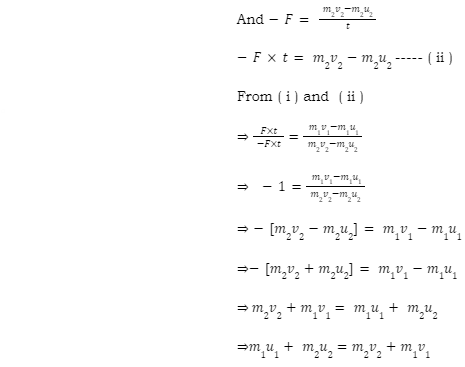
Therefore, the sum of momentum before impact is equal to the sum of the momenta after the impact represents the law of conservation of momentum.
Topic Terminology
Term
Table:
.
Test Your Learning
Assign | Assess | Analyse
Objective Assessment
List Of Questions With Key, Aswers & Solutions
Back To Learn
Go Back To Learn Again
Mind Map Overal Idea Content Speed Notes Quick Coverage What havewe discussed? A fraction is a number representing a partof a whole. The whole maybe a single object or agroup of objects. (Scroll down till end of the page) Study Tools Audio, Visual & Digital Content Whenexpressing a situation of counting partsto write a fraction, readmore
Overal Idea
Content
Quick Coverage
What havewe discussed? A fraction is a number representing a partof a whole. The whole maybe a single object or agroup of objects. (Scroll down till end of the page)
Audio, Visual & Digital Content
Whenexpressing a situation of counting partsto write a fraction, itmust be ensured that allparts are equal.
In5/7, 5 iscalled the numerator and 7 iscalled the denominator.
Fractions can beshown on a number line.
Every fraction has a point associated with it onthe number line.
In a proper fraction, the numerator is less than the denominator.
Thefractions, where the numerator is greater than the denominator are called improper fractions.
An improper fraction can be written as a combination of a whole and a part, and such fraction then called mixed fractions.
Each proper or improper fraction has many equivalent fractions.
To find an equivalent fraction of a given fraction, we may multiply or divide boththe numerator andthe denominator ofthe given fraction by the samenumber.
A fraction issaid to bein the simplest (or lowest) formif its numerator and the denominator haveno common factor except 1.
Topic Terminology
Term
Table:
.
Test Your Learning
Assign | Assess | Analyse
Objective Assessment
List Of Questions With Key, Aswers & Solutions
Back To Learn
Go Back To Learn Again