
Assessment Tools
Assign | Assess | Analyse
Quick Quiz
Objective Assessment
Question Bank
List Of Questions With Key, Aswers & Solutions
Back To Learn
Re – Learn
Go Back To Learn Again
Board Level
Assign | Assess | Analyse
Objective Assessment
List Of Questions With Key, Aswers & Solutions
Back To Learn
Go Back To Learn Again
Assign | Assess | Analyse
Objective Assessment
List Of Questions With Key, Aswers & Solutions
Back To Learn
Go Back To Learn Again
Mind Map Overal Idea Content Speed Notes Quick Coverage Perimeter is the distance around a closed figure whereasarea is the part of plane occupied by the closedfigure. Area is the measure of the part of plane or regionenclosed by it. (Scroll down till end of the page) Study Tools Audio, Visual & Digital Content We… readmore
Overal Idea
Content
Quick Coverage
Perimeter is the distance around a closed figure whereasarea is the part of plane occupied by the closedfigure.
Area is the measure of the part of plane or regionenclosed by it. (Scroll down till end of the page)
Audio, Visual & Digital Content
We have learnt how to find perimeter and area of a squareand rectangle earlierclass.
They are:
(a) Perimeter of a square = 4 × side
(b) Perimeter of a rectangle = 2 × (length + breadth)
(c) Area of a square = side × side
(d) Area of a rectangle = length × breadth Areaof a parallelogram = base × height

Topic Terminology
Term
Table:
.
Test Your Learning

Mind Map Overal Idea Content Speed Notes Quick Coverage Content : (Scroll down till end of the page) Study Tools Audio, Visual & Digital Content Content … Key Terms Topic Terminology Term Important Tables Table: . Assessments Test Your Learning readmore
Overal Idea
Content
Quick Coverage
Content : (Scroll down till end of the page)
Audio, Visual & Digital Content
Content …
Topic Terminology
Term
Table:
.
Test Your Learning
Assign | Assess | Analyse
Objective Assessment
List Of Questions With Key, Aswers & Solutions
Back To Learn
Go Back To Learn Again
Assign | Assess | Analyse
Objective Assessment
List Of Questions With Key, Aswers & Solutions
Back To Learn
Go Back To Learn Again
Assign | Assess | Analyse
Objective Assessment
List Of Questions With Key, Aswers & Solutions
Back To Learn
Go Back To Learn Again
Mind Map Overal Idea Content Speed Notes Quick Coverage One of the main applications of trigonometry is to find the distance between two or more than two places or to find the height of the object or the angle subtended by any object at a given point without actually measuring the distance or heights or… readmore
Overal Idea
Content
Quick Coverage
One of the main applications of trigonometry is to find the distance between two or more than two places or to find the height of the object or the angle subtended by any object at a given point without actually measuring the distance or heights or angles. (Scroll down till end of the page)
Audio, Visual & Digital Content
One of the main applications of trigonometry is to find the distance between two or more than two places or to find the height of the object or the angle subtended by any object at a given point without actually measuring the distance or heights or angles.
Trigonometry is useful to astronomers, navigators, architects and surveyors etc. in solving problems related to heights and distances.
The directions of the objects can be described by measuring :
(i) angle of elevation and (ii) angle of depression
Angles of elevation or angles of depression of the objects are measured by an instrument called The odolite.
The odolite is based on the principles of trigonometry, which is used for measuring angles with a rotating telescope.
In 1856, Sir George Everest first used the giant theodolite, which is now on display in the Museum of the survey of India in Dehradun.
Angle of Elevation:
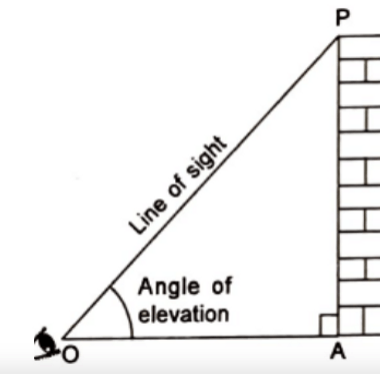
Let P be the position of the object above the horizontal line OA and O be the eye of the observer, then angle AOP is called angle of elevation. It is called the angle of elevation, because the observer has to elevate (raise) his line of sight from the horizontal OA to see the object P. [ When the eye turns upwards above the horizontal line.]
Angle of Depression:
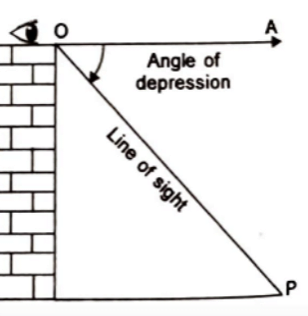
Let P be the position of the object below the horizontal line OA and O be the eye of the observer, then angle AOP is called angle of depression.
It is called the angle of depression because the observer has to depress (lower) his line of sight from the horizontal OA to see the object P.
[When the eye turns downwards below the horizontal line].
Topic Terminology
Term
Table:
.
Test Your Learning
Mind Map Overal Idea Content Speed Notes Quick Coverage Content : (Scroll down till end of the page) Study Tools Audio, Visual & Digital Content Content … Key Terms Topic Terminology Term Important Tables Table: . Assessments Test Your Learning readmore
Overal Idea
Content
Quick Coverage
Content : (Scroll down till end of the page)
Audio, Visual & Digital Content
Content …
Topic Terminology
Term
Table:
.
Test Your Learning
Mind Map Overal Idea Content Speed Notes Quick Coverage Content : (Scroll down till end of the page) Study Tools Audio, Visual & Digital Content Content … Key Terms Topic Terminology Term Important Tables Table: . Assessments Test Your Learning readmore
Overal Idea
Content
Quick Coverage
Content : (Scroll down till end of the page)
Audio, Visual & Digital Content
Content …
Topic Terminology
Term
Table:
.
Test Your Learning