Mind Map Overal Idea Content Speed Notes Quick Coverage Are plants and Animals made of same types of tissues?Plants are stationary, and hence are provided with some tissues made up of dead cells, which provide mechanical strength. They have to withstand unfavourable conditions like strong winds, storms, floods etc. Animals on other hand move around… readmore
Mind Map
Overal Idea
Content
Speed Notes
Quick Coverage
Are plants and Animals made of same types of tissues?
Plants are stationary, and hence are provided with some tissues made up of dead cells, which provide mechanical strength. They have to withstand unfavourable conditions like strong winds, storms, floods etc. Animals on other hand move around in search of food, mates, shelter. (Scroll down till end of the page)
Study Tools
Audio, Visual & Digital Content
They consume more energy as compared to plants. Most of the tissues they contain are living.
Cell growth in animas is more uniform.
The structural organisation of organs and organ systems is far more specialized and localised in complex animals than even in very complex plants.
Plant tissues:
Meristematic Tissue: The growth of plants occurs only in certain specific regions. This is because the dividing tissue
also known as meristematic tissue is the region where they are present, meristematic tissues are classified as apical, lateral and intercalary. Apical meristem is present at the apical or growing tips of stems and roots. Apical meristem
increases the length of the plant. Lateral meristem is present in the radial portion of the stem or root. Lateral meristem increases the girth of the plant.
Intercalary meristem occurs at the base of the leaves or at the internodes. Intercalary meristem increases the length of the internode. Permanent Tissue Old meristematic cells lose the capacity to divide and transform into permanent tissues.
This process of taking up a permanent shape, size, and function is called differentiation. These are cells which have lost their capacity to divide but are specified to provide strength, flexibility and elasticity to the plant. These tissues can be further classified into simple permanent, complex permanent and special tissues. Simple permanent can be categorized into parenchyma, collenchyma and sclerenchyma based on their function. Parenchyma- they are live cells. They are usually loosely packed. This tissue provides support to plants and also stores food. In some situations it contains chlorophyll and performs photosynthesis and then it is called chlorenchyma. Parenchyma which contains large air cavities in aquatic plants is called aerenchyma. The aerenchyma helps in buoyancy. Collenchyma – These are elongated living cells with small intercellular spaces. Their cell walls
are made up of cellulose and pectin. Collenchyma occurs in the peripheral regions of stems and
leaves to provide mechanical support and flexibility in plants. Sclerenchyma – These are long, dead cells with a deposit of lignin in their cell wall. They have no intercellular spaces. Sclerenchyma occurs around the vascular tissues in stems, in the veins of leaves, and in the hard covering of seeds and nuts. They provide strength to the plant.
Epidermis aids in protection against loss of water, mechanical injury and invasion by parasitic
fungi. Since it has a protective role to play, cells of epidermal tissue form a continuous layer
without intercellular spaces. Epidermis of the leaf contains small pores called stomata. These are
necessary for gases exchange and transpiration. Cork – This is the outer protective tissue which replaces the epidermal cells in older roots and stems. Cork cells are dead and lack intercellular spaces. Their cell walls are thickened by suberin
which makes them impermeable to water and gas molecules.
Complex permanent tissue:
Complex permanent tissue comprises of conducting tissues called xylem and phloem. Xylem is useful in transport of water and soluble substances. Xylem consists of tracheids, vessels, fibres and xylem parenchyma. Transport of minerals and water is unidirectional in xylem. Phloem is useful in transport of food molecules. Phloem comprises of sieve tubes, sieve cells, companion cells, phloem fibres and phloem parenchyma. Phloem is unlike xylem in that materials can move in both directions in it.
Animal Tissues:
These are the tissues present only in animals. Different types of animal tissues are epithelial tissue, connective tissue, muscle tissue and nervous tissue.
Epithelial Tissue:
Epithelial tissue forms a lining all over the body of the organism. It protects the inner lying
parts.
It is also secretory in function to secrete sebum and excrete wastes along with sweat.
Sometimes it is absorptive in nature. Epithelial tissues act like a barrier to keep the different body systems separate. These are tightly packed and form a continuous sheet without intercellular spaces.
Squamous epithelium has flat and thin cells with no intercellular spaces.
Squamous epithelium provides is found in the outer layer of the skin, lining the cavities of blood vessels, lung alveoli, lining of oesophagus and the lining of the mouth. Stratified epithelium has epithelial cells lined up one over another. It is found in the epidermis of the skin.
It helps to prevent wear and tear of tissue. Columnar epithelium consists of cylindrical cells. It is found in the lining of the stomach and intestines, and facilitates the movement across the epithelial barrier.
Columnar epithelial tissue with cilia is known as ciliated epithelium. These cilia push the mucus forward into the nasal tract to clear it. Cuboidal epithelium consists of cubical cells. It is found in the lining of the kidney tubules, salivary glands and thyroid glands, where it provides mechanical support. Glandular epithelium consists of modified columnar cells, and is found in the sweat glands and tear glands to produce secretions.
Connective tissue :
Connective tissues are fibrous in nature.
They include blood, bone, ligament, cartilage, areolar and adipose tissues.
These help in binding other tissues together. They also provide support to other tissues.
Blood has plasma and blood cells.
The blood cells suspended in the plasma include RBC’s, WBC’s and platelets.
Blood flows within blood vessels, and transports gases, digested food, hormones and waste materials to different parts of the body. Bone cells are embedded in a hard matrix composed of calcium and phosphorus compounds.
Bones anchor the muscles and support the main organs of the body. Two bones can be connected to each other by another type of connective tissue called ligament. Ligaments are tough and elastic. They provide strength and flexibility. Tendons connect muscles to bones and are another type of connective tissue. Tendons are tough and non-elastic, and provide great strength and limited flexibility. Cartilage has widely spaced cells suspended in a matrix of proteins and sugars. It is found in the nose, ears, and the rings of the trachea to give flexibility. Areolar connective tissue is found between the skin and muscles, around blood vessels and nerves
and in the bone marrow. It helps in repair of tissues. Adipose tissue contains cells filled with fat globules. It is found below the skin and acts as an
insulator.
Muscular Tissue:
Muscle tissues consists of elongated cells also called muscle fibres.
This tissue is responsible for movement.
Muscles contain special proteins called contractile proteins which contract and relax to cause movement.
These are elastic in nature they have tensile strength.
These muscles can be
voluntary or involuntary in function. Muscular tissues are of three kinds namely striated muscles, unstriated muscles and cardiac muscles. Striated muscle cells are long, cylindrical, unbranched and multinucleate.
These are voluntary muscles.
Smooth muscles or involuntary muscles are found in the iris of the eye, in ureters and in the bronchi of the lungs.
These are also called unstriated muscles. The cells are long with pointed ends and uninucleate.
Hear muscles or cardiac muscles are cylindrical, branched and uninucleate.
Nervous Tissue
Nervous tissues are found in the brain, spinal cord and nerves.
Nervous tissue is the tissue which works in coordinating the organs of the body by generating impulses.
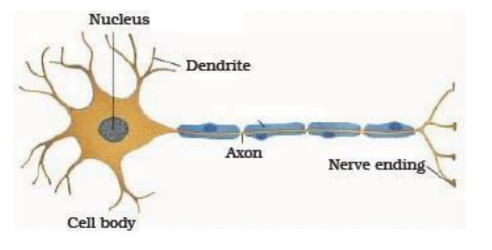
It is made up of special cells called as neurons.
Each neuron consists of a cell body, which contains a nucleus, cytoplasm, called cyton, from which long thin hair like parts arise.
Usually each neuron has a single long part, called the axon, and many short branched parts called dendrites.
Key Terms
Topic Terminology
Term
Important Tables
Table:
.
Assessments
Test Your Learning