Mind Map Overal Idea Content Speed Notes Quick Coverage Content : (Scroll down till end of the page) Study Tools Audio, Visual & Digital Content Content … Key Terms Topic Terminology Term Important Tables Table: . Assessments Test Your Learning readmore
Mind Map Overal Idea Content Speed Notes Quick Coverage Biology is the study of living things. All living things are called organisms, both plants and animals are living organisms. But how we decide whether something is living or non-living depends on 7 lifeprocesses. If something is living it will carryout the 7 life processes below. readmore
Mind Map
Overal Idea
Content
Speed Notes
Quick Coverage
Biology is the study of living things. All living things are called organisms, both plants and animals are living organisms. But how we decide whether something is living or non-living depends on 7 lifeprocesses. If something is living it will carryout the 7 life processes below. (Scroll down till end ..)
Content
Study Tools
Audio, Visual & Digital Content
What are life processes?
Biology is the study of living things. All living things are called organisms, both plants and animals are living organisms. But how we decide whether something is living or non-living depends on 7 lifeprocesses. If something is living it will carryout the 7 life processes below.
1.Movement Both animals and plants have the ability to move. Plants are rooted and move slowly as theygrow. Their roots move down into the soil and their stems moveup towards thelight. Animals onthe other handmove quickly andcan move their entire bodies. They canmove in search of food, shelter or to avoiddanger.
2.Respiration Respiration is theprocess of extracting energy out ofthe food weeat. All living things respire because they need energy to grow, to replace worn out parts and to move. Respiration takes placein the mitochondria of the cell.
3.Sensitivity All living organisms are sensitive; this means that they have anawareness of changes in their environment. Animals respond quickly to stimuli such as heat, light, sound, touch and chemicals which have taste and smell. On the other hand, plants generally appear less sensitive and their response is slower.
4.Growth All living organisms grow. Plants continue growing throughout their lives. Animals stop growing once they reach adulthood. Even when growth stops, materials within an animal’s body arestill being replaced from its food.
5.Excretion All living things make waste products these can beuseless or harmful to it and therefore need to be got rid of. Excretion is the process of getting rid of metabolic waste. Plants store waste substances in their leaves, the waste is removed when their leaves fall off. Animals breathe out waste carbon dioxide, otherwaste substances leavethe body in urineand sweat. Note: Getting rid offaeces or undigested food is notexcretion but egestion.
6.Reproduction All living things must produce offspring like themselves in order for their species to survive. This is the process known as reproduction. Plants produce seeds that give rise to new plants of thesame species. Animals lay eggs orhave babies. Reproduction can be of two types,
Sexual which involves two parents andthe union oftwo gametes andAsexual where oneparent can reproduce itself.
7.Nutrition Nutrition is needed for energy and growth, both plants andanimals need food.Plants are ableto make their own food by photosynthesis. They use sunlight to turn simple molecules like carbon dioxide and water into more complex carbohydrate molecules. Animals are unable to make theirown food sorely on other plants and other animals for their nutrition. Animals takein complex substances and break themdown into small,simple, soluble molecules whichcan be used for energy and growth
Nutrition: Energy required to carry out different life processes is obtained through the process of nutrition.Depending on themode of obtaining nutrition, organisms areclassified as autotrophs or heterotrophs. i. Autotrophs can prepare theirown food from simple inorganic sources such as carbon dioxide and water. Examples: Green plants and somebacteria. ii. Heterotrophs cannot synthesise their own food and are dependent on other organisms for obtaining complex organic substances for nutrition. Example: Animals and fungi
Autotrophic Nutrition: A type of nutrition in which organisms synthesize the organic materials they require frominorganic sources. Chiefsources of carbon and nitrogen arecarbon dioxide andnitrates, respectively. All green plants are autotrophic and use light as a source of energy for the synthesis of foodthrough photosynthesis.
The following events occur during this process. (i) Absorption oflight energy bychlorophyll (ii) Conversion of light energy to chemical energy and splitting of water molecules into hydrogen andoxygen. (iii) Reduction ofcarbon dioxide tocarbohydrates.
These greenplants absorbs waterfrom the soil by roots.Co2 enters fromthe atmosphere through stomata, Sunlight is absorbed by chlorophyll andother green parts of the plants.
Heterotrophic Nutrition: All heterotrophs depend on autotrophs fortheir nutrition. Thethree main typesof heterotrophic nutrition are:
1. Holozoic nutrition: Complex foodis taken intoa specialist digestive system and broken down into smallpieces to be absorbed. Eg: Ameoba, Humans 2. Saprophytic nutrition: Organisms feed ondead organic remains of other organisms. Eg: Fungi like bread moulds yeast andmushrooms.
Parasitic nutrition: Organisms obtain food fromother living organisms (the host), withthe host receiving no benefit fromthe parasite. Eg:cascuta, ticks, lice,leeches and tapeworms.
3. How doOrganisms Obtain Their Utrition?
In single celled organisms, the foodmay be taken in bythe entire surface. Eg: Amoeba takes in food using temporary finger-like extensions of the cell surface which fuseover the food particle forming a food-vacuole. Inside the food vacuole, complex substances are broken down into simpler ones which then diffuse into the cytoplasm. The remaining undigested material is moved to the surface of the cell andthrown out.
Nutrition in Human Beings: In humans, digestion of food takesplace in the alimentary canal, made up of various organsand glands.
In the mouth,food is crushed into small particles through chewing and mixedwith saliva, which contains amylase for digesting starch.
On swallowing, foodpasses through the pharynx and oesophagus to reach thestomach. Gastric juice contains pepsin (for digesting proteins), HCl and mucus.
The hydrochloric acidcreates an acidic medium which facilitates the action of the enzyme pepsin. The mucus protects the inner lining of the stomach from the action of the acid under normal conditions. From the stomach, the food now enters the small intestine. The small intestine is the siteof the complete digestion ofcarbohydrates, proteins and fats.
The liver secretes bilewhich emulsifies fat. The pancreas secretes pancreatic juice which contains the enzymes amylase, trypsin andlipase for digesting starch, proteins and fats, respectively. In the small intestine, carbohydrates, proteins and fats arecompletely digested intoglucose, aminoacids, fattyacids and glycerol. The villi of the small intestine absorb the digested foodand supply it to every cellof the body. The unabsorbed foodis sent intothe large intestine where more villi absorb water fromthis material. The rest of the material is removed fromthe body via the anus.
Respiration: During respiration, the digested foodmaterials are brokendown to release energy in the form of ATP. Depending on the requirement of oxygen, respiration maybe of twotypes:
i. Aerobic respiration: It occurs in the presence of air (oxygen).
ii. Anaerobic respiration: It occurs in the absence of (air) oxygen.
In all cases the first step is the break-down of glucose, a six-carbon molecule, into a three-caron molecule called pyruvate. This process taken place in thecytoplasm. Further, thepyruvate may beconverted into ethanol and carbon dioxide. This process takes place in yeast during fermentation. Since this process takes place in the absence of air (oxygen), it is called anaerobic respiration. Break-down ofpyruvate using oxygen takes place in the mitochondria. A large amount of energy isreleased in aerobic respiration as compared to anaerobic respiration. Some times when there is a lack of oxygen in our muscle cells, the pyruvate is converted into lactic acid. This build up of lactic acid in ourmuscles during sudden activity causes cramps.
Terrestrial organisms useatmospheric oxygen forrespiration, whereas aquatic organisms use oxygen dissolved in water.
In humans, inhalation of air occurs through the following pathway: Nostrils_ Nasal passage _ Pharynx _ Larynx _ Trachea _ Bronchus _ Bronchiole _ Alveolus (please put arrow marks——- à)
In human beings are is taken into the body through the nostrils. The air passing through the nostrils is filtered by fine hairs that line the passage. The passage is also lined with mucus which helps in this process. Fromhere, the air passes through the throat and into thelungs. Rings ofcartilage are present in the throat. These ensure that the air-passage does not collapse. Within the lungs the passage divides into smaller and smaller tubes which finally terminate in balloon-line structures which are called alveoli. The alveoli of lungs are richly supplied with blood and are the sites where exchange of gases (O2 and CO2) occurs between blood and the atmosphere. The blood brings carbon dioxide from the rest of the body for release into the alveoli, and the oxygen in the alveolar air is taken upby blood inthe alveolar blood vessels to be transported to all
the cells inthe body. During the breathing cycle, when air is taken in and let out,the lungs always contain a residual volume of air so that there is sufficient time for oxygen to be absorbed and for the carbon dioxide to be released. In humans, the respiratory pigment haemoglobin carries oxygen from the lungs to the different tissues of the body.This pigment in present in the redblood cells.
Transportation:
Transportation in Human Beings: The circulatory system is composed of the heart, blood and blood vessels which transport various materials throughout the body.
The heart:
The human heart has four chambers—two atria (right and left) and two ventricles (right and left). These chambers prevent the oxygen rich blood from mixing with the blood containing carbon dioxide. The right half of the heart receives deoxygenated blood, whereas the left half receives oxygenated blood.
The carbon dioxide –rich blood has to reach the lungs for the carbon dioxide to be removed, and the oxygenated blood from the lungs has to be brought back to the heart. This oxygen-rich blood isthen pumped to the restof the body. Ventricular walls are much thicker than atrial walls. Humans show double circulation i.e. blood goes through the heart twice and complete separation of oxygenated and deoxygenated blood. Arteries carry blood from the heart to different parts of the body, whereas veins deliver the blood back to the heart. Arteries are connected to veins by thin capillaries, wherein materials are exchanged between the bloodand cells. Blood has platelet cells which circulates around the body and prevent the blood loss at the site of injury. Lymph is also involved in transportation. It is similar to the plasma of blood but colourless and contains less protein. It drains into lymphatic capillaries from the intercellular spaces which join tofrom large lymph vessels that finally open intolarger veins. It carries digested and absorbed fat from intestine and drains excess fluid from extra cellular space back into the blood.
Transportation in plants: Plant transport systems will move energy stores from leaves and raw materials from roots. These two pathways are constructed as independently organized conducting tubes. One, the xylemmoves waterand minerals obtained from the soil.The other, phloem transports products ofphotosynthesis from the leaves where they are synthesised to other partsof the plant. The component of xylem tissue (tracheids and vessesls) of roots, stems, leaves are interconnected to form a continuous system of water conducting channels that reaches all parts of the plant. Transpiration creates a suction pressure, as a result of which water is forced into the xylem cells of the roots. Then there is a steady movement of water fromthe root xylem to all partsof the plant parts through theinterconnected water conducting channels. The loss ofwater in theform of vapour from the aerial parts of theplant is known as transpiration.
Thus it helps in the absorption and upward movement of water and minerals dissolved in it from rootsto the leaves. It also regulates temperature.
The transport of soluble products of photosynthesis is called translocation and itoccurs in phloem. It transports amino acids and other substances. The translocation of food and other substancestakes place in the sieve tubes with the help of adjacent companion cells both in upward and down ward directions. The translocation in phloem is achieved by utilising energy. Material like sucrose is transferred into phloem tissue using energy from ATP. This increases the osmotic pressure of the tissue causing water to move into it. This pressure. This allows the phloem to move material according to the plant’s needs. For example, in the spring, sugar stored in root or stem tissue would be transported to the buds which need energy to grow.
Excretion: During excretion, theharmful metabolic nitrogenous wastes generated areremoved from thebody
Excretion in Human Beings:
In humans, a pair of kidneys, a pair of ureters, the urinary bladder and the urethra constitute the excretory system. Kidneys are located in the addomen, one on either side of the backbone. Urine produced inthe kidneys passes through the ureters into the urinary bladder where it is stored until it is released through the urethra. Each kidney has large numbers of basic filtration units called nephrons. Some substances in the initial filtrate, such as glucose, amino acids, salts and a major amount of water, are selectively re-absorbed as the urine flows along the tube. The amount of water re-absorbed depends on how muchexcess water there is in the body, and on how muchof dissolved wastethere is tobe excreted. The urine forming in each kidney eventually enters a long tube, the ureter, which connects the kidneys with the urinary bladder until the pressure of the expanded bladder leads to the urge to pass it out through the urethra. The bladder is muscular so it is under nervous control. As a result wecan control theurge to urinate.
Excretion in plants: Plants do nothave an excretory system and carryout excretion in various wayssuch as transpiration, releasing wastes into the surrounding soil, losing their leaves and storing waste materials in cell vacuoles. Other waste products arestored as resins and gums in oldxylem.
Use the below buttons to explore our free services to find more…
Mind Map Overal Idea Content Speed Notes Quick Coverage Content : (Scroll down till end of the page) Study Tools Audio, Visual & Digital Content Content … Key Terms Topic Terminology Term Important Tables Table: . Assessments Test Your Learning readmore
Mind Map Overal Idea Content Speed Notes Quick Coverage We have discussed multiples, divisors, factors and have seenhow to identify factors and multiples. We have discussed and discovered thefollowing: (a) A factor of a number is an exactdivisor of thatnumber. (Scroll down till end of the page) Study Tools Audio, Visual & Digital Content (b) readmore
Mind Map
Overal Idea
Content
Speed Notes
Quick Coverage
We have discussed multiples, divisors, factors and have seenhow to identify factors and multiples. We have discussed and discovered thefollowing: (a) A factor of a number is an exactdivisor of thatnumber. (Scroll down till end of the page)
Study Tools
Audio, Visual & Digital Content
(b) Every number is a factor of itself. 1 is a factor ofevery number.
(c) Every factor ofa number isless than or equal tothe given number.
(d) Every number isa multiple ofeach of itsfactors.
(e) Every multiple ofa given number is greater thanor equal tothat number.
(f) Every number is a multiple of itself.
We have learnt that – (a) The number otherthan 1, withonly factors namely 1 and thenumber itself, isa prime number. Numbers that have more than two factors are called composite numbers. Number 1is neither prime nor composite.
(b) The number 2is the smallest prime number andis even. Every prime number other than 2 isodd.
(c) Two numbers withonly 1 asa common factor are called co-prime numbers.
(d) If a number is divisible byanother number thenit is divisible by each of the factors of that number.
(e) A number divisible by two co-prime numbers is divisible by their product also.
We have discussed how we can find just by looking at a number, whether it is divisible by small numbers 2,3,4,5,8,9 and 11.
We have explored the relationship between digits of thenumbers and theirdivisibility by different numbers.
(a) Divisibility by 2,5and 10 canbe seen byjust the lastdigit.
(b) Divisibility by 3and 9 ischecked by finding the sum ofall digits.
(c) Divisibility by 4 and 8is checked bythe last 2and 3 digits respectively.
(d) Divisibility of11 is checked by comparing thesum of digits at odd andeven places.
We have discovered that if twonumbers are divisible by a number then their sum and difference are also divisible by that number.
We have learnt that – (a) The Highest Common Factor (HCF) of two ormore given numbers is the highest of their common factors.
(b) The Lowest Common Multiple (LCM) of two ormore given numbers is the lowest of their common multiples.
Mind Map Overal Idea Content Speed Notes Quick Coverage Quadrilateral Any closed polygon with four sides, four angles and four vertices are called Quadrilateral. It could be regular or irregular. (Sroll down to continute till the end …) Study Tools Audio, Visual & Digital Content Quadrilateral Quadrilateral is a closed figure with four sides. Characteristics readmore
Mind Map
Overal Idea
Content
Speed Notes
Quick Coverage
Quadrilateral
Any closed polygon with four sides, four angles and four vertices are called Quadrilateral. It could be regular or irregular. (Sroll down to continute till the end …)
Study Tools
Audio, Visual & Digital Content
Quadrilateral
Quadrilateral is a closed figure with four sides.
Characteristics of a quadrilateral
Angle Sum Property of a Quadrilateral:
Qudrilateral is a four sided closed figure.
Sum of all angles of a quadrilateral is 360°.
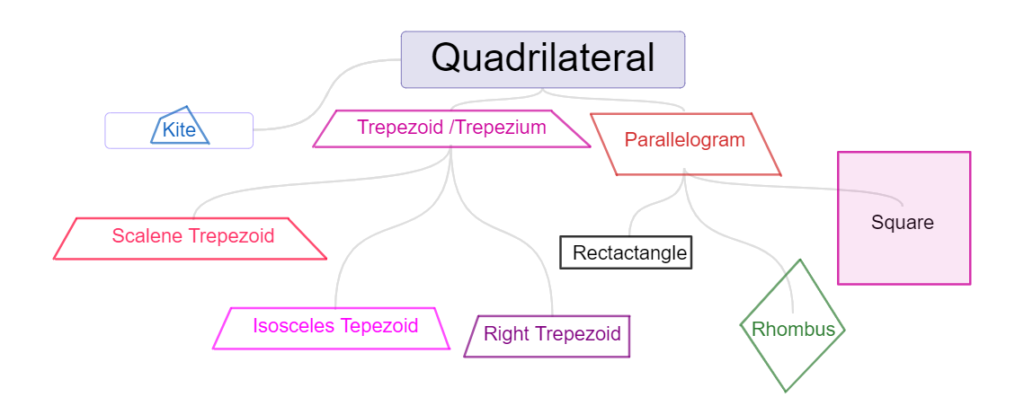
Types Of Quadrilaterals
Classification of quadrilaterals
Quadrilaterals are broadly classified into three categories as:
(i) Kite
(ii) Trapezium
(ii) Parallelogram
Kite:
(i) Kite has no parallel sides
(ii) Kite has a pair of equal adjacent sides.
(ii) It is not a parallelogram
Characteristics Of Kite:
Perimeter Of Square
Area Of Kite
Trapezium:
Trapezium is a quadrilateral with the following characteristics:
(i) One pair of opposite sides is parallel to each other.
(ii) The other pair of opposite sides may not be parallel to each other.
Characteristics Of Trapezium
(i) Sum of all angles of a quadrilateral is 360°.
(ii) One pair of opposite sides is parallel to each other.
(iii) The other pair of opposite sides need not be parallel to each other.
Types Of Trapezium:
Quadrilaterals are broadly classified into two categories as:
(i) Isosceles Trapezium.
(ii) Scalene Trapezium.
(i) Right Trapezium.
Isosceles Trapezium:
Isosceles Trapezium is a quadrilateral with the following characteristics:
(i) One pair of opposite sides is parallel to each other.
(ii) The other pair of opposite sides are equal.
(iii) The other pair of opposite sides need not be parallel to each other.
Isosceles Trapezium is a trapezium with the following characteristics:
(i) One pair of opposite sides is parallel to each other.
(ii) The other pair of opposite sides are equal.
(iii) The other pair of opposite sides need not be parallel to each other.
Characteristics Of Isosceles Trapezium
(i) Sum of all angles of a quadrilateral is 360°.
(ii) One pair of opposite sides is parallel to each other.
(iii) The other pair of opposite sides are equal.
(iv) The other pair of opposite sides need not be parallel to each other.
Scalene Trapezium:
Scalene trapezium: Classified by the length of the legs or the measurement of their angles.
Characteristics Of Scalene Trapezium
Right Trapezium:
Right trapezium: Has one pair of parallel sides and one pair of right angles.
Characteristics Of Right Trapezium
Perimeter Of Trapezium
Area Of Trapezium
Parallelogram:
Parallelogram is a quadrilateral with the following characteristics:
(i) Two pairs of opposite sides are parallel to each other.
(ii) Two pairs of opposite sides are equal in length.
Characteristics of a parallelogram
(i) Sum of all angles of a Parallelogram is 360°.
(ii) Two pairs of opposite sides are parallel to each other.
(ii) Two pairs of opposite sides are equal in length.
(ii) Two pairs of opposite angles are equal.
(iii) Diagonals bisect each other.
(iv) Diagonals need not be equal to each other.
(v) Diagonals divide it into two congruent triangles.
Types Of Parallelogram
Parallelograms are broadly classified into three categories as:
(i) Rectangle
(ii) Rhombus
(iii) Square
Perimeter Of Parallelogram
Area Of Parallelogram
Rectangle:
Rectangleis a quadrilateral with the following characteristics:
(i) Two pairs of opposite sides are parallel to each other.
(ii) Two pairs of opposite sides are equal in length.
(iii) All four angles are right angles. (each angle is 90 o).
Characteristics Of Rectangle
(i) Sum of all angles of a quadrilateral is 360°.
(ii) Two pairs of opposite sides are parallel to each other.
(ii) Two pairs of opposite sides are equal in length.
(iii) All four angles are right angles. (each angle is 90 o).
(iii) Diagonals bisect each other.
(iv) Diagonals are equal to each other.
(v) Diagonals of a rectangle divide it into two congruent triangles.
Conclusions:
Every Rectangle is a Parallelogram. But Every Parallelogram need not to be a Rectangle.
Condition for a rhombus to be a square:
If all four angles of a parallelogram are right angles. (each angle is 90 o), the parallelogram becomes a Rectangle.
Perimeter Of Rectangle
Area Of Recatangle
Rhombus:
Rhombus is a quadrilateral with the following characteristics:
(i) Two pairs of opposite sides are parallel to each other.
(ii) All four sides are equal in length.
Characteristics Of Rhombus
(i) Sum of all angles of a quadrilateral is 360°.
(ii) Two pairs of opposite sides are parallel to each other.
(ii) All four sides are equal in length.
(ii) Two pairs of opposite angles are equal.
(iii) Diagonals bisect each other.
(iv) Diagonals need not be equal to each other.
(v) Diagonals divide a Rhombus into two congruent triangles.
Conclusions:
Every Rhombus is a Parallelogram. But Every Parallelogram need not to be a Rhombus.
Condition for a rhombus to be a square:
If all the sides of a parallelogram are equal, the parallelogram becomes a Rhombus.
Perimeter Of Rhombus
Area Of Rhombus
Square:
Square is a quadrilateral with the following characteristics:
(i) Two pairs of opposite sides are parallel to each other.
(ii) All four sides are equal in length.
(iii) All four angles are right angles. (each angle is 90 o).
Characteristics Of Square
(i) Sum of all angles of a quadrilateral is 360°.
(ii) Two pairs of opposite sides are parallel to each other.
(iii) All four sides are equal in length.
(iv) All four angles are right angles. (each angle is 90 o).
(v) Diagonals bisect each other.
(vi) Diagonals need not be equal to each other.
(vii) Diagonals divide a Rhombus into two congruent triangles.
Conclusions:
Every square is a Rhombus. But Every Rhombus need not to be a square.
Condition for a rhombus to be a square:
If all the angles of a rhombus are right angles (euqal to 90o), the rhombus becomes a square.
2. Every Square is a prallelogram. But Every prallelogram need not to be a square.
Condition for a prallelogramto be a square:
(i) If all the angles of a parallelogram are right angles (euqal to 90o), and all the sides of a parallelogram are equal in length, the parallelogram becomes a square.
3. Every Square is a rectangle. But Every Rectangle need not to be a square.
Condition for a Rectangleto be a square:
If all the sides of a Rectangle are equal in length, the Rectangle becomes a square.
If all the sides of a parallelogram are equal, the parallelogram becomes a Rhombus.
Perimeter Of Square
Area Of Square
Important Points To Remember
The diagonals of a parallelogram are equal if and only if it is a rectangle.
If a diagonal of a parallelogram bisects one of the angles of the parallelogram then it also bisects the opposite angle.
In a parallelogram, the bisectors of any two consecutive angles intersect at a right angle.
The angle bisectors of a parallelogram form a rectangle.
Mid Point Theorem
A line segment joining the mid points of any two sides of a triangle is parallel to the third side and length of the line segment is half of the parallel side.
Converse Of Mid Point Theorem
A line through the midpoint of a side of a triangle parallel to another side bisects the third side.
Intercept Theorem
If there are three parallel lines and the intercepts made by them on one transversal are equal then the intercepts on any other transversal are also equal.
Angle Sum Property of a Quadrilateral
The sum of the four angles of a quadrilateral is 360°
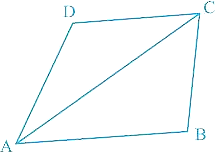
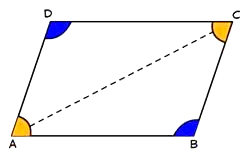
If we draw a diagonal in the quadrilateral, it divides it into two triangles.
And we know the angle sum property of a triangle i.e. the sum of all the three angles of a triangle is 180°.
The sum of angles of ∆ADC = 180°.
The sum of angles of ∆ABC = 180°.
By adding both we get ∠A + ∠B + ∠C + ∠D = 360°
Hence, the sum of the four angles of a quadrilateral is 360°.
Example
Find ∠A and ∠D, if BC∥ AD and ∠B = 52° and ∠C = 60° in the quadrilateral ABCD.
Solution:
Given BC ∥ AD, so ∠A and ∠B are consecutive interior angles.
So ∠A + ∠B = 180° (Sum of consecutive interior angles is 180°).
∠B = 52°
∠A = 180°- 52° = 128°
∠A + ∠B + ∠C + ∠D = 360° (Sum of the four angles of a quadrilateral is 360°).
∠C = 60°
128° + 52° + 60° + ∠D = 360°
∠D = 120°
∴ ∠A = 128° and ∠D = 120 °.
Types of Quadrilaterals
S No.
Quadrilateral
Property
Image
1.
Kite
a. No Parallel Sides b. Two pairs of adjacent sides are equal.
2.
Trapezium
One pair of opposite sides is parallel.
3.
Parallelogram
Both pairs of opposite sides are parallel.
3.
Rectangle
a. Both the pair of opposite sides are parallel. b. Opposite sides are equal.c. All the four angles are 90°.
4.
Square
a. All four sides are equal. b. Opposite sides are parallel. c. All the four angles are 90°.
5.
Rhombus
a. All four sides are equal. b. Opposite sides are parallel. c. Opposite angles are equal.d. Diagonals intersect each other at the centre and at 90°.
Remark: A square, Rectangle and Rhombus are also a parallelogram.
Properties of a Parallelogram
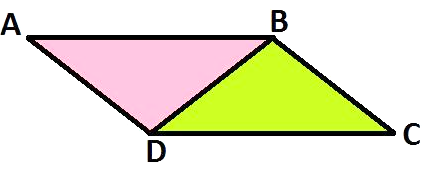
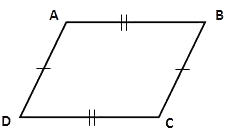
Theorem 1: When we divide a parallelogram into two parts diagonally then it divides it into two congruent triangles.
∆ABD ≅ ∆CDB
Theorem 2: In a parallelogram, opposite sides will always be equal.
Theorem 3: A quadrilateral will be a parallelogram if each pair of its opposite sides will be equal.
Here, AD = BC and AB = DC
Then ABCD is a parallelogram.
Theorem 4: In a parallelogram, opposite angles are equal.
In ABCD, ∠A = ∠C and ∠B = ∠D
Theorem 5: In a quadrilateral, if each pair of opposite angles is equal, then it is said to be a parallelogram. This is the reverse of Theorem 4.
Theorem 6: The diagonals of a parallelogram bisect each other.
Here, AC and BD are the diagonals of the parallelogram ABCD.
So the bisect each other at the centre.
DE = EB and AE = EC
Theorem 7: When the diagonals of the given quadrilateral bisect each other, then it is a parallelogram.
This is the reverse of the theorem 6.
The Mid-point Theorem
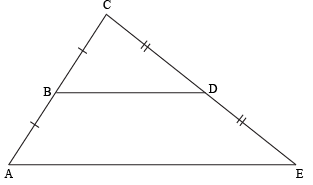
1. If a line segment joins the midpoints of the two sides of the triangle then it will be parallel to the third side of the triangle.
If AB = BC and CD = DE then BD ∥ AE.
2. If a line starts from the midpoint of one line and that line is parallel to the third line then it will intersect the midpoint of the third line.
If D is the midpoint of AB and DE∥ BC then E is the midpoint of AC.
Example
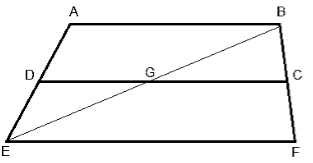
Prove that C is the midpoint of BF if ABFE is a trapezium and AB ∥ EF.D is the midpoint of AE and EF∥ DC.
Solution:
Let BE cut DC at a point G.
Now in ∆AEB, D is the midpoint of AE and DG ∥ AB.
By midpoint theorem, G is the midpoint of EB.
Again in ∆BEF, G is the midpoint of BE and GC∥ EF.