Mind Map Overal Idea Content Speed Notes Quick Coverage Reproduction is a process in which the organisms produce the young ones of their own kind. There are two modes by which animals reproduce. These are: (i) Sexual reproduction, and (ii) Asexual reproduction (Scroll down till end of the page) Study Tools Audio, Visual & Digital readmore
Mind Map
Overal Idea
Content
Speed Notes
Quick Coverage
Reproduction is a process in which the organisms produce the young ones of their own kind. There are two modes by which animals reproduce.
These are: (i) Sexual reproduction, and (ii) Asexual reproduction (Scroll down till end of the page)
Study Tools
Audio, Visual & Digital Content
Sexual Reproduction
Reproduction resulting from the fusion of male and female gametes is called sexual reproduction.
The reproductive organs in the female include ovaries, oviducts and uterus.
The reproductive organs in male include testes, sperm ducts and penis.
The ovary produces female gametes called ovum and the testes produce male gametes called sperms. The fusion of ovum and sperm is called fertilization.
zygote: The fertilized egg is called a zygote.
internal fertilization: Fertilization that takes place inside the female body is called internal fertilization. This is observed in human beings and other animals such as hens, cows and dogs.
external fertilization: Fertilization that takes place outside the female body is called external fertilization. This is observed in frogs, fish, starfish, etc.
The zygote divides repeatedly to give rise to an embryo. The embryo gets embedded in the wall of the uterus for further development.
The stage of the embryo in which all the body parts are identifiable is called foetus.
Animals such as human beings, cows and dogs which give birth to young Ones.
Asexual Reproduction: The type of reproduction in which only a single parent is involved is called asexual reproduction. The transformation of the larva into adult through drastic changes is called Asexual Reproduction
budding: In hydra, new individuals develop from buds. This method of asexual reproduction is called budding.
binary fission.: Amoeba reproduces by dividing itself into two. This type of asexual reproduction is called binary fission.
Mind Map Overal Idea Content Speed Notes Quick Coverage Respiration is essential for survival of living organisms. It releases energy from the food. The oxygen we inhale is used to breakdown glucose into carbon dioxide and water. Energy is released in this process. The breakdown of glucose occurs in the cells of an organism (cellular readmore
Mind Map
Overal Idea
Content
Speed Notes
Quick Coverage
Respiration is essential for survival of living organisms.
It releases energy from the food.
The oxygen we inhale is used to breakdown glucose into carbon dioxide and water.
Energy is released in this process.
The breakdown of glucose occurs in the cells of an organism (cellular respiration) (Scroll down till end of the page)
Study Tools
Audio, Visual & Digital Content
During heavy exercise when the supply of oxygen to our muscle cells is insufficient, food breakdown is by anaerobic respiration (without oxygen)
Types of Respiration:
External respiration also known as breathing refers to a process of inhaling oxygen from the air into the lungs and expelling carbon dioxide from the lungs to the air.
Exchange of gases both in and out of the blood occurs simultaneously.
Internal Respiration: Process in which food is broken down in body cells.
Internal respiration is further classified into two types as aerobic respiration and anaerobic respiration
(a) Aerobic Respiration: Aerobic respiration takes place in the presence of oxygen. Carbon dioxide and water are the end products of aerobic respiration. respiration happens in most of the organisms.
(b) Anaerobic Respiration: Anaerobic respiration takes place in the absence of oxygen.
Anaerobic respiration usually happens in most of the microbes.
Alcohol and carbon dioxide are formed at the end of anaerobic respiration.
In some cases, lactic acid is formed at the end of anaerobic respiration.
Respiration in Plants: Leaves have pores called stomata for gaseous exchange by diffusion.
Stems have openings called lenticels for gaseous exchange by diffusion.
Roots have stomatal pores for gaseous exchange of oxygen dissolved in soil water.
Respiration in Animals: Respiration in animals vary according to their character like:
Earthworm: Earthworms respire through their skin.
Insect: Insects respire through entire body surface.
Fish: Fishes respire through their gills.
Frogs: Frogs respire through their thin, moist and smooth skin when in water and by lungs when on the land.
Respiration in Humans: Inhaled air passes through nostrils into nasal cavity and then into lungs through windpipe.
Breathing is a part of the process of respiration during which an organism takes in the oxygen-rich air and gives out air rich in carbon dioxide.
The respiratory organs for the exchange of gases vary in different organisms.
During inhalation, our lungs expand and then come back to the original state as the air moves out during exhalation.
Increased physical activity enhances the rate of breathing.
In animals like cow, buffalo, dog and cat the respiratory organs and the process of breathing are similar to those in humans.
Mind Map Overal Idea Content Speed Notes Quick Coverage Atoms are the basic building blocks of matter. Different kinds of matter contain different kinds of atoms present in them. Protons were discovered by Ernest Rutherford, in his famous gold foil experiment. Electrons were discovered by J.J. Thomson, in his cathode ray tube experiment. Neutrons were readmore
Mind Map
Overal Idea
Content
Speed Notes
Quick Coverage
Atoms are the basic building blocks of matter.
Different kinds of matter contain different kinds of atoms present in them.
Protons were discovered by Ernest Rutherford, in his famous gold foil experiment.
Electrons were discovered by J.J. Thomson, in his cathode ray tube experiment.
Neutrons were discovered by James Chadwick. (Scroll down till end of the page)
Study Tools
Audio, Visual & Digital Content
Charged Particles in Matter
Whenever we rub two objects together, they become electrically charged.
This is because atoms contain charged particles in them.
Therefore, atoms can be divided further into particles i.e proton, electron and neutron.
Atoms consist of an equal number of protons and electrons.
Protons exist in the interiors of the atom and electrons exist in the exteriors of the atom. Therefore, electrons can be removed from an atom.
Since electrons exist in the exteriors of the atom they can be removed from an atom.
Dalton’s Atomic Theory
The postulates of the atomic theory by John Dalton
The matter is made up of tiny particles called Atoms that cannot be divided.
Atoms are never formed or destroyed during a chemical reaction.
Atoms of an element exhibit the same nature.
Atoms of the same element have equal size, mass and they exhibit similar chemical properties.
Atoms of different elements exhibit variant chemical properties.
Atoms form compounds by combining in a ratio of whole numbers.
A compound contains molecules in which a constant number and types of atoms are present.
Failure of Dalton’s Atomic Theory
Dalton suggested that atoms can neither be created nor destroyed and are indivisible.
But the discovery of electrons and protons in atoms disproved this aspect of Dalton’s theory.
Thomson’s Model of an Atom
According to J.J. Thomson, the structure of an atom can be compared to Christmas pudding.
According to this model the electrons are present inside a positive sphere.
An atom is composed of a positively charged sphere in which electrons are embedded.
Atoms are neutral as the positive and negative charges are equal in number.
Rutherford’s Model of an Atom
Rutherford’s Experiment
Rutherford experimented by passing alpha rays through a thin gold foil.
He expected that the gold atoms would deflect the Alpha particles.
Observations
Inferences
Alpha particles which had high speed moved straight through the gold foil
Atom contains a lot of empty space
Some particles got diverted a by small angles
Positive charges in the atom are not occupying much of its space
Only one out of 12000 particles bounced back
The positive charges are concentrated over a particular area of the atom.
Based on his experiment Rutherford gave the nuclear model of an atom as the following.
Rutherford’s Atomic Model
Rutherford’s Atomic Model is known as Planetary Atomic Model and Nuclear Atomic Model.
According to Rutherford’s Atomic Model:
Atoms contain a lot of unoccupied space
The center of the atom is highly positive , Rutherford named it as nucleus
The atom contains an equal amount of positive and negative charges.
Nucleus of Atom
The nucleus is located at the center of the atom.
All the mass of the atom is because of the nucleus.
The electrons revolve around the nucleus in circular parts which called Orbits
The size of an atomic nucleus is much smaller than its atom.
Drawbacks of the Nuclear Atomic Model
The Rutherford’s Atomic Model failed to explain how an atom remains stable despite having positive and negative charges present in it.
Maxwell’s theory of radiation if any charged particle moves in a circular motion it radiates energy.
So, if electrons move in a circular motion around the nucleus they should radiate some energy as a result this decreases at the speed of the electrons. As a result, they would fall into the nucleus and the nucleus should collapse because of its high positive charge.
But it is not happening because the matter is not collapsing.
Nucleons: The subatomic particles present in the nucleus are collectively called Nucleons. Protons and Neutrons are nucleons.
Bohr’s Model of an Atom
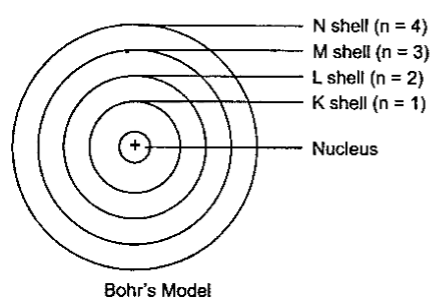
Bohr Atomic Model states as the following:
Electrons revolve around the nucleus in particular circular paths, called orbits.
The electrons do not emit any energy while moving in their orbits.
The orbits are also called Energy Levels.
Energy Levels or Orbits are represented by using letters or numbers as shown in the figure.
Neutron:
J. Chadwick discovered Neutron, a subatomic particle of an atom.
Neutron carries no charge.
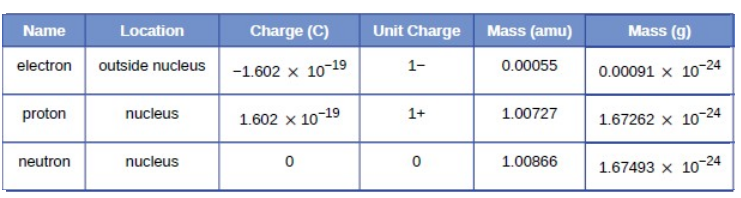
Subatomic Particles of Atom
Electrons
Electron carry a negative charge
Protons
Protons carry a positive charge
Neutrons
Neutrons are neutral
Electronic Configuration:The distribution of electrons in different shells or orbits is called Electronic Configuration.
If Orbit number = n
Then number of electrons present in an Orbit = 2n2
So, for n =1
Maximum electrons present in shell – K = 2 * (1)2 = 2
The outermost shell can contain at most 8 electrons.
The shells in an atom are filled in sequence.
Thus, until the inner shells of an atom are filled completely the outer shells cannot contain any electrons.
Valency
Valence Electrons – Electrons existing in the outermost orbit of an atom are called Valence Electrons.
The atoms which have completely filled the outermost shell are not very active chemically.
The valency of an atom or the combining capacity of an atom is given by the number of elements present in the outermost shell.
For Example, Helium contains two electrons in its outermost shell which means its valency is two. In other words, it can share two electrons to form a chemical bond with another element.
What happens when the outermost shell contains a number of electrons that are close to its maximum capacity?
Valency in such cases is generated by subtracting the number of electrons present in the outermost orbit from octet (8). For example, oxygen contains 6 electrons in its outermost shell. Its valency is calculated as: 8 – 6 = 2. This means oxygen needs two electrons to form a bond with another element.
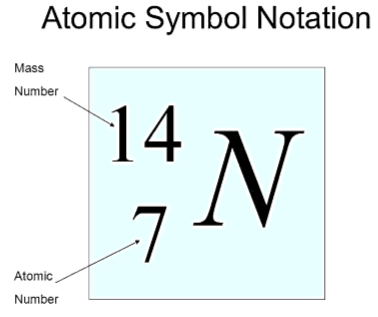
Representation Element:
Atomic Number of an Element
Atomic Number (Z) = Number of protons in an atom
Mass Number of an Element
Mass Number = Number of protons + Number of neutrons
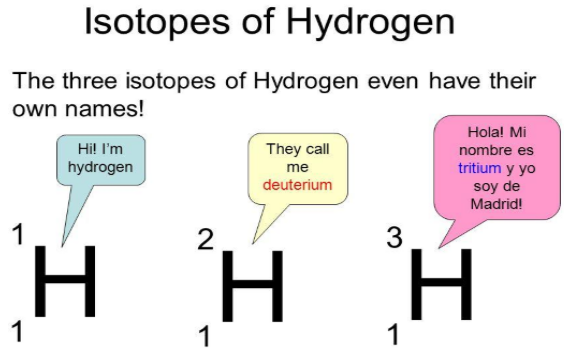
Isotopes
The atoms of an element can exist in several forms having similar atomic numbers but varying mass numbers.
Isotopes are pure substances.
Isotopes have a similar chemical nature.
Isotopes have distinct physical characteristics.
Use of Isotopes:
1. The fuel of Nuclear Reactor – Isotope of Uranium
2. Treatment of Cancer – Isotope of Cobalt
3. Treatment of Goiter – Isotope of Iodine
Example: Consider two atomic species namely U and V. Are they isotopes?
U
V
Protons
5
5
Neutrons
5
6
Mass Number
5 + 5 = 10
5 + 6 = 11
Atomic Number
5
5
From the above example, we can infer that U and V are isotopes because their atomic number is the same.
Isobars
The atoms of several elements can have a similar mass number but distinct atomic masses. Such elements are called Isobars.
Mind Map Overal Idea Content Speed Notes Quick Coverage A closed plane figure bounded by three linesegments. The six elements of a triangle are its three angles and thethree sides. The line segment joining a vertex of a triangle to the mid point of its opposite side is called a medianof the triangle. (Scroll down readmore
Mind Map
Overal Idea
Content
Speed Notes
Quick Coverage
A closed plane figure bounded by three linesegments. The six elements of a triangle are its three angles and thethree sides. The line segment joining a vertex of a triangle to the mid point of its opposite side is called a medianof the triangle. (Scroll down till end of the page)
Mind Map Overal Idea Content Speed Notes Quick Coverage Content Mind Map Overal Idea Content Speed Notes Quick Coverage Content : (Scroll down till end of the page) Study Tools Audio, Visual & Digital Content Content … Key Terms Topic Terminology Term Important Tables Table: . Assessments Test Your Learning Study Tools Content … Key readmore
Mind Map
Overal Idea
Content
Speed Notes
Quick Coverage
Content
Mind Map Overal Idea Content Speed Notes Quick Coverage Content Mind Map Overal Idea Content Speed Notes Quick Coverage Content : (Scroll down till end of the page) Study Tools Audio, Visual & Digital Content Content … Key Terms Topic Terminology Term Important Tables Table: . Assessments Test Your Learning Study Tools Content … Key readmore