Your cart is currently empty!
Tag: CBSE 6
BASIC GEOMETRICAL IDEAS | Study
UNDERSTANDING ELEMENTARY SHAPES | Study
INTEGERS | Study
FRACTIONS | Study
DECIMALS | Study
DATA HANDLING | Study
MENSURATION | Study
ALGEBRA | Study
RATIO AND PROPORTION | Study
CBSE 6 | Mathematics – Study – Premium

BASIC GEOMETRICAL IDEAS | Study
Pre-Requisires
Test & Enrich
English Version Study Tools
Audio, Visual & Digital Content
Basic Geometrical Ideas | Speed Notes
Notes For Quick Recap
Geometry
Geometry is a branch of mathematics concerned with properties of space such as the distance, shape, size, and relative position of figures. A mathematician who works in the field of geometry is called a 🎉geometer.
Space
Space: space refers to a set of points that form a particular type of structure.
Plane
A plane is a flat surface that extends infinitely in all directions
Point
Point is an exact position or location in space with no dimensions.
Mathematically, a point is defined as a circle with zero radius.
Since it is not possible its is represented by a very small dot.
A point is usually represented by a capital letter.
In mathematical terms, pont is a cirlce with no radius. It does mean that a very very small circle.
Lines And Its Types
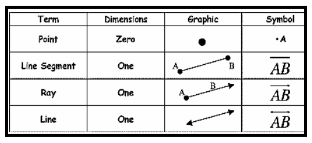
Ray
A Ray is a straight path that stars at a point and extends infinitely in one direction.
Note: A ray is a portion of line starting at a point and extends in one direction endlessly. A ray has only one endpoint (Initial point).
Line or Straight Line
A line is a straight path that extends infinitely in two opposite directions. It can be treated as a combination of two rays starting from the same point but extending in the opposite directions.
Note: A line has no end points.
Line Segment:
A line segment is the part of a line between two points. (Segment means part).
The length of a line segment is the shortest length between two end points.
The line segment has two end points. Note: A line Segment has two endpoints. (both Initial and end points). (Scroll down to continue …).
Parallel Lines
Lines that are always the same distance apart from each other and that never meet are called Parallel lines.
Note: Parallel lines do not have any common point.
Intersecting Lines
Lines that meet at a point with each other are called intersecting lines.
Intersecting lines meet at a point.
Angle
An angle is made up of two rays starting from a common end point.

An angle leads to three divisions of a region:
On the angle, the interior of the angle and the exterior of the angle.
Curve
Curve is a drawing (straight or non-straight) made without lifting the pencil may be called a curve.
Note: In this sense, a line is also a curve.
Types of Curves
Cureves are two types. They are (i) Simple or Open curve (ii) Closed curve.
Simple Curve
Simple or open curve is a curve that does not cross (intersect) itself.
Closed Curve
Closed curve is a curve that crosses (intersects) itself.
Curves–Concave And Convex
In geometry, a curve is a line or shape that is drawn smoothly and continuously in a plane with bends or turns.
Mathematicians define a curve as any shape that can be drawn without lifting the pen.
In Mathematics, A curve is a continuous and smooth line that is defined by a mathematical function or parametric equations.
Concave And Convex curves:
Curves are of two types. They are concave curve and convex curve.
Concave Curve:
A curve is concave is a curve that curves inward, resembling a cave.
Examples:
– The interior of a circle.
– The graph of a concave function like y = -x2.
Convex Curves:
A curve is convex if it curves outward.
Examples:
– The exterior of a circle.
– The graph of a convex function like y = x2.
Polygon
Polygon:
Polygon is a closed figure bounded by three or more line segments such that each line segment intersects the other two line segements at exactly two other points (vertices) as shown in the following figures.
Polygons are classified into two types on the basis of interior angles: as
(i) Convex polygon (ii) Concave polygon.
Part of Polygon
(i) Sides Of The Polygon
The line segments of a polygone are called sides of the polygon.
(ii) Adjacent Sides Of Polygon
Adjacent sides of a polygon are thesides of a polygon with a common end point.
(iii) Vertex Of Polygon
Vertext of a polygon is a point at which a pair of sides meet.
(iv) Adjacent Vertices
Adjacent vertices of polygon are the end points of the same side of the polygon.
(v) diagonal
Diagonal of a polygone is a line segment that joins the non-adjacent vertices of the polygon.
(a) Convex Polygon: In this case, each angle is either acute or obtuse (angle < 180 o) as shown in the following figures.
Concave Polygon: In this case, any one angle is reflex (angle > 180°) and one diagonal is outside the polygon as shown in the following figures.
On the basis of sides, there are two types of polygons :
(a) Regular Polygon: A convex polygon is called a regular polygon, if all its sides and angles are equal as shown in the following figures.
Each angle of a regular polygon of n-sides =
Important results on polygon :
For a regular polygon of n sides (n > 2).
(b) Irregular Polygon: A polygon in which all the sides are unequal as shown in the following figures,
Triangle :
A simple closed figure bounded by three line segments is called a triangle, it has three sides as AB, BC and AC; three vertices as A, B and C and three interior angles A, ZB and ZCand the sum of all angles is 180°.
i.e., <A + <B + <C = 180°
Triangle
A triangle is a three-sided polygon.
In other terms triangle is a three sided closed figure.
Quadrilateral
A quadrilateral is a four-sided polygon. (It shouldbe named cyclically).
In any

similar relations exist for the other three angles.
Circle And Its Parts
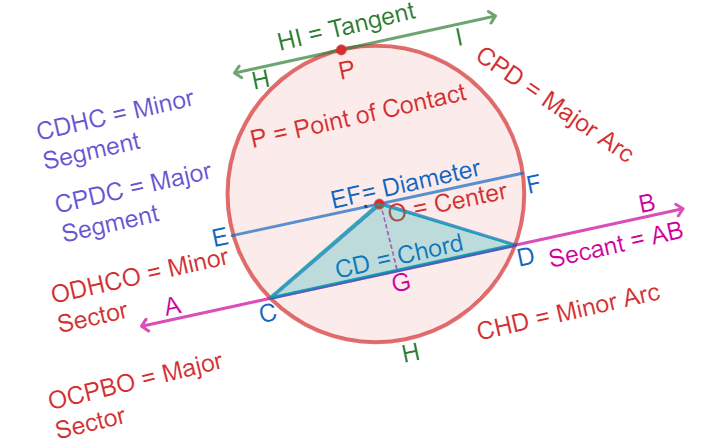
A circle is the path of a point moving at the same distance from a fixed point.
Centre Of Circle
Centre Of Circle is a point that is equidistant from any point on the boundary of the circle.
In other words the centre of the circles is a centre point of the circle.
Radius Of Circle
Radius of circle is the distance between the centre of the circle and any point on the boundary of the circle.
Circumference Of Circle
Circumference of circle is the length of the boundary of the circle.
Chord Of Circle
A chord of a circle is a line segment joining any two points on the circle.
A diameter is a chord passing throughthe Centre of the circle.
Sector Of Circle
A sector is the region in the interior of a circle enclosed by an arc on one side and a pair of radii on the other two sides.
Segment Of Circle
A segment of a circle is a region in the interior of the circle enclosed by an arc and a chord.
The diameter of a circle divides it into two semi-circles.
Hindi Version Dig Deep
Topic Level Resources
Sub – Topics
Select A Topic
Topic:
Chapters Index
Select Another Chapter
[display-posts category=”CBSE 6 – Mathematics – Study – Premium” posts_per_page=”25″]Assessments
Personalised Assessments

UNDERSTANDING ELEMENTARY SHAPES | Study
Pre-Requisires
Test & Enrich
English Version Understanding Elementary Shapes |Speed Notes
Notes For Quick Recap
The distance betweenthe end pointsof a line segment is its length. A graduatedruler and the divider are useful to compare lengthsof line segments. When a hand of a clock moves from one position to another position we have an examplefor an angle. (Scroll down to continue …)
Study Tools
Audio, Visual & Digital Content
One full turn of the hand is 1 revolution.
A right angle is ¼ revolution and a straight angle is ½ a revolution. We use a protractor to measure the size of an angle in degrees.
The measure of a right angle is 90° and hence that of a straight angle is 180°.
An angle is acute if its measure is smaller than that of a right angle and is obtuseif its measure is greaterthan that of a right angle and less than a straightangle.
A reflex angle is largerthan a straight angle.
Two intersecting lines are perpendicular if the anglebetween them is 90°.
The perpendicular bisector of a line segmentis a perpendicular to the line segmentthat divides it into two equal parts.
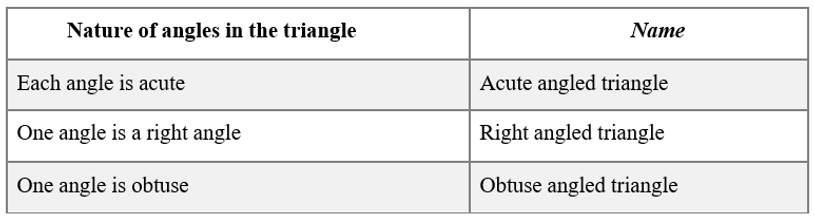
Triangles can be classified as follows based on their angles:

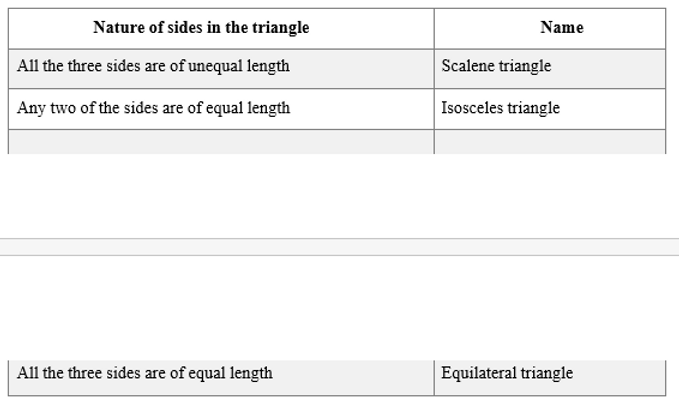
Triangles can be classified as follows based on the lengths of their sides:

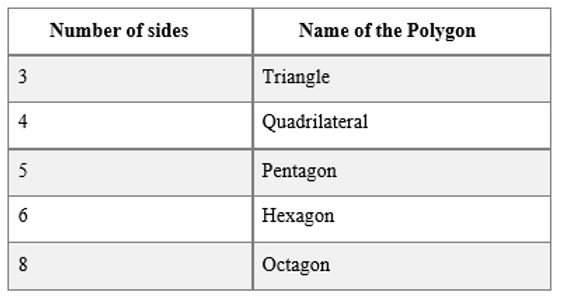
Polygons are namedbased on theirsides.

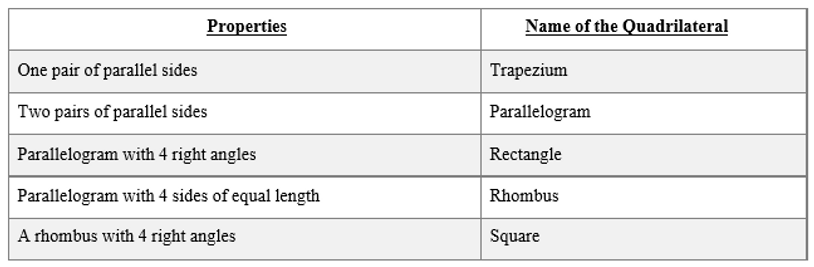
Quadrilaterals are furtherclassified with reference to their properties.
Quadrilateral
Quadrilateral is a closed figure with four sides.
Characteristics of a quadrilateral
Angle Sum Property of a Quadrilateral:
Sum of all angles of a quadrilateral is 360°.
Types Of Quadrilaterals
Quadrilaterals are broadly classified into two categories as:
(i) Trapezium
(ii) Kite
Trapezium:
Trapezium is a quadrilateral with the following characteristics:
(i) One pair of opposite sides is parallel to each other.
(ii) The other pair of opposite sides may not be parallel to each other.
Characteristics Of Trapezium
(i) Sum of all angles of a quadrilateral is 360°.
(ii) One pair of opposite sides is parallel to each other.
(iii) The other pair of opposite sides need not be parallel to each other.
Types Of Trapezium:
Quadrilaterals are broadly classified into two categories as:
(i) Isosceles Trapezium.
(ii) Scalene Trapezium.
(i) Right Trapezium.
Isosceles Trapezium:
Isosceles Trapezium is a quadrilateral with the following characteristics:
(i) One pair of opposite sides is parallel to each other.
(ii) The other pair of opposite sides are equal.
(iii) The other pair of opposite sides need not be parallel to each other.
Isosceles Trapezium is a trapezium with the following characteristics:
(i) One pair of opposite sides is parallel to each other.
(ii) The other pair of opposite sides are equal.
(iii) The other pair of opposite sides need not be parallel to each other.
Characteristics Of Isosceles Trapezium
(i) Sum of all angles of a quadrilateral is 360°.
(ii) One pair of opposite sides is parallel to each other.
(iii) The other pair of opposite sides are equal.
(iv) The other pair of opposite sides need not be parallel to each other.
Scalene Trapezium:
- Scalene trapezium: Classified by the length of the legs or the measurement of their angles.
Characteristics Of Scalene Trapezium
Right Trapezium:
- Right trapezium: Has one pair of parallel sides and one pair of right angles.
Characteristics Of Right Trapezium
Perimeter Of Trapezium
Area Of Trapezium
Parallelogram:
Parallelogram is a quadrilateral with the following characteristics:
(i) Two pairs of opposite sides are parallel to each other.
(ii) Two pairs of opposite sides are equal in length.
Characteristics of a parallelogram
(i) Sum of all angles of a Parallelogram is 360°.
(ii) Two pairs of opposite sides are parallel to each other.
(ii) Two pairs of opposite sides are equal in length.
(ii) Two pairs of opposite angles are equal.
(iii) Diagonals bisect each other.
(iv) Diagonals need not be equal to each other.
(v) Diagonals divide it into two congruent triangles.
Types Of Parallelogram
Parallelograms are broadly classified into three categories as:
(i) Rectangle
(ii) Rhombus
(iii) Square
Perimeter Of Parallelogram
Area Of Parallelogram
Rectangle:
Rectangle is a quadrilateral with the following characteristics:
(i) Two pairs of opposite sides are parallel to each other.
(ii) Two pairs of opposite sides are equal in length.
(iii) All four angles are right angles. (each angle is 90 o).
Characteristics Of Rectangle
(i) Sum of all angles of a quadrilateral is 360°.
(ii) Two pairs of opposite sides are parallel to each other.
(ii) Two pairs of opposite sides are equal in length.
(iii) All four angles are right angles. (each angle is 90 o).
(iii) Diagonals bisect each other.
(iv) Diagonals are equal to each other.
(v) Diagonals of a rectangle divide it into two congruent triangles.
Conclusions:
- Every Rectangle is a Parallelogram. But Every Parallelogram need not to be a Rectangle.
Condition for a rhombus to be a square:
If all four angles of a parallelogram are right angles. (each angle is 90 o), the parallelogram becomes a Rectangle.
Perimeter Of Rectangle
Area Of Recatangle
Rhombus:
Rhombus is a quadrilateral with the following characteristics:
(i) Two pairs of opposite sides are parallel to each other.
(ii) All four sides are equal in length.
Characteristics Of Rhombus
(i) Sum of all angles of a quadrilateral is 360°.
(ii) Two pairs of opposite sides are parallel to each other.
(ii) All four sides are equal in length.
(ii) Two pairs of opposite angles are equal.
(iii) Diagonals bisect each other.
(iv) Diagonals need not be equal to each other.
(v) Diagonals divide a Rhombus into two congruent triangles.
Conclusions:
- Every Rhombus is a Parallelogram. But Every Parallelogram need not to be a Rhombus.
Condition for a rhombus to be a square:
If all the sides of a parallelogram are equal, the parallelogram becomes a Rhombus.
Perimeter Of Rhombus
Area Of Rhombus
Square:
Square is a quadrilateral with the following characteristics:
(i) Two pairs of opposite sides are parallel to each other.
(ii) All four sides are equal in length.
(iii) All four angles are right angles. (each angle is 90 o).
Characteristics Of Square
(i) Sum of all angles of a quadrilateral is 360°.
(ii) Two pairs of opposite sides are parallel to each other.
(iii) All four sides are equal in length.
(iv) All four angles are right angles. (each angle is 90 o).
(v) Diagonals bisect each other.
(vi) Diagonals need not be equal to each other.
(vii) Diagonals divide a Rhombus into two congruent triangles.
Conclusions:
- Every square is a Rhombus. But Every Rhombus need not to be a square.
Condition for a rhombus to be a square:
If all the angles of a rhombus are right angles (euqal to 90o), the rhombus becomes a square.
2. Every Square is a prallelogram. But Every prallelogram need not to be a square.
Condition for a prallelogram to be a square:
(i) If all the angles of a parallelogram are right angles (euqal to 90o), and all the sides of a parallelogram are equal in length, the parallelogram becomes a square.
3. Every Square is a rectangle. But Every Rectangle need not to be a square.
Condition for a Rectangle to be a square:
If all the sides of a Rectangle are equal in length, the Rectangle becomes a square.
If all the sides of a parallelogram are equal, the parallelogram becomes a Rhombus.
Perimeter Of Square
Area Of Square
Kite:
(i) Kite has a pair of equal adjacent sides.
(ii) It is not a parallelogram
Characteristics Of Kite:
Perimeter Of Square
Area Of Kite
Important Points To Remember
- The diagonals of a parallelogram are equal if and only if it is a rectangle.
- If a diagonal of a parallelogram bisects one of the angles of the parallelogram then it also bisects the opposite angle.
- In a parallelogram, the bisectors of any two consecutive angles intersect at a right angle.
- The angle bisectors of a parallelogram form a rectangle.
Mid Point Theorem
A line segment joining the mid points of any two sides of a triangle is parallel to the third side and length of the line segment is half of the parallel side.
Converse Of Mid Point Theorem
A line through the midpoint of a side of a triangle parallel to another side bisects the third side.
Intercept Theorem
If there are three parallel lines and the intercepts made by them on one transversal are equal then the intercepts on any other transversal are also equal.

·We see aroundus many three dimensional shapes.Cubes, cuboids, spheres,
cylinders, cones,prisms and pyramidsare some of them.
Hindi Version Dig Deep
Topic Level Resources
Sub – Topics
Select A Topic
Topic:
Chapters Index
Select Another Chapter
[display-posts category=”CBSE 6 – Mathematics – Study – Premium” posts_per_page=”25″]Assessments
Personalised Assessments

INTEGERS | Study
Pre-Requisires
Test & Enrich
English Version Integers | Speed Notes
Notes For Quick Recap
We haveseen that there are times whenwe need touse numbers witha negative sign. This is when we want to go below zero on the number line. These are called negative numbers. Some examples of their use can be in temperature scale, water level in lake or river, level of oil in tank etc. (Scroll down to continue …)
Study Tools
Audio, Visual & Digital Content
They are also used to denote debit account or outstanding dues. The collection of numbers…, – 4, – 3, – 2, – 1, 0, 1, 2, 3, 4, … is called integers. So, – 1,– 2, – 3, – 4, … called negative numbers are negative integers and 1, 2, 3, 4, … called positive numbers are the positive integers. We havealso seen howone more thangiven number givesa successor andone less than given number gives predecessor. We observe that (a) When we havethe same sign,add and putthe same sign. (i) When two positive integers are added, we get a positive integer [e.g.. (+3) + (+2) = + 5]. (ii) When two negative integers are added, we get a negative integer [e.g.. (–2) +(–1)= – 3]. (b) When one positive and one negative integers are added we subtract them as whole numbers by considering thenumbers without their sign and thenput the signof the bigger number with the subtraction obtained. The bigger integer is decided by ignoring thesigns of theintegers [e.g.. (+4)+ (–3) =+ 1 and(–4) + (+3)= – 1]. (c) The subtraction ofan integer isthe same asthe addition ofits additive inverse. We have shownhow addition andsubtraction of integers can also beshown on a number line.
Hindi Version Dig Deep
Topic Level Resources
Sub – Topics
Select A Topic
Topic:
Chapters Index
Select Another Chapter
[display-posts category=”CBSE 6 – Mathematics – Study – Premium” posts_per_page=”25″]Assessments
Personalised Assessments

FRACTIONS | Study
Pre-Requisires
Test & Enrich
English Version Fractions | Speed Notes
Notes For Quick Recap
What havewe discussed? A fraction is a number representing a partof a whole. The whole maybe a single object or agroup of objects. (Scroll down to continue …)
Study Tools
Audio, Visual & Digital Content
Whenexpressing a situation of counting partsto write a fraction, itmust be ensured that allparts are equal.
In5/7, 5 iscalled the numerator and 7 iscalled the denominator.
Fractions can beshown on a number line.
Every fraction has a point associated with it onthe number line.
In a proper fraction, the numerator is less than the denominator.
Thefractions, where the numerator is greater than the denominator are called improper fractions.
An improper fraction can be written as a combination of a whole and a part, and such fraction then called mixed fractions.
Each proper or improper fraction has many equivalent fractions.
To find an equivalent fraction of a given fraction, we may multiply or divide boththe numerator andthe denominator ofthe given fraction by the samenumber.
A fraction issaid to bein the simplest (or lowest) formif its numerator and the denominator haveno common factor except 1.
Hindi Version Dig Deep
Topic Level Resources
Sub – Topics
Select A Topic
Topic:
Chapters Index
Select Another Chapter
[display-posts category=”CBSE 6 – Mathematics – Study – Premium” posts_per_page=”25″]Assessments
Personalised Assessments
Fractions: Understanding the Basics
Modules:
Introduction of fractions (Picture Based, Verbal)
Decimals And Fractions
Simple fractions and simplification of fractions
GCD (Greatest Common Divisor)
Order Of Fractions (Increasing And Decreasing)
LCM (Least Common Multiple)
Product Of Numbers = Product Of LCM and GCD Of The Numbers
Addition of fractions
LCM (Least Common Multiple)
Rewriting fractions with a common denominator
Subtraction Of Fractions:
Multiplication Of Fractions:
Division Of Fractions
Fractions And Decimals
Introduction to Fractions
Fraction is the representation of the considered number of equal parts out of the total equal parts.
Example: ½. ⅔, 3/2 etc.
We use fractions at different situations such as:
Case 1:
When a single whole item is divided into more than one equal part.
Case 2:
Two or more whole items are divided into more than two equal parts.
This is the special case of addition or subtraction of case 1.
Etymology of Fractions:
The word “fraction” comes from Latin, where “fractus” means “broken.” It’s like breaking something into smaller pieces.
Representation of A Fraction:
A Fraction has the following three parts:
Parts of a Fraction:
A fraction consists of three parts:
Numerator: The upper part of the fraction, representing the selected or shaded sections.
Denominator: The lower part, indicating the total number of parts into which the whole is divided.
Fraction Bar Or Division Line: Fraction Bar Or Division Line is a bar that separates the numerator and denominator.
Example: If we have the fraction 3/4, then 3 is the numerator, and 4 is the denominator.
Rational number:
Rational number is a number used to represent a fraction.
In other words, Fraction is a numerical representation of the considered number of equal parts out of the total equal parts.
A Rational Number is represented as a numerator parts out of the denominator parts.
Examples:
Half (1/2):
Imagine cutting an apple into two equal parts. Each part represents a half of the apple.
One Third (1/3):
Divide a chocolate bar into three equal pieces. Each piece is a third of the whole chocolate.
Quarter (1/4):
Cut a sandwich into four equal parts. Each part is a quarter of the sandwich.
Types of Fractions:
Proper Fraction:
The numerator is smaller than the denominator (e.g., 2/5).
Improper Fraction:
The numerator is equal to or greater than the denominator (e.g., 7/4).
Mixed Fraction:
Combines a whole number and a proper fraction (e.g., 1 3/4).
Like Fractions:
Have the same denominators (e.g., 3/5 and 2/5).
Unlike Fractions:
Have different denominators (e.g., 1/3 and 2/5).
Equivalent Fractions:
Represent the same portion of a whole (e.g., 1/2 and 2/4).
Unit Fraction:
A unit fraction has a numerator of 1 (e.g., 1/3, 1/5).
It represents one equal part out of the whole.
Visualizing Fractions on a Number Line:
Place fractions on a number line to understand their relative positions.
For example, 1/2 lies exactly halfway between 0 and 1.
Operations with Fractions:
Addition Of Fractions:
Adding Fractions: A Step-by-Step Guide
- Check the Denominators:
- First, make sure the denominators (the bottom numbers) are the same for both fractions.
- If they already have the same denominator, you’re dealing with like fractions.
- Example: Adding 1/4 + 2/4 (both have a denominator of 4).
- Add the Numerators:
- The numerator is the number on top of the fraction.
- Simply add the numerators together, just like you would with regular whole numbers.
- Example:
- 1/4 + 2/4 = 3/4 (3 = 1 + 2)
- Place the New Numerator Over the Common Denominator:
- Take the sum of the numerators and place it on top of the fraction.
- The denominator remains the same (don’t add the denominators together).
- Example:
- 1/4 + 2/4 = 3/4 (numerator = 3, denominator = 4)
- Simplify the Fraction (if Possible):
- If the numerator and denominator have a common factor, divide both by that factor to simplify the fraction.
- Example:
- 9/8 (from 3/8 + 2/8 + 4/8) can be simplified to 1 1/8.
Remember, adding fractions is like sharing and combining parts of a whole. Practice these steps, and soon you’ll be a pro at adding all types of fractions!
Create step by step Proces of addition of Fractions.
Multiplying Fractions: A Step-by-Step Guide
- Multiply the Numerators:
- Start by multiplying the numerators (the top numbers) of the fractions.
- Example: Multiply 3/4 by 2/5.
- Numerator product: (3 \times 2 = 6).
- Multiply the Denominators:
- Next, multiply the denominators (the bottom numbers) of the fractions.
- Example: Multiply 3/4 by 2/5.
- Denominator product: (4 \times 5 = 20).
- Combine the Results:
- Place the numerator product over the denominator product to form the new fraction.
- Example: Multiply 3/4 by 2/5.
- Result: \(\frac{6}{20}\)
- Simplify (if Needed):
- To simplify the fraction, find the greatest common factor (GCF) of the numerator and denominator.
- Divide both the numerator and denominator by the GCF.
- Example: Simplify \(\frac{6}{20}\)
- GCF of 6 and 20 is 2.
- Simplified result \(\frac{3}{10}\)
Remember, multiplying fractions is like finding the area of a part of a whole. Practice these steps, and soon you’ll be a pro at multiplying fractions!
Division Of Fractions:
Dividing fractions
Dividing fractions is the same as multiplying by the reciprocal (inverse).
Dividing Fractions: A Step-by-Step Guide
- Check the Denominators:
- First, take the reciprocal (flip) of the second fraction (the divisor).
- Example: If you’re dividing (\frac{3}{4}) by (\frac{2}{5}), the reciprocal of (\frac{2}{5}) is (\frac{5}{2}).
- Multiply the Numerators:
- Multiply the numerators (the top numbers) of both fractions.
- Example:
- Numerator product: (3 \times 5 = 15).
- Multiply the Denominators:
- Multiply the denominators (the bottom numbers) of both fractions.
- Example:
- Denominator product: (4 \times 2 = 8).
- Form the Resultant Fraction:
- Place the numerator product over the denominator product.
- Example:
- Result: (\frac{15}{8}).
- Simplify (if Needed):
- If possible, simplify the fraction by finding the greatest common factor (GCF) of the numerator and denominator.
- Example:
- Simplified result: (\frac{15}{8}) can be expressed as (\frac{1}{\frac{8}{15}}).
Remember, dividing fractions is like sharing parts of a whole. Practice these steps, and soon you’ll be a pro at dividing fractions!
Properties of Fractions:
Fractions share properties similar to real numbers:
Commutative and Associative Properties hold true for fractional addition and multiplication.
The identity element for fractional addition is 0, and for multiplication, it’s 1.
- Check the Denominators:

DECIMALS | Study
Pre-Requisires
Test & Enrich
English Version Decimals | Speed Notes
Notes For Quick Recap
To understand the parts of one whole (i.e. a unit) we represent by a block divided into 10 eaual parts means (1/10) th of a unit. (Scroll down to continue …)
Study Tools
Audio, Visual & Digital Content

Addition of Decimals: Decimalscan be added by writingthem with equal number of decimals places.Example: add 0.005,6.5 and 20.04.
Solution: Convert the given decimals as 0.005, 6.500 and 20.040. 0.005+ 6.500 + 20.040 = 26.545
Subtraction of Decimals: Decimalscan be subtracted by writingthem with equalnumber of decimalplaces.
Example: Subtract the given decimals as 5.674 and 12.500 12.500– 5.674 = 6.826
ComparingDecimals: Decimalsnumberscanbecompare The givendecimals have distinctwhole number part, so we compare wholenumber part only. The whole number part of 45.32 is greater than 35.69. Therefore, 45.32>35.69.
Using Decimals: Many dailylife problems can be solvedby converting different units of measurements such as money,length, weight, etc. in the decimal form.
Money:
100 paise = 1 Rupee
1 paise = 1/100 Rupee = 0.01 Rs. 5 paise = 5/100 Rs. = 0.05 Rs.
105 paise = 1 Rs. +5 paise = 1.05 Rs.
7 Rs. 8 paise= 7 Rs. + 0.08 Rs = 7.08 Rs.
7 Rs. 80 paise = 7 Rs. + 0.80 Rs. = 7.80 Rs.
Length:
10 mm = 1 cm
1mm = 1/10 cm = 0.1 cm 100 cm = 1 m
1 cm = 1/100 m = 0.01 m 1000 m = 1 km
1 m = 1/1000 km = 0.001km
Weight:
1000 g = 1 kg
1 g = 1/1000kg = 0.001 kg
25 g = 25/1000kg = 0.025 kg
Hindi Version Dig Deep
Topic Level Resources
Sub – Topics
Select A Topic
Topic:
Chapters Index
Select Another Chapter
[display-posts category=”CBSE 6 – Mathematics – Study – Premium” posts_per_page=”25″]Assessments
Personalised Assessments

DATA HANDLING | Study
Pre-Requisires
Test & Enrich
English Version Data Handling | Speed Notes
Notes For Quick Recap
Data: A collection of numbers gathered to give someinformation. Recording Data:Data can becollected from different sources. Pictograph: The representation of data through pictures of objects. It helps answer the questions onthe data ata glance. (Scroll down to continue …)
Study Tools
Audio, Visual & Digital Content
Bar Graph: Pictorial representation of numerical datain the formof bars (ractangles) of equal width and varying heights. We have seen that data is a collection of numbers gathered to give some information.
To get a particular information from the givendata quickly, thedata can be arranged ina tabular formusing tally marks. We learnt how a pictograph represents data in the formof pictures, objects or parts ofobjects.
We have also seen how to interpret a pictograph and answer the related questions.
We havedrawn pictographs using symbols to represent a certain number of items orthings.
We havediscussed how torepresent data byusing a bardiagram or abar graph.
Ina bar graph, bars of uniform width are drawn horizontally or vertically with equal spacing between them.
Thelength of eachbar gives therequired information.
To do this we also discussed the process of choosing a scale for the graph. For example, 1unit = 100students.
We havealso practised reading a given bargraph.
We have seen howinterpretations from thesame can bemade.
Hindi Version Dig Deep
Topic Level Resources
Sub – Topics
Select A Topic
Topic:
Chapters Index
Select Another Chapter
[display-posts category=”CBSE 6 – Mathematics – Study – Premium” posts_per_page=”25″]Assessments
Personalised Assessments

MENSURATION | Study
Pre-Requisires
Test & Enrich
English Version Mensuration | Speed Notes
Notes For Quick Recap
Perimeter is the length of the boundary of the geometric shape.
In other words the distance covered along theboundary forming aclosed figure whenyou go round the figure once.
(a) Perimeter of arectangle = 2 × (length + breadth) (b) Perimeter of a square = 4 × length ofits side. (Scroll down to continue …)
Study Tools
Audio, Visual & Digital Content
Mensuration
Perimeter is the length of the boundary of the geometric shape.
In other words the distance covered along theboundary forming aclosed figure whenyou go round the figure once.
(a) Perimeter of arectangle = 2 × (length + breadth)
(b) Perimeter of a square = 4 × length ofits side
(c) Perimeter of anequilateral triangle =3 × length of a side
(d) Perimeter of a regular pentagon has five equal sides = 5 × length of a sides Figures in which all sides and angles are equal are called regular closed figures.
The amount of surface enclosed by a closed figure is called its area. To calculate the area of a figure using a squared paper, the following conventions are adopted :
(a) Ignore portions ofthe area thatare less thanhalf a square.
(b) If more than half a square is in a region. Count it as one square
(c) If exactly half the square is counted, take its area as
Area of a rectangle = length × breadth Area of a square = side × side
Hindi Version Dig Deep
Topic Level Resources
Sub – Topics
Select A Topic
Topic:
Chapters Index
Select Another Chapter
[display-posts category=”CBSE 6 – Mathematics – Study – Premium” posts_per_page=”25″]Assessments
Personalised Assessments
ALGEBRA | Study
Pre-Requisires
Test & Enrich
English Version Algebra | Speed Notes
Notes For Quick Recap
Algebra: A generalization of arithmetic in which letters representing numbers are combined according to the rules of arithmetic.
We looked at patterns of making letters and other shapes using matchsticks.
We learnt how to write the general relation between the number of matchsticks required for repeating a given shape. (Scroll down to continue …)
Study Tools
Audio, Visual & Digital Content
The number of times a given shape is repeated varies;
it takes on values 1,2,3, It is a variable, denoted by some letter like n.
A variable takes on different values, its value is not fixed.
The length of a square can have any value.
It is a variable.
But the number of angles of a triangle has a fixed value 3.
It is not a variable.
We may use any letter a, b, c … x, y, z etc., to show a variable.
A variable allows us to express relations in any practical situation.
Variables are numbers, although their valueis not fixed.
We can do the operations ofaddition, subtraction, multiplication and division on them just as in the case of fixed numbers.
Using different operations we can form expressions with variables like x –3, x +3, 2n, 5m, 3p, 2y + 3, 3l – 5, etc.
Variables allow us to express many common rules in both geometry and arithmetic in a general way.
For example, the rule that the sum of two numbers remains the same if the order in which thenumbers are taken is reversed canbe
expressed as a + b = b +a.
Here, the variables a and b stand for any number, 1, 32, 1000– 7, – 20, etc.
An equation is a condition on a variable.
It is expressed by saying that an expression with avariable is equal to a fixed number, e.g. x– 3 =10.
An equation has twosides, LHS and RHS, between them is the equal (=) sign.
Solution of an Equation: The value ofthe variable inan equation which satisfies the equation.
For getting thesolution of anequation, one method is the trial and error method.
In this method, we give somevalue to the variable and check whether it satisfies the equation.
We go on giving this way different values to the variable until we find the right which satisfies the equation.
The LHS of an equation is equal to its RHS only for a definite value of the variable in the equation.
We say that this definite value of the variable satisfies the equation.
This value itself is called the solution of the equation.
For getting the solution of an equation, one method is the trial and error method.
In this method, we give some value to the variable and check whether it satisfies the equation.
We goon giving this way different values to the variable` until we find the right value which satisfies the equation.
Dig Deep
Topic Level Resources
Sub – Topics
Select A Topic
Topic:
Chapters Index
Select Another Chapter
[display-posts category=”CBSE 6 – Mathematics – Study – Premium” posts_per_page=”25″]Assessments
Personalised Assessments

RATIO AND PROPORTION | Study
Pre-Requisires
Test & Enrich
English Version Ratio and Proportion Comparison By Taking Difference | Speed Notes
Notes For Quick Recap
CHAPTER 12 Ratio and Proportion Comparison by taking difference: For comparing quantities of thesame type, wecommonly use themethod of taking difference between thequantities. Some times thecomparison by difference does not makebetter sense thanthe comparison by division. (Scroll down to continue)
Study Tools
Audio, Visual & Digital Content
Comparison by Division: In many situations, a more meaningful comparison between quantities is made byusing division, i.e.. by seeing how many times one quantity is to the other quantity. This method is known ascomparison by ratio. The comparison of two numbers or quantities bydivision is knownas the ratio. Symbol ‘:’is used todenote ratio. For comparison by ratio, thetwo quantities mustbe in thesame unit. Ifthey are not,they should beexpressed in thesame unit before the ratio istaken. For example, Isha’s weight is25 kg andher father’s weight is 75 kg.We say thatIsha’s father’s weight and Isha’s weight are in theratio 3 : 1


Hindi Version Dig Deep
Topic Level Resources
Sub – Topics
Select A Topic
Topic:
Chapters Index
Select Another Chapter
[display-posts category=”CBSE 6 – Mathematics – Study – Premium” posts_per_page=”25″]Assessments
Personalised Assessments

CBSE 6 | Mathematics – Study – Premium
Educational Tools | Full Course
Study Tools
Audio, Visual & Digital Content
[display-posts category=”CBSE 6 – Mathematics – Study – Premium” posts_per_page=”25″]Assessment Tools
Assign, Assess & Analyse
[display-posts category=”CBSE 8 – Mathematics – Assess – Premium” posts_per_page=”25″]Connnect With Us
Enrich our growing community