Cube number: Number obtained when a number is multiplied by itself three times. 23 = 2 x 2 x 2 = 8, 33 = 3 x 3 x 3=27, etc.
Numbers like 1729, 4104, 13832, are known as Hardy – Ramanujan Numbers. They
can be expressed as sum of two cubes in two different ways.
Study Tools
Audio, Visual & Digital Content
Numbers obtained when a number is multiplied by itself three times are known as cube numbers. For example 1, 8, 27, … etc.
If in the prime factorisation of any number each factor appears three times, then the
number is a perfect cube.
The symbol
denotes cube root. For example
Perfect Cube: A natural number is said to be a perfect cube if it is the cube of some natural number. Example: 8 is perfect cube, because there is a natural number 2 such that 8 = 23, but 18 is not a perfect cube, because there is no natural number whose cube is 18.
The cube of a negative number is always negative.
Properties of Cube of Number:
Cubes of even number are even.
Cubes of odd numbers are odd.
The sum of the cubes of first n natural numbers is equal to the square of their sum.
Cubes of the numbers ending with the digits 0, 1, 4, 5, 6 and 9 end with digits 0, 1, 4, 5, 6 and 9 respectively.
Cube of the number ending in 2 ends in 8 and cube of the number ending in 8 ends in 2.
Cube of the number ending in 3 ends in 7 and cube of the number ending in 7
ends in 3.
Hindi Version
Dig Deep
Topic Level Resources
Sub – Topics
Select A Topic
Topic:
Chapters Index
Select Another Chapter
[display-posts category=”CBSE 8 – Mathematics – Study – Premium” posts_per_page=”25″]
Ratio: Comparing by division is called ratio. Quantities written in ratio have the sameunit. Ratio has no unit. (Scroll down to continue …)
Study Tools
Audio, Visual & Digital Content
Equality of two ratios is called proportion. Product of extremes = Product of means Percentage: Percentage means for every hundred. The result of any division in whichthe divisor is 100 is a percentage. The divisor is denoted by a special symbol %, read as percent. Profit and Loss: (i) Cost Price (CP): The amount for which an article is bought. (ii) Selling Price (SP): The amount for which an article is sold. Additional expenses made after buying an article are included in the cost price and are known as overhead expenses. These may include expenses like amount spent onrepairs, labour charges, transportation, etc. Discount is a reduction given on marked price. Discount = Marked Price – Sale Price. Discount can be calculated when discount percentage is given. Discount
Hindi Version
Dig Deep
Topic Level Resources
Sub – Topics
Select A Topic
Topic:
Chapters Index
Select Another Chapter
[display-posts category=”CBSE 8 – Mathematics – Study – Premium” posts_per_page=”25″]
Algebraic Expressions and Identities | Speed Notes
Notes For Quick Recap
Expressions are formed from variables and constants.
Constant: A symbol having a fixed numerical value.
Example: 2,, 2.1, etc. (Scroll down to continue …)
Study Tools
Audio, Visual & Digital Content
Variable: A symbol which takes various numerical values. Example: x, y, z, etc.
Algebric Expression: A combination of constants and variables connected by the sign
+, -, and is called algebraic expression.
Terms are added to form expressions.
Terms themselves are formed as product of factors.
Expressions that contain exactly one, two and three terms are called monomials, binomials and trinomials respectively.
In general, any expression containing one or more terms with non-zero coefficients (and with variables having non- negative exponents) is called a polynomial.
Like terms are formed from the same variables and the powers of these variables are the same, too.
Coefficients of like terms need not be the same.
While adding (or subtracting) polynomials, first look for like terms and add (or subtract) them; then handle the unlike terms.
There are number of situations in which we need to multiply algebraic expressions: for example, in finding area of a rectangle, the sides of which are given as expressions.
Monomial: An expression containing only one term. Example: -3, 4x, 3xy, etc.
Binomial: An expression containing two terms. Example: 2x-3, 4x+3y, xy-4, etc.,
Polynomial: In general, any expression containing one or more terms with non-zero coefficients (and with variables having non-negative exponents).
A polynomial may contain any number of terms, one or more than one.
A monomial multiplied by a monomial always gives a monomial.
Multiplication of a Polynomial and a monomial:
While multiplying a polynomial by a monomial, we multiply every term in the polynomial by the mononomial.
Trinomial: An expression containing three terms.
Example:
3x+2y+5z, etc.
In carrying out the multiplication of a polynomial by a binomial (or trinomial), we multiply term by term, i.e., every term of the polynomial is multiplied by every term in the binomial (or trinomial).
Note that in such multiplication, we may get terms in the product which are like and have to be combined.
An identity is an equality, which is true for all values of the variables in the equality.
On the other hand, an equation is true only for certain values of its variables.
An equation is not an identity.
The following are the standard identities:
(a + b)2 = a2 + 2ab + b2
(a – b)2 = a2 – 2ab +b2
(a + b)(a – b) = a2 – b2
(x + a) (x + b) = x2 + (a + b) x + ab
The above four identities are useful in carrying out squares and products of algebraic expressions.
They also allow easy alternative methods to calculate products of numbers and so on.
Coefficients: In the term of an expression any of the factors with the sign of the term is called the coefficient of the product of the other factors.
Terms: Various parts of an algebraic expression which are separated by + and – signs. Example: The expression 4x + 5 has two terms 4x and 5.
Constant Term: A term of expression having no lateral factor.
Like term: The term having the same literal factors. Example 2xy and -4xy are like terms.
(iii) Unlike term: The terms having different literal factors.
Example:
are unlike terms.
and 3xy
Factors: Each term in an algebraic expression is a product of one or more number (s) and/or literals. These number (s) and/or literal (s) are known as the factor of that term. A constant factor is called numerical factor, while a variable factor is known as
a literal factor. The term 4x is the product of its factors 4 and x.
Hindi Version
Dig Deep
Topic Level Resources
Sub – Topics
Select A Topic
Topic:
Chapters Index
Select Another Chapter
[display-posts category=”CBSE 8 – Mathematics – Study – Premium” posts_per_page=”25″]
Perimeter: Length of boundary of a simple closed figure.
Perimeter of Rectangle = 2(l +b) Perimeter of Square = 4a Perimeter of Parallelogram = 2(sum of two adjacent sides) Area: The measure of region enclosed in a simple closed figure.
Area of a trapezium = half of the sum of the lengths of parallel sides × perpendiculardistance between them.
Area of a rhombus = half the product of its diagonals. (Scroll down to continue …)
Study Tools
Audio, Visual & Digital Content
Hindi Version
Dig Deep
Topic Level Resources
Sub – Topics
Select A Topic
Topic:
Chapters Index
Select Another Chapter
[display-posts category=”CBSE 8 – Mathematics – Study – Premium” posts_per_page=”25″]
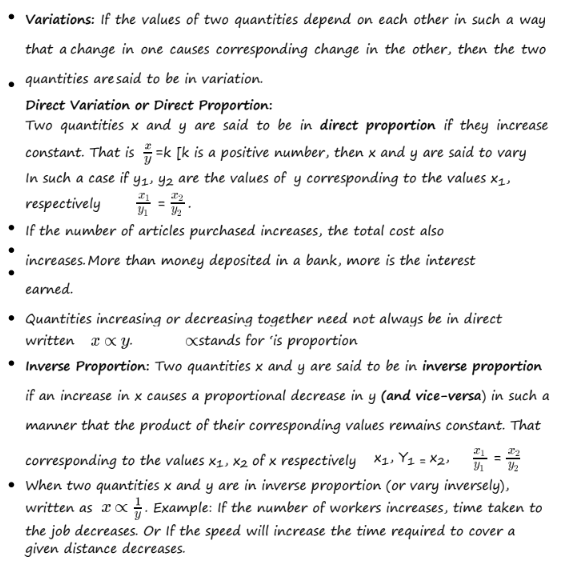
Variations: If the values of two quantities depend on each other in such a way that a change in one causes corresponding change in the other, then the two quantities are said to be in variation. (Scroll down to continue …)
Study Tools
Audio, Visual & Digital Content
Direct Variation or Direct Proportion:
Extra:
Two quantities x and y are said to be in direct proportion if they increase (decrease) together in such a manner that the ratio of their corresponding values remains
constant. That is if
=k [k is a positive number, then x and y are said to vary directly.
In such a case if y1, y2 are the values of y corresponding to the values x1, x of x
respectively then = .
If the number of articles purchased increases, the total cost also increases. More than money deposited in a bank, more is the interest earned.
Quantities increasing or decreasing together need not always be in direct proportion, same in the case of inverse proportion.
When two quantities x and y are in direct proportion (or vary directly), they are
written as
. Symbol
stands for ‘is proportion to’.
Inverse Proportion: Two quantities x and y are said to be in inverse proportion if an increase in x causes a proportional decrease in y (and vice-versa) in such a manner that the product of their corresponding values remains constant. That is, if xy
= k, then x and y are said to vary inversely. In this case if y1, y2 are the values of y
corresponding to the values x1, x2 of x respectively then
x1, Y1 = x2, y2 or
=
When two quantities x and y are in inverse proportion (or vary inversely), they are
written as x
. Example: If the number of workers increases, time taken to finish
the job decreases. Or If the speed will increase the time required to cover a given distance decreases.
1. Distance and Time
Time (hours)
Distance (km)
Formula
0
0
⇒ d=60×t
1
60
2
120
3
180
2. Cost of Groceries
Number of Apples
Total Cost ($)
Formula
0
0
C=2n
1
2
2
4
5
10
3.Cooking Ingredients
Number of Servings
Amount of Flour (cups)
Formula
0
0
F=0.5s
4
2
6
3
8
4
4. Speed and Fuel Consumption
Distance (km)
Fuel Consumed (liters)
Formula
0
0
F=15d
15
1
30
2
45
3
5. Salary and Hours Worked
Hours Worked
Total Earnings ($)
Formula
0
0
E=15h
1
15
5
75
10
150
Hindi Version
Dig Deep
Topic Level Resources
Sub – Topics
Select A Topic
Topic:
Chapters Index
Select Another Chapter
[display-posts category=”CBSE 8 – Mathematics – Study – Premium” posts_per_page=”25″]
Factorisation: Representation of an algebraic expression as the product of two or more expressions is called factorization. Each such expression is called a factor of the given algebraic expression. (Scroll down to continue …)
Study Tools
Audio, Visual & Digital Content
When we factorise an expression, we write it as a product of factors. These factors may be numbers, algebraic variables or algebraic expressions.
An irreducible factor is a factor which cannot be expressed further as a product of factors.
A systematic way of factorising an expression is the common factor method. It consists of three steps:
Write each term of the expression as a product of irreducible factors
Look for and separate the common factors and
Combine the remaining factors in each term in accordance with the distributive law.
Sometimes, all the terms in a given expression do not have a common factor; but the terms can be grouped in such a way that all the terms in each group have a common factor. When we do this, there emerges a common factor across all the groups leading to the required factorisation of the expression. This is the method of regrouping.
In factorisation by regrouping, we should remember that any regrouping (i.e., rearrangement) of the terms in the given expression may not lead to factorisation. We must observe the expression and come out with the desired regrouping by trial and error.
A number of expressions to be factorised are of the form or can be put into the form: a2 + 2ab + b2, a2 – 2ab + b2, a2 – b2 and x2 + (a + b)x + ab. These expressions can be easily factorised using Identities I, II, III and IV
a2 + 2ab + b2 = (a + b)2
a2 – 2ab + b2 = (a – b)2
a2 – b2 = (a + b) (a – b)
Factorisation
x2 + (a + b)x + ab = (x + a)(x + b)
In expressions which have factors of the type (x + a) (x + b), remember the numerical term gives ab.
Its factors, a and b, should be so chosen that their sum, with signs taken care of, is the coefficient of x.
We know that in the case of numbers, division is the inverse of multiplication. This idea is applicable also to the division of algebraic expressions.
In the case of division of a polynomial by a monomial, we may carry out the division either by dividing each term of the polynomial by the monomial or by the common factor method.
In the case of division of a polynomial by a polynomial, we cannot proceed by dividing each term in the dividend polynomial by the divisor polynomial. Instead, we factorise both the polynomials and cancel their common factors.
In the case of divisions of algebraic expressions that we studied in this chapter, we have Dividend = Divisor × Quotient.
In general, however, the relation is Dividend = Divisor × Quotient + Remainder
Thus, we have considered in the present chapter only those divisions in which the remainder is zero.
There are many errors students commonly make when solving algebra exercises.
You should avoid making such errors.
Hindi Version
Dig Deep
Topic Level Resources
Sub – Topics
Select A Topic
Topic:
Chapters Index
Select Another Chapter
[display-posts category=”CBSE 8 – Mathematics – Study – Premium” posts_per_page=”25″]
Graphical presentation of data is easier to understand.
A bar graph is used to show comparison among categories.
A pie graph is used to compare parts of a whole.
A Histogram is a bar graph that shows data in intervals. (Scrol down to continue …)
Study Tools
Audio, Visual & Digital Content
Introduction to Graphs
A line graph displays data that changes continuously over periods of time. A line graph which is a whole unbroken line is called a linear graph.
For fixing a point on the graph sheet we need, x-coordinate and y-coordinate.
The relation between dependent variable and
through a graph.
independent variable is shown
A Bar Graph: A pictorial representation of numerical data in the form of bars (rectangles) of uniform width with equal spacing. The length (or height) of each bar
represents the given number.
A Pie Graph: A pie graph is used to compare parts of a whole. The various
observations or components are represented by the sectors of the circle.
A Histogram: Histogram is a type of bar diagram, where the class intervals are shown on the horizontal axis and the heights of the bars (rectangles) show the frequency of the class interval, but there is no gap between the bars as there is no gap between the
class intervals.
Linear Graph: A line graph in which all the line segments form a part of a single line. Coordinates: A point in Cartesian plane is represented by an ordered pair of numbers.
Ordered Pair: A pair of numbers written in specified order.
Hindi Version
Dig Deep
Topic Level Resources
Sub – Topics
Select A Topic
Topic:
Chapters Index
Select Another Chapter
[display-posts category=”CBSE 8 – Mathematics – Study – Premium” posts_per_page=”25″]
Axiom 1: If a rays stands on a line , then the sum of two adjacent angles so formed is 180 0
Axiom 6.2 : If the sum of two adjacent angles is 180°, then the non-common arms of the angles form a line.
Theorem 6.1 : If two lines intersect each other, then the vertically opposite angles are equal.
Axiom 6.3 : If a transversal intersects two parallel lines, then each pair of corresponding angles is equal.
Axiom 6.4 : If a transversal intersects two lines such that a pair of corresponding angles is equal, then the two lines are parallel to each other.
Theorem 6.2 : If a transversal intersects two parallel lines, then each pair of alternate interior angles is equal
Theorem 6.3 : If a transversal intersects two lines such that a pair of alternate interior angles is equal, then the two lines are parallel.
Theorem 6.4 : If a transversal intersects two parallel lines, then each pair of interior angles on the same side of the transversal is supplementary.
Theorem 6.5 : If a transversal intersects two lines such that a pair of interior angles on the same side of the transversal is supplementary, then the two lines are parallel.
Theorem 6.6 : Lines which are parallel to the same line are parallel to each other.
Theorem 6.7 : The sum of the angles of a triangle is 180º
Theorem 6.8 : If a side of a triangle is produced, then the exterior angle so formed is equal to the sum of the two interior opposite angles.
TRIANGLES:
Axiom 7.1 (SAS congruence rule) : Two triangles are congruent if two sides and the included angle of one triangle are equal to the two sides and the included angle of the other triangle
Theorem 7.1 (ASA congruence rule) : Two triangles are congruent if two angles and the included side of one triangle are equal to two angles and the included side of other triangle
Theorem 7.2 : Angles opposite to equal sides of an isosceles triangle are equal.
Theorem 7.3 : The sides opposite to equal angles of a triangle are equal
Theorem 7.4 (SSS congruence rule) : If three sides of one triangle are equal to the three sides of another triangle, then the two triangles are congruent.
Theorem 7.5 (RHS congruence rule) : If in two right triangles the hypotenuse and one side of one triangle are equal to the hypotenuse and one side of the other triangle, then the two triangles are congruent.
Theorem 7.6 : If two sides of a triangle are unequal, the angle opposite to the longer side is larger (or greater).
Theorem 7.7 : In any triangle, the side opposite to the larger (greater) angle is longer.
Theorem 7.8 : The sum of any two sides of a triangle is greater than the third side
QUADRILATERALS
Theorem 8.1 : A diagonal of a parallelogram divides it into two congruent triangles.
Theorem 8.2 : In a parallelogram, opposite sides are equal.
Theorem 8.3 : If each pair of opposite sides of a quadrilateral is equal, then it is a parallelogram.
Theorem 8.4 : In a parallelogram, opposite angles are equal.
Theorem 8.5 : If in a quadrilateral, each pair of opposite angles is equal, then it is a parallelogram.
Theorem 8.6 : The diagonals of a parallelogram bisect each other
Theorem 8.7 : If the diagonals of a quadrilateral bisect each other, then it is a parallelogram
Theorem 8.8 : A quadrilateral is a parallelogram if a pair of opposite sides is equal and parallel.
Theorem 8.9 : The line segment joining the mid-points of two sides of a triangle is parallel to the third side.
Theorem 8.10 : The line drawn through the mid-point of one side of a triangle, parallel to another side bisects the third side.
AREAS OF PARALLELOGRAMS AND TRIANGLES
Theorem 9.1 : Parallelograms on the same base and between the same parallels are equal in area.
Theorem 9.2 : Two triangles on the same base (or equal bases) and between the same parallels are
equal in area
Theorem 9.3 : Two triangles having the same base (or equal bases) and equal areas lie between the same parallels
CIRCLES
Theorem 10.1 : Equal chords of a circle subtend equal angles at the centre.
Theorem 10.2 : If the angles subtended by the chords of a circle at the centre are equal, then the chords are equal.
Theorem 10.3 : The perpendicular from the centre of a circle to a chord bisects the chord.
Theorem 10.4 : The line drawn through the centre of a circle to bisect a chord is perpendicular to the chord.
Theorem 10.5 : There is one and only one circle passing through three given non-collinear points.
Theorem 10.6 : Equal chords of a circle (or of congruent circles) are equidistant from the centre (or centres).
Theorem 10.7 : Chords equidistant from the centre of a circle are equal in length.
Theorem 10.8 : The angle subtended by an arc at the centre is double the angle subtended by it at any point on the remaining part of the circle.
Theorem 10.9 : Angles in the same segment of a circle are equal
Theorem 10.10 : If a line segment joining two points subtends equal angles at two other points lying on the same side of the line containing the line segment, the four points lie on a circle (i.e. they are concyclic).
Theorem 10.11 : The sum of either pair of opposite angles of a cyclic quadrilateral is 180º.
Theorem 10.12 : If the sum of a pair of opposite angles of a quadrilateral is 180º, the quadrilateral is cyclic.
SURFACE AREAS AND VOLUMES
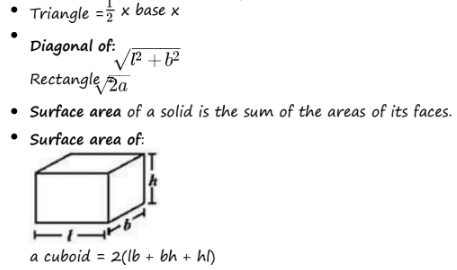
Surface Area of a Cuboid = 2(lb + bh + hl) where l, b and h are respectively the three edges of the cuboid
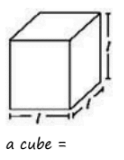
Surface Area of a Cube = 6a2
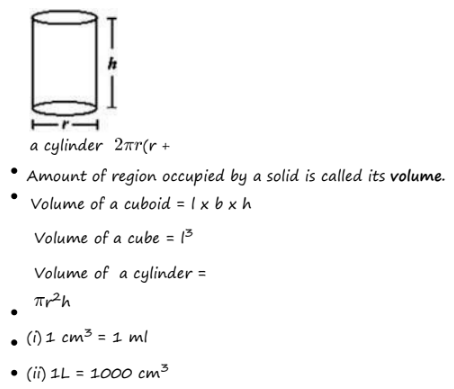
Curved Surface Area of a Cylinder = 2πrh
Total Surface Area of a Cylinder = 2πr(r + h)
Curved Surface Area of a Cone
= 1/2 × l × 2πr = πrl
L2= r2 + h2
Total Surface Area of a Cone
= πrl + πr22 = πr(l + r)
Surface Area of a Sphere = 4 π r2
Curved Surface Area of a Hemisphere = 2πr2
Total Surface Area of a Hemisphere = 3πr2
Volume of a Cuboid = base area × height = length × breadth × height
Sum of the measures of the external angles of any polygon is 360°.
The sum of the measures of the three angles of a triangle is 180°.
A parallelogram is a quadrilateral whose opposite sides are parallel
Property: The opposite sides of a parallelogram are of equal length
Property: The opposite angles of a parallelogram are of equal measure.
Property: The adjacent angles in a parallelogram are supplementary
Property: The diagonals of a parallelogram bisect each other (at the point of their intersection, of course!)
Property: The diagonals of a rhombus are perpendicular bisectors of one another
Property: The diagonals of a rectangle are of equal length.
Property: The diagonals of a square are perpendicular bisectors of each other
MENSURATION
1. Area of (i) a trapezium = half of the sum of
the lengths of parallel sides × perpendicular distance between them.
(ii) a rhombus = half the product of its diagonals.
2. Surface area of a solid is the sum of the areas of its faces.
3. Surface area of a cuboid = 2(lb + bh + hl) a cube = 6l 2 a cylinder = 2πr(r + h)
4. Amount of region occupied by a solid is called its volume.
5. Volume of a cuboid = l × b × h a cube = l3 a cylinder = πr 2h 6.
(i) 1 cm3 = 1 mL
(ii) 1L = 1000 cm3
(iii) 1 m3 = 1000000 cm3 = 1000L
EXPONENTS AND POWERS
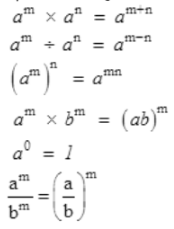
am × an = am+n
 am / an = am-n
(am)n = amn
(am)×(bn) = (ab)m+n
(a0)= am / am = 1
am/am = (a/b)m
Class 7
LINES AND ANGLES
sum of the measures of two angles is 90°, the angles are called complementary angles.
the sum of the measures of two angles is 180°, the angles are called supplementary angles.
These angles are such that:
(i) they have a common vertex;
(ii) they have a common arm;
(iii) the non-common arms are on either side of the common arm.
Such pairs of angles are called adjacent angles. Adjacent angles have a common vertex and a common arm but no common interior points.
A linear pair is a pair of adjacent angles whose non-common sides are opposite rays.
TRIANGLES
An exterior angle of a triangle is equal to the sum of its interior opposite angles.
Statement The total measure of the three angles of a triangle is 1800
A triangle in which all the three sides are of equal lengths is called an equilateral triangle.
A triangle in which two sides are of equal lengths is called an isosceles triangle.
1.The six elements of a triangle are its three angles and the three sides.
2.The line segment joining a vertex of a triangle to the mid point of its opposite side is called a median of the triangle. A triangle has 3 medians.
3.The perpendicular line segment from a vertex of a triangle to its opposite side is called an altitude of the triangle. A triangle has 3 altitudes.
4.An exterior angle of a triangle is formed, when a side of a triangle is produced. At each vertex, you have two ways of forming an exterior angle.
5.A property of exterior angles: The measure of any exterior angle of a triangle is equal to the sum of the measures of its interior opposite angles.
6.The angle sum property of a triangle: The total measure of the three angles of a triangle is 180°.
7. A triangle is said to be equilateral, if each one of its sides has the same length. In an equilateral triangle, each angle has measure 60°
8. A triangle is said to be isosceles, if atleast any two of its sides are of same length. The non-equal side of an isosceles triangle is called its base; the base angles of an isosceles triangle have equal measure.
9. Property of the lengths of sides of a triangle: The sum of the lengths of any two sides of a triangle is greater than the length of the third side. The difference between the lengths of any two sides is smaller than the length of the third side.
CONGRUENCE OF TRIANGLES
If two line segments have the same (i.e., equal) length, they are congruent. Also, if two line segments are congruent, they have the same length.
If two angles have the same measure, they are congruent. Also, if two angles are congruent, their measures are same.
SSS Congruence Criterion:
If under a given correspondence, the three sides of one triangle are equal to the three corresponding sides of another triangle, then the triangles are congruent.
SAS Congruence Criterion:
If under a correspondence, two sides and the angle included between them of a triangle are equal to two corresponding sides and the angle included between them of another triangle, then the triangles are congruent.
ASA Congruence Criterion:
If under a correspondence, two angles and the included side of a triangle are equal to two corresponding angles and the included side of another triangle, then the triangles are congruent.
RHS Congruence Criterion:
If under a correspondence, the hypotenuse and one side of a right-angled triangle are respectively equal to the hypotenuse and one side of another right-angled triangle, then the triangles are congruent.