A plane formed by two number lines, one horizontal
and the other vertical, such that they intersect each
other at their zeroes, and then they form a Cartesian
Plane.
Scroll Down To Continue …
Study Tools
Audio, Visual & Digital Content
Coordinate Axes:
The position of a point in a plane is fixed by selecting the axes of reference which are formed by two number lines intersecting each other at right angles, so that their zeroes coincide.
The horizontal number line is called x-axis and vertical number line is called y axis.
A point that lies on X Axis is (x,0)
A point that lies on Y Axis is (0,y)
Equation of Y Axis is x = 0
Equation of X Axis is y = 0
Equation of a lne parallel to Y Axis is x = a
Equation of a lne parallel to X Axis is y = a
Equation of a lne perpendicular to X Axis is X = a
Equation of a lne perpendicular to X Axis is X = a
The point of intersection of the two lines is called origin.
is the x-axis and Y1OY is the y-axis. These coordinate axes are also called rectangular axes as they are perpendicular to each other.
Rectangular coordinates are ordered pairs in which the first element is called the abscissa and the second element is called the ordinate.
● In the first quadrant, x is + ve and y is + ve
● In the second quadrant, x is – ve and y is + ve
● In the third quadrant, x is – ve and y is – ve
● In the fourth quadrant, x is + ve and y is -ve.
Distance Formula:
Example:
Example:
Collinearity of three points:
Three points P, Q and R are said to be collinear, if they lie in the same straight line.
i.e., PR = PQ + QR
i.e., PQ = PR + RQ
i.e., QR = QP + PR
If three points are not collinear, they always form a triangle.
Special Polygons:
(i) In Case of Triangle
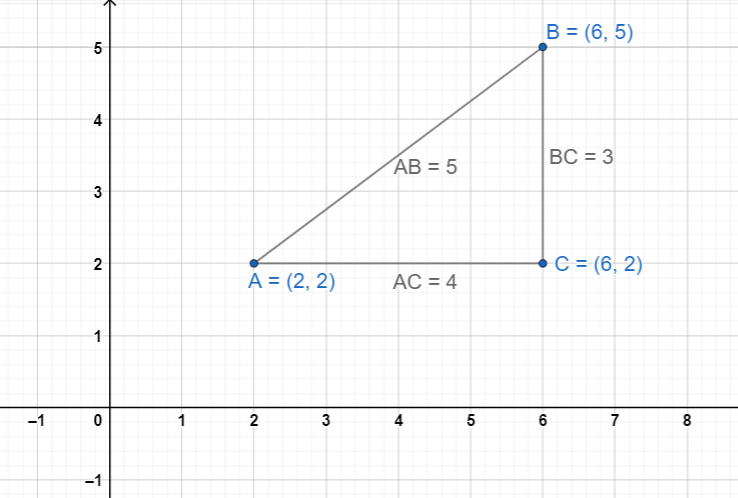
(a) a right-angled triangle, if sum of squares of any two sides is equal to square of third side.
(b) an equilateral triangle, if all the three sides are equal.
(c) an isosceles triangle, if any two sides are equal.
(ii) In Case of Quadrilateral
(a) parallelogram, if opposite sides are equal and diagonals are not equal.
(b) rectangle, if opposite sides are equal and diagonals are equal.
(c) square, if all the four sides are equal and diagonals are equal.
(d) rhombus, if all the four sides are equal and diagonals are not equal.
Section Formula (Internal division only)
Midpoint Formula:
Point Dividing Two points in K : 1 Ratio:
Note:
If k is positive, the point divides the given points internally.
If k is Negative, the point divides the given points externally
Coordinates of the centroid of a triangle:
Points of Trisection:
If a line segment is divided into three equal parts by two points, the points are said to be the points of trisection.
In the given figure, the points R and S divide the line segment PQ into three equal parts i.e., PR=RS=SQ. The points R and S are said to be points of trisection.
Area of a Triangle:
The area of the triangle formed by the points
is calculated by the following expression.
Area of ∆PQR =
Area of Quadrilateral:
Area of a quadrilateral can be found by splitting up the quadrilateral into two triangles and sum up their areas.
Thus, area of quadrilateral PQRS = area of ∆PQR+ area of ∆PRS
Condition for collinearity of three points :
Three given points will be collinear, if the area of the triangle formed by these points is zero.
Rule to prove that three given points are collinear:
Step 1. Find the area of the triangle formed by the given points.
Step 2. Show that the area of the triangle formed by the given points is zero.
* The coordinates of the origin are O(0,0)
* The coordinates of any point on x-axis are (x, 0)
i.e., y=0 or ordinate is zero.
* The coordinates of any point on y – axis are (0, y) i.e., x=0 or abscissa is zero.
The numbers 1,2, 3, ……which we usefor counting areknown as natural numbers. If you add1 to a natural number, we get itssuccessor. If yousubtract 1 froma natural number, you get itspredecessor. Every natural number has a successor. Every natural number except 1 has apredecessor. If we addthe number zeroto the collection of natural numbers, we get thecollection of whole numbers. (Scroll down to continue …)
Study Tools
Audio, Visual & Digital Content
Thus, the numbers 0, 1, 2, 3, … form the collection of whole numbers. Every wholenumber has asuccessor. Every whole number except zerohas a predecessor. All natural numbers are wholenumbers, but allwhole numbers arenot natural numbers. We take a line, mark a point on it and label it 0. We then mark out points to the right of 0, at equal intervals. Label them as1, 2, 3,…………………………………. Thus, we havea number linewith the whole numbers represented on it.We can easily perform the number operations of addition, subtraction and multiplication on the number line. Addition corresponds to moving tothe right onthe number line, whereas subtraction corresponds to moving to the left. Multiplication corresponds to making jumps of equal distance starting from zero. Addingtwo whole numbers always gives a whole number. Similarly, multiplying twowhole numbers always gives a whole number. We say that whole numbers are closed under addition and also under multiplication. However, whole numbers are not closed under subtraction andunder division. Division by zerois not defined. Zero is theidentity for addition of whole numbers. The whole number 1 is theidentity for multiplication of whole numbers. You can addtwo whole numbers in any order. You can multiply two whole numbers
in anyorder. We saythat addition andmultiplication are commutative for whole numbers. Addition and multiplication, both, are associative for whole numbers. Multiplication isdistributive over addition for whole numbers. Commutativity, associativity and distributivity properties of whole numbers are useful in simplifying calculations and we use them without being aware of them.Patterns with numbers are not onlyinteresting, but areuseful especially forverbal calculations and helpus to understand properties of numbers better.
Hindi Version
Dig Deep
Topic Level Resources
Sub – Topics
Select A Topic
Topic:
Chapters Index
Select Another Chapter
[display-posts category=”CBSE 6 – Mathematics – Study – Premium” posts_per_page=”25″]
Whole Numbers The numbers 1,2, 3, ……which we usefor counting areknown as natural numbers. If you add1 to a natural number, we get itssuccessor. If yousubtract 1 froma natural number, you get itspredecessor. (Scroll down to continue …)
Study Tools
Audio, Visual & Digital Content
Every natural number has a successor. Every natural number except 1 has apredecessor. If we addthe number zeroto the collection of natural numbers, we get thecollection of whole numbers. Thus, the numbers 0, 1, 2, 3, … form the collection of whole numbers. Every wholenumber has asuccessor. Every whole number except zerohas a predecessor. All natural numbers are wholenumbers, but allwhole numbers arenot natural numbers. We take a line, mark a point on it and label it 0. We then mark out points to the right of 0, at equal intervals. Label them as1, 2, 3,…………………………………. Thus, we havea number linewith the whole numbers represented on it.We can easily perform the number operations of addition, subtraction and multiplication on the number line. Addition corresponds to moving tothe right onthe number line, whereas subtraction corresponds to moving to the left. Multiplication corresponds to making jumps of equal distance starting from zero. Addingtwo whole numbers always gives a whole number. Similarly, multiplying twowhole numbers always gives a whole number. We say that whole numbers are closed under addition and also under multiplication. However, whole numbers are not closed under subtraction andunder division. Division by zerois not defined. Zero is theidentity for addition of whole numbers. The whole number 1 is theidentity for multiplication of whole numbers. You can addtwo whole numbers in any order. You can multiply two whole numbers in anyorder. We saythat addition andmultiplication are commutative for whole numbers. Addition and multiplication, both, are associative for whole numbers. Multiplication isdistributive over addition for whole numbers. Commutativity, associativity and distributivity properties of whole numbers are useful in simplifying calculations and we use them without being aware of them.Patterns with numbers are not onlyinteresting, but areuseful especially forverbal calculations and helpus to understand properties of numbers better.
Hindi Version
Dig Deep
Topic Level Resources
Sub – Topics
Select A Topic
Topic:
Chapters Index
Select Another Chapter
[display-posts category=”CBSE 6 – Mathematics – Study – Premium” posts_per_page=”25″]
We have discussed multiples, divisors, factors and have seenhow to identify factors and multiples. We have discussed and discovered thefollowing: (a) A factor of a number is an exactdivisor of thatnumber. (Scroll down to continue …)
Study Tools
Audio, Visual & Digital Content
(b) Every number is a factor of itself. 1 is a factor ofevery number.
(c) Every factor ofa number isless than or equal tothe given number.
(d) Every number isa multiple ofeach of itsfactors.
(e) Every multiple ofa given number is greater thanor equal tothat number.
(f) Every number is a multiple of itself.
We have learnt that – (a) The number otherthan 1, withonly factors namely 1 and thenumber itself, isa prime number. Numbers that have more than two factors are called composite numbers. Number 1is neither prime nor composite.
(b) The number 2is the smallest prime number andis even. Every prime number other than 2 isodd.
(c) Two numbers withonly 1 asa common factor are called co-prime numbers.
(d) If a number is divisible byanother number thenit is divisible by each of the factors of that number.
(e) A number divisible by two co-prime numbers is divisible by their product also.
We have discussed how we can find just by looking at a number, whether it is divisible by small numbers 2,3,4,5,8,9 and 11.
We have explored the relationship between digits of thenumbers and theirdivisibility by different numbers.
(a) Divisibility by 2,5and 10 canbe seen byjust the lastdigit.
(b) Divisibility by 3and 9 ischecked by finding the sum ofall digits.
(c) Divisibility by 4 and 8is checked bythe last 2and 3 digits respectively.
(d) Divisibility of11 is checked by comparing thesum of digits at odd andeven places.
We have discovered that if twonumbers are divisible by a number then their sum and difference are also divisible by that number.
We have learnt that – (a) The Highest Common Factor (HCF) of two ormore given numbers is the highest of their common factors.
(b) The Lowest Common Multiple (LCM) of two ormore given numbers is the lowest of their common multiples.
Hindi Version
Dig Deep
Topic Level Resources
Sub – Topics
Select A Topic
Topic:
Chapters Index
Select Another Chapter
[display-posts category=”CBSE 6 – Mathematics – Study – Premium” posts_per_page=”25″]