Practice Questions & Answered Practice Questions & Answered Practice Questions & Answered Practice Questions & Answered Practice Questions & Answered Practice Questions & Answered Practice Questions & Answered Practice Questions & Answered
Whole Numbers The numbers 1,2, 3, ……which we use for counting are known as natural numbers. If you add 1 to a natural number, we get its successor. If you subtract 1 from a natural number, you get its predecessor. (Scroll down to continue …)
Study Tools
Audio, Visual & Digital Content
Integers
Definition
Integers are the set of whole numbers that include positive numbers, negative numbers, and zero. The set of integers can be represented as: Integers={…,−3,−2,−1,0,1,2,3,…}Integers={…,−3,−2,−1,0,1,2,3,…}
Key Properties of Integers
Closure Properties:
Addition: The sum of any two integers is an integer.
Examples:
2+3=52+3=5
−1+4=3−1+4=3
−2+(−3)=−5−2+(−3)=−5
Subtraction: The difference between any two integers is an integer.
Examples:
5−3=25−3=2
−2−1=−3−2−1=−3
0−(−4)=40−(−4)=4
Multiplication: The product of any two integers is an integer.
Examples:
3×2=63×2=6
−4×5=−20−4×5=−20
−3×−2=6−3×−2=6
Identity Elements:
Additive Identity: The integer 0 is the identity element for addition.
Examples:
7+0=77+0=7
−5+0=−5−5+0=−5
0+0=00+0=0
Multiplicative Identity: The integer 1 is the identity element for multiplication.
Examples:
4×1=44×1=4
−3×1=−3−3×1=−3
0×1=00×1=0
Inverse Elements:
Additive Inverse: For every integer a, there exists an integer −a such that a+(−a)=a+−a=0.
Examples:
The additive inverse of 5 is -5: 5+(−5)=5+−5=0
The additive inverse of -3 is 3: −3+3=0
The additive inverse of 0 is 0: 0+0=0
Multiplicative Inverse: Integers do not have multiplicative inverses within the set of integers (except for 1 and -1).
−5,−2,0,4,3−5,−2,0,4,3 arranged in order: −5<−2<0<3<4−5<−2<0<3<4
Absolute Value
The absolute value of an integer is its distance from zero on the number line, regardless of direction.
Notation: ∣a∣∣a∣
Examples:
∣3∣=3∣3∣=3
∣−3∣=3∣−3∣=3
∣0∣=0∣0∣=0
Conclusion
Understanding integers and their properties is fundamental in mathematics. They play a critical role in various areas, including algebra, number theory, and real-world applications. Mastery of integer operations is essential for higher-level mathematics.
Hindi Version
Dig Deep
Topic Level Resources
Sub – Topics
Select A Topic
Topic:
Chapters Index
Select Another Chapter
[display-posts category=”CBSE 6 – Mathematics – Study – Premium” posts_per_page=”25″]
A polynomial is an algebraic expression that includes constants, variables, and exponents. It is the expression in which the variables have only positive integral powers.
Example
1. 4x3 + 3x2 + x +3 is a polynomial in variable x.
2. 4x2 + 3x-1 – 4 is not a polynomial as it has negative power.
3. 3x3/2 + 2x – 3 is not a polynomial, since it power is not an integer.
.
Polynomials are denoted by p (x), q (x), etc.
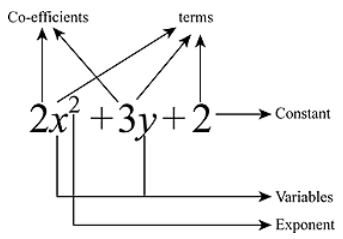
In the above polynomials, 2x2, 3y, and 2 are the terms of the polynomial.
2 and 3 are the coefficients of x2 and y, respectively.
x and y are the variables.
2 is the constant term, which has no variable.
Polynomials in One Variable
If there is only one variable in the expression, then this is called the polynomial in one variable.
Example
x3 + x – 4 is polynomial in variable x and is denoted by p(x).
r2 + 2 is polynomial in variable r and is denoted by p(r).
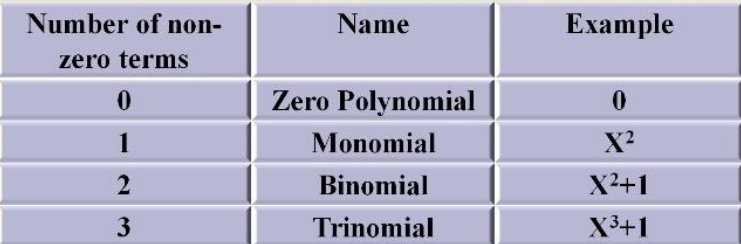
Types of polynomials on the basis of the number of terms
Types of polynomials on the basis of the number of degrees
The highest value of the power of the variable in the polynomial is the degree of the polynomial.
Zeros of a Polynomial
If p(x) is a polynomial, then the number ‘a’ will be the zero of the polynomial with p(a) = 0. We can find the zero of the polynomial by equating it to zero.
Example: 1
The given polynomial is p(x) = x – 4
To find the zero of the polynomial, we will equate it to zero.
x – 4 = 0
x = 4
p(4) = x – 4 = 4 – 4 = 0
This shows that if we place 4 in place of x, we get the value of the polynomial as zero. So 4 is the zero of this polynomial. And also, we are getting the value 4 by equating the polynomial with 0.
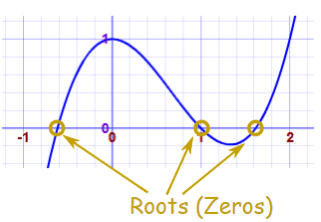
So 4 is the zero of the polynomial or the root of the polynomial.
The root of the polynomial is basically the x-intercept of the polynomial.
If the polynomial has one root, it will intersect the x-axis at one point only, and if it has two roots, it will intersect at two points, and so on.
Example: 2
Find p (1) for the polynomial p (t) = t2 – t + 1
p (1) = (1)2 – 1 + 1
= 1 – 1 + 1
= 1
Remainder Theorem
We know the property of division which follows in the basic division, i.e.
Dividend = (Divisor × Quotient) + Remainder
This follows the division of polynomials.
If p(x) and g(x) are two polynomials in which the degrees of p(x) ≥ degree of g(x) and g(x) ≠ 0 are given, then we can get the q(x) and r(x) so that:
P(x) = g(x) q(x) + r(x),
where r(x) = 0 or degree of r(x) < degree of g(x).
It says that p(x) divided by g(x), gives q(x) as a quotient and r(x) as a remainder.
Let’s understand it with an example
Division of a Polynomial with a Monomial
We can see that ‘x’ is common in the above polynomial, so we can write it as
Hence, 3x2 + x + 1 and x the factors of 3x3 + x2 + x.
Steps of the Division of a Polynomial with a Non –Zero Polynomial
Divide x2 – 3x -10 by 2 + x
Step 1: Write the dividend and divisor in descending order, i.e., in the standard form. x2 – 3x -10 and x + 2
Divide the first term of the dividend with the first term of the divisor.
x2/x = x this will be the first term of the quotient.
Step 2: Now multiply the divisor by this term of the quotient and subtract it from the dividend.
Step 3: Now the remainder is our new dividend, so we will repeat the process again by dividing the dividend by the divisor.
Step 4: – (5x/x) = – 5
Step 5:
The remainder is zero.
Hence x2 – 3x – 10 = (x + 2)(x – 5) + 0
Dividend = (Divisor × Quotient) + Remainder
The Remainder Theorem says that if p(x) is any polynomial of degree greater than or equal to one and let ‘t’ be any real number and p (x) is divided by the linear polynomial x – t, then the remainder is p(t).
As we know,
P(x) = g(x) q(x) + r(x)
If p(x) is divided by (x-t) then
If x = t
P (t) = (t – t). q (t) + r = 0
To find the remainder or to check the multiple of the polynomial, we can use the remainder theorem.
Example:
What is the remainder if a4 + a3 – 2a2 + a + 1 is divided by a – 1.
Solution:
P(x) = a4 + a3 – 2a2 + a + 1
To find the zero of (a – 1), we need to equate it to zero.
a -1 = 0
a = 1
p (1) = (1)4 + (1)3 – 2(1)2 + (1) + 1
= 1 + 1 – 2 + 1 + 1
= 2
So by using the remainder theorem, we can easily find the remainder after the division of the polynomial.
Factor Theorem
The factor theorem says that if p(y) is a polynomial with degree n≥1 and t is a real number, then
(y – t) is a factor of p(y), if p(t) = 0, and
P (t) = 0 if (y – t) is a factor of p (y).
Example: 1
Check whether g(x) = x – 3 is the factor of p(x) = x3 – 4x2 + x + 6 using the factor theorem.
Solution:
According to the factor theorem, if x – 3 is the factor of p(x), then p(3) = 0, as the root of x – 3 is 3.
P (3) = (3)3 – 4(3)2 + (3) + 6
= 27 – 36 + 3 + 6 = 0
Hence, g (x) is the factor of p (x).
Example: 2
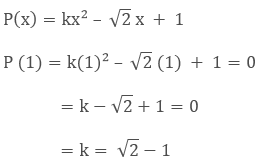
Find the value of k, if x – 1 is a factor of p(x) = kx2 – √2x + 1
Solution:
As x -1 is the factor, p(1) = 0
Factorization of Polynomials
Factorization can be done by three methods
1. By taking out the common factor
If we have to factorise x2 –x then we can do it by taking x common.
x(x – 1) so that x and x-1 are the factors of x2 – x.
2. By grouping
ab + bc + ax + cx = (ab + bc) + (ax + cx)
= b(a + c) + x(a + c)
= (a + c)(b + x)
3. By splitting the middle term
x2 + bx + c = x2 + (p + q) + pq
= (x + p)(x + q)
This shows that we have to split the middle term in such a way that the sum of the two terms is equal to ‘b’ and the product is equal to ‘c’.
Example: 1
Factorize 6x2 + 17x + 5 by splitting the middle term.
Solution:
If we can find two numbers p and q such that p + q = 17 and pq = 6 × 5 = 30, then we can get the factors.
Some of the factors of 30 are 1 and 30, 2 and 15, 3 and 10, 5 and 6, out of which 2 and 15 is the pair which gives p + q = 17.
Any closed polygon with four sides, four angles and four vertices are called Quadrilateral. It could be regular or irregular. (Sroll down to continute …)
Study Tools
Audio, Visual & Digital Content
Revision Notes – CBSE 09 Math – Quadrilaterals
Quadrilaterals
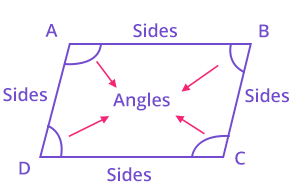
A simple closed figure bounded by four line segments is called a quadrilateral, it has four sides i.e., AB, BC, CD and AD and four vertices as A, B, Can d D and the sum of all angles of a quadrilateral is 360.
Characteristics of a quadrilateral
Angle Sum Property of a Quadrilateral:
Quadrilateral is a four sided closed figure.
Sum of all angles of a quadrilateral is 360°.
Parts Of Quadrilaterals
Types Of Quadrilaterals
Classification of quadrilaterals
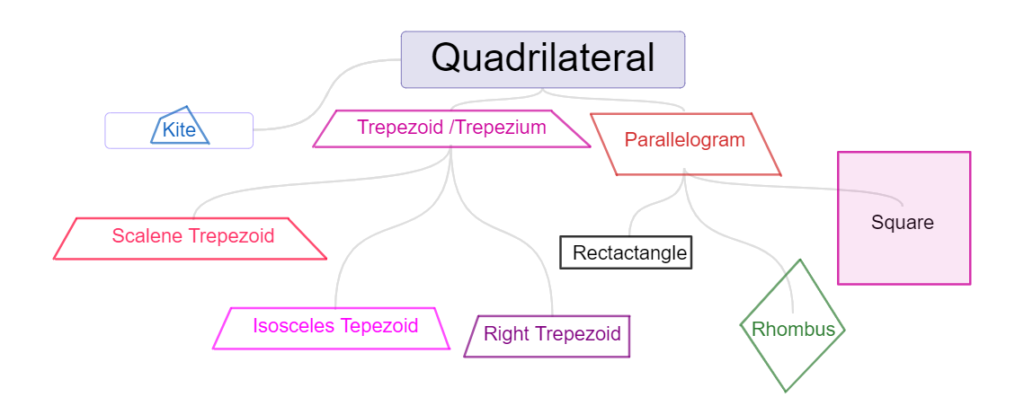
Quadrilaterals are broadly classified into three categories as:
(i) Kite
(ii) Trapezium
(ii) Parallelogram
Kite:
A kite is a quadrilateral with two distinct pairs of adjacent sides that are equal in length. It resembles a flying kite in shape.
🪁 Types of Kites:
There are several types of kites based on their properties:
Square Kites:
All four sides are equal in length, making it both a kite and a square.
Rhombus Kites:
All four sides are equal in length, and opposite angles are equal, making it both a kite and a rhombus.
Right Kites:
One pair of opposite angles is a right angle (90 degrees).
Equilateral Kites:
Two pairs of adjacent sides are equal, and the diagonals are perpendicular bisectors of each other.
(i) Kite has no parallel sides
(ii) Kite has a pair of equal adjacent sides.
(ii) It is not a parallelogram
Characteristics Of Kite:
Perimeter Of Kite
Area Of Kite
Trapezium:
Trapezium is a quadrilateral with the following characteristics:
(i) One pair of opposite sides is parallel to each other.
(ii) The other pair of opposite sides may not be parallel to each other.
Characteristics Of Trapezium
(i) Sum of all angles of a quadrilateral is 360°.
(ii) One pair of opposite sides is parallel to each other.
(iii) The other pair of opposite sides need not be parallel to each other.
Types Of Trapezium:
Quadrilaterals are broadly classified into two categories as:
(i) Isosceles Trapezium.
(ii) Scalene Trapezium.
(i) Right Trapezium.
Isosceles Trapezium:
Isosceles Trapezium is a quadrilateral with the following characteristics:
(i) One pair of opposite sides is parallel to each other.
(ii) The other pair of opposite sides are equal.
(iii) The other pair of opposite sides need not be parallel to each other.
Isosceles Trapezium is a trapezium with the following characteristics:
(i) One pair of opposite sides is parallel to each other.
(ii) The other pair of opposite sides are equal.
(iii) The other pair of opposite sides need not be parallel to each other.
Characteristics Of Isosceles Trapezium
(i) Sum of all angles of a quadrilateral is 360°.
(ii) One pair of opposite sides is parallel to each other.
(iii) The other pair of opposite sides are equal.
(iv) The other pair of opposite sides need not be parallel to each other.
Scalene Trapezium:
Scalene trapezium: Classified by the length of the legs or the measurement of their angles.
Characteristics Of Scalene Trapezium
Right Trapezium:
Right trapezium: Has one pair of parallel sides and one pair of right angles.
Characteristics Of Right Trapezium
Perimeter Of Trapezium
Area Of Trapezium
Parallelogram:
A parallelogram is a quadrilateral (a four-sided polygon) in which both pairs of opposite sides are parallel and equal in length.
In other words, Parallelogram is a quadrilateral with the following characteristics:
Characteristics of a parallelogram
Parallelogramis a quadrilateral with the following characteristics:
(i) Two pairs of opposite sides are parallel to each other.
(ii) Two pairs of opposite sides are equal in length.
(iii) Sum of all angles of a Parallelogram is 360°.
(iv) Two pairs of opposite sides are parallel to each other.
(v) Two pairs of opposite sides are equal in length.
(vi) Two pairs of opposite angles are equal.
(vii) Diagonals bisect each other.
(viii) Diagonals need not be equal to each other.
(ix) Diagonals divide it into two congruent triangles.
Types Of Parallelogram
Parallelograms are broadly classified into three categories as:
(i) Rectangle (ii) Rhombus (iii) Square
Perimeter Of Parallelogram:
Perimeter of a Parallelogram is the length of the boundary of the Parallelogram.
Perimeter of a Parallelogram = 2(length + width)
Area Of Parallelogram
Measure of the space enclosed by the boundary of a Parallelogram is called its area.
Area of a Parallelogram = Base x Height
Rectangle:
A rectangle is a Parallelogram with four right angles.
In other words, A rectangle is a quadrilateral (a four-sided polygon) in which both pairs of opposite sides are parallel and equal in length.and has four right angles.
Characteristics Of Rectangle
Rectangleis a quadrilateral with the following characteristics:
(i) Two pairs of opposite sides are parallel to each other.
(ii) Two pairs of opposite sides are equal in length.
(iii) All four angles are right angles. (each angle is 90 o).Sum of all angles of a quadrilateral is 360°.
(iv) Two pairs of opposite sides are parallel to each other.
(v) Two pairs of opposite sides are equal in length.
(vi) All four angles are right angles. (each angle is 90 o).
(vii) Diagonals bisect each other.
(viii) Diagonals are equal to each other.
(ix) Diagonals of a rectangle divide it into two congruent triangles.
Conclusions:
Every Rectangle is a Parallelogram. But Every Parallelogram need not be a Rectangle.
Condition for a rhombus to be a square:
If all four angles of a parallelogram are right angles. (each angle is 90 o), the parallelogram becomes a Rectangle.
Perimeter Of Rectangle
Perimeter of a rectangle is the length of the boundary of the rectangle.
Perimeter of a rectangle = 2(length + width)
Area Of Rectangle
Measure of the space enclosed by the boundary of a rectangle is called its area.
Area of a rectangle = length x width
Rhombus:
Rhombus is a Parallelogram with four equal sides.
In other words, A rectangle is a quadrilateral (a four-sided polygon) in which both pairs of opposite sides are parallel and equal in length.and also has four equal sides.
Characteristics Of Rhombus
Rhombusis a quadrilateral with the following characteristics:
(i) Two pairs of opposite sides are parallel to each other.
(ii) All four sides are equal in length.
(iii) Sum of all angles of a quadrilateral is 360°.
(iv) Two pairs of opposite sides are parallel to each other.
(v) All four sides are equal in length.
(vi) Two pairs of opposite angles are equal.
(vii) Diagonals bisect each other.
(viii) Diagonals need not be equal to each other.
(ix) Diagonals divide a Rhombus into two congruent triangles.
Conclusions:
Every Rhombus is a Parallelogram. But Every Parallelogram need not be a Rhombus.
Condition for a rhombus to be a square:
If all four angles of the Rhombus are right angles, the Rhombus becomes a square.
If all the sides of a parallelogram are equal, the parallelogram becomes a Rhombus.
Perimeter Of Rhombus
Perimeter of a Rhombus is the length of the boundary of the Rhombus.
Perimeter of Rhombus = 2(length + width)
Area Of Rhombus
Measure of the space enclosed by the boundary of a rhombus is called its area.
Area of Rhombus = ½(Diagonal 1 + Diagonal 2 x height)
Area of Rhombus = Base x Height
Square:
Characteristics Of Square
Square is a quadrilateral with the following characteristics:
(i) Two pairs of opposite sides are parallel to each other.
(ii) All four sides are equal in length.
(iii) All four angles are right angles. (each angle is 90 o).
(iv) Sum of all angles of a quadrilateral is 360°.
(v) Diagonals bisect each other.
(vi) Diagonals need not be equal to each other.
(vii) Diagonals divide a Rhombus into two congruent triangles.
Conclusions:
Every square is a Rhombus. But Every Rhombus need not be a square.
Condition for a rhombus to be a square:
If all the angles of a rhombus are right angles (equal to 90o), the rhombus becomes a square.
Condition for a parallelogramto be a square:
(i) If all the angles of a parallelogram are right angles (equal to 90o), and all the sides of a parallelogram are equal in length, the parallelogram becomes a square.
Note: Every Square is a rectangle. But Every Rectangle need not be a square.
Condition for a Rectangleto be a square:
If all the sides of a Rectangle are equal in length, the Rectangle becomes a square.
Perimeter Of Square
Perimeter of a Square is the length of the boundary of the square.
Perimeter of square = 4(side)
Area Of Square
Measure of the space enclosed by the boundary of a Square is called its area.
Area of square = side2
Practical Geometry Of Quadrilaterals:
Angle Sum Property of a Quadrilateral
The sum of the four angles of a quadrilateral is 360°
If we draw a diagonal in the quadrilateral, it divides it into two triangles.
And we know the angle sum property of a triangle i.e. the sum of all the three angles of a triangle is 180°.
The sum of angles of ∆ADC = 180°.
The sum of angles of ∆ABC = 180°.
By adding both we get ∠A + ∠B + ∠C + ∠D = 360°
Hence, the sum of the four angles of a quadrilateral is 360°.
Example
Find ∠A and ∠D, if BC∥ AD and ∠B = 52° and ∠C = 60° in the quadrilateral ABCD.
Solution:
Given BC ∥ AD, so ∠A and ∠B are consecutive interior angles.
So ∠A + ∠B = 180° (Sum of consecutive interior angles is 180°).
∠B = 52°
∠A = 180°- 52° = 128°
∠A + ∠B + ∠C + ∠D = 360° (Sum of the four angles of a quadrilateral is 360°).
∠C = 60°
128° + 52° + 60° + ∠D = 360°
∠D = 120°
∴ ∠A = 128° and ∠D = 120 °.
Types of Quadrilaterals
S No.
Quadrilateral
Property
Image
1.
Trapezium
One pair of opposite sides is parallel.
2.
Parallelogram
Both pairs of opposite sides are parallel.
3.
Rectangle
a. Both the pair of opposite sides is parallel.b. Opposite sides are equal.c. All the four angles are 90°.
4.
Square
a. All four sides are equal.b. Opposite sides are parallel.c. All the four angles are 90°.
5.
Rhombus
a. All four sides are equal.b. Opposite sides are parallel.c. Opposite angles are equal.d. Diagonals intersect each other at the centre and at 90°.
6.
Kite
Two pairs of adjacent sides are equal.
Remark: A square, Rectangle and Rhombus are also a parallelogram.
Properties of a Parallelogram
Theorem 1: When we divide a parallelogram into two parts diagonally then it divides it into two congruent triangles.
∆ABD ≅ ∆CDB
Theorem 2: In a parallelogram, opposite sides will always be equal.
Theorem 3: A quadrilateral will be a parallelogram if each pair of its opposite sides will be equal.
Here, AD = BC and AB = DC
Then ABCD is a parallelogram.
Theorem 4: In a parallelogram, opposite angles are equal.
In ABCD, ∠A = ∠C and ∠B = ∠D
Theorem 5: In a quadrilateral, if each pair of opposite angles is equal, then it is said to be a parallelogram. This is the reverse of Theorem 4.
Theorem 6: The diagonals of a parallelogram bisect each other.
Here, AC and BD are the diagonals of the parallelogram ABCD.
So the bisect each other at the centre.
DE = EB and AE = EC
Theorem 7: When the diagonals of the given quadrilateral bisect each other, then it is a parallelogram.
This is the reverse of the theorem 6.
The Mid-point Theorem
1. If a line segment joins the midpoints of the two sides of the triangle then it will be parallel to the third side of the triangle.
If AB = BC and CD = DE then BD ∥ AE.
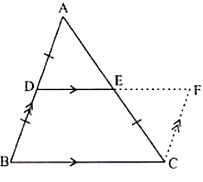
2. If a line starts from the midpoint of one line and that line is parallel to the third line then it will intersect the midpoint of the third line.
If D is the midpoint of AB and DE∥ BC then E is the midpoint of AC.
Example
Prove that C is the midpoint of BF if ABFE is a trapezium and AB ∥ EF.D is the midpoint of AE and EF∥ DC.
Solution:
Let BE cut DC at a point G.
Now in ∆AEB, D is the midpoint of AE and DG ∥ AB.
By midpoint theorem, G is the midpoint of EB.
Again in ∆BEF, G is the midpoint of BE and GC∥ EF.
We haveseen that there are times whenwe need touse numbers witha negative sign. This is when we want to go below zero on the number line. These are called negative numbers. Some examples of their use can be in temperature scale, water level in lake or river, level of oil in tank etc. (Scroll down to continue …)
Study Tools
Audio, Visual & Digital Content
They are also used to denote debit account or outstanding dues. The collection of numbers…, – 4, – 3, – 2, – 1, 0, 1, 2, 3, 4, … is called integers. So, – 1,– 2, – 3, – 4, … called negative numbers are negative integers and 1, 2, 3, 4, … called positive numbers are the positive integers. We havealso seen howone more thangiven number givesa successor andone less than given number gives predecessor. We observe that (a) When we havethe same sign,add and putthe same sign. (i) When two positive integers are added, we get a positive integer [e.g.. (+3) + (+2) = + 5]. (ii) When two negative integers are added, we get a negative integer [e.g.. (–2) +(–1)= – 3]. (b) When one positive and one negative integers are added we subtract them as whole numbers by considering thenumbers without their sign and thenput the signof the bigger number with the subtraction obtained. The bigger integer is decided by ignoring thesigns of theintegers [e.g.. (+4)+ (–3) =+ 1 and(–4) + (+3)= – 1]. (c) The subtraction ofan integer isthe same asthe addition ofits additive inverse. We have shownhow addition andsubtraction of integers can also beshown on a number line.
Hindi Version
Dig Deep
Topic Level Resources
Sub – Topics
Select A Topic
Topic:
Chapters Index
Select Another Chapter
[display-posts category=”CBSE 6 – Mathematics – Study – Premium” posts_per_page=”25″]
What havewe discussed? A fraction is a number representing a partof a whole. The whole maybe a single object or agroup of objects. (Scroll down to continue …)
Study Tools
Audio, Visual & Digital Content
Whenexpressing a situation of counting partsto write a fraction, itmust be ensured that allparts are equal.
In5/7, 5 iscalled the numerator and 7 iscalled the denominator.
Fractions can beshown on a number line.
Every fraction has a point associated with it onthe number line.
In a proper fraction, the numerator is less than the denominator.
Thefractions, where the numerator is greater than the denominator are called improper fractions.
An improper fraction can be written as a combination of a whole and a part, and such fraction then called mixed fractions.
Each proper or improper fraction has many equivalent fractions.
To find an equivalent fraction of a given fraction, we may multiply or divide boththe numerator andthe denominator ofthe given fraction by the samenumber.
A fraction issaid to bein the simplest (or lowest) formif its numerator and the denominator haveno common factor except 1.
Hindi Version
Dig Deep
Topic Level Resources
Sub – Topics
Select A Topic
Topic:
Chapters Index
Select Another Chapter
[display-posts category=”CBSE 6 – Mathematics – Study – Premium” posts_per_page=”25″]
To understand the parts of one whole (i.e. a unit) we represent by a block divided into 10 eaual parts means (1/10) th of a unit. (Scroll down to continue …)
Study Tools
Audio, Visual & Digital Content
Addition of Decimals: Decimalscan be added by writingthem with equal number of decimals places.Example: add 0.005,6.5 and 20.04.
Solution: Convert the given decimals as 0.005, 6.500 and 20.040. 0.005+ 6.500 + 20.040 = 26.545
Subtraction of Decimals: Decimalscan be subtracted by writingthem with equalnumber of decimalplaces.
Example: Subtract the given decimals as 5.674 and 12.500 12.500– 5.674 = 6.826
ComparingDecimals: Decimalsnumberscanbecompare The givendecimals have distinctwhole number part, so we compare wholenumber part only. The whole number part of 45.32 is greater than 35.69. Therefore, 45.32>35.69.
Using Decimals: Many dailylife problems can be solvedby converting different units of measurements such as money,length, weight, etc. in the decimal form.
Data: A collection of numbers gathered to give someinformation. Recording Data:Data can becollected from different sources. Pictograph: The representation of data through pictures of objects. It helps answer the questions onthe data ata glance. (Scroll down to continue …)
Study Tools
Audio, Visual & Digital Content
Bar Graph: Pictorial representation of numerical datain the formof bars (ractangles) of equal width and varying heights. We have seen that data is a collection of numbers gathered to give some information.
To get a particular information from the givendata quickly, thedata can be arranged ina tabular formusing tally marks. We learnt how a pictograph represents data in the formof pictures, objects or parts ofobjects.
We have also seen how to interpret a pictograph and answer the related questions.
We havedrawn pictographs using symbols to represent a certain number of items orthings.
We havediscussed how torepresent data byusing a bardiagram or abar graph.
Ina bar graph, bars of uniform width are drawn horizontally or vertically with equal spacing between them.
Thelength of eachbar gives therequired information.
To do this we also discussed the process of choosing a scale for the graph. For example, 1unit = 100students.
We havealso practised reading a given bargraph.
We have seen howinterpretations from thesame can bemade.
Hindi Version
Dig Deep
Topic Level Resources
Sub – Topics
Select A Topic
Topic:
Chapters Index
Select Another Chapter
[display-posts category=”CBSE 6 – Mathematics – Study – Premium” posts_per_page=”25″]
Perimeter is the length of the boundary of the geometric shape.
In other words the distance covered along theboundary forming aclosed figure whenyou go round the figure once.
(a) Perimeter of arectangle = 2 × (length + breadth) (b) Perimeter of a square = 4 × length ofits side. (Scroll down to continue …)
Study Tools
Audio, Visual & Digital Content
Mensuration
Perimeter is the length of the boundary of the geometric shape.
In other words the distance covered along theboundary forming aclosed figure whenyou go round the figure once.
(a) Perimeter of arectangle = 2 × (length + breadth)
(b) Perimeter of a square = 4 × length ofits side
(c) Perimeter of anequilateral triangle =3 × length of a side
(d) Perimeter of a regular pentagon has five equal sides = 5 × length of a sides Figures in which all sides and angles are equal are called regular closed figures.
The amount of surface enclosed by a closed figure is called its area. To calculate the area of a figure using a squared paper, the following conventions are adopted :
(a) Ignore portions ofthe area thatare less thanhalf a square.
(b) If more than half a square is in a region. Count it as one square
(c) If exactly half the square is counted, take its area as
Area of a rectangle = length × breadth Area of a square = side × side
Hindi Version
Dig Deep
Topic Level Resources
Sub – Topics
Select A Topic
Topic:
Chapters Index
Select Another Chapter
[display-posts category=”CBSE 6 – Mathematics – Study – Premium” posts_per_page=”25″]
Ratio and ProportionComparison By Taking Difference | Speed Notes
Notes For Quick Recap
CHAPTER 12Ratio and ProportionComparison by taking difference: For comparing quantities of thesame type, wecommonly use themethod of taking difference between thequantities. Some times thecomparison by difference does not makebetter sense thanthe comparison by division. (Scroll down to continue)
Study Tools
Audio, Visual & Digital Content
Comparison by Division: In many situations, a more meaningful comparison between quantities is made byusing division, i.e.. by seeing how many times one quantity is to the other quantity. This method is known ascomparison by ratio. The comparison of two numbers or quantities bydivision is knownas the ratio. Symbol ‘:’is used todenote ratio. For comparison by ratio, thetwo quantities mustbe in thesame unit. Ifthey are not,they should beexpressed in thesame unit before the ratio istaken. For example, Isha’s weight is25 kg andher father’s weight is 75 kg.We say thatIsha’s father’s weight and Isha’s weight are in theratio 3 : 1
Hindi Version
Dig Deep
Topic Level Resources
Sub – Topics
Select A Topic
Topic:
Chapters Index
Select Another Chapter
[display-posts category=”CBSE 6 – Mathematics – Study – Premium” posts_per_page=”25″]
Whole Numbers The numbers 1,2, 3, ……which we use for counting are known as natural numbers. If you add 1 to a natural number, we get its successor. If you subtract 1 from a natural number, you get its predecessor. (Scroll down to continue …)
Study Tools
Audio, Visual & Digital Content
Every natural number has a successor. Every natural number except 1 has a predecessor.
Whole Numbers
Whole numbers are formed by adding zero to the collection of natural numbers. Hence, the set of whole numbers includes 0, 1, 2, 3, and so on.
Key Properties of Whole Numbers:
Successors and Predecessors:
Every whole number has a successor. For example:
The successor of 0 is 1.
The successor of 1 is 2.
The successor of 2 is 3.
Every whole number except zero has a predecessor. For example:
The predecessor of 1 is 0.
The predecessor of 2 is 1.
The predecessor of 3 is 2.
Relationship with Natural Numbers:
All natural numbers (1, 2, 3, …) are whole numbers, but not all whole numbers are natural numbers since whole numbers include 0.
Number Line Representation:
Whole Number Line
To visualize whole numbers, we can draw a number line starting from 0:
Mark points at equal intervals to the right: 0, 1, 2, 3, …
This number line allows us to carry out operations:
Addition: Moving to the right (e.g., 1 + 2 = 3).
Subtraction: Moving to the left (e.g., 3 – 1 = 2).
Multiplication: Making equal jumps (e.g., 2 × 3 means jumping twice the distance of 2, reaching 6).
Division: Although division can be tricky, it involves partitioning. For example, 6 ÷ 2 means splitting 6 into 2 equal parts, resulting in 3.
Closure Properties:
Adding two whole numbers always results in a whole number:
Examples:
2 + 3 = 5
0 + 4 = 4
1 + 1 = 2
Multiplying two whole numbers also results in a whole number:
Examples:
2 × 3 = 6
0 × 5 = 0
1 × 4 = 4
Whole numbers are closed under subtraction only if the result is non-negative:
Examples:
2 – 1 = 1
5 – 3 = 2
3 – 3 = 0
Yet, if the result is negative, they are not closed under subtraction:
Example: 2 – 3 = -1 (not a whole number).
So, the whole numbers are not not closed under subtraction.
Division by whole numbers is defined only when the divisor is not zero, and the result is a whole number:
Examples:
6 ÷ 2 = 3
8 ÷ 4 = 2
0 ÷ 5 = 0
Division by zero is undefined (e.g., 5 ÷ 0).
So, the whole numbers are not not closed under division.
Identity Elements:
Zero acts as the identity for addition:
Example: 5 + 0 = 5.
The whole number 1 acts as the identity for multiplication:
Example: 3 × 1 = 3.
Commutative and Associative Properties:
Addition is commutative:
Examples:
2 + 3 = 3 + 2
1 + 4 = 4 + 1
0 + 5 = 5 + 0
Multiplication is also commutative:
Examples:
2 × 3 = 3 × 2
1 × 4 = 4 × 1
0 × 5 = 5 × 0
Both addition and multiplication are associative:
Examples for addition:
(1 + 2) + 3 = 1 + (2 + 3)
(0 + 4) + 1 = 0 + (4 + 1)
(2 + 2) + 2 = 2 + (2 + 2)
Examples for multiplication:
(1 × 2) × 3 = 1 × (2 × 3)
(0 × 4) × 1 = 0 × (4 × 1)
(2 × 2) × 2 = 2 × (2 × 2)
Distributive Property:
Multiplication distributes over addition:
Example: 2 × (3 + 4) = 2 × 3 + 2 × 4.
Understanding these properties helps simplify calculations. It enhances our grasp of numerical patterns. These patterns are not only interesting but also practical for mental math.
Hindi Version
Dig Deep
Topic Level Resources
Sub – Topics
Select A Topic
Topic:
Chapters Index
Select Another Chapter
[display-posts category=”CBSE 6 – Mathematics – Study – Premium” posts_per_page=”25″]
We have discussed multiples, divisors, factors and have seenhow to identify factors and multiples. We have discussed and discovered thefollowing: (a) A factor of a number is an exactdivisor of thatnumber. (Scroll down to continue …)
Study Tools
Audio, Visual & Digital Content
(b) Every number is a factor of itself. 1 is a factor ofevery number.
(c) Every factor ofa number isless than or equal tothe given number.
(d) Every number isa multiple ofeach of itsfactors.
(e) Every multiple ofa given number is greater thanor equal tothat number.
(f) Every number is a multiple of itself.
We have learnt that – (a) The number otherthan 1, withonly factors namely 1 and thenumber itself, isa prime number. Numbers that have more than two factors are called composite numbers. Number 1is neither prime nor composite.
(b) The number 2is the smallest prime number andis even. Every prime number other than 2 isodd.
(c) Two numbers withonly 1 asa common factor are called co-prime numbers.
(d) If a number is divisible byanother number thenit is divisible by each of the factors of that number.
(e) A number divisible by two co-prime numbers is divisible by their product also.
We have discussed how we can find just by looking at a number, whether it is divisible by small numbers 2,3,4,5,8,9 and 11.
We have explored the relationship between digits of thenumbers and theirdivisibility by different numbers.
(a) Divisibility by 2,5and 10 canbe seen byjust the lastdigit.
(b) Divisibility by 3and 9 ischecked by finding the sum ofall digits.
(c) Divisibility by 4 and 8is checked bythe last 2and 3 digits respectively.
(d) Divisibility of11 is checked by comparing thesum of digits at odd andeven places.
We have discovered that if twonumbers are divisible by a number then their sum and difference are also divisible by that number.
We have learnt that – (a) The Highest Common Factor (HCF) of two ormore given numbers is the highest of their common factors.
(b) The Lowest Common Multiple (LCM) of two ormore given numbers is the lowest of their common multiples.
Hindi Version
Dig Deep
Topic Level Resources
Sub – Topics
Select A Topic
Topic:
Chapters Index
Select Another Chapter
[display-posts category=”CBSE 6 – Mathematics – Study – Premium” posts_per_page=”25″]
Geometry is a branch of mathematics concerned with properties of space such as the distance, shape, size, and relative position of figures. A mathematician who works in the field of geometry is called a 🎉geometer. (Scroll down to continue …)
Study Tools
Audio, Visual & Digital Content
Basic Geometrical Ideas | Speed Notes
Notes For Quick Recap
Geometry
Geometry is a branch of mathematics concerned with properties of space such as the distance, shape, size, and relative position of figures. A mathematician who works in the field of geometry is called a 🎉geometer.
Space
Space: space refers to a set of points that form a particular type of structure.
Plane
A plane is a flat surface that extends infinitely in all directions
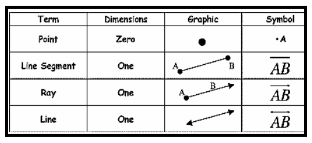
Point
Point is an exact position or location in space with no dimensions.
Mathematically, a point is defined as a circle with zero radius.
Since it is not possible its is represented by a very small dot.
A point is usually represented by a capital letter.
In mathematical terms, pont is a cirlce with no radius. It does mean that a very very small circle.
A point determines a location. It is usually denoted by a capital letter.
Lines And Its Types
Ray
A Ray is a straight path that stars at a point and extends infinitely in one direction.
Note: A ray is a portion of line starting at a point and extends in one direction endlessly. A ray has only one endpoint (Initial point).
Line or Straight Line
A line is a straight path that extends infinitely in two opposite directions. It can be treated as a combination of two rays starting from the same point but extending in the opposite directions.
Note: A line has no end points.
Line Segment:
A line segment is the part of a line between two points. (Segment means part).
The length of a line segment is the shortest length between two end points.
The line segment has two end points. Note: A line Segment has two endpoints. (both Initial and end points). (Scroll down to continue …).
Intersecting Lines and Non-intersecting Lines
Intersecting And Parallel Lines
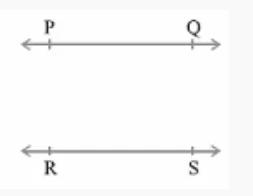
Parallel Lines
The lines which never cross each other at any point are called Parallel lines or Non-intersecting lines.
In other words, lines that are always the same distance apart from each other and that never meet are called Parallel lines Or Non-intersecting lines.
The perpendicular length between two lines is the distance between parallel lines.
Note: Parallel lines do not have any common point.
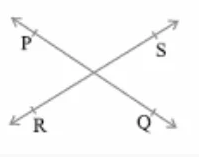
Intersecting Lines
The lines which cross (meet) each other at a point are called Intersecting Lines or non-parallel lines.
Intersecting lines meet at only one point.
Angle
An angle is made up of two rays starting from a common end point.
An angle leads to three divisions of a region:
On the angle, the interior of the angle and the exterior of the angle.
Curve
In geometry, a curve is a line or shape that is drawn smoothly and continuously in a plane with bends or turns.
In other words, Curve is a drawing (straight or non-straight) made without lifting the pencil may be called a curve.
Mathematicians define a curve as any shape that can be drawn without lifting the pen.
In Mathematics, A curve is a continuous and smooth line that is defined by a mathematical function or parametric equations.
Note: In this sense, a line is also a curve.
Types of Curves
Simple Or Open And Closed Curves
Cureves are two types based on intersection (crossing). They are (i) Simple or Open curve (ii) Closed curve.
Simple Curve
Simple or open curve is a curve that does not cross (intersect) itself.
Closed Curve
Closed curve is a curve that crosses (intersects) itself.
Concave And Convex Curves
Curves are of two types. They are concave curve and convex curve.
Concave Curve:
A curve is concave is a curve that curves inward, resembling a cave.
Examples:
– The interior of a circle.
– The graph of a concave function like y = -x2.
Convex Curves:
A curve is convex if it curves outward.
Examples:
– The exterior of a circle.
– The graph of a convex function like y = x2.
Polygon
A polygon is a simple closed figure formed by the line segments.
Types of Polygons
Polygons are classified into two types on the basis of interior angles: as (i) Convex polygon (ii) Concave polygon.
(a) Concave Polygon:
A concave polygon is a simple polygon that has at least one interior angle, that is greater than 1800 and less than 3600 (Reflex angle).
And at Least one diagonal lies outside of the closed figure.
Atlest one diagonal lies outside of the polygon.
b. Convex Polygon:
A convex polygon is a simple polygon that has at least no interior angle that is greater than 1800 and less than 3600 (Reflex angle).
And no diagonal lies outside of the closed figure.
In this case, the angles are either acute or obtuse (angle < 180 o).
Regular And Irregular Polygon
On the basis of sides, there are two types of polygons as Regular Polygon and Irregular Polygon
(a) Regular Polygon:
A convex polygon is called a regular polygon, if all its sides and angles are equal as shown in the following figures.
Each angle of a regular polygon of n-sides =
Part of Polygon
(i) Sides Of The Polygon
The line segments of a polygone are called sides of the polygon.
(ii) Adjacent Sides Of Polygon
Adjacent sides of a polygon are thesides of a polygon with a common end point.
(iii) Vertex Of Polygon
Vertext of a polygon is a point at which a pair of sides meet.
(iv) Adjacent Vertices
Adjacent vertices of polygon are the end points of the same side of the polygon.
(v) diagonal
Diagonal of a polygone is a line segment that joins the non-adjacent vertices of the polygon.
Triangle
A triangle is a three-sided polygon.
In other terms triangle is a three sided closed figure.
Quadrilateral
A quadrilateral is a four-sided polygon. (It shouldbe named cyclically).
In any
similar relations exist for the other three angles.
Circle And Its Parts
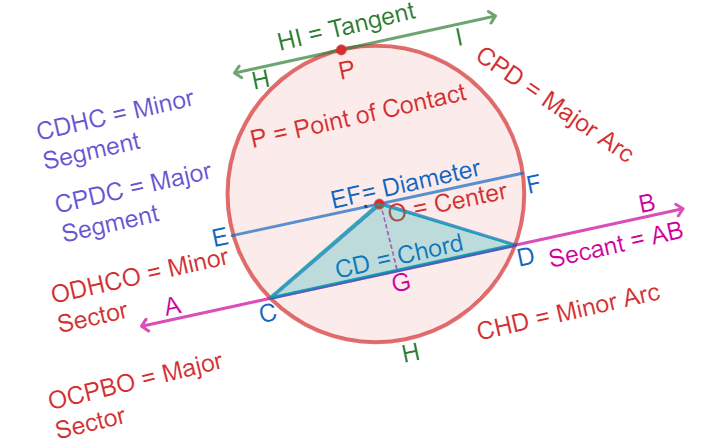
A circle is the path of a point moving at the same distance from a fixed point.
Centre Of Circle
Centre Of Circle is a point that is equidistant from any point on the boundary of the circle.
In other words the centre of the circles is a centre point of the circle.
Radius Of Circle
Radius of circle is the distance between the centre of the circle and any point on the boundary of the circle.
Circumference Of Circle
Circumference of circle is the length of the boundary of the circle.
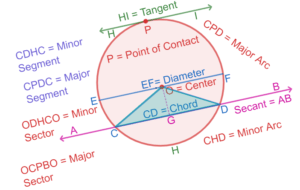
Chord Of Circle
A chord of a circle is a line segment joining any two points on the circle.
A diameter is a chord passing throughthe Centre of the circle.
Sector Of Circle
A sector is the region in the interior of a circle enclosed by an arc on one side and a pair of radii on the other two sides.
Segment Of Circle
A segment of a circle is a region in the interior of the circle enclosed by an arc and a chord.
The diameter of a circle divides it into two semi-circles.
The diameter of a circle divides it into two semi-circles.
Hindi Version
Dig Deep
Topic Level Resources
Sub – Topics
Select A Topic
Topic:
Chapters Index
Select Another Chapter
[display-posts category=”CBSE 6 – Mathematics – Study – Premium” posts_per_page=”25″]
The distance betweenthe end pointsof a line segment is its length. A graduatedruler and the divider are useful to compare lengthsof line segments. When a hand of a clock moves from one position to another position we have an examplefor an angle. (Scroll down to continue …)
Study Tools
Audio, Visual & Digital Content
One full turn of the hand is 1 revolution.
A right angle is ¼ revolution and a straight angle is ½ a revolution. We use a protractor to measure the size of an angle in degrees.
The measure of a right angle is 90° and hence that of a straight angle is 180°.
An angle is acute if its measure is smaller than that of a right angle and is obtuseif its measure is greaterthan that of a right angle and less than a straightangle.
A reflex angle is largerthan a straight angle.
Two intersecting lines are perpendicular if the anglebetween them is 90°.
The perpendicular bisector of a line segmentis a perpendicular to the line segmentthat divides it into two equal parts.
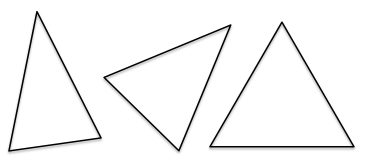
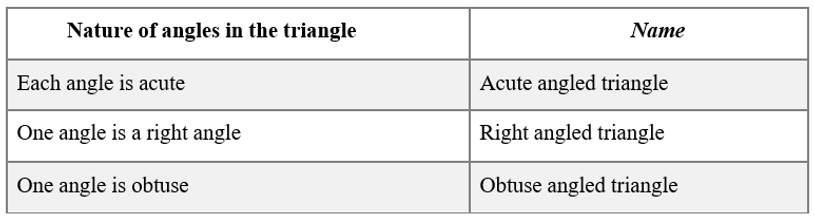
Triangles can be classified as follows based on their angles:
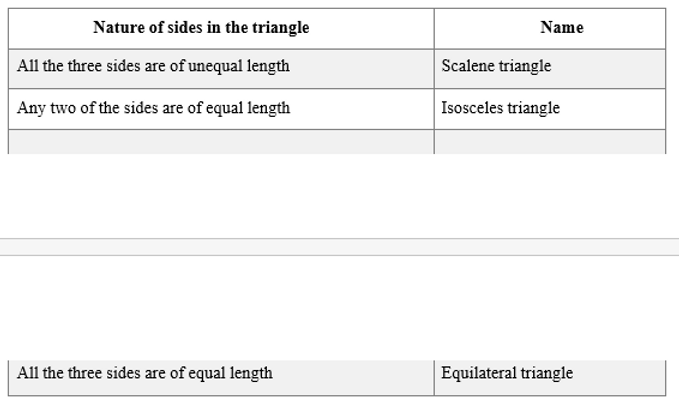
Triangles can be classified as follows based on the lengths of their sides:
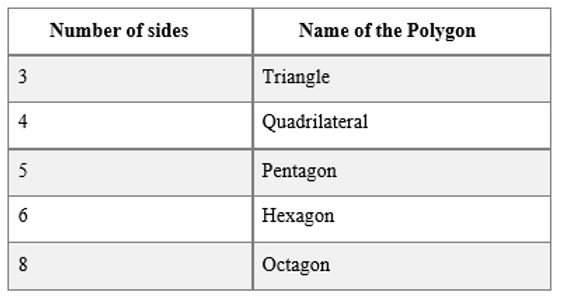
Polygons are namedbased on theirsides.
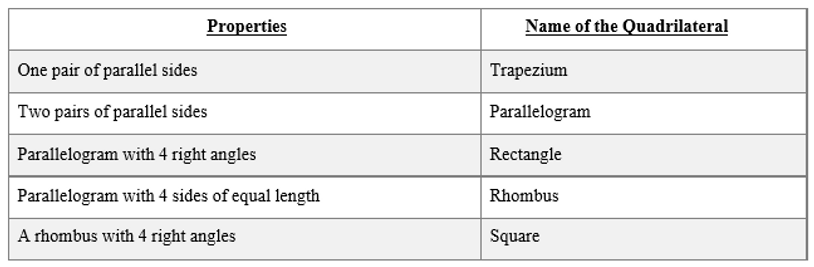
Quadrilaterals are furtherclassified with reference to their properties.
·We see aroundus many three dimensional shapes.Cubes, cuboids, spheres,
cylinders, cones,prisms and pyramidsare some of them.
Hindi Version
Dig Deep
Topic Level Resources
Sub – Topics
Select A Topic
Topic:
Chapters Index
Select Another Chapter
[display-posts category=”CBSE 6 – Mathematics – Study – Premium” posts_per_page=”25″]
The circle, thesquare, the rectangle, the quadrilateral and the triangle are examples of plane figures; the cube, the cuboid, the sphere, the cylinder, the cone and the pyramid areexamples of solid shapes.(Scroll down to continue …)
Study Tools
Audio, Visual & Digital Content
Plane figures areof two-dimensions (2-D) and the solid shapes are of three- dimensions (3-D). The corners of a solid shape are called its vertices; theline segments ofits skeleton areits edges; and itsflat surfaces areits faces. A net is a skeleton-outline of a solid that can be folded to make it. The same solid can haveseveral types ofnets. Solid shapes can be drawn on a flat surface (like paper) realistically. We call this 2-D representation of a 3-Dsolid. Two types ofsketches of asolid are possible: (a) An oblique sketch does nothave proportional lengths. Still it conveys all important aspects of the appearance of the solid. (b) An isometric sketch is drawn on an isometric dot paper, a sample of which isgiven at theend of thisbook. In an isometric sketch of the solidthe measurements kept proportional. Visualising solidshapesis a veryuseful skill. Youshould be ableto see ‘hidden’ parts of thesolid shape. Different sections of a solid can be viewed in many ways: (a) One way is to viewby cutting or slicing the shape, whichwould result in the cross- section of thesolid. (b) Another way isby observing a 2-D shadow of a 3-Dshape. (c) A third wayis to lookat the shapefrom different angles; the front-view, theside- view and thetop view canprovide a lotof information aboutthe shape observed.
19. When a grouping symbol preceded by ‘ sign is removed or inserted, thenthe sign of eachterm of thecorresponding expression ischanged (from ‘ + ‘ to ‘−’ and from‘− ‘ to + ‘).
Hindi Version
Dig Deep
Topic Level Resources
Sub – Topics
Select A Topic
Topic:
Chapters Index
Select Another Chapter
[display-posts category=”CBSE 7 – Mathematics – Study – Premium” posts_per_page=”25″]
Exponents are used to express large numbers in shorter form to make them easy to read, understand, compare and operate upon. (Scroll down to continue …)
Study Tools
Audio, Visual & Digital Content
Expressing Large Numbers in the Standard Form: Any number can be expressed as a decimal number between 1.0 and 10.0 (including 1.0) multiplied by a power of 10. Such form of a number is called its standard form or scientific motion. Very large numbers are difficult to read, understand, compare and operate upon. To make all these easier, we use exponents, converting many of the large numbers in a shorter form. The following are exponential forms of some numbers?
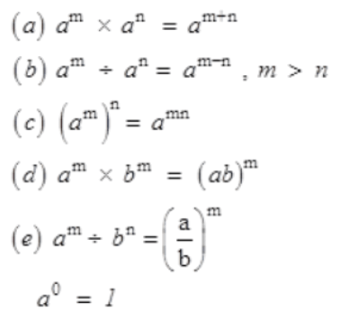
Here, 10, 3 and 2 are the bases, whereas 4, 5 and 7 are their respective exponents. We also say, 10,000 is the 4th power of 10, 243 is the 5th power of 3, etc. Numbers in exponential form obey certain laws, which are: For any non-zero integers a and b and whole numbers m and n,
(g) (–1) even number = 1 (–1) odd number = – 1
Hindi Version
Dig Deep
Topic Level Resources
Sub – Topics
Select A Topic
Topic:
Chapters Index
Select Another Chapter
[display-posts category=”CBSE 7 – Mathematics – Study – Premium” posts_per_page=”25″]
A closed plane figure bounded by three linesegments. The six elements of a triangle are its three angles and thethree sides. The line segment joining a vertex of a triangle to the mid point of its opposite side is called a medianof the triangle. (Scroll down to continue …)
Study Tools
Audio, Visual & Digital Content
Notes For Quick Recap
A closed plane figure bounded by three linesegments. The six elements of a triangle are its three angles and thethree sides. The line segment joining a vertex of a triangle to the mid point of its opposite side is called a medianof the triangle. (Scroll down to continue …)
Triangle:
A closed plane figure bounded by three line segments is called Triangle.
The six elements of a triangle are its three angles and the three sides. The line segment joining a vertex of a triangle to the midpoint of its
Median:
The opposite side is called the median of the triangle.
A triangle has three medians.
Altitude of the triangle:
The perpendicular line segment from vertex of a triangle to its opposite sides is called an altitude of the triangle.
A triangle has3 altitudes.
Type of triangle based onSides:Equilateral:
A triangle is said to be equilateral, if each one of its sides has the same length. In An equilateral triangle, each angle measures 60°.
Isosceles Triangle:
A triangle is said to be isosceles, if atleast any two of its sides are of same length. The non-equal side of an isosceles triangle is called its base; the base angles of an isosceles triangle have equal measure.
Scalene Triangle:
A triangle having all sides of different lengths. It has no two angles equal.
Property of the lengths of sides of a triangle:
The sum of the lengths of any two sides of a triangle is greater than the length of the third side. The difference between the lengths of any two sides is smaller than the length of the third side. This property is useful to know if it is possible to draw a triangle when the lengths of the three sides are known.
Types of Triangle based on Angles:
(i) Right Angled Triangle:
A triangle one of whose angles measures
(ii) Obtuse Angled Triangle:
A triangle one of whose angles measures more than
(iii) Acute Angled Triangle:
A triangle each of whose angles measures less than In a right angled triangle, the side opposite to the right angle is called the hypotenuse and the other two sides are called its legs.
Pythagoras property:
In a right-angled triangle, the square on the hypotenuse = the sum of the squares on its legs.If a triangle is not right-angled, this property does not hold good. Thisproperty is useful to decide whether a given triangle is right-angled
or not.
Exterior angle of a triangle:
An exterior angle of a triangle is formed, when a side of a triangle is produced. At each vertex, you have two ways of forming an exterior angle.
A property of exterior angles:
The measure of any exterior angle of a triangle is equal to the sum of the measures of its interior opposite angles.
The angle sum property of a triangle:
The total measure of the three angles of a triangle is 180°.
Property of the Lengths of Sides of a Triangle:
The sum of the lengths of any two sides of a triangle is always greater than the length of the third side. The difference of the lengths of any two sides of a triangle is always smaller than the length of the third side.
Important Formulas – TheTriangles and its Properties
1. A triangle is a figure made up by three line segments joining, in pairs, three non-collinear points. That is, if A, B, C are three non-collinear points, the figure formed by three line segments AB,BC and CA is called a triangle with vertices A, B, C.
2. The three line segments forming a triangle are called the sides of the triangle.
3. The three sides and three angles of a triangle are together called the six parts or elements of the triangle.
4. A triangle whose two sides are equal, is called an isosceles triangle.
5. A triangle whose all sides are equal, is called an equilateral triangle.
6. A triangle whose no two sides are equal, is called a scalene triangle.
7. A triangle whose all the angles are acute is called an acute triangle.
8. A triangle whose one of the angles is a right angle is called a right triangle.
9. A triangle whose one of the angles is an obtuse angle is called an obtuse triangle.
10. The interior of a triangle is made up of all such points P of the plane, as are enclosed by the triangle.
11. The exterior of a triangle is that part of the plane which consists of those points Q, which are neither on the triangle nor in its interior.
12. The interior of a triangle together with the triangle itself is called the triangular region.
13. The sum of the angles of a triangle is two right angles or 180°.
14. If a side of a triangle is produced, the exterior angle so formed is equal to the sum of the interior opposite angles.
15. In any triangle, an exterior angle is greater than either of the interior opposite angles.
16. The sum of any two sides of a triangle is greater than the third side.
17. In a right triangle, if a, b are the lengths of the sides and c that of the hypotenuse, then
18. If the sides of a triangle are of lengths a, b and c such that
then the triangle is right-angled and the side of length c is the hypotenuse.
19. Three positive numbers a, b, c in this order are said to form a Pythagorean triplet, if
Triplets (3, 4, 5) (5, 12,13), (8, 15, 17), (7,24, 25) and (12, 35,37) are somePythagorean triples.
Hindi Version
Dig Deep
Topic Level Resources
Sub – Topics
Select A Topic
Topic:
Chapters Index
Select Another Chapter
[display-posts category=”CBSE 7 – Mathematics – Study – Premium” posts_per_page=”25″]
Comparing Quantities: Weare often requiredto compare two quantities, in our dailylife. They may be heights, weights, salaries, marks etc. To compare two quantities, their units must be the same.
We are often required to compare two quantities in our daily life. They may be heights, weights,salaries, marks etc. (Scroll down to continue …)
Study Tools
Audio, Visual & Digital Content
While comparing heights of two persons with heights150 cm and 75 cm, we write it as the ratio 150 : 75 or 2 : 1.
Ratio: A ratio compares two quantities using a particular operation.
Percentage: Percentage are numerators of fractions with denominator 100. Percent is represent by the symbol% and means hundredth too.
Two ratios can be compared by converting them to like fractions. If the two fractions are equal,we say the two given ratios are equivalent.
If two ratios are equivalent then the four quantities are said to be in proportion. For example, the ratios 8 : 2 and 16 : 4 are equivalent therefore 8, 2, 16 and 4 are in proportion.
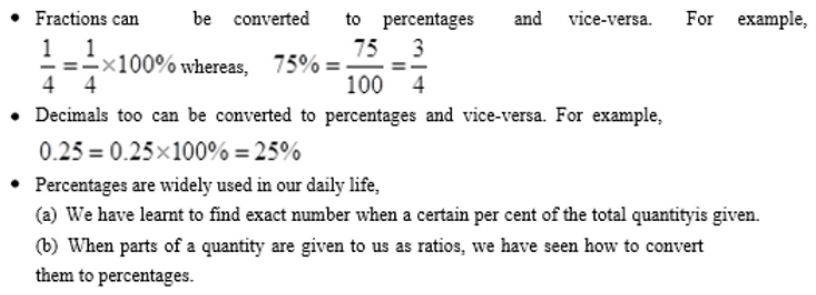
A way of comparing quantities is percentage. Percentages are numerators of fractions with denominator 100. Per cent means per hundred. For example 82% marks means
82 marks out of hundred.
Percentages are widely used in our daily life,
(a) We have learnt to find exact number when a certain per cent of the total quantity is given.
(b) When parts of a quantityare given to us as ratios, we have seen how to convert
them to percentages.
(c) The increase or decrease in a certainquantity can also be expressed as percentage.
(d) The profit or loss incurredin a certain transaction can be expressedin terms of percentages.
(e) While computing intereston an amount borrowed, the rate of interest is given in terms of per cents. For example, ` 800 borrowed for 3 years at 12% per annum. Simple Interest:Principal means the borrowed money.
The extra money paid by borrower for using borrowedmoney for given time is called interest(I).
The period for which the money is borrowed is called ‘TimePeriod’ (T).
Rate of interestis generally given in percentper year.
Interest, I = PTR/100
Total money paid by the borrower to the lenderis called the amount.
Hindi Version
Dig Deep
Topic Level Resources
Sub – Topics
Select A Topic
Topic:
Chapters Index
Select Another Chapter
[display-posts category=”CBSE 7 – Mathematics – Study – Premium” posts_per_page=”25″]