The collection, recording and presentation of data help us organiseour experiences and draw inferences from them.
Before collecting data we need to know what we would use it for.
The data that is collected needs to be organised in a propertable, so that it becomeseasy to understand and interpret. (Scroll down to continue …).
Study Tools
Audio, Visual & Digital Content
Average is a numberthat represents or shows the central tendencyof a group of observations or data.
Arithmetic mean is one of the representative values of data.
Mean = sum of all observations/ Number of observations.
Mode is another form of central tendency or representative value.
The mode of a set of observations is the observation that occurs most often.
If each of the value in a data is occurring one time, then all are mode.
Sometimes we also say that this data has no mode since none of them is occurring frequently.
Median is also a form of representative value.
It refers to the value which lies in the middle of the data with half of the observations above it and the other half below it.
.
A bar graph is a representation of numbers using bars of uniform widths.
Double bar graphshelp to comparetwo collections of data at a glance.
Double bar graphshelp to comparetwo collections of data at a glance.
There are situations in our life, that are certain to happen, some that are impossible and some that may or may not happen.
The situation that may or may not happen has a chanceof happening.
Probability: A branch of mathematics that is capable of calculating the chance or likelihood of an event taking place (in percentage terms).
If you have 10 likelihoods and you want to calculate the probability of 1 event taking place,it is said that its probability is 1/10 or event has a 10% probability of taking place.
Events that have many possibilities can have probability between 0 and 1.
Important Formulae – Data Handling
1. A trial is anaction which results in one or several outcomes. 2. An experiment in whichthe result ofa trial cannot be predicted inadvance is called a random experiment.
3. An event associated to a random experiment is thecollection of someoutcomes of theexperiment.
4. An event associated witha random experiment is said tohappen if anyone of theoutcomes satisfying thedefinition of theevent is anoutcome of theexperiment when it is performed.
5. The Empirical probability ofhappening of an event E is defined as: P(E)= Number of trials in which the event happened/ Total number of trials.
Hindi Version
Dig Deep
Topic Level Resources
Sub – Topics
Select A Topic
Topic:
Chapters Index
Select Another Chapter
[display-posts category=”CBSE 7 – Mathematics – Study – Premium” posts_per_page=”25″]
An equation isa condition ona variable suchthat two expressions in the variable should have equalvalue.
Thevalue of thevariable for whichthe equation issatisfied is called the solution ofthe equation.
An equation remains the same if the LHSand the RHSare interchanged. (Scroll down to continue …)
Study Tools
Audio, Visual & Digital Content
In case ofthe balanced equation, if we add the same number to both thesides, or subtract the same number from both the sides,
or
multiply both sidesby the same number, or divide both sidesby the samenumber, the balance remains un disturbed,
i.e.,the value of the LHS remains equal to the value of the RHS The above property gives a systematic method of solving an equation.
We carry out a series of identical mathematical operations on the two sides of the equation in such a waythat on oneof the sides we get justthe variable. Thelast step isthe solution of the equation.
Transposing means moving to the other side.
Transposition of a number has the same effect as adding same number to (or subtracting the same number from) both sides of the equation.
Whenyou transpose a number fromone side ofthe equation tothe other side, you change itssign.
For example, transposing +3 fromthe LHS tothe RHS in equation x + 3 = 8 gives x = 8 – 3 (= 5).
We can carry out the transposition of an expression in thesame way as the transposition of a number.
We havelearnt how to construct simple algebraic expressions corresponding to practical situations.
Wealso learnt how,using the technique of doing thesame mathematical operation (for example adding the samenumber) on bothsides, we could build an equation starting fromits solution.
Further, we also learnt that we could relate a given equation tosome appropriate problem/puzzlefrom the equation. practical situation and build a practical word.
Hindi Version
Dig Deep
Topic Level Resources
Sub – Topics
Select A Topic
Topic:
Chapters Index
Select Another Chapter
[display-posts category=”CBSE 7 – Mathematics – Study – Premium” posts_per_page=”25″]
(ii) A ray has only one end point (its vertex);and
(III) A line has no end points on either side.
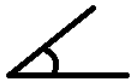
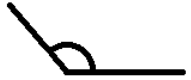
An angle is formed when two lines (or rays or line-segments) meet.
Study Tools
Audio, Visual & Digital Content
Important Formulas | Lines and Angles
When two lines l and m meet, we say they intersect; the meeting point is calledthe point of intersection.
When lines drawnon a sheet of paper do not meet, howeverfar produced, we call them to be parallel lines.
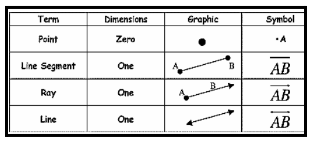
Point: A point name a location.
Line: A line is perfectlystraight and extends forever in both direction.
Line segment: A line segmentis the part of a line betweentwo points.
Ray: A ray is part of a line that starts at one point and extendsforever in one direction.
Intersecting lines: Two or more lines that have one and only one point in common.
The common point where all the intersecting lines meet is called the point of
intersection.
Transversal: A line intersects two or more lines that lie in the same plane in distinct points.
Parallel lines: Two lineson a plane that nevermeet. They distance apart.
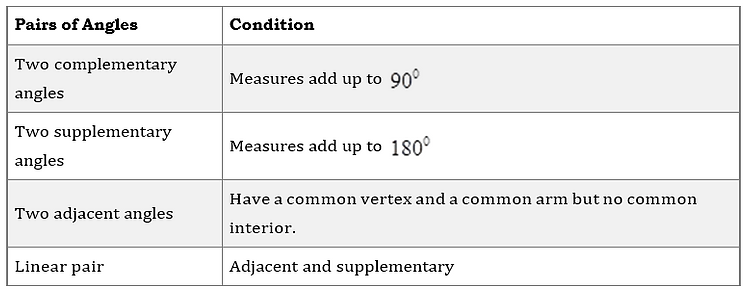
Complementary Angles: Two angles whose measures add to 90^O Supplementary Angles: Two angles whose measures add to 180 ^o
Adjacent Angles: Two angles have a common vertex and a
common interiorpoints.
Linear pairs: A pair of adjacentangles whose non-common sides are oppositerays. Vertically Opposite Angles: Two angles formed by two intersecting lines have common arm.
Angles made by Transversal: When two lines are intersecting by a transversal, eight anglesare formed.
Transversal of Parallel Lines: If two parallel lines are intersected by a transversal, each pair of:
Corresponding angles are congruent. Alternateinterior angles are congruent. Alternateexterior angles are congruent.
If the transversal is perpendicular to the parallellines, all of the angles formed are congruent to 90 o angles.
1. A linewhich intersects two or more given lines at distinct points is called a transversal to the given lines.
2. Lines in a plane areparallel if theydo not intersect when produced indefinitely in either direction.
3. The distance between two intersecting lines is zero.
4. The distance between two parallel lines is thesame everywhere andis equal tothe perpendicular distance between them.
5. If two parallel lines are intersected by a transversal then (i) pairs ofalternate (interior orexterior) angles are equal. (ii) pairs of corresponding angles are equal. (iii) interior angles onthe same sideof the transversal are supplementary. 6. If twonon-parallel lines areintersected by transversal then none of (i), (ii) and (iii) hold true in 5. 7. If twolines are intersected by a transversal, thenthey are parallel ifany one of thefollowing is true: (i) The angles of a pair of corresponding angles are equal. (ii) The angles of a pairof alternate interior angles are equal. (iii) The angles of a pairof interior angles on the sameside of the transversal are supplementary.
Hindi Version
Dig Deep
Topic Level Resources
Sub – Topics
Select A Topic
Topic:
Chapters Index
Select Another Chapter
[display-posts category=”CBSE 7 – Mathematics – Study – Premium” posts_per_page=”25″]
Integers are a bigger collection of numbers which is formed by whole numbers and their negatives. You have studied inthe earlier class, about the representation of integers onthe number lineand their addition and subtraction. (Scroll down to continue …)
Study Tools
Audio, Visual & Digital Content
We now study theproperties satisfied by addition andsubtraction.
(a) Integers are closed for addition and subtraction both. That is, a + b and a – b are again integers, where a andb are anyintegers.
(b) Addition is commutative forintegers, i.e., a + b = b + a for allintegers a andb.
(c) Addition is associative for integers, i.e., (a + b) + c = a + (b + c) for all integers a, b and c.
(d) Integer 0 is the identity under addition. That is, a + 0 = 0 + a = a for every integer a. We studied, how integers could be multiplied, andfound that product of a positive and a negative integer is a negative integer, whereas the product of two negative integers isa positive integer. For example, –2 × 7 = –14 and –3 × – 8 =24.
Product of even number of negative integers is positive, whereas the product of odd number of negative integers is negative. Integers showsome properties under multiplication.
(a) Integers are closed under multiplication. Thatis, a × b isan integer forany two integers a and b.
(b) Multiplication is commutative for integers. Thatis, a × b = b × a forany integers a and b.
(c) The integer 1 is theidentity under multiplication, i.e., 1 × a = a × 1 = a forany integer a.
(d) Multiplication is associative for integers, i.e.,(a × b) × c = a × (b × c) for anythree integers a,b and c.
Under addition and multiplication, integers show a property called distributive property.
That is, a× (b +c) = a × b+ a × c forany three integers a, b andc.
The properties of commutativity, associativity under addition and multiplication, and the distributive property help us to make our calculations easier. We alsolearn how to divide integers. We found that,
(a) When a positive integer is divided by a negative integer, the quotient obtained is a negative integer and vice-versa. (b) Division of a negative integer by another negative integer gives a positive integer as quotient. For any integer a,we have
2) 1, 2, 3, 4, 5. . . . are positive integers and —1,-2, —3,.. are negative integers.
3) 0 isan integer which is neither positive nornegative.
4). On an integer number line, all numbers to the right of 0 arepositive integers andall numbers tothe left of0 are negative integers.
5) 0 is less than everypositive integer and greater than everynegative integer.
6) Every positive integer is greater than every negative integer.
7) Two integers thatare at thesame distance from 0, but onopposite sides of it are called opposite numbers.
8. The greater the number, the lesser is its opposite.
9. The sumof an integer and its opposite is zero.
10. The absolute valueof an integer is the numerical value of theinteger without regard to its sign.
The absolute value of an integer a isdenoted by |a| and is given by a,if a is positive or 0 a = -a,if a is negative
11. The sum oftwo integers of the same sign is an integer of the same sign whose absolute value is equal to the sum of the absolute values of the given integers.
12. The sum of two integers of opposite signs is an integer whose absolute value is the difference of the absolute values of addend and whose sign isthe sign ofthe addend having greater absolute value.
13. To subtract an integer b from another integer a, we change the sign ofb and addit to a. Thus, a − b = a + (−b)
14. All properties of operations onwhole numbers aresatisfied by theseoperations on integers.
15. If aand b are two integers, then(a − b) is alsoan integer.
16. −a and aare negative oradditive inverses of each other.
17. To find theproduct of twointegers, we multiply theirabsolute values andgive the result a plus signif both thenumbers have the same sign or a minussign otherwise.
18. To find thequotient of oneinteger divided by another non-zero integer, we divide their absolute values and give the result a plus sign if both the numbers have the same sign or a minus signotherwise.
19. All the properties applicable to wholenumbers are applicable to integers in addition, the subtraction operation has the closure property.
20. Any integer whenmultiplied or divided by 1 gives itself and whenmultiplied or divided by-1 gives its opposite.
21. When expression hasdifferent types ofoperations, some operations haveto be performed before the others. That is, each operation has its own precedence. The order in which operations are performed is division, multiplication, addition and finally subtraction (DMAS).
22. Brackets are usedin an expression when we wanta set of operations to be performed before the others.
23. While simplifying anexpression containing brackets, the operations within the innermost set of brackets are performed first and then those brackets are removed followed by the ones immediately after them tillall the brackets are removed.
24. While simplifying arithmetic expressions involving various brackets and operations, we use BODMAS rule.
Hindi Version
Dig Deep
Topic Level Resources
Sub – Topics
Select A Topic
Topic:
Chapters Index
Select Another Chapter
[display-posts category=”CBSE 7 – Mathematics – Study – Premium” posts_per_page=”25″]
4. A fraction whose numerator is less than the denominator is called a proper fraction.
5. A fraction whose numerator is more than or equal to the denominator is called animproper fraction.
6. A combination of a whole number and a proper fraction is called a mixed fraction.
7. To get a fractionequivalent to a given fraction,we multiply (or divide) its numerator and denominator by the same non-zero number.
8. Fractions having the same denominators are called like fractions. Otherwise, they are calledunlike fractions.
9. A fraction is said to be in its lowest termsif its numerator and denominator have no commonfactor other than 1.
10. To compare fractions, we use the followingsteps:
Step I Find the LCMof the denominators of the given fractions.
Step II Converteach fraction to itsequivalent fraction with denominator equal to the LCM obtained in step I.
Step Ill Arrangethe fractions in ascending or descending order byarranging numerators in ascending or descending order.
11. To convert unlike fractions into like fractions, we use the following steps:Step I Find the LCM of the denominators of the given fractions.
Step II Convert each of the given fractions into an equivalent fraction having denominator equal to the LCM obtained in step I.
12. To add (or subtract)fractions, we may use the following steps:Step I Obtain the fractionsand their denominators.
Step II Find the LCMof the denominators.
Step III Convert each fraction into an equivalent fraction having its denominator equal to the LCM obtainedin step II.
Step IV Add (or subtract) like fractions obtained in Step Ill.
Step III Convert each fraction into an equivalent fraction having its denominator equal to the LCM obtainedin step II.
Step IV Add (or subtract) like fractions obtained in Step Ill.
14. Two fractions are said to be reciprocal of each other, if their product is 1. The reciprocal of a non zero fraction a/b is b/a.
15. The divisionof a fraction a/b by a non-zero fraction c/d is the product of a/b with the
reciprocal of c/d.
Decimals:
1. Decimals are an extension of our number system.
2. Decimals are fractionswhose denominators are 10, 100, 1000 etc.
3. A decimal has two parts, namely, the whole numberpart and decimal part.
4. The number of digits containedin the decimal part of a decimal number is known as the numberof decimal places.
5. Decimals having the same number of places are called like decimals, otherwise they are knownas unlike decimals.
6. We have, 0.1 = 0.10 = 0.100 etc, 0.5 = 0.50 = 0.500 etc and so on. That is by annexing zeros on the right side of the extreme right digit of the decimalpart of a number does not alterthe value of the number.
7. Unlike decimals may be converted into like decimals by annexing the requisite numberof zeros on the right side of the extreme right digit in the decimal part.
8. Decimal numbers may be convertedby using the following steps.Step I Obtain the decimalnumbers
Step II Compare the whole partsof the numbers. The number with greater whole part will be greater. If the whole parts are equal, go to next step.
Step Ill Compare the extreme left digits of the decimal parts of two numbers. The number with greater extreme left digit will be greater. If the extreme left digits of decimal parts are equal,then compare the next digits and so on.
9. A decimal can be converted into a fractionby using the following steps:Step I: Obtain the decimal.
Step II: Take the numerator as the number obtained by removing the decimal point from the given decimal.
Step III: Take the denominator as the number obtainedby inserting as many zeros with 1 (e.g.10, 100 or 1000 etc.)as there are number of places in the decimal part.
10. Fractions can be converted into decimals by using the following steps:
Step I: Obtain the fractionand convert it into an equivalent fraction with denominator 10 or 100 or 1000 if it is not so.
Step II: Write its numeratorand mark decimal point after one place or two places or threeplaces from right towards left if the denominator is 10 or 100 or 1000 respectively. If the numerator is short of digits, insert zeros at the left of the numerator.
11. Decimals can be added or subtracted by using the following steps:Step I: Convert the given decimals to like decimals.
Step II: Write the decimals in columns with their decimal pointsdirectly below each other so that tenthscome under tenths, hundredths come and hundredths and so on.
Step III: Addor subtract as we add or subtract whole numbers.
Step IV: Place the decimal point, in the answer, directly below the other decimal points.
12. In order to multiply a decimal by 10, 100, 1000 etc., we use the following rules:
Rule I: On multiplying a decimal by 10, the decimalpoint is shiftedto the right by one place.
Rule II: On multiplying a decimal by 100, the decimal point is shiftedto the right by two places.
Rule III: On multiplying a decimal by 1000, the decimal point is shiftedto the right by threeplaces, and so on.
13. A decimal can be multiplied by a whole number by using following steps:
Step I: Multiply the decimal without the decimalpoint by the given whole number.
Step II: Mark the decimal point in the product to have as many placesof decimal as are there in the given decimal.
14. To multiply a decimal by another decimal, we follow following steps:
Step I: Multiply the two decimalswithout decimal point just like whole numbers.
Step II: Insert the decimal point in the product by countingas many places from the right to left as the sum of the number of decimalplaces of the given decimals.
15. A decimal can be dividedby 10, 100, 1000 etc by using the followingrules:
Rule I When a decimal is divided by 10, the decimal point is shifted to the left by one place.
Rule II When a decimal is divided by 100, the decimal point is shifted to the left by two places.
Rule III When a decimal is divided by 1000, the decimal point is shiftedto the left by threeplaces.
16. A decimal can be divided by a whole number by using the following steps:Step I: Check the whole number part of the dividend.
Step II: If the wholenumber part of the dividend is less than the divisor,then place a 0 in the onesplace in the quotient. Otherwise, go to step Ill.
Step III: Divide the whole number part of the dividend.
Step IV: Place the decimal point to the right of ones place in the quotient obtained in step I.
Step V: Divide the decimal part of the dividend by the divisor. If the digits of the dividend are exhausted, then place zeros to the right of dividendand remainder each time and continue the process.
17. A decimal can be divided by a decimal by using the following steps:
Step 1 Multiple the dividend and divisor by 10 or 100 or 1000 etc. to convert the divisor into a whole number.
Step II Divide the new dividendby the whole number obtainedin step I.
Extra:
Hindi Version
Dig Deep
Topic Level Resources
Sub – Topics
Select A Topic
Topic:
Chapters Index
Select Another Chapter
[display-posts category=”CBSE 7 – Mathematics – Study – Premium” posts_per_page=”25″]
Perimeter: Length of boundary of a simple closed figure.
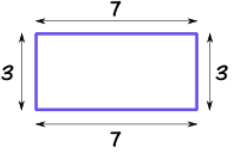
Perimeter of Rectangle = 2(l +b) Perimeter of Square = 4a Perimeter of Parallelogram = 2(sum of two adjacent sides) Area: The measure of region enclosed in a simple closed figure.
Area of a trapezium = half of the sum of the lengths of parallel sides × perpendiculardistance between them.
Area of a rhombus = half the product of its diagonals. (Scroll down to continue …)
Study Tools
Audio, Visual & Digital Content
Hindi Version
Dig Deep
Topic Level Resources
Sub – Topics
Select A Topic
Topic:
Chapters Index
Select Another Chapter
[display-posts category=”CBSE 8 – Mathematics – Study – Premium” posts_per_page=”25″]
A quadrilateral has 10 parts – 4 sides, 4 angles and 2 diagonals. Five measurements can determine a quadrilateral uniquely. (Scroll down to continue …)
Study Tools
Audio, Visual & Digital Content
Curve: Curve is a figure formed on a plane surface by joining a number of non linear points without lifting a pencil.
Open Curve: An open curve is a curve which does not end at the same starting point or which does not intersect itself.
Closed Curve: Closed curve is a curve which intersects itself or which starts and ends at the same point.
Simple Closed Curve: A simple closed curve is a closed curve that does not intersect itself.
Polygon: Polygon is a closed figure bounded by three or more line segments such that each line segment intersects the other two line segements at exactly two other points (vertices) as shown in the following figures.
Polygons are classified into two types on the basis of interior angles: as (i) Convex polygon (ii) Concave polygon
(a) Convex Polygon: In this case, each angle is either acute or obtuse (angle < 180 o) as shown in the following figures.
Concave Polygon: In this case, any one angle is reflex (angle > 180°) and one diagonal is outside the polygon as shown in the following figures.
On the basis of sides, there are two types of polygons :
(a) Regular Polygon: A convex polygon is called a regular polygon, if all its sides and angles are equal as shown in the following figures.
Each angle of a regular polygon of n-sides =
Important results on polygon :
For a regular polygon of n sides (n > 2).
(b) Irregular Polygon: A polygon in which all the sides are unequal as shown in the following figures,
Triangle :
A simple closed figure bounded by three line segments is called a triangle, it has three sides as AB, BC and AC; three vertices as A, B and C and three interior angles A, ZB and ZCand the sum of all angles is 180°.
i.e., <A + <B + <C = 180°
Quadrilateral:
A simple closed figure bounded by four line segments is called a quadrilateral, it has four sides i.e.,
AB, BC, CD and AD and four vertices as A, B, Can d D and the sum of all angles of a quadrilateral is 360.
Practical Geometry
Five measurements can determine a quadrilateral uniquely.
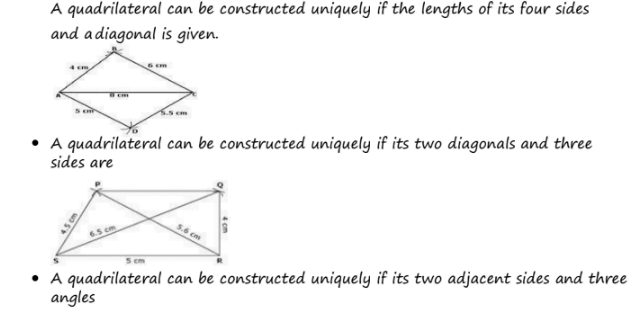
A quadrilateral can be constructed uniquely if the lengths of its four sides and a diagonal is given.
A quadrilateral can be constructed uniquely if its two diagonals and three sides are
known.
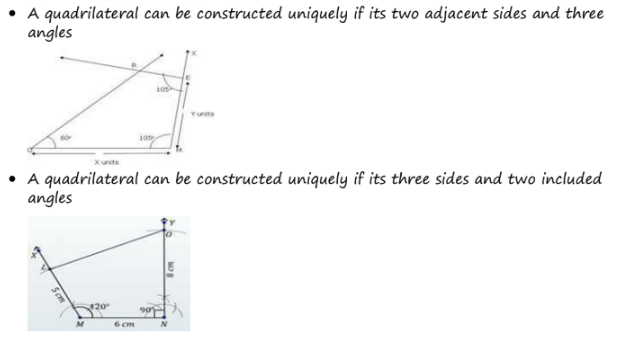
A quadrilateral can be constructed uniquely if its two adjacent sides and three angles
are known.
A quadrilateral can be constructed uniquely if its three sides and two included angles
are given.
Quadrilateral
Quadrilateral is a closed figure with four sides.
Characteristics of a quadrilateral
Angle Sum Property of a Quadrilateral:
Qudrilateral is a four sided closed figure.
Sum of all angles of a quadrilateral is 360°.
Types Of Quadrilaterals
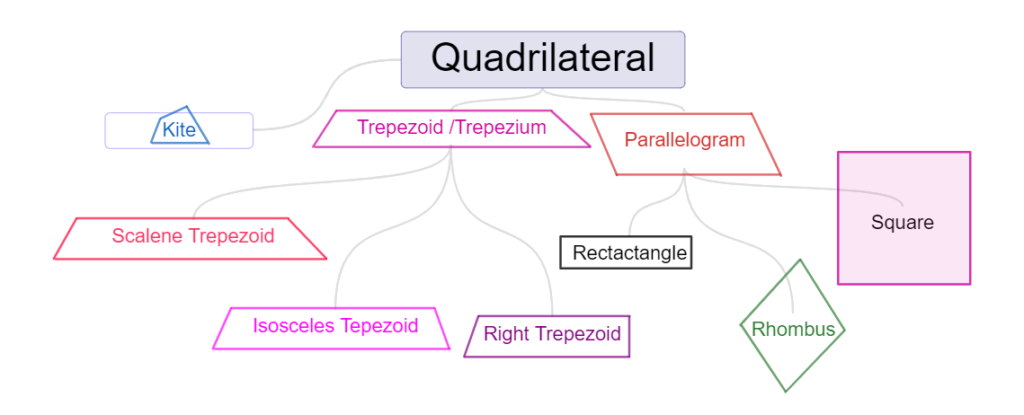
Classification of quadrilaterals
Quadrilaterals are broadly classified into three categories as:
(i) Kite
(ii) Trapezium
(ii) Parallelogram
Kite:
(i) Kite has no parallel sides
(ii) Kite has a pair of equal adjacent sides.
(ii) It is not a parallelogram
Characteristics Of Kite:
Perimeter Of Square
Area Of Kite
Trapezium:
Trapezium is a quadrilateral with the following characteristics:
(i) One pair of opposite sides is parallel to each other.
(ii) The other pair of opposite sides may not be parallel to each other.
Characteristics Of Trapezium
(i) Sum of all angles of a quadrilateral is 360°.
(ii) One pair of opposite sides is parallel to each other.
(iii) The other pair of opposite sides need not be parallel to each other.
Types Of Trapezium:
Quadrilaterals are broadly classified into two categories as:
(i) Isosceles Trapezium.
(ii) Scalene Trapezium.
(i) Right Trapezium.
Isosceles Trapezium:
Isosceles Trapezium is a quadrilateral with the following characteristics:
(i) One pair of opposite sides is parallel to each other.
(ii) The other pair of opposite sides are equal.
(iii) The other pair of opposite sides need not be parallel to each other.
Isosceles Trapezium is a trapezium with the following characteristics:
(i) One pair of opposite sides is parallel to each other.
(ii) The other pair of opposite sides are equal.
(iii) The other pair of opposite sides need not be parallel to each other.
Characteristics Of Isosceles Trapezium
(i) Sum of all angles of a quadrilateral is 360°.
(ii) One pair of opposite sides is parallel to each other.
(iii) The other pair of opposite sides are equal.
(iv) The other pair of opposite sides need not be parallel to each other.
Scalene Trapezium:
Scalene trapezium: Classified by the length of the legs or the measurement of their angles.
Characteristics Of Scalene Trapezium
Right Trapezium:
Right trapezium: Has one pair of parallel sides and one pair of right angles.
Characteristics Of Right Trapezium
Perimeter Of Trapezium
Area Of Trapezium
Parallelogram:
Parallelogram is a quadrilateral with the following characteristics:
(i) Two pairs of opposite sides are parallel to each other.
(ii) Two pairs of opposite sides are equal in length.
Characteristics of a parallelogram
(i) Sum of all angles of a Parallelogram is 360°.
(ii) Two pairs of opposite sides are parallel to each other.
(ii) Two pairs of opposite sides are equal in length.
(ii) Two pairs of opposite angles are equal.
(iii) Diagonals bisect each other.
(iv) Diagonals need not be equal to each other.
(v) Diagonals divide it into two congruent triangles.
Types Of Parallelogram
Parallelograms are broadly classified into three categories as:
(i) Rectangle
(ii) Rhombus
(iii) Square
Perimeter Of Parallelogram
Area Of Parallelogram
Rectangle:
Rectangleis a quadrilateral with the following characteristics:
(i) Two pairs of opposite sides are parallel to each other.
(ii) Two pairs of opposite sides are equal in length.
(iii) All four angles are right angles. (each angle is 90 o).
Characteristics Of Rectangle
(i) Sum of all angles of a quadrilateral is 360°.
(ii) Two pairs of opposite sides are parallel to each other.
(ii) Two pairs of opposite sides are equal in length.
(iii) All four angles are right angles. (each angle is 90 o).
(iii) Diagonals bisect each other.
(iv) Diagonals are equal to each other.
(v) Diagonals of a rectangle divide it into two congruent triangles.
Conclusions:
Every Rectangle is a Parallelogram. But Every Parallelogram need not to be a Rectangle.
Condition for a rhombus to be a square:
If all four angles of a parallelogram are right angles. (each angle is 90 o), the parallelogram becomes a Rectangle.
Perimeter Of Rectangle
Area Of Recatangle
Rhombus:
Rhombus is a quadrilateral with the following characteristics:
(i) Two pairs of opposite sides are parallel to each other.
(ii) All four sides are equal in length.
Characteristics Of Rhombus
(i) Sum of all angles of a quadrilateral is 360°.
(ii) Two pairs of opposite sides are parallel to each other.
(ii) All four sides are equal in length.
(ii) Two pairs of opposite angles are equal.
(iii) Diagonals bisect each other.
(iv) Diagonals need not be equal to each other.
(v) Diagonals divide a Rhombus into two congruent triangles.
Conclusions:
Every Rhombus is a Parallelogram. But Every Parallelogram need not to be a Rhombus.
Condition for a rhombus to be a square:
If all the sides of a parallelogram are equal, the parallelogram becomes a Rhombus.
Perimeter Of Rhombus
Area Of Rhombus
Square:
Square is a quadrilateral with the following characteristics:
(i) Two pairs of opposite sides are parallel to each other.
(ii) All four sides are equal in length.
(iii) All four angles are right angles. (each angle is 90 o).
Characteristics Of Square
(i) Sum of all angles of a quadrilateral is 360°.
(ii) Two pairs of opposite sides are parallel to each other.
(iii) All four sides are equal in length.
(iv) All four angles are right angles. (each angle is 90 o).
(v) Diagonals bisect each other.
(vi) Diagonals need not be equal to each other.
(vii) Diagonals divide a Rhombus into two congruent triangles.
Conclusions:
Every square is a Rhombus. But Every Rhombus need not to be a square.
Condition for a rhombus to be a square:
If all the angles of a rhombus are right angles (euqal to 90o), the rhombus becomes a square.
2. Every Square is a prallelogram. But Every prallelogram need not to be a square.
Condition for a prallelogramto be a square:
(i) If all the angles of a parallelogram are right angles (euqal to 90o), and all the sides of a parallelogram are equal in length, the parallelogram becomes a square.
3. Every Square is a rectangle. But Every Rectangle need not to be a square.
Condition for a Rectangleto be a square:
If all the sides of a Rectangle are equal in length, the Rectangle becomes a square.
If all the sides of a parallelogram are equal, the parallelogram becomes a Rhombus.
Perimeter Of Square
Area Of Square
Important Points To Remember
The diagonals of a parallelogram are equal if and only if it is a rectangle.
If a diagonal of a parallelogram bisects one of the angles of the parallelogram then it also bisects the opposite angle.
In a parallelogram, the bisectors of any two consecutive angles intersect at a right angle.
The angle bisectors of a parallelogram form a rectangle.
Mid Point Theorem
A line segment joining the mid points of any two sides of a triangle is parallel to the third side and length of the line segment is half of the parallel side.
Converse Of Mid Point Theorem
A line through the midpoint of a side of a triangle parallel to another side bisects the third side.
Intercept Theorem
If there are three parallel lines and the intercepts made by them on one transversal are equal then the intercepts on any other transversal are also equal.
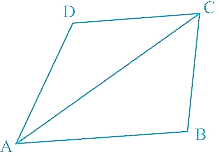
Angle Sum Property of a Quadrilateral
The sum of the four angles of a quadrilateral is 360°
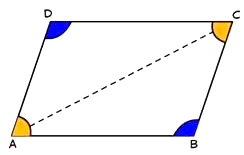
If we draw a diagonal in the quadrilateral, it divides it into two triangles.
And we know the angle sum property of a triangle i.e. the sum of all the three angles of a triangle is 180°.
The sum of angles of ∆ADC = 180°.
The sum of angles of ∆ABC = 180°.
By adding both we get ∠A + ∠B + ∠C + ∠D = 360°
Hence, the sum of the four angles of a quadrilateral is 360°.
Example
Find ∠A and ∠D, if BC∥ AD and ∠B = 52° and ∠C = 60° in the quadrilateral ABCD.
Solution:
Given BC ∥ AD, so ∠A and ∠B are consecutive interior angles.
So ∠A + ∠B = 180° (Sum of consecutive interior angles is 180°).
∠B = 52°
∠A = 180°- 52° = 128°
∠A + ∠B + ∠C + ∠D = 360° (Sum of the four angles of a quadrilateral is 360°).
∠C = 60°
128° + 52° + 60° + ∠D = 360°
∠D = 120°
∴ ∠A = 128° and ∠D = 120 °.
Types of Quadrilaterals
S No.
Quadrilateral
Property
Image
1.
Kite
a. No Parallel Sides b. Two pairs of adjacent sides are equal.
2.
Trapezium
One pair of opposite sides is parallel.
3.
Parallelogram
Both pairs of opposite sides are parallel.
3.
Rectangle
a. Both the pair of opposite sides are parallel. b. Opposite sides are equal.c. All the four angles are 90°.
4.
Square
a. All four sides are equal. b. Opposite sides are parallel. c. All the four angles are 90°.
5.
Rhombus
a. All four sides are equal. b. Opposite sides are parallel. c. Opposite angles are equal.d. Diagonals intersect each other at the centre and at 90°.
Remark: A square, Rectangle and Rhombus are also a parallelogram.
Properties of a Parallelogram
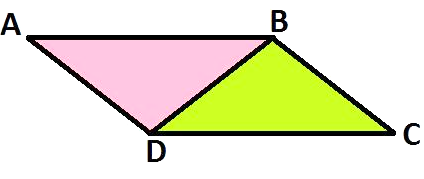
Theorem 1: When we divide a parallelogram into two parts diagonally then it divides it into two congruent triangles.
∆ABD ≅ ∆CDB
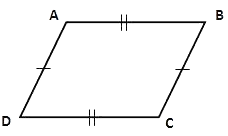
Theorem 2: In a parallelogram, opposite sides will always be equal.
Theorem 3: A quadrilateral will be a parallelogram if each pair of its opposite sides will be equal.
Here, AD = BC and AB = DC
Then ABCD is a parallelogram.
Theorem 4: In a parallelogram, opposite angles are equal.
In ABCD, ∠A = ∠C and ∠B = ∠D
Theorem 5: In a quadrilateral, if each pair of opposite angles is equal, then it is said to be a parallelogram. This is the reverse of Theorem 4.
Theorem 6: The diagonals of a parallelogram bisect each other.
Here, AC and BD are the diagonals of the parallelogram ABCD.
So the bisect each other at the centre.
DE = EB and AE = EC
Theorem 7: When the diagonals of the given quadrilateral bisect each other, then it is a parallelogram.
This is the reverse of the theorem 6.
The Mid-point Theorem
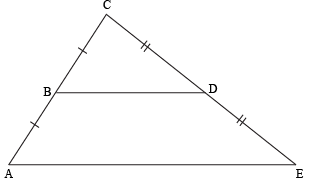
1. If a line segment joins the midpoints of the two sides of the triangle then it will be parallel to the third side of the triangle.
If AB = BC and CD = DE then BD ∥ AE.
2. If a line starts from the midpoint of one line and that line is parallel to the third line then it will intersect the midpoint of the third line.
If D is the midpoint of AB and DE∥ BC then E is the midpoint of AC.
Example
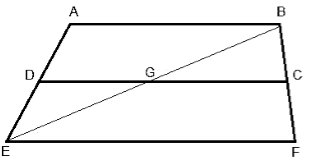
Prove that C is the midpoint of BF if ABFE is a trapezium and AB ∥ EF.D is the midpoint of AE and EF∥ DC.
Solution:
Let BE cut DC at a point G.
Now in ∆AEB, D is the midpoint of AE and DG ∥ AB.
By midpoint theorem, G is the midpoint of EB.
Again in ∆BEF, G is the midpoint of BE and GC∥ EF.
So, by midpoint theorem C is the midpoint of BF.
Hence proved.
Hindi Version
Dig Deep
Topic Level Resources
Sub – Topics
Select A Topic
Topic:
Chapters Index
Select Another Chapter
[display-posts category=”CBSE 8 – Mathematics – Study – Premium” posts_per_page=”25″]
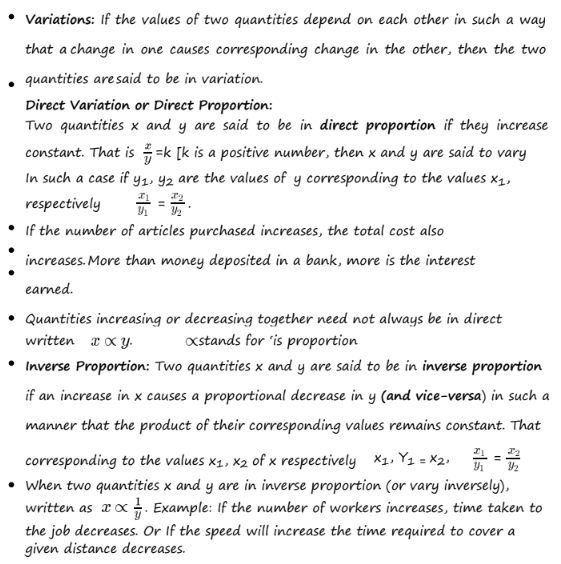
Variations: If the values of two quantities depend on each other in such a way that a change in one causes corresponding change in the other, then the two quantities are said to be in variation. (Scroll down to continue …)
Study Tools
Audio, Visual & Digital Content
Direct Variation or Direct Proportion:
Extra:
Two quantities x and y are said to be in direct proportion if they increase (decrease) together in such a manner that the ratio of their corresponding values remains
constant. That is if
=k [k is a positive number, then x and y are said to vary directly.
In such a case if y1, y2 are the values of y corresponding to the values x1, x of x
respectively then = .
If the number of articles purchased increases, the total cost also increases. More than money deposited in a bank, more is the interest earned.
Quantities increasing or decreasing together need not always be in direct proportion, same in the case of inverse proportion.
When two quantities x and y are in direct proportion (or vary directly), they are
written as
. Symbol
stands for ‘is proportion to’.
Inverse Proportion: Two quantities x and y are said to be in inverse proportion if an increase in x causes a proportional decrease in y (and vice-versa) in such a manner that the product of their corresponding values remains constant. That is, if xy
= k, then x and y are said to vary inversely. In this case if y1, y2 are the values of y
corresponding to the values x1, x2 of x respectively then
x1, Y1 = x2, y2 or
=
When two quantities x and y are in inverse proportion (or vary inversely), they are
written as x
. Example: If the number of workers increases, time taken to finish
the job decreases. Or If the speed will increase the time required to cover a given distance decreases.
Hindi Version
Dig Deep
Topic Level Resources
Sub – Topics
Select A Topic
Topic:
Chapters Index
Select Another Chapter
[display-posts category=”CBSE 8 – Mathematics – Study – Premium” posts_per_page=”25″]
Factorisation: Representation of an algebraic expression as the product of two or more expressions is called factorization. Each such expression is called a factor of the given algebraic expression. (Scroll down to continue …)
Study Tools
Audio, Visual & Digital Content
When we factorise an expression, we write it as a product of factors. These factors may be numbers, algebraic variables or algebraic expressions.
An irreducible factor is a factor which cannot be expressed further as a product of factors.
A systematic way of factorising an expression is the common factor method. It consists of three steps:
Write each term of the expression as a product of irreducible factors
Look for and separate the common factors and
Combine the remaining factors in each term in accordance with the distributive law.
Sometimes, all the terms in a given expression do not have a common factor; but the terms can be grouped in such a way that all the terms in each group have a common factor. When we do this, there emerges a common factor across all the groups leading to the required factorisation of the expression. This is the method of regrouping.
In factorisation by regrouping, we should remember that any regrouping (i.e., rearrangement) of the terms in the given expression may not lead to factorisation. We must observe the expression and come out with the desired regrouping by trial and error.
A number of expressions to be factorised are of the form or can be put into the form: a2 + 2ab + b2, a2 – 2ab + b2, a2 – b2 and x2 + (a + b)x + ab. These expressions can be easily factorised using Identities I, II, III and IV
a2 + 2ab + b2 = (a + b)2
a2 – 2ab + b2 = (a – b)2
a2 – b2 = (a + b) (a – b)
Factorisation
x2 + (a + b)x + ab = (x + a)(x + b)
In expressions which have factors of the type (x + a) (x + b), remember the numerical term gives ab.
Its factors, a and b, should be so chosen that their sum, with signs taken care of, is the coefficient of x.
We know that in the case of numbers, division is the inverse of multiplication. This idea is applicable also to the division of algebraic expressions.
In the case of division of a polynomial by a monomial, we may carry out the division either by dividing each term of the polynomial by the monomial or by the common factor method.
In the case of division of a polynomial by a polynomial, we cannot proceed by dividing each term in the dividend polynomial by the divisor polynomial. Instead, we factorise both the polynomials and cancel their common factors.
In the case of divisions of algebraic expressions that we studied in this chapter, we have Dividend = Divisor × Quotient.
In general, however, the relation is Dividend = Divisor × Quotient + Remainder
Thus, we have considered in the present chapter only those divisions in which the remainder is zero.
There are many errors students commonly make when solving algebra exercises.
You should avoid making such errors.
Hindi Version
Dig Deep
Topic Level Resources
Sub – Topics
Select A Topic
Topic:
Chapters Index
Select Another Chapter
[display-posts category=”CBSE 8 – Mathematics – Study – Premium” posts_per_page=”25″]
Graphical presentation of data is easier to understand.
A bar graph is used to show comparison among categories.
A pie graph is used to compare parts of a whole.
A Histogram is a bar graph that shows data in intervals. (Scrol down to continue …)
Study Tools
Audio, Visual & Digital Content
Introduction to Graphs
A line graph displays data that changes continuously over periods of time. A line graph which is a whole unbroken line is called a linear graph.
For fixing a point on the graph sheet we need, x-coordinate and y-coordinate.
The relation between dependent variable and
through a graph.
independent variable is shown
A Bar Graph: A pictorial representation of numerical data in the form of bars (rectangles) of uniform width with equal spacing. The length (or height) of each bar
represents the given number.
A Pie Graph: A pie graph is used to compare parts of a whole. The various
observations or components are represented by the sectors of the circle.
A Histogram: Histogram is a type of bar diagram, where the class intervals are shown on the horizontal axis and the heights of the bars (rectangles) show the frequency of the class interval, but there is no gap between the bars as there is no gap between the
class intervals.
Linear Graph: A line graph in which all the line segments form a part of a single line. Coordinates: A point in Cartesian plane is represented by an ordered pair of numbers.
Ordered Pair: A pair of numbers written in specified order.
Hindi Version
Dig Deep
Topic Level Resources
Sub – Topics
Select A Topic
Topic:
Chapters Index
Select Another Chapter
[display-posts category=”CBSE 8 – Mathematics – Study – Premium” posts_per_page=”25″]
Data Handling: Deals with the process of collecting data, presenting it and getting result.
Data mostly available to us in an unorganised form is called raw data. (Scroll down to continue …)
Study Tools
Audio, Visual & Digital Content
Grouped data can be presented using histogram. Histogram is a type of bar diagram, where the class intervals are shown on the horizontal axis and the heights of the bars show the frequency of the class interval. Also, there is no gap between the bars as there is no gap between the class intervals.
In order to draw meaningful inferences from any data, we need to organise the data systematically.
Frequency gives the number of times that a particular entry occurs.
Raw data can be ‘grouped’ and presented systematically through ‘grouped frequency distribution’.
Statistics: The science which deals with the collection, presentation, analysis and interpretation of numerical data.
Observation: Each entry (number) in raw data.
Range: The difference between the lowest and the highest observation in a given data.
Array: Arranging raw data in ascending or descending order of magnitude. Data can also presented using circle graph or pie chart. A circle graph shows the relationship between a whole and its part.
There are certain experiments whose outcomes have an equal chance of occurring. A random experiment is one whose outcome cannot be predicted exactly in advance. Outcomes of an experiment are equally likely if each has the same chance of occurring.
Frequency: The number of times a particular observation occurs in the given data.
Class Interval: A group in which the raw data is condensed.
(i) Continuous: The upper limit of a class interval coincides with the lower limit of the next class.
Hindi Version
Dig Deep
Topic Level Resources
Sub – Topics
Select A Topic
Topic:
Chapters Index
Select Another Chapter
[display-posts category=”CBSE 8 – Mathematics – Study – Premium” posts_per_page=”25″]
Square: Number obtained when a number is multiplied by itself. It is the number raised to the power 2. 22 = 2 x 2=4(square of 2 is 4).
If a natural number m can be expressed as n2, where n is also a natural number, then m is a square number.(Scroll down to continue …)
Study Tools
Audio, Visual & Digital Content
All square numbers end with 0, 1, 4, 5, 6 or 9 at unit’s place. Square numbers can only have even number of zeros at the end. Square root is the inverse operation of square.
There are two integral square roots of a perfect square number.
Positive square root of a number is denoted by the symbol For example, 32=9 gives
Perfect Square or Square number: It is the square of some natural number. If m=n2, then m is a perfect square number where m and n are natural numbers. Example: 1=1 x 1=12, 4=2 x 2=22.
Properties of Square number:
A number ending in 2, 3, 7 or 8 is never a perfect square. Example: 152, 1028, 6593 etc.
A number ending in 0, 1, 4, 5, 6 or 9 may not necessarily be a square number. Example: 20, 31, 24, etc.
Square of even numbers are even. Example: 22 = 4, 42=16 etc.
Square of odd numbers are odd. Example: 52 = 25, 92 = 81, etc.
A number ending in an odd number of zeroes cannot be a perferct square. Example: 10, 1000, 900000, etc.
The difference of squares of two consecutive natural number is equal to their sum. (n + 1)2– n2 = n+1+n. Example: 42 – 32 =4 + 3=7. 122– 112 =12+11 =23, etc.
A triplet (m, n, p) of three natural numbers m, n and p is called Pythagorean
triplet, if m2 + n2 = p2: 32 + 42 = 25 = 52
Hindi Version
Dig Deep
Topic Level Resources
Sub – Topics
Select A Topic
Topic:
Chapters Index
Select Another Chapter
[display-posts category=”CBSE 8 – Mathematics – Study – Premium” posts_per_page=”25″]
Cube number: Number obtained when a number is multiplied by itself three times. 23 = 2 x 2 x 2 = 8, 33 = 3 x 3 x 3=27, etc.
Numbers like 1729, 4104, 13832, are known as Hardy – Ramanujan Numbers. They
can be expressed as sum of two cubes in two different ways.
Study Tools
Audio, Visual & Digital Content
Numbers obtained when a number is multiplied by itself three times are known as cube numbers. For example 1, 8, 27, … etc.
If in the prime factorisation of any number each factor appears three times, then the
number is a perfect cube.
The symbol
denotes cube root. For example
Perfect Cube: A natural number is said to be a perfect cube if it is the cube of some natural number. Example: 8 is perfect cube, because there is a natural number 2 such that 8 = 23, but 18 is not a perfect cube, because there is no natural number whose cube is 18.
The cube of a negative number is always negative.
Properties of Cube of Number:
Cubes of even number are even.
Cubes of odd numbers are odd.
The sum of the cubes of first n natural numbers is equal to the square of their sum.
Cubes of the numbers ending with the digits 0, 1, 4, 5, 6 and 9 end with digits 0, 1, 4, 5, 6 and 9 respectively.
Cube of the number ending in 2 ends in 8 and cube of the number ending in 8 ends in 2.
Cube of the number ending in 3 ends in 7 and cube of the number ending in 7
ends in 3.
Hindi Version
Dig Deep
Topic Level Resources
Sub – Topics
Select A Topic
Topic:
Chapters Index
Select Another Chapter
[display-posts category=”CBSE 8 – Mathematics – Study – Premium” posts_per_page=”25″]
Ratio: Comparing by division is called ratio. Quantities written in ratio have the sameunit. Ratio has no unit. (Scroll down to continue …)
Study Tools
Audio, Visual & Digital Content
Equality of two ratios is called proportion. Product of extremes = Product of means Percentage: Percentage means for every hundred. The result of any division in whichthe divisor is 100 is a percentage. The divisor is denoted by a special symbol %, read as percent. Profit and Loss: (i) Cost Price (CP): The amount for which an article is bought. (ii) Selling Price (SP): The amount for which an article is sold. Additional expenses made after buying an article are included in the cost price and are known as overhead expenses. These may include expenses like amount spent onrepairs, labour charges, transportation, etc. Discount is a reduction given on marked price. Discount = Marked Price – Sale Price. Discount can be calculated when discount percentage is given. Discount
Algebraic Expressions and Identities | Speed Notes
Notes For Quick Recap
Expressions are formed from variables and constants.
Constant: A symbol having a fixed numerical value.
Example: 2,, 2.1, etc. (Scroll down to continue …)
Study Tools
Audio, Visual & Digital Content
Variable: A symbol which takes various numerical values. Example: x, y, z, etc.
Algebric Expression: A combination of constants and variables connected by the sign
+, -, and is called algebraic expression.
Terms are added to form expressions.
Terms themselves are formed as product of factors.
Expressions that contain exactly one, two and three terms are called monomials, binomials and trinomials respectively.
In general, any expression containing one or more terms with non-zero coefficients (and with variables having non- negative exponents) is called a polynomial.
Like terms are formed from the same variables and the powers of these variables are the same, too.
Coefficients of like terms need not be the same.
While adding (or subtracting) polynomials, first look for like terms and add (or subtract) them; then handle the unlike terms.
There are number of situations in which we need to multiply algebraic expressions: for example, in finding area of a rectangle, the sides of which are given as expressions.
Monomial: An expression containing only one term. Example: -3, 4x, 3xy, etc.
Binomial: An expression containing two terms. Example: 2x-3, 4x+3y, xy-4, etc.,
Polynomial: In general, any expression containing one or more terms with non-zero coefficients (and with variables having non-negative exponents).
A polynomial may contain any number of terms, one or more than one.
A monomial multiplied by a monomial always gives a monomial.
Multiplication of a Polynomial and a monomial:
While multiplying a polynomial by a monomial, we multiply every term in the polynomial by the mononomial.
Trinomial: An expression containing three terms.
Example:
3x+2y+5z, etc.
In carrying out the multiplication of a polynomial by a binomial (or trinomial), we multiply term by term, i.e., every term of the polynomial is multiplied by every term in the binomial (or trinomial).
Note that in such multiplication, we may get terms in the product which are like and have to be combined.
An identity is an equality, which is true for all values of the variables in the equality.
On the other hand, an equation is true only for certain values of its variables.
An equation is not an identity.
The following are the standard identities:
(a + b)2 = a2 + 2ab + b2
(a – b)2 = a2 – 2ab +b2
(a + b)(a – b) = a2 – b2
(x + a) (x + b) = x2 + (a + b) x + ab
The above four identities are useful in carrying out squares and products of algebraic expressions.
They also allow easy alternative methods to calculate products of numbers and so on.
Coefficients: In the term of an expression any of the factors with the sign of the term is called the coefficient of the product of the other factors.
Terms: Various parts of an algebraic expression which are separated by + and – signs. Example: The expression 4x + 5 has two terms 4x and 5.
Constant Term: A term of expression having no lateral factor.
Like term: The term having the same literal factors. Example 2xy and -4xy are like terms.
(iii) Unlike term: The terms having different literal factors.
Example:
are unlike terms.
and 3xy
Factors: Each term in an algebraic expression is a product of one or more number (s) and/or literals. These number (s) and/or literal (s) are known as the factor of that term. A constant factor is called numerical factor, while a variable factor is known as
a literal factor. The term 4x is the product of its factors 4 and x.
Hindi Version
Dig Deep
Topic Level Resources
Sub – Topics
Select A Topic
Topic:
Chapters Index
Select Another Chapter
[display-posts category=”CBSE 8 – Mathematics – Study – Premium” posts_per_page=”25″]
A statement of equality of two algebraic expressions involving one or more variables. Example: x + 2 = 3
Linear Equation in One variable: The expressions which form the equation that contain single variable and the highest power of the variable in the equation is one. (Scroll down to continue …)
Study Tools
Audio, Visual & Digital Content
Linear Equations in One Variable
An algebraic equation is an equality involving variables. It says that the value of the expression on one side of the equality sign is equal to the value of the expression on the other side.
The equations we study in Classes VI, VII and VIII are linear equations in one variable. In such equations, the expressions which form the equation contain only one variable. Further, the equations are linear, i.e., the highest power of the variable appearing in the equation is 1.
A linear equation may have for its solution any rational number.
An equation may have linear expressions on both sides. Equations that we studied in Classes VI and VII had just a number on one side of the equation.
Just as numbers, variables can, also, be transposed from one side of the equation to the other.
Occasionally, the expressions forming equations have to be simplified before we can solve them by usual methods. Some equations may not even be linear to begin with, but they can be brought to a linear form by multiplying both sides of the equation by a suitable expression.
The utility of linear equations is in their diverse applications; different problems on numbers, ages, perimeters, combination of currency notes, and so on can be solved
using linear equations.
Hindi Version
Dig Deep
Topic Level Resources
Sub – Topics
Select A Topic
Topic:
Chapters Index
Select Another Chapter
[display-posts category=”CBSE 8 – Mathematics – Study – Premium” posts_per_page=”25″]
1. Point – A Point is that which has no component. It is represented by a dot.
A point is shown with a capital letter.
Examples: A, B, C …..
Colinear And Non-colinear Points
5. Collinear points: Points lying on the same line are called Collinear Points.
Non-collinear points: Points which do not lie on the same line are called Non-Collinear Points.
Line – When we join two distinct points then we get a line. A line has no endpoints; it can be extended on both sides infinitely.
Line Segment Line – Segment is the part of the line which has two endpoints.
Ray – Ray is also a part of the line that has only one endpoint and has no end on the other side. (Scroll to continue …)
Study Tools
Audio, Visual & Digital Content
Lines And Their Types
Ray
A Ray is a straight path that stars at a point and extends infinitely in one direction.
Note: A ray is a portion of line starting at a point and extends in one direction endlessly. A ray has only one endpoint (Initial point).
Line or Straight Line
A line is a straight path that extends infinitely in two opposite directions. It can be treated as a combination of two rays starting from the same point but extending in the opposite directions.
Note: A line has no end points.
Line Segment:
A line segment is the part of a line between two points. (Segment means part).
The length of a line segment is the shortest length between two endpoints.
The line segment has two endpoints. Note: A line Segment has two endpoints. (both Initial and end points).
Intersecting Lines and Non-intersecting Lines
Intersecting Lines
Lines that meet or cross at a point with each other are called intersecting lines Or Non-parallel lines.
Intersecting lines meet at a point.
Parallel Lines
Lines that are always the same distance apart from each other and that never meet are called Parallel lines or Non-intersecting lines.
Note: Parallel lines do not have any common point.
Angles
When two rays begin from the same endpoint then they form an Angle. The two rays are the arms of the angle and the endpoint is the vertex of the angle.
Types of Angles By Measure
Angle
Notation
Image
Acute
An angle which is between 0° and 90°.
Right
An angle which is exactly equal to 90°.
Obtuse
An angle which is between 90° and 180°.
Reflex
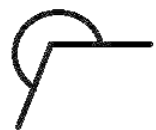
An angle which is between 180° and 360°
Straight
An angle which is exactly equal to 180°.
Complete
An angle which is exactly equal to 360°.
Types of Angles
Complementary and Supplementary Angles
Complementary Angles are the different angles whose sum is 90°.
Suplementary Angles are the different angles whose sum is 180°
Angles Based On Position
Adjacent Angles: Two angles that share a common sideare called Adjacent Angles.
Linear Pair: A pair of adjacent angles whose non-common sides form a straight line (i.e., they are supplementary and add up to 180°).
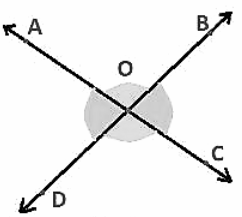
Vertical (Opposite) Angles:
Angles opposite each other when two lines intersect. They are always equal.
Angles:
An angle is formed by two rays(called the sides or arms of the angle) with a common endpoint called the vertex.
Angles are measured in degrees(°) or radians, with a full rotation being 360°.
Special Angle Pairs:
Complementary Angles:
Two angles whose measures add up to 90°.
Supplementary Angles: Two angles whose measures add up to 180°
Angles in Polygons:
Interior Angles: Angles on the inside of a polygon. The sum of the interior angles of an n-sided polygon is ((n-2) times 180°).
Exterior Angles: Angles on the outside of a polygon. The sum of the exterior angles of any polygon is always 360°.
Angles Formed by Parallel Lines and Transversals:
When a transversal intersects two parallel lines, several angle pairs are formed:
Corresponding Angles: Angles in the same position relative to the two lines and the transversal. They are equal.
Alternate Interior Angles: Angles on opposite sides of the transversal and inside the parallel lines. They are equal.
Alternate Exterior Angles: Angles on opposite sides of the transversal and outside the parallel lines. They are equal.
– **Consecutive (Same-Side) Interior Angles:** Angles on the same side of the transversal and inside the parallel lines. They are supplementary.
Measuring Angles:
Protractor: A tool used to measure angles in degrees.
Radians: Another unit of angle measure. One full revolution (360°) is equal to (2pi) radians.
Angle Relationships in Circles:
Central Angle: An angle whose vertex is the centre of the circle. The measure of a central angle is equal to the measure of the arc it intercepts.
Inscribed Angle: An angle whose vertex is on the circle and whose sides contain chords of the circle. The measure of an inscribed angle is half the measure of the intercepted arc.
Angles Formed by Tangents and Chords: The measure of the angle formed by a tangent and a chord through the point of contact is half the measure of the intercepted arc.
Angles Inside the Circle (but not at the centre): The measure of an angle formed by two intersecting chords is half the sum of the measures of the arcs intercepted by the angle and its vertical angle.
Trigonometric Angles:
Standard Position: An angle with its vertex at the origin and one side on the positive x-axis.
Reference Angle: The acute angle formed by the terminal side of an angle and the x-axis.
Quadrantal Angles: Angles that are multiples of 90° (0°, 90°, 180°, 270°, 360°).
Angle Conversions:
Degrees to Radians: Multiply the number of degrees by (frac{pi}{180}).
Radians to Degrees: Multiply the number of radians by (frac{180}{pi}).
Key Properties and Theorems:
Angle Sum Property of a Triangle:
The sum of the interior angles of a triangle is always 180°.
Exterior Angle Theorem:
The measure of an exterior angle of a triangle is equal to the sum of the measures of the two non-adjacent interior angles.
Polygon Interior Angles Theorem:
The sum of the interior angles of an n-sided polygon is ((n-2) times 180°).
Understanding these fundamental aspects of angles will enhance your comprehension of geometric principles and their applications.
Pairs of Angles Axioms
1. If a ray stands on a line, then the sum of two adjacent angles formed by that ray is 180°.
This shows that the common arm of the two angles is the ray which is standing on a line and the two adjacent angles are the linear pair of the angles. As the sum of two angles is 180° so these are supplementary angles too.
2. If the sum of two adjacent angles is 180°, then the arms which are not common of the angles form a line.
This is the reverse of the first axiom which says that the opposite is also true.
Vertically opposite Angles Theorem
When two lines intersect each other, then the vertically opposite angles so formed will be equal.
AC and BD are intersecting each other so ∠AOD = ∠BOC and ∠AOB = DOC.
Parallel Lines and a Transversal
If a line passes through two distinct lines and intersects them at distant points then this line is called Transversal Line.
Here line “l” is transversal of line m and n.
Exterior Angles – ∠1, ∠2, ∠7 and ∠8
Interior Angles – ∠3, ∠4, ∠5 and ∠6
Pairs of angles formed when a transversal intersects two lines-
1. Corresponding Angles:
∠ 1 and ∠ 5
∠ 2 and ∠ 6
∠ 4 and ∠ 8
∠ 3 and ∠ 7
2. Alternate Interior Angles:
∠ 4 and ∠ 6
∠ 3 and ∠ 5
3. Alternate Exterior Angles:
∠ 1 and ∠ 7
∠ 2 and ∠ 8
4. Interior Angles on the same side of the transversal:
∠ 4 and ∠ 5
∠ 3 and ∠ 6
Transversal Axioms
1. If a transversal intersects two parallel lines, then
Each pair of corresponding angles will be equal.
Each pair of alternate interior angles will be equal.
Each pair of interior angles on the same side of the transversal will be supplementary.
2. If a transversal intersects two lines in such a way that
Corresponding angles are equal then these two lines will be parallel to each other.
Alternate interior angles are equal then the two lines will be parallel.
Interior angles on the same side of the transversal are supplementary then the two lines will be parallel.
Lines Parallel To The Same Line
If two lines are parallel with a common line then these two lines will also be parallel to each other.
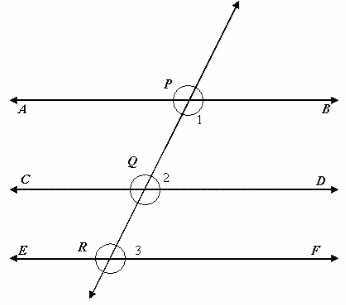
As in the above figure if AB ∥ CD and EF ∥ CD then AB ∥ EF.
Angle Sum Property of a Triangle
1. The sum of the angles of a triangle is 180º.
∠A + ∠B + ∠C = 180°
2. If we produce any side of a triangle, then the exterior angle formed is equal to the sum of the two interior opposite angles.
Any closed polygon with four sides, four angles and four vertices are called Quadrilateral. It could be regular or irregular. (Sroll down to continute …)
Study Tools
Audio, Visual & Digital Content
Revision Notes – CBSE 09 Math – Quadrilaterals
Angle Sum Property of a Quadrilateral
The sum of the four angles of a quadrilateral is 360°
If we draw a diagonal in the quadrilateral, it divides it into two triangles.
And we know the angle sum property of a triangle i.e. the sum of all the three angles of a triangle is 180°.
The sum of angles of ∆ADC = 180°.
The sum of angles of ∆ABC = 180°.
By adding both we get ∠A + ∠B + ∠C + ∠D = 360°
Hence, the sum of the four angles of a quadrilateral is 360°.
Example
Find ∠A and ∠D, if BC∥ AD and ∠B = 52° and ∠C = 60° in the quadrilateral ABCD.
Solution:
Given BC ∥ AD, so ∠A and ∠B are consecutive interior angles.
So ∠A + ∠B = 180° (Sum of consecutive interior angles is 180°).
∠B = 52°
∠A = 180°- 52° = 128°
∠A + ∠B + ∠C + ∠D = 360° (Sum of the four angles of a quadrilateral is 360°).
∠C = 60°
128° + 52° + 60° + ∠D = 360°
∠D = 120°
∴ ∠A = 128° and ∠D = 120 °.
Types of Quadrilaterals
S No.
Quadrilateral
Property
Image
1.
Trapezium
One pair of opposite sides is parallel.
2.
Parallelogram
Both pairs of opposite sides are parallel.
3.
Rectangle
a. Both the pair of opposite sides is parallel.b. Opposite sides are equal.c. All the four angles are 90°.
4.
Square
a. All four sides are equal.b. Opposite sides are parallel.c. All the four angles are 90°.
5.
Rhombus
a. All four sides are equal.b. Opposite sides are parallel.c. Opposite angles are equal.d. Diagonals intersect each other at the centre and at 90°.
6.
Kite
Two pairs of adjacent sides are equal.
Remark: A square, Rectangle and Rhombus are also a parallelogram.
Properties of a Parallelogram
Theorem 1: When we divide a parallelogram into two parts diagonally then it divides it into two congruent triangles.
∆ABD ≅ ∆CDB
Theorem 2: In a parallelogram, opposite sides will always be equal.
Theorem 3: A quadrilateral will be a parallelogram if each pair of its opposite sides will be equal.
Here, AD = BC and AB = DC
Then ABCD is a parallelogram.
Theorem 4: In a parallelogram, opposite angles are equal.
In ABCD, ∠A = ∠C and ∠B = ∠D
Theorem 5: In a quadrilateral, if each pair of opposite angles is equal, then it is said to be a parallelogram. This is the reverse of Theorem 4.
Theorem 6: The diagonals of a parallelogram bisect each other.
Here, AC and BD are the diagonals of the parallelogram ABCD.
So the bisect each other at the centre.
DE = EB and AE = EC
Theorem 7: When the diagonals of the given quadrilateral bisect each other, then it is a parallelogram.
This is the reverse of the theorem 6.
The Mid-point Theorem
1. If a line segment joins the midpoints of the two sides of the triangle then it will be parallel to the third side of the triangle.
If AB = BC and CD = DE then BD ∥ AE.
2. If a line starts from the midpoint of one line and that line is parallel to the third line then it will intersect the midpoint of the third line.
If D is the midpoint of AB and DE∥ BC then E is the midpoint of AC.
Example
Prove that C is the midpoint of BF if ABFE is a trapezium and AB ∥ EF.D is the midpoint of AE and EF∥ DC.
Solution:
Let BE cut DC at a point G.
Now in ∆AEB, D is the midpoint of AE and DG ∥ AB.
By midpoint theorem, G is the midpoint of EB.
Again in ∆BEF, G is the midpoint of BE and GC∥ EF.
Introduction to Euclid Geometry The necessity of geometry had been felt from ancient times in different parts of the world.
The practical problems faced by people of ancient civilization had developed this branch of mathematics.
Let us cite few examples.
With floods in the river, the demarcations of land owners on the river-side land were used to wipe out. (Scroll down to continue …)
Study Tools
Audio, Visual & Digital Content
In order to redraw the boundaries, the idea of area was introduced, the idea of area was introduced.
The volumes of granaries could be measured by using geometry.
The existence of Egyptian pyramids indicates the use of geometry from olden times.
In Vedic period, there was a manual of geometrical construction, known as Sulbasutra’s.
Different geometrical shapes were constructed as altars to perform various Vedic rites.
The word Geometry originates from the green word ‘Geo’ (earth) and metrein (to measure) Through Geometry was developed and applied from ancient time in various part the world, it was not presented in a systematic manner.
Later in 300 BC, the Egyptian mathematician Euclid, collected all the known work and arranged it in a systematic manner.
‘Elements’ is a classic treatise in geometry which was written by Euclid.
This was the most influential book. The ‘element’ was used as a text book for several years in western Europe.
The ‘elements’ started with 28 definitions, five postulates and five common notions and systematically built the rest of plane and solid geometry.
The geometrical approach given by Euclid is known as Euclid method.
The Euclid method consists of making a small set of assumptions and then proving many other proposition from these assumptions.
The assumptions, made were obvious universal truth. The two types of assumption, made were ‘axioms’ and ‘postulates’.
Euclid’s Definitions Euclid listed 23 definitions in book 1 of the ‘elements’.
We list a few of them: 1) 2) 3) 4) 5) 6) 7) A point is that which has no part A line is a breadth less length The ends of a line are points A straight line is a line which lies evenly with the points on itself. A surface is that which has length and breadth only.
The edges of a surface are lines A plane surface is surface which lies evenly with straight lines on its self. Starting with these definitions, Euclid assumed certain assumptions, known as axioms and postulates.
Euclid’s Axioms Axioms were assumptions which were used throughout mathematics and are not specifically linked to geometry.
Few of Euclid’s axioms are:
1) Things which are equal to the same thing are equal to one another.
2) It equals are added to equals; the wholes are equal.
3) 4) 5) 6) 7) If equals are subtracted from equals, the remainders are equal.
Things which coincide one another are equal to one another.
The whole is greater than the part Things which are double of the same thing are equal to one another.
Things which are half of the same things are equal to one another.
All these axioms refer to magnitude of same kind.
Axiom – 1 can be written as follows: If x = Z and y = Z, then x = y
Axiom – 2 explains the following: If x = y, then x + Z = y + Z According to axiom – 3, If x = y, then x – Z = y – Z Axiom – 4 justifies the principle of superposition that every thing equals itself.
Axiom – 5, gives us the concept of comparison. If x is a part of y, then there is a quantity Z such that x = y + Z or x > y Note that magnitudes of the same kind can be added, subtracted or compared.
Euclid’s Postulates Euclid used the term postulate for the assumptions that were specific to geometry. Euclid’s five postulates are as follows: Postulate 1: A straight line may be drawn from any one point to any other point. Same may be stated as axiom 5.1 Given two distinct points, there is a unique line that passes through them.
Postulate 2: A terminated line can be produced indefinitely. Postulate 3: A circle can be drawn with any centre and any radius. Postulate 4: All right angles are equal to one another. Postulate 5: If a straight line falling on two straight lines makes the interior angle on the same side of it taken together less than two right angles, then two straight lines, if produced indefinitely, meet on that side on which the sum of the angles is less than two right angles. Postulates 1 to Postulates 4 are very simple and obvious and therefore they are taken a ‘self evident truths’. Postulates 5 is complex and it needs to be discussed. Suppose the line XY falls on two lines AB and CD such that ∠1 + ∠2 < 180°, then the lines AB and CD will intersect at a point. In the given figure, they intersect on left side of PQ, if both are produced. Note: In mathematics the words axiom and postulate may be used interchangeably, though they have distinct meaning according to Euclid. System of Consistent Axioms A system of axioms is said to be consistent, if it is impossible to deduce a statement from these axioms, which contradicts any of the given axioms or proposition. Proposition or Theorem The statement or results which were proved by using Euclid’s axioms and postulates are called propositions or Theorems. Theorem: Two distinct lines cannot have more than one point in common. Proof: Given: AB and CD are two lines. To prove: They intersect at one point or they do not intersect. Proof: Suppose the lines AB and CD intersect at two points P and Q. This implies the line AB passes through the points P and Q. Also the line CD passes through the points P and Q. This implies there are two lines which pass through two distinct point P and Q. But we know that one and only one line can pass through two distinct points. This axiom contradicts out assumption that two distinct lines can have more than one point in common. The lines AB and CD cannot pass through two distinct point P and Q. Equivalent Versions of Euclid’s Fifth Postulate The two different version of fifth postulate a) For every line l and for every point P not lying on l, there exist a unique line m passing through P and parallel to l. b) Two distinct intersecting lines cannot be parallel to the same line.