THE RIGHT MENTOR

Tool : Study

Study Toools

  • Heat | Study

    Mind Map Overal Idea Content Speed Notes Quick Coverage Heat: It is a form of energy, which makes any object hot or cold. The materials which allow heat to pass through them easily are conductors of heat. The materials which do not allow heat to pass through them easily are called insulators. Temperature: The degree… readmore

    Mind Map

    Overal Idea

    Content

    Speed Notes

    Quick Coverage

    Heat: It is a form of energy, which makes any object hot or cold.

    The materials which allow heat to pass through them easily are conductors of heat.

    The materials which do not allow heat to pass through them easily are called insulators.

    Temperature: The degree of hotness of an object is called temperature.

    Heat is the cause of temperature.

    Our sense of touch is not reliable to measure the temperature. (Scroll down till end of the page)

    Study Tools

    Audio, Visual & Digital Content

    Heat:

    It is a form of energy, which makes any object hot or cold.

    Temperature: The degree of hotness of an object is called temperature. Our sense of touch is not reliable to measure the temperature.

    Thermometer is a device used for measuring temperatures.

    Heat is the cause of temperature.

    Clinical thermometer is used to measure our body temperature.

    Transfer of Heat: Heat flows from a hotter object to a colder object until both objects reach the same temperature.

    The heat flows from a body at a higher temperature to a body at a lower temperature.

    There are three ways in which heat can flow from one object to another.

    These are conduction, convection and radiation.

    Conduction: It is the process by which heat is transferred from the hotter end to the colder and end of an object.

    Convection: It is the flow of heat through a fluid from places of higher temperature to places of lower temperature by movement of the fluid itself.

    Radiation: It is the mode of transfer of heat in which energy is directly transferred from one place to another.

    It does not need any material medium.

    Dark-coloured objects absorb radiation better than the light-coloured objects.

    That is the reason we feel more comfortable in light-coloured clothes in the summer.

    Woollen clothes keep us warm during winter.

    It is so because wool is a poor conductor of heat and it has air trapped in between the fibres.

    Thermometer:

    Thermometer is a device used for measuring temperatures.

    Clinical thermometer:

    Clinical thermometer is used to measure our body temperature.

    A thermometer used to measure the temperature of our body is called a clinical thermometer.

    For other purposes, we use the laboratory thermometers.

    The range of these thermometers is usually from –10°C to 110°C.

    The normal temperature of the human body is 37°C.

    It consists of a long, narrow, uniform glass tube with a bulb containing mercury at one end.

    There is a kink near the bulb.

    The range of clinical thermometer is from 35°C to 42°C. (Or from 94°F to 108°F).

    Laboratory Thermometer:

    Laboratory Thermometer: It is a thermometer used to measure the temperature of objects other than our body.

    It consists of a column of mercury enclosed in a glass casing.

    The column is continuous without any kink.

    It measures a range of temperature from -10˚C to 110˚C.

    Sea Breeze:

    Sea Breeze: Durign the day, the land heats up faster than the sea.

    Warm air above the land rises and cold air from sea takes its place.

    Warm air from the land moves towards the sea to compele the cycle.

    This produces a sea breeze from the sea to the land.

    Land Breeze:

    Land Breeze: At night the land cools faster than sea.

    The warm air above the sea rises.

    This warm air is replaced by colder air from the land producing a land breeze.

    Hindi Version

    Key Terms

    Topic Terminology

    Term

    Important Tables

    Table:

    .

    Thumbnail - Study, Assess, Interact
    Advanced Tools For Study Assess Interact
  • MICROORGANISMS : FRIEND AND FOE | Study

    Mind Map Overal Idea Content Speed Notes Quick Coverage Micro-organisms: Micro-organisms are too small and are not visible to the un aided eye. They can survive under all types of environment, ranging from ice cold climate to hot springs and deserts to marshy lands. They are also found inside the bodies of animals including humans.… readmore

    Mind Map

    Overal Idea

    Content

    Speed Notes

    Quick Coverage

    Micro-organisms: Micro-organisms are too small and are not visible to the un aided eye.

    They can survive under all types of environment, ranging from ice cold climate to hot springs and deserts to marshy lands.

    They are also found inside the bodies of animals including humans. (Scroll down till end of the page)

    Study Tools

    Audio, Visual & Digital Content

    Micro-organisms are found in air, water and in the bodies of plants and animals.They may be unicellular or multicellular.

    Micro-organisms are classified into four major groups. These groups are bacteria,fungi, protozoa and some algae.

    Viruses are quite different from other micro-organisms. They reproduce only inside

    Micro-organisms: Friend and Foe

    Based on the significance, micro-organisms can be useful or harmful.

    Uses Of Microorganisms

    Protozoan cause serious diseases like dysentery and malaria.

    Some bacteria and blue green algae present in the soil fix nitrogen from the atmosphere and convert into nitrogenous compounds.

    Certain bacteria convert compounds of nitrogen present in the soil into nitrogen gas which is released to the atmosphere.

    Pathogens: Some of the microorganisms cause diseases animals. Such disease causing microorganisms are called pathogens.

    Cleaning of Environment: The microorganisms decompose dead organic waste
    of plants and animals converting them into simple substances. These substances are again used by other plants and animals.

    Microorganisms can be used to degrade theharmful and smelly substances and thereby clean up the environment.

    Hindi Version

    Key Terms

    Topic Terminology

    Term

    Important Tables

    Table:

    .

    Thumbnail - Study, Assess, Interact
    Advanced Tools For Study Assess Interact
  • Pair of Linear Equations in Two Variables | Study

    Mind Map Overal Idea Content Speed Notes Quick Coverage Content : (Scroll down till end of the page) Study Tools Audio, Visual & Digital Content Content … Key Terms Topic Terminology Term Important Tables Table: . Assessments Test Your Learning readmore

    Mind Map

    Overal Idea

    Content

    Speed Notes

    Quick Coverage

    Content : (Scroll down till end of the page)

    Study Tools

    Audio, Visual & Digital Content

    Content …

    Hindi Version

    Key Terms

    Topic Terminology

    Term

    Important Tables

    Table:

    .

    Thumbnail - Study, Assess, Interact
    Advanced Tools For Study Assess Interact
  • STATISTICS | Study

    Mind Map Overal Idea Content Speed Notes Quick Coverage Content Study Tools Content … Key Terms Topic Terminology Term: Important Tables Topic Terminology Term: Assessments Test Your Learning readmore
    Mind Map

    Overal Idea

    Content

    Speed Notes

    Quick Coverage

    Content

    Study Tools

    Content …

    Key Terms

    Topic Terminology

    Term:

    Important Tables

    Topic Terminology

    Term:

  • SURFACE AREAS AND VOLUMES | Study

    Mind Map Overal Idea Content Speed Notes Quick Coverage Plane figure The figures which we can be drawn on a flat surface or that lie on a plane are called Plane Figure. Example – Circle, Square, Rectangle etc. Solid figures The 3D shapes which occupy some space are called Solid Figures. Example – Cube, Cuboid,… readmore

    Mind Map

    Overal Idea

    Content

    Speed Notes

    Quick Coverage

    Plane figure

    The figures which we can be drawn on a flat surface or that lie on a plane are called Plane Figure.

    Example – Circle, Square, Rectangle etc.

    Solid figures

    The 3D shapes which occupy some space are called Solid Figures.

    Example – Cube, Cuboid, Sphere etc. (Scroll down the till the end of the page)

    Study Tools

    Volume

    Space occupied by any solid shape is the capacity or volume of that figure. The unit of volume is a cubic unit.

    Surface Area

    The area of all the faces of the solid shape is its total surface area. The unit of surface area is a square unit.

    Lateral or Curved Surface Area

    The surface area of the solid shape after leaving the top and bottom face of the figure is called the lateral surface of the shape. The unit of lateral surface area is a square unit.

    Surface Area and Volume of a Cube

    Cube is a solid shape having 6 equal square faces.

    Lateral surface area of a cube4s2
    Total surface area of a cube6s2
    The volume of a cubes3
    Diagonal√3 s,  s = edge of the cube = side length of face of cube
    Surface Area and Volume of a Cube

    Example

    What is the capacity of a cubical vessel having each side of 8 cm?

    Solution

    Given side = 8 cm So, Volume of the cubical vessel = l3 = (8)3 = 256 cm3.

    Surface Area and volume of a Cuboid

    Cuboid is a solid shape having 6 rectangular faces at a right angle.

    Lateral surface area of a cuboid2h(l + b)
    Total surface area of a cuboid2(lb + bh + lh)
    Volume of a cuboidlbh
    Diagonall = length, b = breadth, h = height
    Surface Area and volume of a Cuboid

    Example

    What is the surface area of a cereal box whose length, breadth and height is 20 cm, 8 cm and 30 cm respectively?

    Solution

    Given, length = 20 cm, breadth = 8 cm, Height = 30 cm

    Total surface area of the cereal box = 2(lb + bh + lh)

    = 2(20 × 8 + 8 × 30 + 20 × 30)

    = 2(160 + 240 + 600)

    = 2(1000) = 2000 cm2.

    Surface Area and Volume of a Right Circular Cylinder

    If we fold a rectangular sheet with one side as its axis then it forms a cylinder. It is the curved surface of the cylinder. And if this curved surface is covered by two parallel circular bases then it forms a right circular cylinder.

    Curved surface area of a Right circular cylinder2πrh
    Total surface area of a Right circular cylinder2πr2 + 2πrh = 2πr(r + h)
    The volume of a Right circular cylinderπr2h
     r = radius, h = height
    Surface Area and Volume of a Right Circular Cylinder

    Surface Area and Volume of a Hollow Right Circular Cylinder

    If a right circular cylinder is hollow from inside then it has different curved surface and volume.

    Curved surface area of a Right circular cylinder2πh (R + r)
    Total surface area of a Right circular cylinder2πh (R + r) + 2π(R2 – r2)
     R = outer radius, r = inner radius, h = height
    Surface Area and Volume of a Hollow Right Circular Cylinder

    Example

    Find the Total surface area of a hollow cylinder whose length is 22 cm and the external radius is 7 cm with 1 cm thickness. (π = 22/7)

    Solution

    Given, h = 22 cm, R = 7 cm, r = 6 cm (thickness of the wall is 1 cm).

    Total surface area of a hollow cylinder = 2πh(R + r) + 2π(R2 – r2)     

    = 2(π) (22) (7+6) + 2(π)(72 – 62

    = 572 π + 26 π = 598 π

    = 1878.67 cm2

    Surface Area and Volume of a Right Circular Cone

    If we revolve a right-angled triangle about one of its sides by taking other as its axis then the solid shape formed is known as a Right Circular Cone.

    Curved surface area of a Right Circular Coneπrl = πr[√(h2 + r2)]
    Total surface area of a Right Circular Coneπr2 + πrl = πr(r + l)
    The volume of Right Circular Cone(1/3) πr2h
     r = radius, h = height, l = slant height
    Surface Area and Volume of a Right Circular Cone

    Surface Area and Volume of a Sphere

    A sphere is a solid shape which is completely round like a ball. It has the same curved and total surface area.

    Curved or Lateral surface area of a Sphere4πr2
    Total surface area of a Sphere4πr2
    Volume of a Sphere(4/3) πr3
     R = radius
    Surface Area and Volume of a Sphere

    Surface Area and Volume of a Hemisphere

    If we cut the sphere in two parts then is said to be a hemisphere.

    Curved or Lateral surface area of a Sphere2πr2
    Total surface area of a Sphere3πr2
    Volume of a Sphere(2/3) πr3
     r = radius
    Surface Area and Volume of a Hemisphere

    Example

    If we have a metal piece of cone shape with volume 523.33 cm3 and we mould it in a sphere then what will be the surface area of that sphere?

    Solution

    Given, volume of cone = 523.33 cm3

    Volume of cone = Volume of Sphere

    Volume of sphere = 100 π cm3

    125 = r3

    r = 5

    Surface area of a sphere = 4πr2

    = 314.28 cm2.

    Hindi Version

    Key Terms

    Topic Terminology

    Term:

    Important Tables

    Topic Terminology

    Term:

  • Understanding Quadrilaterals | Study

    Mind Map Overal Idea Content Speed Notes Quick Coverage A quadrilateral has 10 parts – 4 sides, 4 angles and 2 diagonals. Five measurements can determine a quadrilateral uniquely. (Scroll down till end of the page) Study Tools Audio, Visual & Digital Content Practical Geometry Five measurements can determine a quadrilateral uniquely. A quadrilateral can… readmore

    https://www.youtube.com/watch?v=5Wi9JTYOblw&list=PLEuUy4TjqFeAD5Xcp85qBGE8VHxrYIu7F&pp=gAQBiAQB

    Mind Map

    Overal Idea

    Content

    Speed Notes

    Quick Coverage

    A quadrilateral has 10 parts – 4 sides, 4 angles and 2 diagonals. Five measurements can determine a quadrilateral uniquely. (Scroll down till end of the page)

    Study Tools

    Audio, Visual & Digital Content

    Practical Geometry

    Five measurements can determine a quadrilateral uniquely.

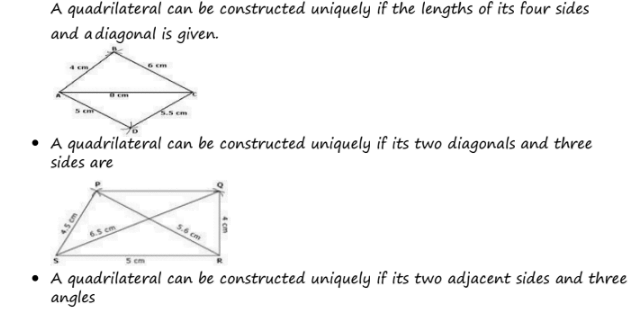
    A quadrilateral can be constructed uniquely if the lengths of its four sides and a diagonal is given.

    A quadrilateral can be constructed uniquely if its two diagonals and three sides are

    known.

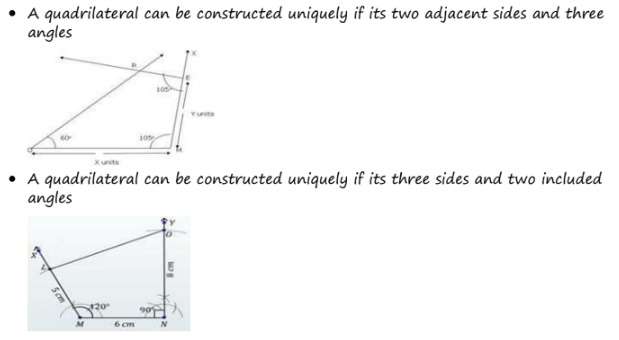
    A quadrilateral can be constructed uniquely if its two adjacent sides and three angles

    are known.

    A quadrilateral can be constructed uniquely if its three sides and two included angles

    are given.

    Hindi Version

    Key Terms

    Topic Terminology

    Term

    Important Tables

    Table:

    .

    Thumbnail - Study, Assess, Interact
    Advanced Tools For Study Assess Interact
  • Chemical Reactions and Equations | Study

    0%
    0 votes, 0 avg

    Report a question

    You cannot submit an empty report. Please add some details.
    You must log in to pass this quiz.

    Mind Map Overal Idea Content Speed Notes Quick Coverage Any process that involves the rearrangement of structure of the substance or conversion of reactants into products is defined as Chemical Reaction. For a Chemical Reaction to occur, the change can be observed in the form of – Content Study Tools Audio, Visual & […] readmore

    Mind Map

    Overal Idea

    Content

    Speed Notes

    Quick Coverage

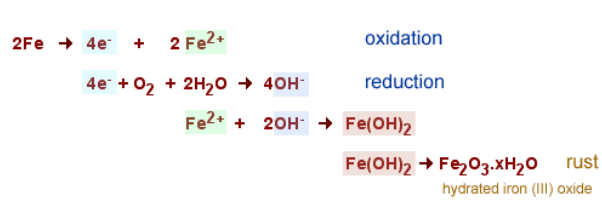
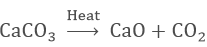
    Any process that involves the rearrangement of structure of the substance or conversion of reactants into products is defined as Chemical Reaction.

    For a Chemical Reaction to occur, the change can be observed in the form of –

    • Change in State: Melting of ice into water.
    • Change in Colour: Iron rusting which has colour change from silver to reddish brown. (Scroll down till the end)

    Content

    Study Tools

    Audio, Visual & Digital Content

    Hindi Version

    Key Terms

    Topic Terminology

    Term:

    Important Tables

    Topic Terminology

    Term:

    Thumbnail - Study, Assess, Interact
    Advanced Tools For Study Assess Interact

  • CROP PRODUCTION AND MANAGEMENT | Study

    Mind Map Overal Idea Content Speed Notes Quick Coverage In order to provide food for a large population – regular production, proper management and distribution of food is necessary. (Scroll down till end of the page) Study Tools Audio, Visual & Digital Content Crop : When plants of the same kind are grown and cultivated… readmore

    Mind Map

    Overal Idea

    Content

    Speed Notes

    Quick Coverage

    In order to provide food for a large population – regular production, proper management and distribution of food is necessary. (Scroll down till end of the page)

    Study Tools

    Audio, Visual & Digital Content

    Crop : When plants of the same kind are grown and cultivated at one place on a large scale,
    it is called a crop.

    In India, crops can be broadly categorised into two types based on seasons – Rabi and Kharif crops. Sowing of seeds at appropriate depths and distances gives good yield.

    Good variety of seeds are sown after selection of healthy seeds.

    Sowing is done by seed drills.

    Soil needs replenishment and enrichment through the use of organic manure introduction of new crop varieties.

    Basic practices of crop production:
    (i) Preparation of Soil: One of the most important tasks in agriculture is to
    turn the soil and loosen it.

    The process of loosening and turning of the soil is
    called tilling or ploughing.

    (ii) Sowing: Sowing of seeds at appropriate depths and distances gives good yield.

    Good variety of seeds is sown after selection of healthy seeds. Sowing is done by seed
    drills.

    (iii) Adding Manure and Fertilisers Soil needs replenishment and enrichment through the use of organic manure and fertilisers.

    Use of chemical fertilisers

    fertilisers has increased tremendously with the introduction of new crop varieties.

    Fertiliser: The inorganic compounds containing nutrients such as nitrogen, potassium and phosphorus. They are made in the factories.

    Example: ammonium sulphate, potash, etc.

    Manure: A natural substance prepared from decomposition of plant and animal wastes (cow dung, animal bones, dead leaves, dead insects and vegetable wastes) by t(he action of microbes.

    iv) Irrigation : Supply of water to crops at appropriate intervals is called
    irrigation. Method of Irrigation:
    (a)Tradition methods of Irrigation: Moat, Chain pump, Dheki, Rahat.

    (b) Modern methods of Irrigation: Sprinkler system, Drip

    (v) Protection from Weeds: Weeding involves removal of unwanted and
    uncultivated plants called weeds.

    (vi) Harvesting: Harvesting is the cutting of the mature crop manually or by
    machines.

    (vii) Storage Proper storage of grains is necessary to protect them from pests
    and microorganisms.

    Harvested food grains normally contain more moisture than
    required for storage.

    Large scale of storage of grains is done in silos and granaries to
    pest like rats and insects.

    Farmers store grains in jute bags or metallic bins.

    Food is also obtained from animals for which animals are reared.

    Hindi Version

    Key Terms

    Topic Terminology

    Term

    Important Tables

    Table:

    .

    Thumbnail - Study, Assess, Interact
    Advanced Tools For Study Assess Interact
  • Fractions and Decimals | Study

    Mind Map Overal Idea Content Speed Notes Quick Coverage (Scroll down till end of the page) Study Tools Audio, Visual & Digital Content Fractions: 4. A fraction whose numerator is less than the denominator is called a proper fraction. 5. A fraction whose numerator is more than or equal to the denominator is called animproper… readmore

    Mind Map

    Overal Idea

    Content

    Speed Notes

    Quick Coverage

    (Scroll down till end of the page)

    Study Tools

    Audio, Visual & Digital Content

    Fractions:

    4. A fraction whose numerator is less than the denominator is called a proper fraction.

    5. A fraction whose numerator is more than or equal to the denominator is called animproper fraction.

    6. A combination of a whole number and a proper fraction is called a mixed fraction.

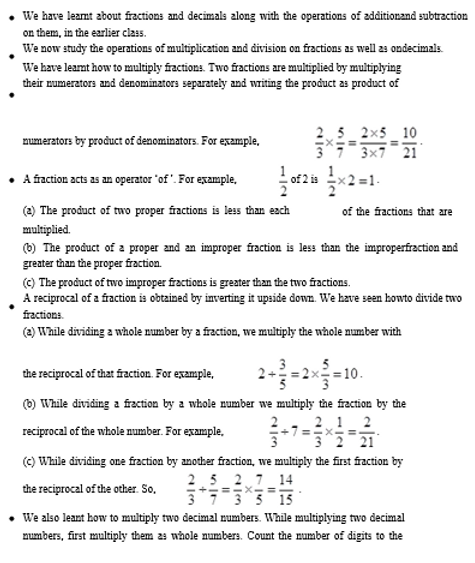
    7. To get a fractionequivalent to a given fraction,we multiply (or divide) its numerator and denominator by the same non-zero number.

    8. Fractions having the same denominators are called like fractions. Otherwise, they are calledunlike fractions.

    9. A fraction is said to be in its lowest termsif its numerator and denominator have no commonfactor other than 1.

    10. To compare fractions, we use the followingsteps:

    Step I Find the LCMof the denominators of the given fractions.

    Step II Converteach fraction to itsequivalent fraction with denominator equal to the LCM obtained in step I.

    Step Ill Arrangethe fractions in ascending or descending order byarranging numerators in ascending or descending order.

    11. To convert unlike fractions into like fractions, we use the following steps:Step I Find the LCM of the denominators of the given fractions.

    Step II Convert each of the given fractions into an equivalent fraction having denominator equal to the LCM obtained in step I.

    12. To add (or subtract)fractions, we may use the following steps:Step I Obtain the fractionsand their denominators.

    Step II Find the LCMof the denominators.

    Step III Convert each fraction into an equivalent fraction having its denominator equal to the LCM obtainedin step II.

    Step IV Add (or subtract) like fractions obtained in Step Ill.

    Step III Convert each fraction into an equivalent fraction having its denominator equal to the LCM obtainedin step II.

    Step IV Add (or subtract) like fractions obtained in Step Ill.

    14. Two fractions are said to be reciprocal of each other, if their product is 1. The reciprocal of a non zero fraction a/b is b/a.

    15. The divisionof a fraction a/b by a non-zero fraction c/d is the product of a/b with the

    reciprocal of c/d.

    Decimals:

    1. Decimals are an extension of our number system.

    2. Decimals are fractionswhose denominators are 10, 100, 1000 etc.

    3. A decimal has two parts, namely, the whole numberpart and decimal part.

    4. The number of digits containedin the decimal part of a decimal number is known as the numberof decimal places.

    5. Decimals having the same number of places are called like decimals, otherwise they are knownas unlike decimals.

    6. We have, 0.1 = 0.10 = 0.100 etc, 0.5 = 0.50 = 0.500 etc and so on. That is by annexing zeros on the right side of the extreme right digit of the decimalpart of a number does not alterthe value of the number.

    7. Unlike decimals may be converted into like decimals by annexing the requisite numberof zeros on the right side of the extreme right digit in the decimal part.

    8. Decimal numbers may be convertedby using the following steps.Step I Obtain the decimalnumbers

    Step II Compare the whole partsof the numbers. The number with greater whole part will be greater. If the whole parts are equal, go to next step.

    Step Ill Compare the extreme left digits of the decimal parts of two numbers. The number with greater extreme left digit will be greater. If the extreme left digits of decimal parts are equal,then compare the next digits and so on.

    9. A decimal can be converted into a fractionby using the following steps:Step I: Obtain the decimal.

    Step II: Take the numerator as the number obtained by removing the decimal point from the given decimal.

    Step III: Take the denominator as the number obtainedby inserting as many zeros with 1 (e.g.10, 100 or 1000 etc.)as there are number of places in the decimal part.

    10. Fractions can be converted into decimals by using the following steps:

    Step I: Obtain the fractionand convert it into an equivalent fraction with denominator 10 or 100 or 1000 if it is not so.

    Step II: Write its numeratorand mark decimal point after one place or two places or threeplaces from right towards left if the denominator is 10 or 100 or 1000 respectively. If the numerator is short of digits, insert zeros at the left of the numerator.

    11. Decimals can be added or subtracted by using the following steps:Step I: Convert the given decimals to like decimals.

    Step II: Write the decimals in columns with their decimal pointsdirectly below each other so that tenthscome under tenths, hundredths come and hundredths and so on.

    Step III: Addor subtract as we add or subtract whole numbers.

    Step IV: Place the decimal point, in the answer, directly below the other decimal points.

    12. In order to multiply a decimal by 10, 100, 1000 etc., we use the following rules:

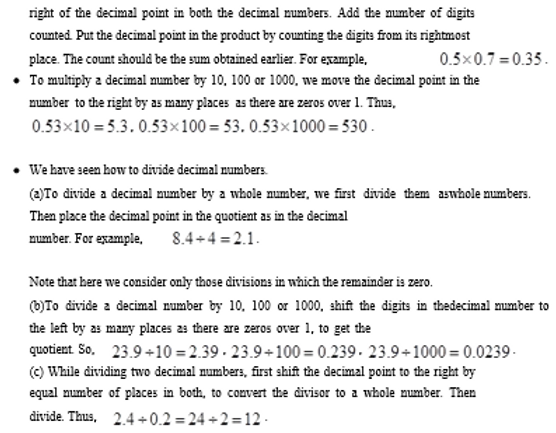
    Rule I: On multiplying a decimal by 10, the decimalpoint is shiftedto the right by one place.

    Rule II: On multiplying a decimal by 100, the decimal point is shiftedto the right by two places.

    Rule III: On multiplying a decimal by 1000, the decimal point is shiftedto the right by threeplaces, and so on.

    13. A decimal can be multiplied by a whole number by using following steps:

    Step I: Multiply the decimal without the decimalpoint by the given whole number.

    Step II: Mark the decimal point in the product to have as many placesof decimal as are there in the given decimal.

    14. To multiply a decimal by another decimal, we follow following steps:

    Step I: Multiply the two decimalswithout decimal point just like whole numbers.

    Step II: Insert the decimal point in the product by countingas many places from the right to left as the sum of the number of decimalplaces of the given decimals.

    15. A decimal can be dividedby 10, 100, 1000 etc by using the followingrules:

    Rule I When a decimal is divided by 10, the decimal point is shifted to the left by one place.

    Rule II When a decimal is divided by 100, the decimal point is shifted to the left by two places.

    Rule III When a decimal is divided by 1000, the decimal point is shiftedto the left by threeplaces.

    16. A decimal can be divided by a whole number by using the following steps:Step I: Check the whole number part of the dividend.

    Step II: If the wholenumber part of the dividend is less than the divisor,then place a 0 in the onesplace in the quotient. Otherwise, go to step Ill.

    Step III: Divide the whole number part of the dividend.

    Step IV: Place the decimal point to the right of ones place in the quotient obtained in step I.

    Step V: Divide the decimal part of the dividend by the divisor. If the digits of the dividend are exhausted, then place zeros to the right of dividendand remainder each time and continue the process.

    17. A decimal can be divided by a decimal by using the following steps:

    Step 1 Multiple the dividend and divisor by 10 or 100 or 1000 etc. to convert the divisor into a whole number.

    Step II Divide the new dividendby the whole number obtainedin step I.

    Extra:

    Hindi Version

    Key Terms

    Topic Terminology

    Term

    Important Tables

    Table:

    .

    Thumbnail - Study, Assess, Interact
    Advanced Tools For Study Assess Interact
wpChatIcon
    wpChatIcon
    error: Content is protected !!
    Scan the code