Mind Map Overal Idea Content Speed Notes Quick Coverage Any process that involves the rearrangement of structure of the substance or conversion of reactants into products is defined as Chemical Reaction. For a Chemical Reaction to occur, the change can be observed in the form of – Content Study Tools Audio, Visual & Digital Content readmore
Mind Map
Overal Idea
Content
Speed Notes
Quick Coverage
Any process that involves the rearrangement of structure of the substance or conversion of reactants into products is defined as Chemical Reaction.
For a Chemical Reaction to occur, the change can be observed in the form of –
Change in State: Melting of ice into water.
Change in Colour: Iron rusting which has colour change from silver to reddish brown. (Scroll down till the end)
Content
Study Tools
Audio, Visual & Digital Content
Chemical Reactions and Equations | Study Tools
Chemical Reactions and Equations
Any process that involves the rearrangement of structure of the substance or conversion of reactants into products is defined as Chemical Reaction.
For a Chemical Reaction to occur, the change can be observed in the form of –
Change in State: Melting of ice into water.
Change in Colour: Iron rusting which has colour change from silver to reddish brown.
Change in Temperature: There are two types of reaction i.e Exothermic and Endothermic Reaction.
Exothermic Reactions: Those reactions in which energy is released in the form of heat are called Exothermic Reactions.
Examples –
(1) All combustion reactions e.g.
CH4+ 2O2 —> CO2 + 2H2O + Heat
(2) Thermite reactions e.g.
2A1 + Fe2O3 —> 2Fe + Al2O3 + Heat
Combinations are generally exothermic in nature. The decomposition of organic matters into compost is an example of exothermic reaction.
Endothermic Reactions: Those reactions in which energy is absorbed are called Endothermic Reactions.
Examples –
also, the reaction of photosynthesis –
Evolution of any gas: When Zinc reacts with sulphuric acid it gives hydrogen gas.
Zn + H2 SO4 → ZnSO4 + H2
Formation of Precipitate: When a soluble carbonate reacts with Barium, Barium Carbonate precipitate can be observed.
Change in State
Some chemical reactions are characterised by a change in state.
When wax is burned (in the form of wax candle,) then water and carbon dioxide are formed.
Now, wax is a liquid whereas carbon dioxide is a gas. This means that during the combustion reaction of wax, the physical state changes from solid to liquid and gas.
Physical Change
In this change identity of the substance remains same.
For Example, Melting, Boiling etc.
Chemical Change
The identity of the substances change
Reactants are converted into substance due to formation or broken down of older bonds
Chemical Equation
The symbolic representation of chemical reaction using symbols and formulae is known as Chemical Equation. For this, reactants are written on the left hand side whereas products are written on the right.
Balanced Chemical Equation
A balanced chemical equation is the one where the number of atoms involved in reactants side is equal to number of atoms on product side.
Eq.1. Example of Balanced Chemical Equation
Steps to form Balanced Equation
To show how to balance the equation, the following equation is used-
Fe + H2O → Fe3O4 + H2
Step 1: First of all, draw the boxes around each formula as shown below-
Step 2: Find out the number of atoms of each element. For Example, on reactant side, 1 for Fe, 2 H, and 1 O and on product side we have, 3 for Fe, 4 for O and 2 for H.
Step 3: Start to balance the equation with the compound having maximum number of atoms. While balancing does not alter the formula of the compound.
Step 4: One by one balance each element on reactant and product side.
Step 5: After balancing number of atoms on both the side of the equation, finally check the correctness of the balanced equation.
Step 6: then write the symbols of the physical state of reactants and products as shown below-
3Fe(s) + 4H2O (g) → Fe3O4 (s) + 4H2 (g)
This above equation represents the balanced equation.
Balancing a Redox Reaction
The basic ionic form of the equation is-
Fe2+ + Cr2O72- → Fe3+ + Cr3+
Oxidation half reaction is-
Reduction half reaction is-
Use the reduction half method to balance the equation. Balance the atoms in each half of the reaction except H and O atoms.
Cr2O72- (aq) → 2 Cr3+(aq)
Add water molecules as the reaction is taking place in acidic solution. This is to balance the O atoms and hydrogen ions.
Cr2O72- (aq) + 14 H+(aq) → 2 Cr3+(aq) + 7H2O (I)
Then balance the charges in both half reactions.
Fe2+(aq) → Fe3+(aq) + e–
Cr2O72- (aq) + 14 H+ + 6e– → 2 Cr3+ + 7H2O
6 Fe2+(aq) → 6 Fe3+(aq) + 6e–
Two half of the equations are added to get the overall reaction
Combination Reaction is reaction when single product is formed from the combination of two or more reactants. For Example-
Eq.2. Example of Combination Reaction
Reactions can be exothermic as well as endothermic. Exothermic reaction release heats and raises the temperature of the surroundings. For Example, Respiration is an example of exothermic reaction.
Eq.3. Example of Exothermic Reaction
Endothermic reaction involved the absorption of the heat and thus it cools the surrounding. The decomposition of dead organic material is an endothermic reaction.
Decomposition Reaction is type of reaction which involves breakdown of single reactant into simpler products. Decomposition of silver chloride into silver and chlorine in presence of sunlight is an example of decomposition reaction.
Eq.4. Example of Decomposition Reaction
Displacement Reaction is a reaction in which more reactive element will displaces the less reactive element.
Eq. 5. Example of Displacement Reaction
Double Displacement Reaction is a type of reaction in which cations and anions in the reactants switch the places to form new products.
Eq. 6. Example of Double Displacement Reaction
Redox Reaction is also known as Oxidation-reduction Reaction. In this type of reaction transfer of electrons occurs between the two species. Oxidation is defined as addition of oxygen or removal of hydrogen. Reduction is defined as removal of oxygen or addition of hydrogen. Oxidizing agent is the one which gains the electrons and is reduced in a chemical reaction. Reducing agent is oxidized in a chemical reaction and it loses the electrons. Fluorine is the strongest oxidizing agent. Formic acid is a reducing agent
Eq.7. Example of Redox Reaction
Corrosion
Metals are prone to corrosion. It is a slow conversion of metals into some undesirable compounds. This occur may be due to reaction with oxygen, gases, acids etc. When irons reacts with atmospheric oxygen and moisture, a red layer is formed on the surface of the iron, this process is known as Rusting.
Eq. 8. Equation for Iron Rusting
Rancidity
When food containing fats and oils are exposed to the atmosphere, the oxidation of fat and oil occurs, this is known as Rancidity.
Methods to Prevent Rancidity
Store cooking oils from direct sunlight.
Food should be placed at low temperature.
By adding antioxidants food can be protected from rancidity.
Mind Map Overal Idea Content Speed Notes Quick Coverage The taste of the food is due to the presence of acids and bases in them. Acids Content Study Tools Audio, Visual & Digital Content ACIDS, BASES AND SALTS | FULL NOTES The taste of the food is due to the presence of acids and bases readmore
Mind Map
Overal Idea
Content
Speed Notes
Quick Coverage
The taste of the food is due to the presence of acids and bases in them.
Acids
Acids are defined as the substances which produce hydrogen ions or Hydronium ions (H3O+) in water. For Example, Sulphuric Acid, Hydrochloric, Nitric Acid, Acetic Acid etc.
They taste sour.
Acids turn blue litmus to red. This is used as a confirmation test for the presence of acid.
When acids react with metals, gases are evolved. (Scroll down till the end…)
Content
Study Tools
Audio, Visual & Digital Content
ACIDS, BASES AND SALTS | FULL NOTES
The taste of the food is due to the presence of acids and bases in them.
Acids
Acids are defined as the substances which produce hydrogen ions or Hydronium ions (H3O+) in water. For Example, Sulphuric Acid, Hydrochloric, Nitric Acid, Acetic Acid etc.
They taste sour.
Acids turn blue litmus to red. This is used as a confirmation test for the presence of acid.
NaHCO3 (s) + HCl (aq) → NaCl(aq) + H2O (l) + CO2 (g)
Similarity between Acids and Bases
Both acids and bases react with water. They produce ions in water
Both acids and bases act as electrolytes, so are good conductors of electricity.
Both of them change the colour of the litmus paper.
Classification of Acids
Acids are classified as Organic Acids and Mineral Acids. Acids which are derived from plants and animals, they are known as Organic Acids.
Example, Citric Acid from fruit.
Mineral acids are inorganic acids such as Sulphuric Acid. They are dangerous to be used, so need more precautions.
Acids are also classified as Strong Acids or Weak Acids. Strong acid is an acid that completely dissociates into ions in aqueous solutions. For Example, Sulphuric Acid, Hydrochloric Acid.
Weak acid is the one which does not dissociate completely into ions in aqueous solutions. For Example, Acetic Acid.
Acids can also be as Dilute Acid and Concentrated Acids. The one which has low concentration of acids in aqueous solution, they are known as Dilute Acids whereas the one which has high concentration of acids in aqueous solution, are known as Concentrated Acids.
It is advisable to add acid to water and not vice versa because a large amount of heat is released if water is added to acid. This released heat is large enough to cause harm.
Acids can also be classified based on the number of hydrogen ions. Monoprotic acid is the one which gives one mole of hydrogen ions per mole of acid, such as HCl. Diprotic Acid is the one which produces two mol of hydrogen ions per mole of acid. For Example, H2SO4.
Bases
Bases are the one which produces hydroxide ions in aqueous solutions. Bases which are water soluble are known as Alkalis.
They turn red litmus to blue.
They have a bitter taste.
They also produced carbon-dioxide when reacted with carbonates.
They also evolved hydrogen gas when bases react with metals.
Reactions of Bases
1. Reaction with Metals
Base reacts with metals and produces hydrogen gas.
2NaOH + Zn → Na2 → Na2ZnO2 + H2
2. Reaction with Acids
Base reacts with acids to form salts. For Example,
KOH + HCl → KCl + H2O
3. Reaction with Non-metallic Oxides
Base reacts with non-metallic oxides to form salt and water.
2NaOH + CO2 → CO2 → Na2CO3 + H2O
Classification of Bases
Bases are classified as Strong Base and Weak Base. Strong base is the one which dissociates completely into its ions in aqueous solution. For Example, NaOH.
Weak base is the one which does not dissociate completely into its ions in aqueous solutions. For Example, Ammonium Hydroxide, NH4OH
Bases are also classified as Dilute Base and Concentrated Base. The solution which has low concentration of base in aqueous solution is defined as Dilute Base whereas the one which has high concentration of base in aqueous solution is known as Concentrated Base.
Strength of Acid or Base Solutions
The dissociation constant of weak acid or weak base can be represented as-
Suppose HA is weak acid, then dissociation constant is represented as-
Strength of an acid or base can be determined using a pH scale. It is a scale to measure the hydrogen ion concentration in a solution. The p stands for ‘potenz’, it is a German word which means power.
If pH is equal to 7, means the solution is neutral.
If pH is greater then 7 means alkaline solution.
If pH is less then 7 means the solution is acidic.
Fig.1. pH scale
Importance of pH
Human body works at a pH of about 7.4.
Stomach has a pH of about 2 due to the presence of hydrochloric acid in it. It is needed for the activation of pepsin protein required for protein digestion.
When we eat food containing sugar, then the bacteria present in our mouth break down the sugar to form acids. This acid lowers the pH in the mouth. Tooth decay starts when the pH of acid formed in the mouth falls below 5.5. This is because then the acid becomes strong enough to attack the enamel of our teeth and corrode it. This sets in tooth decay. The best way to prevent tooth decay is to clean the mouth thoroughly after eating food.
Many animals and plants protect themselves from enemies by injecting painful and irritating acids and bases into their skin.
When a honey bee stings a person, it injects an acidic liquid into the skin. Rubbing with a mild base like baking soda solution on the stung area of the skin gives relief.
When a wasp stings, it injects an alkaline liquid into the skin. Then rubbing with a mild acid like vinegar on the stung area of the skin gives relief.
Soil pH and plant growth: Most of the plants grow best when the pH of the soil is close to 7. If the soil is too acidic or basic, the plants grow badly or do not grow at all. The soil pH is also affected by the use of chemical fertilisers in the field. Chemicals can be added to soil to adjust its pH and make it suitable for growing plants. If the soil is too acidic then it is treated with materials like quicklime or slaked lime. If the soil is too alkaline then alkalinity can be reduced by adding decaying organic matter.
Salts
When acid and base neutralise, salts are formed. Strong acid and strong base combine to form neutral salt.
NaOH + HCl → NaCl + H2O
Eq.1. Formation of Neutral Salt
Strong acid and weak base combine to form acidic salt. For Example, Hydrochloric Acid and ammonium hydroxide combine to form ammonium chloride. Other examples, sodium hydrogen carbonate, sodium hydrogen sulphate etc.
HCl + NH4OH → NH4Cl + H2O
Eq.2. Formation of Acidic Salt
Similarly, weak acid and strong base combine to form basic salt. For Example, Acetic Acid and sodium hydroxide combine to form sodium acetate. Other examples are calcium carbonate, potassium cyanide etc.
CH3COOH + NaOH → CH3COONa + H2O
Eq.3. Formation of Basic Salt
The most common salt is table salt or sodium chloride (NaCl).
Indicators
They are the substances that indicate acidic or basic nature of the solution using colour change. For Example, litmus solution, methyl orange, phenolphthalein, methyl red etc. Acids convert blue litmus paper red in colour. Bases turn red litmus blue. Phenolphthalein remains colourless in presence of acids but turns pink in presence of bases.
Some Important Chemical Compounds and their uses
Salt
Preparation
Uses
Common Salt (Sodium Chloride) (NaCl)
1. NaOH + HCl → NaCl + H2O2. From sea water by evaporation3. From underground deposit{Large crystals of common salt found in underground deposits which are brown due to presence of impurities in it. It is mined from underground deposits like coal.}
1. Raw material for making large numbers of useful chemicals in industry. Eg: NaOH (caustic soda), Na2CO3 (washing soda), NaHCO3 (baking soda).2. Preservative in pickle and curing meat and fish.3. To melt ice and clear roads in winters in cold countries.4. Used in the manufacturing of soap.
Caustic Soda (NaOH)(Sodium Hydroxide)
Passing electricity through concentrated solution of NaCl (called ‘brine’)2NaCl (Brine) + 2H2O 2NaOH (Caustic Soda) + Cl2 + H2At anode (+ve electrode): Cl2 is producedAt cathode (-ve electrode): H2 is producedIt is called chloro-alkali process because products formed are chlorine (Chloro) and NaOH (alkali).
Uses of H21. Hydrogenation of oil to get vegetable ghee (margarine)2. To make ammonia for fertilisers3. In fuel for rockets.Uses of Cl21. In water treatment2. To clean water in swimming pools3. To make plastic, e.g. PVC4. To make CFCs, chloroform, dyes etc.Uses of NaOH1. Used in making soap and detergent.2. Used in manufacturing of paper3. De-greasing metals4. Refining oil5. Making dyes and bleachesUses of HCl1. Cleaning steel2. Preparation of chloride, e.g. NH4Cl3. In making medicines and cosmetics4. In making plastics, PVC etc.
Baking Soda (NaHCO3)(Sodium Hydrogen Carbonate)
NaCl + NH3 + H2O + CO2 → NaHCO3 + NH4ClPropertiesAction of Heat:
1. Used as antacid in medicine to remove acidity of the stomach2. Used in making baking powder (Basic soda + tartaric acid)NaHCO3 + H⊕ (from mild acid) → Na⊕ (sodium salt of acid) + CO2 + H2OThe CO2 produced during the process gets trapped in wet dough and bubbles out slowly to make the cake ‘rise’ so that it becomes soft and spongy.Tartaric acid neutralises it, and so it has a pleasant taste.3. Used in soda-acid fire extinguisher
Washing Soda (Na2CO3.10H2O)(Sodium Carbonate)
Na2CO3 + 10 H2O → Na2CO3.10H2OPreparation of Na2CO3{NaCl + NH3 + H2O + CO2 NaHCO3 + NH4ClNaHCO3 → Na2CO3 + CO2 + H2O}
1. Used in glass, soap and paper industries2. Used in manufacturing of sodium compounds such as Borax3. Cleaning agent for domestic purpose4. Remove permanent hardness of water
Bleaching Powder (CaOCl2)Calcium Oxychloride
Ca(OH)2 + Cl2 → CaOCl2 + H2OSlaked Lime Calcium OxychloridePropertiesCaOCl2 + H2SO4 → CaSO4 + Cl2 + H2OThe Cl2 produced by action of dilute acid acts as a bleaching agent.
1. For bleaching cotton and linen in textile industry, for bleaching wood pulp in paper factories, for bleaching washed clothes in laundry2. Oxidising agent in chemical industries3. Disinfecting drinking water
Plaster of Paris (P.O.P) (CaSO4.1/2 H2O)(Calcium Sulphate Hemihydrate)
CaSO4.H2O (Plaster of Paris) +3/2 H2O* Heating of gypsum should not be done above 100oC as above that temperature, water of crystallisation will be eliminated and anhydrous CaSO4 will be obtained. This anhydrous CaSO4 is known as Dead Burnt Plaster.* CaSO4.1/2 H2O means that two molecules of CaSO4 share one molecule of water.PropertiesHas the remarkable property of setting into a hard mass on wetting with water, as gypsum is formed.CaSO4.1/2 H2O (P.O.P) + 1/2 H2O → CaSO4.2H2O (Gypsum set as hard mass)Hence, P.O.P should be stored in moisture-proof containers as moisture can cause slow setting of P.O.P by hydrating it.
1. Used in hospital for setting fractured bones in the right position to ensure correct healing.2. Making toys, decorative materials, cheap ornaments, and casts of statues.3. Used as fire-proofing material4. Used in chemistry labs for setting air gaps in apparatus.5. Making smooth surfaces, such as For making ornamental designs on ceilings of houses and other buildings
Mind Map Overal Idea Content Speed Notes Quick Coverage Elements are classified as metals and non-metals based on different properties. The properties of metals and non-metals are given in the form of table below- Metals Non-metals Metals are lustrous, that is, they have a property to shine. They are not lustrous, that is, they do readmore
Mind Map
Overal Idea
Content
Speed Notes
Quick Coverage
Elements are classified as metals and non-metals based on different properties. The properties of metals and non-metals are given in the form of table below-
Metals
Non-metals
Metals are lustrous, that is, they have a property to shine.
They are not lustrous, that is, they do not have shining surface. except, graphite and iodine
All metals exist as solids except mercury which is liquid at room temperature.
They are generally soft, except diamond.
They can be drawn into wires, this is known as Ductility.
They are non-ductile.
Metals can be converted into sheets, this is known as Malleability, except mercury
They are non-malleable
They are good conductors of electricity and heat. Except Lead and mercury.
They are poor conductors of electricity and heat. Exception-graphite is good conductor of electricity
They have high density and high melting point. Exception-sodium and potassium have low melting points
They have low density compared to metals and low melting point except Diamond which has high melting point
Study Tools
Audio, Visual & Digital Content
Elements are classified as metals and non-metals based on different properties. The properties of metals and non-metals are given in the form of table below-
Metals
Non-metals
Metals are lustrous, that is, they have a property to shine.
They are not lustrous, that is, they do not have shining surface. except, graphite and iodine
All metals exist as solids except mercury which is liquid at room temperature.
They are generally soft, except diamond.
They can be drawn into wires, this is known as Ductility.
They are non-ductile.
Metals can be converted into sheets, this is known as Malleability, except mercury
They are non-malleable
They are good conductors of electricity and heat. Except Lead and mercury.
They are poor conductors of electricity and heat. Exception-graphite is good conductor of electricity
They have high density and high melting point. Exception-sodium and potassium have low melting points
They have low density compared to metals and low melting point except Diamond which has high melting point
Chemical Properties of Metals
Metals react with air or oxygen to form metal oxide.
For Example, Copper reacts with oxygen to form copper oxide.
Metal + O2 → Metal oxide
2Cu + O2 → 2CuO
4Al + 3O2 → 2Al2O3
Oxides of metals can react with both acids and bases to produce salt and water. Such oxides are known as Amphoteric Oxides.
Al2O3 + 6HCl → 2AlCl3 + H2O
Metals also reacts with water to form metal oxide. Metal oxide in turn can react with water to form metal hydroxide. For Example
2Na + 2H2O → 2NaOH + 1H2
2Al + 3H2O → Al2O3 + 3H2
Metals also reacts with dilute acids to form salt and hydrogen. For example, magnesium reacts with dilute hydrochloric acid to form magnesium chloride and hydrogen.
Metal + Acid → Metal Salt + Hydrogen
Mg + 2HCl → MgCl2 + H2
Chemical Properties of Nonmetals
Non-metals react with oxygen to form non-metal oxide.
Non-metal + Oxygen → Non-metal oxide
C + O2 → CO2
Non-metals do not react with water and acids to evolve hydrogen gas.
Non-metals can react with salt solution; more reactive elements will displace the less reactive non-metal.
2 NaBr (aq) + Cl2(aq) → 2NaCl (aq) + Br2 (aq)
Non-metals can also react with hydrogen to form hydrides.
H2(g) + S(l) → H2S(g)
Reactivity Series
The series in which metals are arranged in the decreasing order of reactivity, it is known as Reactivity Series.
Fig.1. Reactivity Series
Ionic Compounds
Compounds formed due to the transfer of electrons from a metal to a non-metal are known as Ionic Compounds.
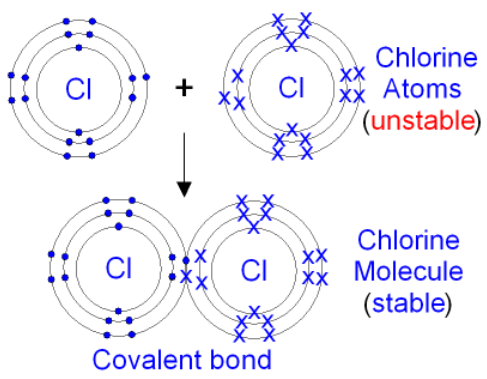
Covalent Bond
Bond formed by sharing of electrons between the two atoms. They share their valence electrons to gain stability.
Properties of Ionic Compounds
They are generally hard and solid.
They have a high melting and boiling point.
They are soluble in water but insoluble in inorganic solvents such as ether etc.
They are conductors of electricity in molten and solution state.
Occurrence of Metals
Elements or compounds which occur naturally in earth crust are known as Minerals. Minerals from which pure metals can be extracted are known as Mineral Ores.
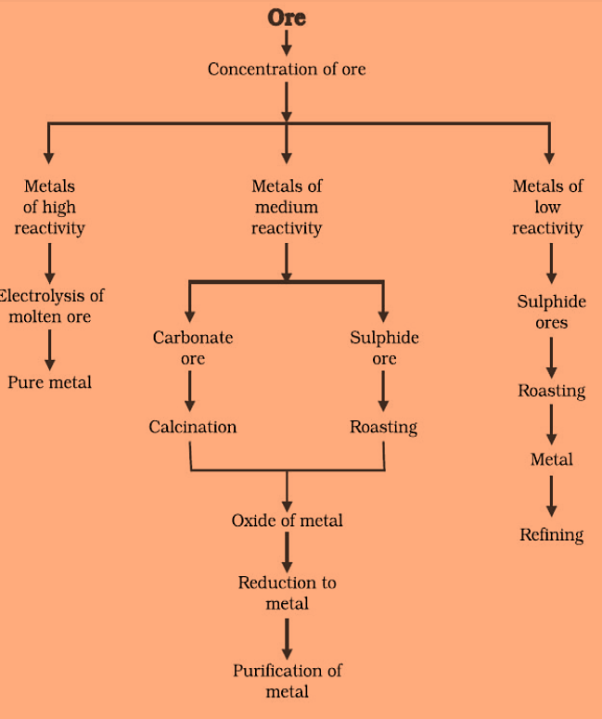
Extraction of pure metals from its ores/steps for extraction of metals from its ore
The first step is enrichment of the ore.
Second step includes extraction of metals
Third steps involve refining of metal
Gangue – Ores contain different impurities in it such as sand, soil etc. These impurities are known as Gangue.
Extracting Metals which are low in activity series
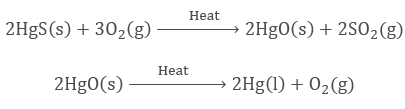
Metals which are low in activity series are unreactive. The oxides of such metals can be reduced to metals by heating alone. For Example, Cinnabar (HgS)
Extracting Metals in the middle of the Activity Series
These metals are moderately reactive. They exists as sulphides or carbonates in nature. Before reduction, metal sulphides and carbonates must be converted into metal oxides. Sulphide ores are converted into oxides by heating strongly in presence of excess air, this is known as Roasting. Carbonate ores are converted into oxides by heating in limited air. This is known as Calcination.
Roasting
Calcination
Reduction-metal oxides can be reduced to metals using reducing agent such as such as Carbon.
Extracting metals towards the top of the activity series
The metals are highly reactive. They cannot be obtained by heating. For Example, Sodium, magnesium and calcium are obtained by the electrolysis of their molten chlorides.
At cathode Na+ + e– → Na
At anode 2Cl– → Cl2 + 2e–
Refining of Metals
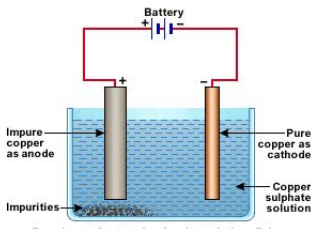
Refining of impure metal is done using electrolytic refining. Impure copper is used as anode and strip of pure copper is used as Cathode. Acidified copper sulphate is used as electrolyte. When electric current is passed through this, impure metal from the anode gets deposited in the electrolyte solution, whereas pure metal from the electrolyte is deposited at cathode.
Deposition of insoluble residue formed from the dissolution of anode during commercial electrolysis.
Electrolytic refining
Corrosion
Metals when exposed to moist air for a long period of time, they become corroded. This is known as Corrosion. For Example, Silver reacts with moist air and becomes black in colour due to silver sulphide coating.
Iron + oxygen → Iron (III) oxide
Fe + O 2 → Fe2O3
Prevention of Corrosion
Rusting of iron can be prevented by oiling, galvanising, painting, greasing etc.
To protect steel and iron from rusting, a thin layer of zinc is coated on them, this is known as Galvanization.
Alloy
Mixture of two or more metals or metal and non-metal is known as Alloy. For Example,
Mind Map Overal Idea Content Speed Notes Quick Coverage Two or more elements combine to form compounds. There are two types of compounds- Organic Compound and Inorganic Compounds. Organic compounds are the one which are made up of carbon and hydrogen. (Scroll down till the end…) Study Tools Audio, Visual & Digital Content Revision Notes readmore
Mind Map
Overal Idea
Content
Speed Notes
Quick Coverage
Two or more elements combine to form compounds. There are two types of compounds- Organic Compound and Inorganic Compounds. Organic compounds are the one which are made up of carbon and hydrogen. (Scroll down till the end…)
Study Tools
Audio, Visual & Digital Content
Revision Notes on Carbon and its Compounds
Two or more elements combine to form compounds. There are two types of compounds- Organic Compound and Inorganic Compounds. Organic compounds are the one which are made up of carbon and hydrogen.
Covalent Bond
The bond formed by sharing a pair of electrons between two atoms is known as Covalent Bond. Carbon forms a covalent bond. Carbon exists in two forms- as free state and as combined state. Free form of carbon is found in graphite, diamond and fullerene. In a combined state, carbon exists as Carbon-dioxide, Glucose, Sugar etc.
Allotropes of Carbon
Different forms of an element that has same chemical properties but different physical properties are known as Allotropes. There are three allotropes of carbon- diamond, graphite and fullerene.
Diamond
Diamond exits as three-dimensional network with strong carbon-carbon covalent bonds. Diamond is hard in nature with high melting point. It shines in presence of light and it is a bad conductor of electricity. The most common use of diamond is in making jewellery. It is also used in cutting and drilling tools.
Graphite
Graphite is made from weak van der wall forces. Each carbon atom is bonded with other three carbon atoms in order to form hexagonal rings. It serves as good conductor of heat and electricity. It is used as dry lubricant for machine parts as well as it is used in lead pencils.
Fullerene
It is a hollow cage which exits in the form of sphere. Its structure is similar to fullerene. But along with hexagonal rings, sometimes pentagonal or heptagonal rings are also present.
Fig.1 Structure of fullerene
Two Important Properties of Carbon
Catenation and tetravalency are the two important properties of carbon.
Catenation is a property of carbon by which carbon atoms can link one another via covalent bond and can form long chains, closed rings or branched chains etc.
Multiple Bonds:
Carbon atoms can be linked by single, double or triple bonds.
Carbon has a valency of 4 due to which it is known to have tetravalency. Due to this one carbon atom can bond with other 4 carbon atoms, with other atoms also such as Oxygen, Nitrogen etc.
Hydrocarbons
Compounds which are made up of carbon and hydrogen are known as Hydrocarbons.
There are two types of hydrocarbons found – Saturated Hydrocarbons and Unsaturated Hydrocarbons.
Saturated Hydrocarbons
Saturated Hydrocarbons consist of single bonds between the carbon atoms.
For Example, Alkanes. Alkanes are saturated hydrocarbons.
General formula of saturated hydrocarbons
CnH2n+2.
Unsaturated Hydrocarbons are the one with double or triple bonds between the carbon atoms.
For Example, Alkenes and Alkynes. Alkenes are represented as CnH2n whereas alkynes are represented as CnH2n-2. Some saturated hydrocarbons and unsaturated hydrocarbons are represented as –
Fig.2. Saturated hydrocarbons
Fig. 3. Unsaturated hydrocarbons
Structure of hydrocarbons can be represented in the form of electron dot structure as well as open structures as shown below-
Fig.4. Electron dot structure and open structure of ethane
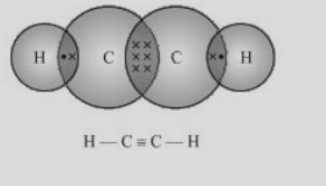
Fig.5. Electron dot structure and open structure of ethyne
Carbons Compounds based on the basis of structure
Carbon Compounds can be classified as straight chain compounds, branched chain compounds and cyclic compounds.They are represented as –
Fig.6. Straight chain carbon compound
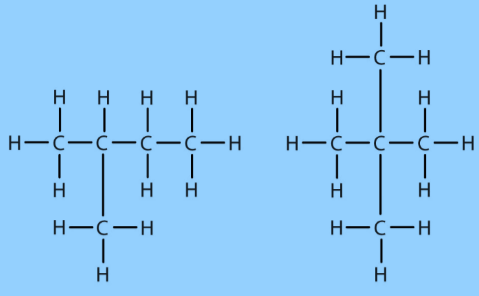
Fig.7. Branched chain compounds
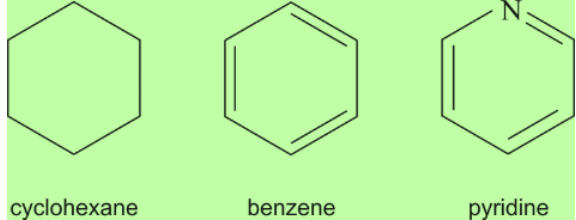
Fig.8. Cyclic carbon compounds
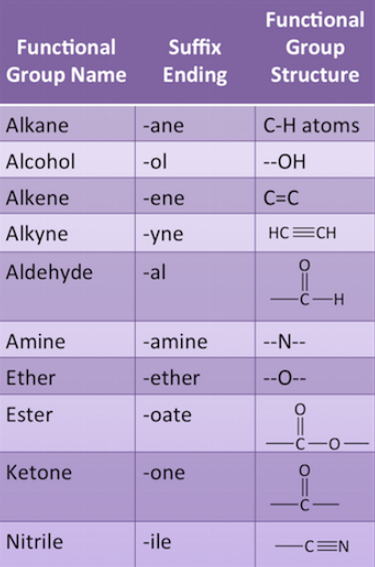
Functional Groups
One of the hydrogen atoms in hydrocarbon can be replaced by other atoms according to their valencies. The atoms which decides the properties of the carbon atoms, are known as Functional Groups. For Example, Cl, Br, -OH, Aldehyde, Ketone, Carboxylic Acid etc.
Homologous Series
Series of compounds in which same functional group substitutes for the hydrogen atom in a chain of carbon.
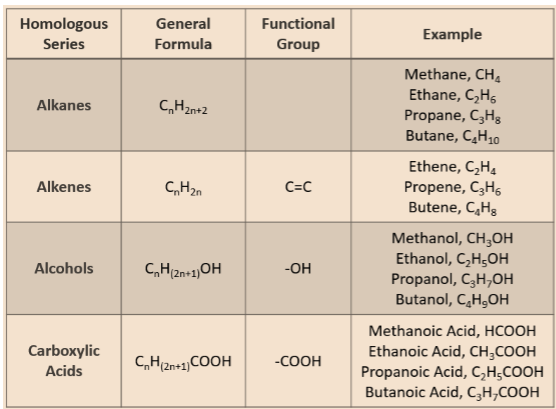
Fig.9. Homologous series
Nomenclature of Carbon Compounds
First of all, identify the number of carbon atoms in compounds. And in it identify the longest chain
Then functional group can be indicated by suffix or prefix.
Cyclic hydrocarbon is designated by prefix cyclo.
If there are two or more different substituents they are listed in alphabetical order
If the same substituent occurs more than once, the location of each point on which the substituent occurs is given
Fig.10. Different functional groups
Chemical Properties of Carbon Compounds
Combustion
Carbon along with its compound is used as a fuel as it burns in presence of oxygen to release energy. Saturated hydrocarbons produce blue and non-sooty flame whereas unsaturated hydrocarbons produce yellow sooty flame.
CH4 + 2O2 → CO2 + 2H2O
Oxidation
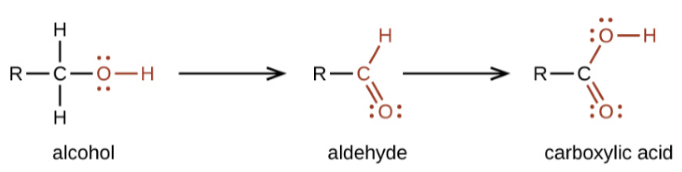
Alcohol can be oxidized to aldehydes whereas aldehydes in turn can be oxidized to carboxylic acid. Oxidizing agent such as potassium permanganate can be used for oxidation.
Addition Reaction
Hydrogenation of vegetable oil is an example of addition reaction. Addition of hydrogen in presence of catalyst such as nickel or palladium. This converts oil into ghee.
Substitution Reaction
When one atom in hydrocarbon is replaced by chlorine, bromine, etc. this is known as Substitution Reaction.
Important Carbon Compounds: Ethanol and Ethanoic Acid
Ethanol is a volatile liquid with low melting point. It reacts with sodium to form sodium ethoxide.
This above reaction is used to test the presence of ethanol by the evolution of hydrogen gas.
Dehydration of ethanol in presence of hot sulphuric acid forms alkene.
Ethanoic acid is a colourless liquid. When pure ethanoic acid freeze like ice, it is known as Glacial Acetic Acid. It is formed at a temperature of about 16.6 degree centigrade
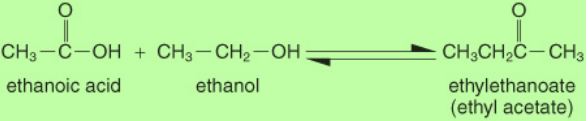
Ethanoic Acid/Acetic acid when reacts with ethanol it forms an ester. Ester can be identified by its sweet smell.
Reaction of ester with strong base is used to form soap. This is known as Saponification. Acetic acid also reacts with strong base to form sodium acetate and water.
NaOH + CH3COOH + CH3COONa + H2O
Soaps and Detergents
Sodium or potassium salt of carboxylic acid is known as Soap. They work most effectively in soap water. Detergents are sulphonate or ammonium salt of long chain of carboxylic acid. They can work effectively on soft as well as hard water.
Cleansing Action of Soaps and Detergents
Cleansing action of soaps and detergents is due to ability to minimize the surface tension of water, to emulsify oil or grease and to hold them in a suspension of water. When soap dissolves in water, it forms soap anions and soap cations. The hydrophobic part of soaps and detergents are soluble in grease and hydrophilic part is soluble in water.
Soap and Micelle Formation
When dirt and grease are mixed with soap water, soap molecules arrange them in tiny clusters known as Micelle. The hydrophilic part sticks to the water and form outer surface of the micelle and hydrophobic part binds to oil and grease.
Mind Map Overal Idea Content Speed Notes Quick Coverage Biology is the study of living things. All living things are called organisms, both plants and animals are living organisms. But how we decide whether something is living or non-living depends on 7 lifeprocesses. If something is living it will carryout the 7 life processes below. readmore
Mind Map
Overal Idea
Content
Speed Notes
Quick Coverage
Biology is the study of living things. All living things are called organisms, both plants and animals are living organisms. But how we decide whether something is living or non-living depends on 7 lifeprocesses. If something is living it will carryout the 7 life processes below. (Scroll down till end ..)
Content
Study Tools
Audio, Visual & Digital Content
What are life processes?
Biology is the study of living things. All living things are called organisms, both plants and animals are living organisms. But how we decide whether something is living or non-living depends on 7 lifeprocesses. If something is living it will carryout the 7 life processes below.
1.Movement Both animals and plants have the ability to move. Plants are rooted and move slowly as theygrow. Their roots move down into the soil and their stems moveup towards thelight. Animals onthe other handmove quickly andcan move their entire bodies. They canmove in search of food, shelter or to avoiddanger.
2.Respiration Respiration is theprocess of extracting energy out ofthe food weeat. All living things respire because they need energy to grow, to replace worn out parts and to move. Respiration takes placein the mitochondria of the cell.
3.Sensitivity All living organisms are sensitive; this means that they have anawareness of changes in their environment. Animals respond quickly to stimuli such as heat, light, sound, touch and chemicals which have taste and smell. On the other hand, plants generally appear less sensitive and their response is slower.
4.Growth All living organisms grow. Plants continue growing throughout their lives. Animals stop growing once they reach adulthood. Even when growth stops, materials within an animal’s body arestill being replaced from its food.
5.Excretion All living things make waste products these can beuseless or harmful to it and therefore need to be got rid of. Excretion is the process of getting rid of metabolic waste. Plants store waste substances in their leaves, the waste is removed when their leaves fall off. Animals breathe out waste carbon dioxide, otherwaste substances leavethe body in urineand sweat. Note: Getting rid offaeces or undigested food is notexcretion but egestion.
6.Reproduction All living things must produce offspring like themselves in order for their species to survive. This is the process known as reproduction. Plants produce seeds that give rise to new plants of thesame species. Animals lay eggs orhave babies. Reproduction can be of two types,
Sexual which involves two parents andthe union oftwo gametes andAsexual where oneparent can reproduce itself.
7.Nutrition Nutrition is needed for energy and growth, both plants andanimals need food.Plants are ableto make their own food by photosynthesis. They use sunlight to turn simple molecules like carbon dioxide and water into more complex carbohydrate molecules. Animals are unable to make theirown food sorely on other plants and other animals for their nutrition. Animals takein complex substances and break themdown into small,simple, soluble molecules whichcan be used for energy and growth
Nutrition: Energy required to carry out different life processes is obtained through the process of nutrition.Depending on themode of obtaining nutrition, organisms areclassified as autotrophs or heterotrophs. i. Autotrophs can prepare theirown food from simple inorganic sources such as carbon dioxide and water. Examples: Green plants and somebacteria. ii. Heterotrophs cannot synthesise their own food and are dependent on other organisms for obtaining complex organic substances for nutrition. Example: Animals and fungi
Autotrophic Nutrition: A type of nutrition in which organisms synthesize the organic materials they require frominorganic sources. Chiefsources of carbon and nitrogen arecarbon dioxide andnitrates, respectively. All green plants are autotrophic and use light as a source of energy for the synthesis of foodthrough photosynthesis.
The following events occur during this process. (i) Absorption oflight energy bychlorophyll (ii) Conversion of light energy to chemical energy and splitting of water molecules into hydrogen andoxygen. (iii) Reduction ofcarbon dioxide tocarbohydrates.
These greenplants absorbs waterfrom the soil by roots.Co2 enters fromthe atmosphere through stomata, Sunlight is absorbed by chlorophyll andother green parts of the plants.
Heterotrophic Nutrition: All heterotrophs depend on autotrophs fortheir nutrition. Thethree main typesof heterotrophic nutrition are:
1. Holozoic nutrition: Complex foodis taken intoa specialist digestive system and broken down into smallpieces to be absorbed. Eg: Ameoba, Humans 2. Saprophytic nutrition: Organisms feed ondead organic remains of other organisms. Eg: Fungi like bread moulds yeast andmushrooms.
Parasitic nutrition: Organisms obtain food fromother living organisms (the host), withthe host receiving no benefit fromthe parasite. Eg:cascuta, ticks, lice,leeches and tapeworms.
3. How doOrganisms Obtain Their Utrition?
In single celled organisms, the foodmay be taken in bythe entire surface. Eg: Amoeba takes in food using temporary finger-like extensions of the cell surface which fuseover the food particle forming a food-vacuole. Inside the food vacuole, complex substances are broken down into simpler ones which then diffuse into the cytoplasm. The remaining undigested material is moved to the surface of the cell andthrown out.
Nutrition in Human Beings: In humans, digestion of food takesplace in the alimentary canal, made up of various organsand glands.
In the mouth,food is crushed into small particles through chewing and mixedwith saliva, which contains amylase for digesting starch.
On swallowing, foodpasses through the pharynx and oesophagus to reach thestomach. Gastric juice contains pepsin (for digesting proteins), HCl and mucus.
The hydrochloric acidcreates an acidic medium which facilitates the action of the enzyme pepsin. The mucus protects the inner lining of the stomach from the action of the acid under normal conditions. From the stomach, the food now enters the small intestine. The small intestine is the siteof the complete digestion ofcarbohydrates, proteins and fats.
The liver secretes bilewhich emulsifies fat. The pancreas secretes pancreatic juice which contains the enzymes amylase, trypsin andlipase for digesting starch, proteins and fats, respectively. In the small intestine, carbohydrates, proteins and fats arecompletely digested intoglucose, aminoacids, fattyacids and glycerol. The villi of the small intestine absorb the digested foodand supply it to every cellof the body. The unabsorbed foodis sent intothe large intestine where more villi absorb water fromthis material. The rest of the material is removed fromthe body via the anus.
Respiration: During respiration, the digested foodmaterials are brokendown to release energy in the form of ATP. Depending on the requirement of oxygen, respiration maybe of twotypes:
i. Aerobic respiration: It occurs in the presence of air (oxygen).
ii. Anaerobic respiration: It occurs in the absence of (air) oxygen.
In all cases the first step is the break-down of glucose, a six-carbon molecule, into a three-caron molecule called pyruvate. This process taken place in thecytoplasm. Further, thepyruvate may beconverted into ethanol and carbon dioxide. This process takes place in yeast during fermentation. Since this process takes place in the absence of air (oxygen), it is called anaerobic respiration. Break-down ofpyruvate using oxygen takes place in the mitochondria. A large amount of energy isreleased in aerobic respiration as compared to anaerobic respiration. Some times when there is a lack of oxygen in our muscle cells, the pyruvate is converted into lactic acid. This build up of lactic acid in ourmuscles during sudden activity causes cramps.
Terrestrial organisms useatmospheric oxygen forrespiration, whereas aquatic organisms use oxygen dissolved in water.
In humans, inhalation of air occurs through the following pathway: Nostrils_ Nasal passage _ Pharynx _ Larynx _ Trachea _ Bronchus _ Bronchiole _ Alveolus (please put arrow marks——- à)
In human beings are is taken into the body through the nostrils. The air passing through the nostrils is filtered by fine hairs that line the passage. The passage is also lined with mucus which helps in this process. Fromhere, the air passes through the throat and into thelungs. Rings ofcartilage are present in the throat. These ensure that the air-passage does not collapse. Within the lungs the passage divides into smaller and smaller tubes which finally terminate in balloon-line structures which are called alveoli. The alveoli of lungs are richly supplied with blood and are the sites where exchange of gases (O2 and CO2) occurs between blood and the atmosphere. The blood brings carbon dioxide from the rest of the body for release into the alveoli, and the oxygen in the alveolar air is taken upby blood inthe alveolar blood vessels to be transported to all
the cells inthe body. During the breathing cycle, when air is taken in and let out,the lungs always contain a residual volume of air so that there is sufficient time for oxygen to be absorbed and for the carbon dioxide to be released. In humans, the respiratory pigment haemoglobin carries oxygen from the lungs to the different tissues of the body.This pigment in present in the redblood cells.
Transportation:
Transportation in Human Beings: The circulatory system is composed of the heart, blood and blood vessels which transport various materials throughout the body.
The heart:
The human heart has four chambers—two atria (right and left) and two ventricles (right and left). These chambers prevent the oxygen rich blood from mixing with the blood containing carbon dioxide. The right half of the heart receives deoxygenated blood, whereas the left half receives oxygenated blood.
The carbon dioxide –rich blood has to reach the lungs for the carbon dioxide to be removed, and the oxygenated blood from the lungs has to be brought back to the heart. This oxygen-rich blood isthen pumped to the restof the body. Ventricular walls are much thicker than atrial walls. Humans show double circulation i.e. blood goes through the heart twice and complete separation of oxygenated and deoxygenated blood. Arteries carry blood from the heart to different parts of the body, whereas veins deliver the blood back to the heart. Arteries are connected to veins by thin capillaries, wherein materials are exchanged between the bloodand cells. Blood has platelet cells which circulates around the body and prevent the blood loss at the site of injury. Lymph is also involved in transportation. It is similar to the plasma of blood but colourless and contains less protein. It drains into lymphatic capillaries from the intercellular spaces which join tofrom large lymph vessels that finally open intolarger veins. It carries digested and absorbed fat from intestine and drains excess fluid from extra cellular space back into the blood.
Transportation in plants: Plant transport systems will move energy stores from leaves and raw materials from roots. These two pathways are constructed as independently organized conducting tubes. One, the xylemmoves waterand minerals obtained from the soil.The other, phloem transports products ofphotosynthesis from the leaves where they are synthesised to other partsof the plant. The component of xylem tissue (tracheids and vessesls) of roots, stems, leaves are interconnected to form a continuous system of water conducting channels that reaches all parts of the plant. Transpiration creates a suction pressure, as a result of which water is forced into the xylem cells of the roots. Then there is a steady movement of water fromthe root xylem to all partsof the plant parts through theinterconnected water conducting channels. The loss ofwater in theform of vapour from the aerial parts of theplant is known as transpiration.
Thus it helps in the absorption and upward movement of water and minerals dissolved in it from rootsto the leaves. It also regulates temperature.
The transport of soluble products of photosynthesis is called translocation and itoccurs in phloem. It transports amino acids and other substances. The translocation of food and other substancestakes place in the sieve tubes with the help of adjacent companion cells both in upward and down ward directions. The translocation in phloem is achieved by utilising energy. Material like sucrose is transferred into phloem tissue using energy from ATP. This increases the osmotic pressure of the tissue causing water to move into it. This pressure. This allows the phloem to move material according to the plant’s needs. For example, in the spring, sugar stored in root or stem tissue would be transported to the buds which need energy to grow.
Excretion: During excretion, theharmful metabolic nitrogenous wastes generated areremoved from thebody
Excretion in Human Beings:
In humans, a pair of kidneys, a pair of ureters, the urinary bladder and the urethra constitute the excretory system. Kidneys are located in the addomen, one on either side of the backbone. Urine produced inthe kidneys passes through the ureters into the urinary bladder where it is stored until it is released through the urethra. Each kidney has large numbers of basic filtration units called nephrons. Some substances in the initial filtrate, such as glucose, amino acids, salts and a major amount of water, are selectively re-absorbed as the urine flows along the tube. The amount of water re-absorbed depends on how muchexcess water there is in the body, and on how muchof dissolved wastethere is tobe excreted. The urine forming in each kidney eventually enters a long tube, the ureter, which connects the kidneys with the urinary bladder until the pressure of the expanded bladder leads to the urge to pass it out through the urethra. The bladder is muscular so it is under nervous control. As a result wecan control theurge to urinate.
Excretion in plants: Plants do nothave an excretory system and carryout excretion in various wayssuch as transpiration, releasing wastes into the surrounding soil, losing their leaves and storing waste materials in cell vacuoles. Other waste products arestored as resins and gums in oldxylem.
Use the below buttons to explore our free services to find more…
Mind Map Overal Idea Content Speed Notes Quick Coverage Content Study Tools Content … Key Terms Topic Terminology Term: Important Tables Topic Terminology Term: Assessments Test Your Learning readmore
Mind Map Overal Idea Content Speed Notes Quick Coverage Content Study Tools Audio, Visual & Digital Content Chapter 9 -Heredity and Evolution 1. Accumulation of variation during Reproduction. Variations in an individual may be an advantage or disadvantage for it. It may enable or disable it to cope with changes in the environment. Advantageous variations readmore
Mind Map
Overal Idea
Content
Speed Notes
Quick Coverage
Content
Study Tools
Audio, Visual & Digital Content
Chapter 9 -Heredity and Evolution
1. Accumulation of variation during Reproduction. Variations in an individual may be an advantage or disadvantage for it. It may enable or disable it to cope with changes in the environment. Advantageous variations are selected by environmental factors. For example bacteria that can withstand heat will survive better in a heat wave. Such heritable variations lead tothe evolution andformation of newspecies. An advantage of sexual reproduction is that the variations accumulated in the gametes of each sex are combined when they fuse to form the zygote. Hence an offspring produced from the zygote receives and carries the variations of both the parents. On the other hand, in asexual reproduction there are minor differences among the offspring. These are due to small errors in DNA copying. As gametes and zygote formation are not involves the asexually produced offspring arequite similar. Theyhave fewer variations accumulated over generations.
2. Heredity: The process ofpassing traits fromparent to offspring is called heredity. Trait is any characteristic thatis transferred fromparent to offspring. e.g. height and colour. 2.1 inherited traits. In humans, eye color is an example of an inherited characteristic: an individual might inherit the brown-eye trait from one of the parents. Inherited traits are controlled by genes and the complete set of genes within an organism’s genome is called itsgenotype. 2.2 Rules for theInheritance of traits- Mendel’s contributions: Gregor Johann Mendel was a pioneer among geneticists who put forward the concept of inheritance of characteristics or traits from parent to offspring. Mendel proposed the principle of inheritance and is known as the “Father of Genetics”. Mendel has chosen pea plants for his experimentation and found variations among them. Gene is a structural and functional unit of heredity and variations. Gene is a DNA segment on the chromosome. Genes control the expression of characteristics. Mendel called the genes to be factors. Traits can be either dominant or recessive. Tallness in a plant is a dominant trait, controlled by a dominant allele and is represented by “T” (capital). Shortness in a plant is a recessive trait, controlled by a recessive allele and is represented by “t” (small). · Homozygous is a condition in which a gene possesses a pair ofthe same alleles (TT or tt)for a single characteristic. · Heterozygous is a condition in which a gene possesses a pair of different alleles (Tt) fora single characteristic. Phenotype is a morphological expression of a single character. For example, tallness or shortness represents the phenotype of the plant. Genotype is the genetic make-up of a cell, an organism, or an individual (i.e. the specific allele make-up of the individual), usually with
reference to a specific characteristic under consideration. Alleles combine to make agenotype, such as TT or Tt or tt. Punnettsquare is a statistical method that was usedby Mendel to predict thepossible genotypes andphenotypes of the offspring.
Monohybrid inheritance It is the inheritance ofa single characteristic controlled by different alleles of thesame gene. · F1 generation is thefirst filial generation offspring produced by crossing twoparental strains. visible. All the progeny of F1 generation weretall i.e. thetraits of onlyone parent were · generation isthe second filial generation offspring produced by crossing F2 F1’s. TheF2 progeny were not all tall. Instead, one quarter of themwas short indicating both the traits – that oftallness and shortness were inherited inthe F2 plants. · Genotypic ratio – 1:2:1, Phenotypic ratio – 3:1. Dihybrid inheritance It is thesimultaneous inheritance oftwo characters. Dihybrid inheritance is theexperimentation of twocharacteristics with their four contrasting traits. For instance, dihybrid inheritance involves a plant producing round and yellow seeds (RR and YY) crossing with a plant producing wrinkled green seeds(rr and yy). · · F1 progeny produces roundand yellow seeds(R and r, and Y and y)in which roundand · yellow are dominant traits. F2 progeny were similar to their parents and produced roundyellow seeds, whilesome of · them produced wrinkled green seeds. However, some plants of the progeny even showed new combinations, like round-green seedsand wrinkled-yellow seeds. Thus the tall/ shorttrait and theround seed/wrinkled seedtrait are independently inherited. F2
2.3 How do thesetraits get expressed? A section of DNA that provides information for one protein is called the gene for that protein. The proteins synthesized according to this information may be enzymes that catalyse biochemical reactions. Each trait is the outcome of several suchbiochemical reactions eachof this is controlled by a specific enzyme. Each parent contributes one copy of the gene for a particular character. Thus there are two genes for every character. In the gamete, however, only one copy is present because of reduction division and these may be either maternal or paternal origin. When two germ cells combine they will restore the normal number of gene copies in the progeny ensuring the stability of theDNA of thespecies.
2.4 Sex determination It is a mechanism which determines the individual to be a male or a female based on the sex chromosomes present in it. In human beings, sex is determined by genetic inheritance. Genes inherited fromthe parents determine whether an offspring will be a boy or a girl.Gene for all
the characters are linearly arrange on the chromosomes. The chromosomes that carry genes for sexual characters are called autosomes or sex chromosomes while those that carry genes for the vegetative characters are called autosomes ornon sex chromosomes. Women have XX chromosomes whilemen have XY. All the children will inherit an X chromosome from their mother regardless of whether they are boys or girls. Thus the sex of the children will be determined by what they inherit from their father.
3. Evolution: All the life on Earth has descended from a common ancestor. Evolution is the sequence of gradual changes over millions of years in which new species are produced. Charles Robert Darwin was an English naturalist who observed various species of life on the earth and put forward the idea of “evolution of species by natural selection.” He said that a species inherits its characters from its ancestors. Acquired and inherited traits: An acquired trait is not transmitted to the off spring. In sexually reproducing organisms germ cells are produced in the reproductive organs, while the rest of the body has somatic cells. Changes in somatic cells due to environmental factors are not transmitted to the offspring. This is because a change in a somatic organ caused by a physiological response by the body does not bringabout a corresponding changein reproduction organs. A trait or character that is genetically inherited or passed down from generation to generation is known as inherited trait. Hugo de Vries explained the mechanism of heritable variations. According to him heritable variations arise when there is a change in the genes of the germplasm. He called it mutation. If a particular trait spreads in the population, it means that is favuored by natural selection.
4. Speciation: Speciescan be defined as a group of individuals ofthe same kindthat can interbreed and produce fertile progeny. Speciation: It is an eventthat splits a population into two independent species which cannotreproduce among them.
· Process of speciation-Genetic drift: It occurs due to changes in thefrequencies of particular genes by chance alone. e.g. If a hurricane strikes the mainland, and bananas with beetle eggs on themare washed away to an island. Thisis called a genetic drift.
· Process of speciation – natural selection: These are the variations caused in individuals due to natural selection which lead to the formation of a new species. e.g. If the ecological conditions are slightly different on the island as compared to the mainland, it leads to a change in the morphology and food preferences in the organisms over the course of generations.
Process of speciation -splitting of population: A population splits into different sub- populations due to geographical isolation thatleads to theformation of a new species.
Natural selection: It explains that organisms that are physiologically or behaviourally betteradapted for theenvironment are selected. Selected organisms can survive and reproduce.
Genetic drift: It is the genetic variation in smallpopulations caused by a specific environmental factor. Gene flow: It is the transfer of genes from one population to another due to migration. Breeding between the brown and green beetles introduces new gene combinations into the population. Over generations, genetic drift will accumulate different changes in each sub population. Also, natural selection may also operate differently in the different geographic locations. Speciation due to inbreeding, genetic drift and natural selection will be applicable to all sexually reproducing organism. 5. Evolution and Classification: Characteristics are the hereditary traits transmitted from parent organisms to their offspring. These are details of appearance or behavior in other words a particular form or a particular function. It shows how closely organisms are related with respect to evolution. The more characteristics two species will have in common, the more closely they are related. And the more closely they are related, the more recently they will have had a common ancestor. For example, a brother and a sister are closely related. They have common ancestors in the first generation before them, namely their parents. A girl and her first cousin are also related, but less than the girl and her brother. This is because cousins have common ancestors, their grandparents in the second generation before them, not in the first one. 5.1 Tracing Evolutionary relationships: Characteristics are of two types namely, homologous characteristics or analogous characteristics. · Homologous characteristics are organs that have the same basic structure and origin, but different functions. For example, mammals, birds, reptiles and amphibians have four limbs with the same basic limb layout because they have inherited the limbs from a common ancestor. These limbshave been modified to perform different functions. · Analogous characteristics are organs that have different structures and are of different origin, but perform same functions. For example, the design of the wings of bats and the wings of birds look similar because they have a common purpose – to fly.
5.2 Fossils:
Usually, when organisms die, their bodies will decompose and be lost. But sometime some body parts may not decompose completely and they will eventually harden and retain the impression of the body parts. All such preserved traces of living organisms are called fossils. Fossils are the remains or traces of a plant or animal that existed in a past geological age, and that has been excavated from the soil. Fossilisation is the process in which an organism is converted into a fossil. Paleontology is the study of fossils.
There are two ways to determine the age of fossils. One way is to dig the earth and start finding fossils. The second way of dating fossils is by detecting the ratios of different isotopes of the same element in the fossil material.
5.3 Evolution by Stages:
Evolution is a gradual process- no organism evolved suddenly. Complex organs evolved in organisms gradually. The eyes of the octopus and the eyes of vertebrates have evolved independently. These similarities of structure, despite of different origins provide a classic example of biological convergence. Biological convergence is a phenomenon by which two unrelated organisms become quite alike after a period of time through few generations, if it is assumed that they have a common ancestor. A change that is useful for one property to start with can become useful for quite a different function. Forexample, long feathers were considered to provide insulation in cold weather. Some reptiles like the dinosaur had feathers but very few were adapted for flying. In the present day, birds use feathers for flight, which is an example of adaptation. It is a characteristic of a particular animal may, post-evolution be useful for performing a totally different function. It is all very well to say that very dissimilar looking structures evolve from a common ancestral design. It is true that analysis of the organ structure in fossils allow us to make estimates of how far back evolutionary relationships go. The wild cabbage plant is a good example. Broccoli, kohlrabi and kale areproduced from itsancestor wild cabbage by artificial selection. Another way of tracing evolutionary relationships depends on the changes in DNA during reproduction. Comparing the DNA of different species should give us a direct estimate of how much the DNA has changed during the formation of new species. This method is now extensively used to define evolutionary relationships.
6. Evolution should not beequated with progress.
Evolution is simply generation of diversity and the shaping of the diversity by environmental selection. It is not as if the newlygenerated species arein any way better than the olderone. It is just natural selection and genetic drift have together led to the formation of a population that cannot reproduce with the original one, as in case of the evolution of humans and chimpanzees froma common ancestor. In evolution thenew forms evolved are more complex than their ancestors. It is theadaptability of a species to the environment that supports its survival not the complexity of the species. Each species, whether complex or simple is subjected to natural selection. Each species hasto go through the process of natural selection to survive andreproduce. In evolutionary terms, we cannot say that a particular species has a better design than another. Each species is well suited and adapted to its environment and hence is good enough to live andreproduce.
6.1 Human Evolution: The tools used to traceevolutionary relationships are excavation, time-dating, studying fossils, and determining DNA sequences have been usedfor studying human evolution. All the human beings in the world, whether they are African or American, share the same gene pool and hence all modern humans belong to the same species- Homo sapiens. There are, however, a large number of genes in the gene pool that serve as the source of individual variations. It is forthis reason that no two individuals are identical in looks, abilities, behavior, etc. therefore, there is great diversity in human features such as skin colour, height, hair colour, and so on. But there is no biological basis for assuming that humans with different features belong to different races.
Mind Map Overal Idea Content Speed Notes Quick Coverage Nervous system is the organ system present in the animals to control and coordinate different activities of the body. Nervous system comprises ofthe brain, thespinal cord, anda huge network of nerves thatare spread throughout the body. The nervous system is responsible for sending, receiving and processing readmore
Mind Map
Overal Idea
Content
Speed Notes
Quick Coverage
Nervous system is the organ system present in the animals to control and coordinate different activities of the body.
Nervous system comprises ofthe brain, thespinal cord, anda huge network of nerves thatare spread throughout the body.
The nervous system is responsible for sending, receiving and processing messages in the form of chemical signals called as impulses. (Scroll down till end..)
Study Tools
Audio, Visual & Digital Content
Animals- Nervous System:
Nervous system is the organ system present in the animals to control and coordinate different activities of the body.
Nervous system comprises ofthe brain, thespinal cord, anda huge network of nerves thatare spread throughout the body.
The nervous system is responsible for sending, receiving and processing messages in the form of chemical signals called as impulses.
Nervous tissue is made up of an organized network of nerve cells or neurons.
It is specialized for conducting information via electrical impulses from one part of the body to another.
A neuron is the basic unit of the nervous system. Each neuron consists of three parts, namely, the cell body or cyton, branched projections called dendrites, the long process from the cell body, called the axon.
Synapse is a gap between two neurons.
Nerves are thread like structures emerging out of the brain and spinal cord.
Nerves branch out to all parts of the body and are responsible of carrying messages in the body.
Types of nerve cells or neurons:
Sensory nerves send messages from the sense organs to the brain or spinal cord.
Motor nerves carry messages back from the brain or spinal cord to all the muscles and glands in the body.
Interneuron or relay neuron connects neuron within specific regions of the central nervous system. These are neither motor norsensory.
Reflex action:
What happens in reflex actions?
A reflex action, differently known as a reflex, is an involuntary and nearly instantaneous movement in response to a stimulus.
Reflex is an action generated by the body in response to the environment.
The process of detecting signal or the input and responding to it by an output action might be completed quickly. Such a connection is commonly called a reflex arc.
Reflex arcs are formed in the spinal cord itself; although the information input goes onto reach the brain.
In higher animals, most sensory neurons do not pass directly in to the brain, but synapse in the spinal cord.
Reflex arc continue to be more efficient for quick response.
Human brain:
Types of nervous system
The nervous system is divided into two systems as
Central nervous system
Peripheral nervous system.
Central nervous system:
Central nervous system includes the brain and the spinal cord.
It receives information from the body and sends out instructions to particular organs.
The brain has three such major parts or regions namely the fore brain, mid brain and hind brain.
Forebrain:
The forebrain is the main thinking part of the brain.
It consists of the cerebrum and diencephalon.
The cerebrum is the seat of memory and intelligence, and of sensory centres like hear, smell and sight.
The diencephalon is the seat for pressure and pain.
Midbrain:
The midbrain connects the forebrain to the hindbrain and controls the reflexes for sight and hearing.
Hindbrain:
The hindbrain consists of the cerebellum, pons and medulla.
The cerebellum coordinates muscular activities and maintains balance and posture.
The medulla controls involuntary activities like blood pressure, salivation, vomiting and heartbeat.
The spinal cord extends from the medulla of the brain through the whole length of the vertebral column and is protected by the vertebral column or backbone. Peripheral nervous system:
Peripheral nervous system consists of the cranial and spinal nerves arises from the brain and spinal cord respectively.
How are the tissues protected? Human brain is protected by the thick bones of the skull and a fluid called cerebrospinal fluid which provides further shock absorption.
How does the nervous tissue cause action? When a nerve impulse reaches the muscle the muscle fibre must move.
The muscle cells will move by changing their shape so that they shorten.
Muscle cells have special proteins that change both their shape and their arrangement in the cellin response to nervous electrical impulses.
When this happens new arrangements of these proteins give the muscle cells a shorter form.
Coordination in plants:
All living things respond to environmental stimuli.
Plants also respond to stimuli with the helpof chemical compoundssecreted by thecells.
Plants being living organisms, exhibit some movements.
Plants show two different types of movements.
Types of movements shown by the plants are:
dependent on growth
independent of growth.
The plants also use electrical chemical means to convey this information from cellto cell but there is nospecialized tissue in plants for the conduction of information.
Plants respond to stimuli slowly by growing in a particular direction.
Because this growth is directional it appears as if the plant is moving.
Directional movements or Tropic movements:
Directional movements are also called as tropic movements.
Directional movements movements can be either towards the stimulus or away from the stimulus.
Positive phototropism is seen in shoots which respond by bending towards light.
Negative geotropism is seen in shoots by growing away from the ground.
Roots bend away from light exhibiting negative phototropism. They grow towards the ground exhibiting positive geotropism.
Hydrotropism is a growth response in which thedirection is determined by the stimuli of water.
Chemotropism is a growth movement of a plant part in response to chemical stimulus.
e.g. Growth of pollen tubes towards ovules.
Hormones
Hormones are the chemical compounds released by stimulated cells.
Hormones diffuse all around the cell.
They are synthesised at places away from where they act and simply diffuse to the area of action.
Different plant hormones help to coordinate growth, development and responses to the environment.
Different hormones secreted by the plants are auxins, gibberellins, cytokinins, abscisic acid.
Auxins are the hormones synthesised at the tip of the stem. These help the plants in growth by cell elongation.
Auxin induces shoot apicaldominance.
Gibberellins are hormones that help in the growth of the stem, seed germination, bolting, and flowering.
Cytokinins are hormones present in the areas of rapid cell division, such as fruits and seeds.
They also promote the opening of the stomata.
Abscisic acid is a hormone that inhibits the growth in various parts.
It is also responsible for the closure of stomata. Its effects include wilting of leaves.
Hormones in Animals: Endocrine system is the system formed by ductless glands which secrete chemical substances called as hormones.
Endocrine glands release hormones directly in to the blood. Hormones are minute, chemical messengers thrown into blood to act on target organs.
Endocrine glands
Different types of endocrine glands present in our body are the pituitary gland, pineal gland, hypothalamus, thyroid, parathyroid, thymus, adrenal gland, pancreas, testes and ovary.
Adrenal glands:
These are located above kidneys.
Two regions of the adrenal gland are adrenal cortex and adrenal medulla.
• Adrenal cortex secretes the hormones like cortisol, aldosterone and androgens.
• Adrenal medulla secretes the hormones like adrenaline andnoradrenaline.
Adrenaline is also called the “hormone of fight or flight,” or the emergency hormone.
It prepares the body to face an emergency condition of physical stress, like danger, anger and excitement.
Thyroid gland:
• It is located in the neck, ventral to thelarynx. • It is the one of the largest endocrine glands. • The principal hormones produced by this gland are triiodothyronine and thyroxine.
• Thyroxine is a hormone that regulates the metabolism of carbohydrates, proteins and fats in the body.
Iodine is essential for the synthesis of thyroxin.
Deficiency of iodine in food causes goiter.
One of the symptoms of this disease is a swollen neck.
The pituitary gland:
• It is located at the base of the brain. • It is considered to be master gland as it secretes many hormones to regulate organs as wellas the other glands. • Different hormones secreted by this gland include Growth hormone, TSH, FSH, LH, ACTH, MSH, Vasopressin and Oxytocin.
Growth hormone regulates growth and development of the body. If there is a deficiency of this hormone in childhood, it leads to dwarfism.
Excess secretion of this hormone leads to gigantism.
Gonads:
Two types of gonads present in human beings are female gonads and male gonads.
Female gonads
• A pair of ovaries forms the gonads in female. • Ovaries are the female sex organs that lie one on either side of the abdominal cavity.
Ovaries produce two hormones, namely, oestrogen and progesterone. • Oestrogencontrols the changes that occur during puberty, like feminine voice, soft skin and development in mammary glands. • Progesterone controls the uterine changes in the menstrual cycle, and helps in the maintenance of pregnancy.
Male gonads
• A pair of testes forms the gonads in males. • A pair of testes isthe male sexorgan located inthe scrotum, whichis outside theabdomen. • Testes produce the hormone testosterone. • Testosterone controls the changes, whichoccur during puberty, like deeper voice, development of penis, facial and bodyhair.
Pancreas: It is located just below the stomach within the curve of the duodenum. It is both exocrine and endocrine in function. • It secretes hormones such as insulin, glucagon, somatostatin and pancreatic polypeptide. • Insulin regulates the sugar level inour blood.
Insulin secreted in small amounts increases the sugar level in our blood which in turn causes a disease called diabetes mellitus.
Pineal gland: • It is located near the centre of the brain, dorsal to the diencephalon. • It produces the hormone melatonin. • Melatonin affects reproductive development, modulation of wake and sleep patterns, and seasonal functions.
Hypothalamus: • It is a neuro-endocrine part of the brain. • It links the nervous system and the endocrine system through the pituitary gland. • Hormones likeStomatostatin, Dopamine aresecreted by thisgland.
Parathyroid glands:
• These are two pairs of small, oval-shaped glands embedded on the dorsal surface of the thyroid gland present in theneck. • They secrete parathormone.
parathormone helps in regulation of calcium and phosphate ions inthe bones and blood. • Hypo secretion leads to tetany and hypersecretion causes osteoporosis.
Thymus gland:
• It is located infront of the heart, in the upper part ofthe sternum. • It produces the hormone thymosine. • It helps in the maturation of T-lymphocytes.
The timing and amount of hormones released are regulated by feedback mechanisms.
For example, if the sugar levels in blood rise, they are detected by the cells of pancreas which respond by producing more insulin.
As the blood sugar level falls, insulin secretion is reduced.
Mind Map Overal Idea Content Speed Notes Quick Coverage Content Study Tools Speed Notes Notes For Quick Recap Study Tools Audio, Visual & Digital Content The Right Mentor Educational Services Mr. Amarnath Reddy Email: info@therightmentor.com www.therightmentor.com CBSE 10 PHYSICS Light – Reflection And Refraction _____________________________________________ Full Notes Introduction To Reflection and Refraction of Light Light readmore
Introduction To Reflection and Refraction of Light
Light travels in a straight path in a uniform medium.
The light that bounces back when it strikes a smooth or roughOpaque surface is called reflection of light.
Light bends when it travels from one transparent medium to the other transparent medium at the surface that separates the two transparent media. Such a phenomenon is called Refraction of light.
Reflection of light
Reflection of light is of two types they are;
(i) Specular or Regular
(ii) Diffused or Irregular Reflection.
(i) Specular or Regular
(ii) Diffused or Irregular reflection
Laws of Reflection
In the case of reflection, The light obeys two laws of reflection as follows.
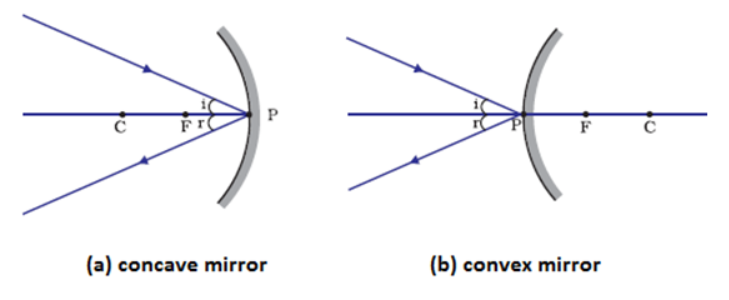
(i) angle of incidence, i is equal to the angle of reflection, r. Mathematically, it is represented as: ∠i = ∠r
(ii) The incident ray, The normal ray and reflected ray lie in the same plane.
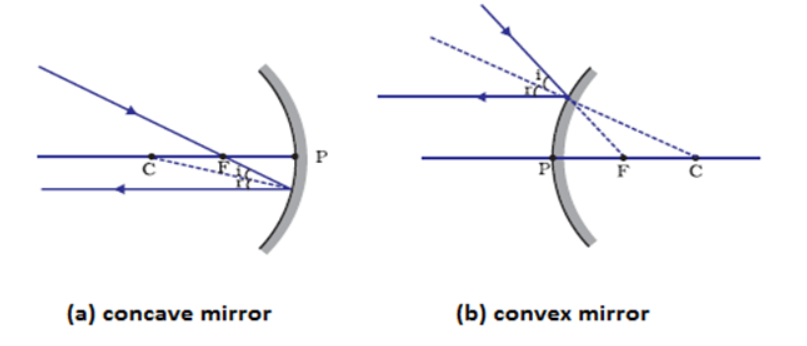
The image formed by a mirror, such as a plane mirror and a spherical mirror are due to regular reflection of light.
Based on the nature of images formed by the mirrors, the images are of two types they are:
Real images
Virtual Images
Real images are the images which can be captured onto a screen.The real images are formed when the light rays really meet at a point.
Example, Slide projector in a cinema hall forms an image on the screen.
Virtual images are the images which cannot be caught on a screen.
The virtual images are formed when the light ranys really do not meet at a point.
But they appear to be images formed by the meeting of light rays.
Note:
The virtual images can be viewed with our naked eyes.
For example, the images formed due to reflection of light by a plane mirror of a dressing table and parking (convex) mirror.
Types of Mirrors
Generally the mirrors are classified into the following two types as:
Plane mirrors
Curved mirrors.
Generally mirrors refer to plane mirrors. But if the surface of a mirror is curved it is said to be a curved mirror.
Examples:
Concave mirror, convex mirror and Elliptical mirror etc.,
If the curvature of a mirror is a huge sphere, the mirror is said to be a spherical mirror.
Examples:
Concave mirror, convex mirror
Spherical mirrors are a special type of curved mirror.
Characteristics of Image Formed By A Plane Mirror
*The image formed by a plane mirror is unmagnified, virtual and erect.
*The image formed by a plane mirror has right-left reversal known as lateral Inversion.
*Focal length of a plane mirror is infinite.
*Power of a plane mirror is zero.
*If a plane mirror is turned by an angle, θ , the reflected ray turns by 2θ .
*The least size of a plane mirror to view an object is equal to half the size of the object.
A mirror that has a curved reflecting surface is said to be a curved mirror.
Spherical Mirrors
If the curvature of a mirror is a huge sphere, the curved mirror is said to be a spherical mirror.
The reflecting surface of a mirror can be curved inwards or curved outwards.
Curved mirrors and Spherical mirrors are classified into the following two types:
Concave mirrors
Convex mirrors.
A curved mirror or a spherical mirror whose reflecting surface is curved inward is known as a concave mirror.
Conversely, A curved mirror or a spherical mirror whose reflecting surface is outward curved is known as a convex mirror.
Terms Associated with Spherical Mirrors
*Pole – The geometric centre of the reflecting surface of a spherical mirror is its pole. It is represented by P.
*Centre of curvature – The centre of the curvature of the reflecting surface of a spherical mirror is known as centre of curvature. It is represented by C.
*Centre of curvature in a convex mirror lies behind the mirror.
*But it lies in front of the mirror in a concave mirror.
*Radius of curvature – The radius of the reflecting surface of the spherical mirror is known as radius of curvature. It is represented by R.
*Principal axis – Straight line passing through the pole and centre of curvature in a spherical mirror is known as principal axis.
*Principal focus – The reflected rays appear to come from a point on the principal axis, known as principal focus. Principal focus (F) is the point on the principal axis, where a parallel beam of light, parallel to the principal axis after reflection converges in the case of a concave mirror and appears to diverge from in the case of a convex mirror.
*Focal length – The distance between the pole and the principal focus in a spherical mirror, known as focal length and it is represented by f.
*Note: Radius of curvature is twice the focal length (R=2f). In other words, The focal length is half the radius of curvature.
*Focal plane: A plane, drawn perpendicular to the principal axis such as it passes through the principal focus is called the focal plane.
*Aperture – The diameter of the reflecting surface is known as its aperture. The size of the mirror is called its aperture. In other words It is also defined as the effective diameter of the light reflecting area of the mirror.
Image Formation by Spherical Mirrors
Rules for Construction of Ray Diagrams for Spherical Mirrors
Rule 1: An incident light ray parallel to the principal axis, passes through the principal focus or appears to pass through the principal focus after reflection.
Rule 2: An incident light ray that passes through the principal focus or appears to pass through the principal focus, travel parallel to the principal axis after reflection.
Rule 3: An incident light ray that passes through the center of curvature or appears to pass through the center of curvature, after reflection and retraces its initial path.
Rule 4: A ray incident obliquely to the principal axis towards the pole, P of the curved mirror (concave mirror and convex mirror) is reflected obliquely.
Note:
The incident and reflected rays always follow the laws of reflection at the point of incidence (P) making equal angles with the principal axis.
that passes through the center of curvature or appears to pass through the center of curvature, after reflection and retraces its initial path.
Reflection By Concave Mirrors
Incident Ray
Reflected Ray
Parallel to principal axis
Passes through focus
Passes through C
Retraces its path
Passes through focus
parallel to principal axis
Strikes the pole at an angle with principal axis
Makes the same angle with the principal axis.
Reflection by Convex Mirror
Incident Ray
Reflected Ray
Parallel to principal axis
Appears to pass through focus
Directed towards the focus
Appears to pass parallel to principal axis
Strikes the pole at an angle with principal axis
Makes the same angle with principal axis
Concave Mirror
A spherical mirror whose reflecting surface is curved inward is known as a concave mirror.
Terms Associated With Concave Mirror
The geometric centre of a concave mirror is called its pole.
The centre of the sphere from which the concave mirror was cut is called the centre of curvature of the concave mirror.
The centre of curvature of the reflecting surface of a concave mirror is called the centre of curvature of the concave mirror.
The distance from any point on the concave mirror to its center of curvature is called the radius of curvature of the concave mirror.
An imaginary line passing through the center of curvature and the pole of the concave mirror is called the principal axis of the concave mirror.
The area of a concave mirror that is exposed to incident light is called the aperture of the concave mirror.
The length along the principal axis from the pole to the principal focus is called the focal length of the concave mirror.
If an object is placed close to a concave mirror such that the distance between the mirror and the object is less than its focal length, then a magnified and virtual image is formed.
This property of the concave mirror is used in many applications such as a dentist mirror to view the inner parts of the mouth clearly and a shaving mirror.
Concave mirrors converge the light incident on them and hence are called converging mirrors.
Image Formation by Concave Mirror
Location of an image of an object formed by a concave mirror by drawing the ray diagrams.
*We can locate the image of an object formed by a concave mirror by drawing the ray diagrams.
*The intersecting point of at least two reflections will give the position of image of the point object.
*The following rays can be used to draw the ray diagrams.
*A ray parallel to the principal axis of a concave mirror.
*A ray passing through the focus of the concave mirror
*A ray which is passing through the centre of curvature of a concave mirror
*A ray incident obliquely to the principal axis on a concave mirror.
Rules for Drawing Ray Diagrams in Spherical Concave Mirrors
A ray parallel to the principal axis of a concave mirror.
*A ray parallel to the principal axis of the concave mirror reflects through its focus.
A ray passing through the focus of the concave mirror.
*A ray passing through the focus of the concave mirror reflects parallel to the principal axis.
A ray which is passing through the centre of curvature of a concave mirror
*A ray which is passing through the centre of curvature of a concave mirror reflects back on the same path.
*A ray incident obliquely to the principal axis on a concave mirror.
A ray when incident obliquely to the principal axis on a concave mirror also reflects obliquely.
Concave Mirrors – Ray Diagrams
Depending on the position of the object in front of the concave mirror, the position, size and the nature of the image varies.
We can represent the images formed by a Concave Mirror using Ray Diagrams.
Object at infinity
A real, inverted, highly diminished image is formed at the focus, F, in front of the concave mirror.
Object beyond C
A real, inverted, diminished image is formed between C and F, in front of the concave mirror.
Object at C
A real, inverted, same sized image is formed at C, in front of the concave mirror.
Object between C and F
A real, inverted, enlarged image is formed beyond C, in front of the concave mirror.
Object at F
A real, inverted, highly enlarged image is formed at infinity, in front of the concave mirror.
Object between F and P
A virtual, erect and enlarged image is formed behind the concave mirror.
Image Formation by a Concave Mirror
Object Location
Image Location
Nature of Image
Infinity
At F
Real, InvertedHighly DiminishedMagnification<<1
Beyond C
Beyond F and C
Real, InvertedDiminishedMagnification<1
At C
At C
Real, InvertedEqual to size of objectMagnification=1
Between C and F
Beyond C
Real, InvertedMagnifiedMagnification>1
At F
Infinity
Real, InvertedHighly MagnifiedMagnification>>1
Between F and P
Behind the mirror
Virtual, ErectMagnifiedMagnification>1
Uses of Concave Mirrors
Concave mirrors are used as shaving mirrors to see a larger image of the face.
Dentists use concave mirrors to view a magnified view of the interior parts of the mouth.
ENT doctors use them for examining the internal parts of the ear, nose and throat.
They are used as reflectors in the headlights of vehicles, searchlights and in torch lights to produce a strong parallel beam of light.
Huge concave mirrors are used to focus sunlight to produce heat in solar furnaces.
Convex Mirror
A spherical mirror whose reflecting surface is curved outward is known as a convex mirror.
Terms Associated With Convex Mirror
The geometric centre of the curvature of the convex mirror is called its pole.
The centre of curvature of the reflecting surface of a convex mirror is called the centre of curvature of the convex mirror.
The distance from any point on the reflecting surface of a convex mirror to its centre of curvature is called radius of curvature of the convex mirror.
An imaginary line passing through the centre of curvature and the pole of the convex mirror is called the principal axis of the convex mirror.
The reflected rays, when projected backwards, appear to meet at a point on the principal axis. This point is called the principal focus. The length along the principal axis from the pole to the principal focus is called the focal length of the concave mirror.
The area of a convex mirror that is exposed to incident light is called the apertureof the convex mirror.
If the aperture of a convex mirror is small, then Convex mirrors, such as the rear view mirrors of cars and bikes, always form erect, virtual, and diminished images.
The location of the object does not affect the characteristics of the image formed by a convex mirror.
When an object approaches a convex mirror, the image formed by the mirror also approaches the mirror, but not proportionately. Because of this it is mentioned as “Objects seen in the mirror are closer than they appear” on the outside rear view mirrors of vehicles.
Image Formation by Concave Mirror
ray diagrams –
We can locate the image of an object formed by drawing a ray diagram.
The intersecting point of at least two reflections will give the position of image of the point object.
The two rays that can be used to draw the ray diagram are:
A ray parallel to the principal axis.
A ray parallel to the principal axis reflects
It passes through the focus in case of a concave mirror.
A ray parallel to the principal axis. On reflection it appears to diverge from principal focus after reflection in case of a convex mirror.
A ray passing through the focus of the concave mirror. On reflection it becomes parallel to the principal axis due to reflection.
A ray directed towards the focus of convex mirrors. On reflection it becomes parallel to the principal axis due to reflection.
A ray which is passing through the centre of curvature of a concave mirror. It reflects back on the same path.
A ray which is directed towards the centre of curvature of a convex mirror. It reflects back on the same path.
A ray when incident obliquely to the principal axis on a concave x mirror is also reflected obliquely.
A ray when incident obliquely to the principal axis on a convex mirror is also reflected obliquely.
Reflection by Convex Mirror
Incident Ray
Reflected Ray
Parallel to principal axis
Appears to pass through focus
Directed towards the focus
Appears to pass parallel to principal axis
Strikes the pole at an angle with principal axis
Makes the same angle with principal axis
Image Formed By A Convex Mirror
Irrespective of the position of the object, a virtual, erect and diminished image is formed between F and P, behind the convex mirror.
Uses of Convex Mirrors
Convex mirrors are used as:
rear view mirrors in automobiles and in ATM centres as it covers a wide area behind the driver.
reflectors in street light bulbs as it diverges light rays over a wide area.
Rear view mirrors of vehicles and the ones used.
Sign Convention for Spherical Mirrors
Object is always considered at the left side of the mirror
Distances measured in the direction of the incident ray are taken as positive.
Distances measured in the direction opposite to that of the incident rays are taken as negative.
All distances are measured from the pole of the mirror.
Distances measured along the y-axis above the principal axis are taken as positive.
Distances measured along the y-axis below the principal axis are taken as negative.
Table Showing Sign Convention
Type of Mirror
Object Distance, u
Image Distance, v
Focal length, f
Radius of Curvature, R
Height of the Object, hO
Height of the Image, hi
Real
Virtual
Real
Virtual
Concave mirror
–Ve
–Ve
+Ve
–Ve
–Ve
+Ve
–Ve
+Ve
Convex mirror
–Ve
Virtual image
+Ve
+Ve
+Ve
+Ve
Virtual image
+Ve
Mirror Formula
The relation between the focal length (f), object distance (u) and the image distance (v) is given by:
Magnification
The ratio of the height of the image in a spherical mirror, to the height of the object is called magnification (m)
Magnification,m = Height of Image, HHeight of Object, i= Image Distance, HObject Distance, i
The distance from the principal focus to the pole of the mirror is the focal length of the mirror and is equal to half the radius of curvature, which is the distance between the centre of curvature and the pole.
For a real image object distance (u) and the image distance (v) are negative and the magnification is negative.
If the magnification of an image is negative it does mean that the image is real and inverted.
On the other hand for a virtual image object distance (u) is negative and image distance (v) is positive and hence the magnification is positive, i.e., the image is erect.
If the magnification of an image is positive it does mean that the image is virtual and erect.
If the magnification is less than 1 The image formed is diminished in size.
If the magnification is more than 1 The image formed is magnified in size.
If the magnification is equal to 1 The image formed is equal to the object in size.
Convex mirrors diverge the light incident on them and hence they are called the diverging mirrors.
Due to this they always form diminished, virtual and erect images irrespective of the position of the object in front of them.
Thus, the magnification caused by these mirrors is always less than one.
The field of view for a convex mirror is greater than that for a plane mirror, the aperture being the same.
Hence, convex mirrors are used as rear-view mirrors in vehicles.
It is also installed behind automated teller machines as a security measure.
The field of view for a convex mirror is greater than that for a plane mirror, the aperture being the same.
Hence, convex mirrors are used as rear-view mirrors in vehicles. It is also installed behind automated teller machines as a security measure.
The images formed by convex mirrors are always diminished, virtual and erect, irrespective of the position of the object.
Differences Between Convex Mirror and Concave Mirror
Convex Mirror
Concave Mirror
Convex mirror is curved outwards.
1. Concave mirror is curved inwards.
The focal point of the convex mirror is behind the mirror.
2. The focal point of the concave mirror is in front of the mirror.
In convex mirrors the image is always virtual, upright and smaller than the object.
3. In the case of concave mirrors different types of images are formed on different locations of the object. The image is upside down (inverted) and far away but if we bring the object close to the mirror then the image will be larger and upright.
Convex mirrors are used in cars (as passenger-side mirrors since they provide upright and wide view), they are also used in camera phones, for safety measures there are also used in roads and driveways.Besides these convex mirrors are found in many hospitals, schools etc. as hallway safety mirrors.
4. Concave mirrors are used in telescopes. These are also used as make up and shaving mirrors since these provide larger images. Besides these concave mirrors are used by dentists and also used in headlights of cars, solar devices, satellite dishes etc.
Refraction Of Light At Plane Surfaces
Introduction
Light bends while traveling from one medium to another. Since the refraction of light occurs at the surface joining two media, the refraction is a surface phenomenon.
The bending of light when it travels from one medium into another is called refraction of light.
The reason for refraction of light is the change in speed of light.
The speed of light in an optically rarer medium is more than that in an optically denser medium.
Light rays passing from rarer to denser medium bends towards the normal. This makes the angle of incidence (angle between the incident ray and the normal at the point of incidence) more than that of the angle of refraction (angle between the normal and the refracted ray).
Light rays passing from denser to rarer medium bends away from the normal. This makes the angle of incidence (angle between the incident ray and the normal at the point of incidence) less than that of the angle of refraction (angle between the normal and the refracted ray).
The extent to which a light ray bends depends on the refrangibility of the ray with respect to the medium.
In other words, the extent to which a light ray bends depends on the refractive index of the respective medium.
The ratio of velocity of light in vacuum to that in a medium is termed as the absolute refractive index (m) of the medium or simply termed as the refractive index of the medium.
Refractive index (m) of the medium is the measure of the ability of light to get bent in the given medium.
Measuring the speed of light is difficult.
We can determine the refractive index using Snell’s law
According to Snell’s law,
The refraction of light obeys the following two laws:
The incident ray, the refracted ray and the normal at the point of incidence all lie in the same plane.
The ratio of the sine of the angle of incidence to the sine of the angle of refraction is a constant. This constant is called the index of refraction or refractive index.
Mathematically, (sin i)/(sin r)= (n2/n1) (Or)
(sin i)/(sin r)= (1n2), where (1n2), is the refractive index of the medium 2, in which the refracted ray travels, with respect to medium 1, in which the incident ray travels.
This law is credited to Willebrord Snell and is, therefore, called Snell’s law.
If wng is the refractive index of glass w.r.t. water, angbe the refractive index of glass w.r.t. air and anwbe the refractive index of water w.r.t. air ,then
wng= ang/anw
If the light ray retraces its path while traveling from denser to rarer, the angle of incidence is lesser than that of the refraction. This is the principle of reversibility.
The extent to which a light ray bends depends on the refrangibility of the ray with respect to the medium.
The ratio of velocity of light in vacuum to that in a medium is termed as the absolute refractive index (m) of the medium. Absolute refractive index (m) of the medium is the measure of the ability of light to get bent in the given medium.
Measuring the speed of light is difficult.
We can determine the refractive index using Snell’s law
According to Snell’s law,
Refraction of Light At A plane Surface
The bottom of a water glass appears to rise upwards when viewed normally. This is due to the vertical shift of the bottom of the glass, which takes place because of refraction.
Refraction of Light At Glass Slab
When a light ray, incident at an angle, passes through a glass slab, the emergent ray shifts laterally, known as lateral shift.
The lateral shift depends on the thickness and refractive index of the glass slab.
If the angle of incidence increases gradually, the angle of refraction also increases.
But, at a particular angle of incidence in the denser medium, the refracted ray emerges along the surface. That particular angle is known as the critical angle.
If the angle of incidence is greater than the critical angle, the ray undergoes Total Internal Reflection.
The formation of Mirages in deserts is due to total internal reflection of light.
n=cv
n=(Speed of light in vacuum)/( speed of light in the medium)
As light travels from one medium to another, the frequency of light does not change.
Lenses
A lens is a piece of transparent optical material with one or two curved surfaces to refract light rays.
The simplest lens has two spherical surfaces close enough together that we can neglect the distance between them. Such a lens is called a thin lens.
The two common types of lenses are Converging lens or Convex lens.
It should be noted that, if the above lenses are surrounded by a material with a refractive index greater than that of the lens, the convex lens gets converted into a concave lens and vice versa.
A lens may converge or diverge light rays to form an image.
Types of Lenses
A bi-convex lens is one with a surface that is bulged outwards on both the sides. It is generally referred to as a convex lens.
Another type of lens is a bi-concave lens that has two inward bent surfaces. It is generally referred to as a concave lens.
A Plano-convex lens has a convex surface on one side and a plane surface on the other.
A Plano-concave lens is the one that has a concave surface on one side and a plane surface on the other.
A concavo-convex lens has a concave surface on one side and a convex surface on the other.
Convex and concave lenses are important as they are more commonly used than the other types of lenses.
Terms Used for Lens
Center of Curvature: The center of the imaginary glass sphere of which the lens is a part, is called center of curvature.
Principal Axis: An imaginary line joining the centers of curvature of the two spheres, of which lens is a part, is called Principal Axis.
Optic Center: A point within the lens, where a line drawn through the diameter of lens meets the principal axis, is called the optic center.
Principal Focus for Convex Lens: It is a point on the principal axis of a convex lens, where parallel beams of light rays, traveling parallel to the principal axis, after passing through the lens actually meet.
Principal Focus for Concave Lens: It is a point on the principal axis of a concave lens, from where a parallel beam of light rays, traveling parallel to the principal axis, after passing through the lens, appears to come.
Focal Length: The distance between principal focus and optical centre is called focal length.
Aperture: The effective diameter of the lens through which refraction takes place is called aperture of lens.
Optic centre is a point on the axis of a lens such that any light ray passing through this point emerges without refraction.
• Principal focus is a point on the axis of a lens.
• Principal focus is also known as the focal point.
Spherical Lenses
Convex Lense
A lens in which both the surfaces are convex, is known as convex lens.
Since the convex lens converges the light incident on it. It is called the converging lens.
The convex lenses form different types of images depending on its relative position with respect to the position of the object in front of them.
Thus, the magnification produced by these lenses varies.
Concave Lense
A lens in which both the surfaces are concave, is known as a concave lens.
Since the concave lens diverges the light incident on it. It is called the diverging lens.
Due to this the concave lenses always form diminished, virtual and erect images irrespective of the position of the object in front of them.
Thus, the magnification produced by these lenses is always less than one.
Image Formation by Refraction Of Light Through Spherical Lenses
Behaviour of Light Rays Propagating Through a Convex Lens
Rules for Construction of Ray Diagrams for Convex Lens
Rule 1: All rays parallel to the
principal axis of a convex lens passes through the principal focus after refraction.
Rule 2: A ray of light passing through the focus of a convex lens becomes parallel to the principal axis after refraction.
Rule 3: A ray of light passing through the optical center of a convex lens passes un deviated after refraction.
Rule 4:
Note: A convex and a concave lens can be supposed to be made-up of prisms.
Image Formation by a Convex Lens
Object Location
Image Location
Nature of Image
Uses
Infinity
At F2
• Real• Inverted• Highly Diminished
Telescopes
Beyond 2F1
Between F2 and 2F2
• Real• Inverted• Diminished
In a camera, In eye while reading
At 2F1
At 2F2
• Real• Inverted• Equal to size of object
Photocopier
Between 2F1 and F1
Beyond 2F2
• Real• Inverted• Magnified
Projector, Microscope objective
At F1
Infinity
• Real• Inverted• Highly Magnified
Spotlights
Between F and O
On the same side of lens as the object
• Virtual• Erect• Magnified
Magnifying glass, eye lenses spectacles for short distances.
Concave Lens:
A lens, in which both the surfaces are concave, is known as a concave lens.
An image formed by a concave lens is always diminished due to the divergence of rays. This is why concave lenses are widely used to correct eye defects such as myopia.
A concave lens is also known as a diverging, reducing, negative and myopic or minus lens.
Behaviour of Light Rays Propagating Through a Concave Lens.
Behaviour of Light Rays Propagating Through a Concave Lens
Rules for Construction of Ray Diagrams for Concave Lens
Rule 1: All rays parallel to the principal axis of a concave lens diverge such that they are coming from the principal focus after refraction.
Rule 2: A ray of light directed towards the focus of a concave lens becomes parallel to the principal axis after refraction.
Rule 3: A ray of light passing through the optical center of a concave lens passes un deviated.
Note: A convex and a concave lens can be supposed to be made-up of prisms.
The lens formula defines the relationship between the focal length of the lens (f), the distance of the object from the optic center (u) and the distance of the image from the optic center (v):
Location and Characteristic of the Images Formed by a Concave Lens
Sign convention for spherical lenses:
All distances on the principal axis are measured from the optic center of the lens.
All distances measured above the principal axis are taken as positive. Thus, height of an object and that of an erect image are positive and all distances measured below the principal axis are taken as negative.
The distances measured in the direction of the incident light are taken as positive (+)
The distances measured in the direction opposite to that of the incident light are taken as negative (-).
Mind Map Overal Idea Content Speed Notes Quick Coverage Content Study Tools Audio, Visual & Digital Content Content … Key Terms Topic Terminology Term: Important Tables Topic Terminology Term: Assessments Test Your Learning readmore
Mind Map Overal Idea Content Speed Notes Quick Coverage Electricity Electricity is a branch of physics that deals with the study of phenomena associated with stationary or moving electric charges. Therefore, the various manifestations of electricity are the result of the accumulation or motion of electrons. Electricity is classified into two types. They are Static readmore
Mind Map
Overal Idea
Content
Speed Notes
Quick Coverage
Electricity
Electricity is a branch of physics that deals with the study of phenomena associated with stationary or moving electric charges.
Therefore, the various manifestations of electricity are the result of the accumulation or motion of electrons.
Electricity is classified into two types. They are Static Electricity and Current Electricity. (Scroll down to continue …)
Study Tools
Audio, Visual & Digital Content
ELECTRICITY
V-Lab
Book
Slides
V-Class
Quiz
Solutions
Resources of Electricity
Static Electricity
Static Electricity is a branch of physics that deals with the study of phenomena associated with stationary electric charges.
Current Electricity.
Current Electricity is a branch of physics that deals with the study of phenomena associated with moving electric charges.
Electric Charge
Electric charge is a fundamental property of matter.
Though we can’t say what is charge with certainty, we can study the properties and behaviour of charge.
Charge is defined as the property associated with matter due to which it produces and experiences electrical and magnetic effects.
The electric charge is caused by the elementary particles, electrons and protons.
Protons possess positive charge, electrons possess negative charge and Neutrons do not possess any charge.
Laws of Electric Charges:
Similar electric charges repel each other
Dissimilar (opposite) electric charges attract each other.
Conductors And Insulators
Conductors are the materials in which electrons move freely.
Example: All metals.
Insulators are the materials which do not have any free electrons to move.
Example: Wood and plastic.
Electric Circuit:
The path of flow of current is known as electric circuit.
Electric Potential Energy
Electric potential energy of a group of charges is defined as the amount of work done in bringing the charges to their respective positions in the system.
Electric Potential At A Point
The electric potential at a point, in an electric field, is defined as the amount of work done in moving a unit + ve charge from infinity to that point, without acceleration or without a change in K.E., against the electric force due to the electric field.
The potential at a point is given by the expression V = W/q
The S.I Unit of potential is mathematically written as 1 volt = 1 joule/1 coulomb.
Potential is a scalar quantity, therefore it is added algebraically.
For a positively charged body, potential is positive and for a negatively charged body potential is negative.
Electric current flows through a conductor only if there is a potential difference across its ends.
Work done in moving a charge in the electric field of another charge is given by:
W = Vq
More is the charge on a body, the more is its potential due to it.
Electric current flows through a conductor only if there is a potential difference across its ends.
Positive charge flows from a body at higher potential to a body at lower potential and negative charge flows from a body at a lower potential to a body at higher potential.
Potential difference
The work done in moving a unit positive charge from one point to another is known as Potential Difference between those points.
Example
The work done in moving a unit positive charge from point A to another point B is known as Potential Difference between the points A and B.
SI Unit: volt
The unit of potential difference is volt (V).
Volt
In other words, Volt is defined as the potential difference between two points, if 1 Joule of work is done in moving 1 coulomb charge from one point to another.
Potential difference between two points across a conductor is measured by using a voltmeter.
Voltmeter is always connected in parallel to the points across which potential difference is to be measured.
Battery:
Battery is an arrangement that creates a constant potential difference between its terminals.
Battery is defined as a combination of a number of cells in series.
Electric Current
The literary meaning of Electric Current isflow of electric charge.
Definition
Electric current is defined as the amount of charge passing a cross section of conductor per a unit time (second in SI Units).
Electric current is expressed mathematically in terms of rate of flow of charges as:
Electric Current =(Net Charge, Q)/(Time,t)
i =n.et , Where n = number of electrons, e = charge of one electron, t= time taken to flow,
Q = charge through the crosssection of the conductor.
The SI unit of electric current is Ampere (A).
Direction of electric current is the same as the direction of positive charges But it is opposite to the direction of flow of negative charges.
Potential difference, V between two points at a constant temperature is directly proportional to the current, I.
V ∝ I
⇒ V = lR
Where, R is a constant termed as ElectricResistance.
The SI unit of resistance is ohm (Ω)
Q.1. State Ohm’s law. How can it be verified?
Answer: It states “Physical conditions’ remaining same, the current flowing through a conductor is directly proportional to the potential difference across its two ends”.
i.e., V∞ I
or
V = IR, where, R is the constant of proportionality.
R is called the electrical resistance or resistance of the conductor.
Verification:
V∞ I or V = IR, where the constant of proportionality R is called the electrical resistance or resistance of the conductor.
The following circuit diagram is used to verify Ohm’s law.
Take a few cells; connect one cell across a nichrome wire AB, along with an ammeter and a voltmeter as shown in figure. Note the voltage and the current from the voltmeter and the
ammeter.
Now, connect two cells and again note the voltage and the current. Repeat the procedure for three cells and four cells. Calculate the ratio for each set.
You will find the ratio is nearly the same in all cases. If a graph of current against voltage is plotted, it will turn to be a straight line as shown in figure. This shows that the current is directly proportional to the potential difference.
Laws of Electric Resistance
Or
Factors Affecting Resistance
Resistance is directly proportional to length of conductor.
Resistance is inversely proportional to the area of cross-section.
Resistance is directly proportional to the temperature.
Depends on the nature of the material. This is determined by the resistivity of material.
Laws of Electric Resistance
The resistance of any substance depends on the following factors,
Length of the substance.
Cross sectional area of the substance.
The nature of material of the substance.
Temperature of the substance.
There are mainly four (4) laws of resistance from which the resistivity or specific resistance of any substance can easily be determined.
The resistance of a substance is directly proportional to the length of the substance. Electric resistance, R of a substance is written as
Where L is the length of the substance.
The resistance of a substance is inversely proportional to the cross-sectional area of the substance. Electrical resistance R of a substance is
Where A is the cross-sectional area of the substance.
Resistivity
Combining these two laws we get,
Where, ρ (rho) is the proportionality constant and known as resistivity or specific resistance of the material of the conductor or substance.
Now if we put L = 1 and A = 1 in the equation, we get, R = ρ.
That means resistance of a material of unit length having unit cross – sectional area is equal to its resistivity or specific resistance.
Resistivity of a material can alternatively be defined as the electrical resistance between opposite faces of a cube of unit volume of that material.
Unit of Resistivity
The unit of resistivity can be easily determined form its equation
The unit of resistivity is Ω – m in the MKS system and Ω – cm in the CGS system and 1 Ω – m = 100 Ω – cm.
Resistivity
Resistivity is the property of the material. It does depend on the length and area of the conductor.
Resistance = (Resistivity) x (Length of Conductor) / (Cross Sectional Area)
The SI unit of resistivity is ohm-metre.
Resistivity of metals varies from 10-8 to 10-6.
Resistivity of insulators varies from 1012 to 1017
Copper and aluminium are used in electrical transmission due to their low resistivity.
Net Resistance in Resistors In Series
When several resistors are joined in series, the resistance of the combination Rs equals the sum of their individual resistances, R1, R2, R3
It is mathematically expressed as: RS = R1 + R2 + R3
Thus greater than any individual resistance.
Derivation of Net Resistance of Resistors In Series
When two or more resistors are joined in series, then their total resistance is given by the formula:
⇒ RS = R1 + R2 + R3
The current will remain the same through all resistors.
Total voltage is given by: V = V1 + V2 + V3
Voltage across each resistor is given as: V1 = IR1, V2 = IR2, V3 = IR3
⇒ V = V1 + V2 + V3
But Total Voltage V = I × R, Here I = Current in electric circuit and R = Net Resistance in the circuit.
⇒ IR = IR1 + IR2 + IR3 ⇒ IR = I(R1 + R2 + R3) ⇒ R = R1 + R2 + R3
Resistors In Parallel
The reciprocal of the equivalent resistance of a group of resistances joined in parallel is equal to the sum of the reciprocals of the individual resistances.
(V/Rp) = (V/R1) + (V/R2) + (V/R3)
Derivation of Net Resistance of Resistors In Parallel
In this case, voltage is the same across each resistor and is equal to applied voltage.
Total current is given as:
I = I1 + I2 + I3
It is observed that the total current I, is equal to the sum of the separate currents through each branch of the combination.
I = I1 + I2 + I3 ————– (i)
Let Rp be the equivalent resistance of the parallel combination of resistors.
By applying Ohm’s law to the parallel combination of resistors, we have: I = V/Rp ————– (ii)
On applying Ohm’s law to each resistor, we have
I1= V /R1; I2= V /R2; and I3= V /R3 —————– (iii)
From Eqs. (ii) to (iii), we have
(V/Rp) = (V/R1) + (V/R2) + (V/R3)
⇒ V(1/Rp) = V[(1/R1) + (1/R2) + (1/R3)]
⇒ (1/Rp) = [(1/R1) + (1/R2) + (1/R3)] ————– ()
Thus, we may conclude that the reciprocal of the equivalent resistance of a group of resistances joined in parallel is equal to the sum of the reciprocals of the individual resistances.
Advantages of Parallel Combination over Series Combination:
If one component fails in series, then the complete circuit is broken and no component can work properly. Different appliances need different current, this can be met through parallel.
Heating effects of Electric Current
When charge Q moves against the potential difference V in time t, the amount of work is given by-
Joule’s Law of Heating
Heat produced in a resistor is directly proportional to square root of current.
It is also directly proportional to resistance for a given current.
Also, directly proportional to time
⇒ H = l2 Rt
Filament of an electric bulb is made up of tungsten because it has a very high melting point and also does not oxidise readily at a high temperature.
Electric fuse is a safety device to protect the electrical appliance from short circuits.
Electric Power
The rate at which electric energy is dissipated or consumed in an electric current. The SI unit of power is Watt.
⇒ P = Vl
⇒ P = l2 R = V2/R
The commercial unit of electric energy is kilowatt hour (KWh).
Mind Map Overal Idea Content Speed Notes Quick Coverage Content Study Tools MAGNETIC EFFECTS OF ELECTRIC CURRENT | ELECTROMAGNETISM | FULL NOTES Chapter At A Glance Interactive Notes E-Book L-Plan Solutions Assessment (Quiz Time) Assignment (Worksheet/QB) Summary Interactive Notes Summary L-Plan Q-Bank E-Book Assessment V-Lab Video Key Assignment Magnetic Effects of readmore
Mind Map
Overal Idea
Content
Speed Notes
Quick Coverage
Content
Study Tools
MAGNETIC EFFECTS OF ELECTRIC CURRENT | ELECTROMAGNETISM | FULL NOTES
Take a battery (12 V), a variable resistance (or a rheostat), an ammeter (0–5 A), a plug key, connecting wires and a long straight thick copper wire.
Insert the thick wire through the centre, normal to the plane of a rectangular cardboard.
Take care that the cardboard is fixed and does not slide up or down.
Connect the copper wire vertically between thepoints X and Y, as shown in Fig. 13.6 (a), in series with the battery, a plug and key.
Sprinkle some iron filings uniformly on the cardboard. (You may use a salt sprinkler for this purpose.)
Keep the variable of the rheostat at a fixed position and note the current through the ammeter.
Close the key so that a current flows through the wire. Ensure that the copper wire placed between the points X and Y remains vertically
straight.
Gently tap the cardboard a few times. Observe The pattern of the iron filings. You would find that the iron filings align themselves showing a pattern of concentric circles around the copper wire.
What do these concentric circles represent?
They represent the magnetic field lines.
How can the direction of the magnetic field be found? Place a compass at a point (say P) over a circle.
Observe the direction of the needle.
The direction of the north pole of the compass needle would give the direction of the field lines produced by the electric current through the straight wire at point P. Show the direction by an arrow.
Does the direction of magnetic field lines get reversed if the direction of current through the straight copper wire is reversed? Check it out.
Finding Direction of Magnetic Field
Right Hand Thumb Rule Or Right Hand Grip Rule
Imagine that you are holding a current-carrying straight conductor in your right hand such that the thumb points towards the direction of current.
Then your fingers will wrap around the conductor in the direction of the field lines of the magnetic field, as shown in Figure known as the right-hand thumb rule*.
The field lines about the wire consist of a series of concentric circles whose direction is given by the right-hand rule.
Right hand thumb rule states that if we hold the conductor in the right hand such that the thumb points in the direction of electric current, then the direction in which the fingers curl gives the direction of the magnetic field
If we point the thumb downwards in the direction of the current, the magnetic field would be represented by the curled fingers as the circles around the conductor.
So, if it is viewed from the above plane these field lines will be clockwise circles, but the direction of the magnetic field at any point on these circular magnetic lines is in the direction of the tangent drawn to the circular magnetic lines at the desired points.
Example:
A current through a horizontal power line flows in an east to west direction. What is the direction of the magnetic field at a point directly below it and at a point directly above it?
Solution
The current is in the east-west direction. Applying the right-hand thumb rule, we get that the magnetic field (at any point below or above the wire) turns clockwise in a plane perpendicular to the wire, when viewed from the east end, and anti-clockwise, when viewed from the west end.
Maxwell’ cork screwrule is also known as maxwell’s right hand thumb rule Maxwell’s right hand thumb rule states that, if the head of a cork-Screw is rotated such that the tip of the screw advances in the direction of electric current, then the direction of rotation of the head of the screw represents the direction of the magnetic field around the conductor.
A magnetic field caused by a current-carrying conductor consists of sets of concentric lines of force. The direction of the magnetic field lines depends on the direction of the current passed through the conductor.
Example 13.1
A current through a horizontal power line flows in east to west
direction. What is the direction of magnetic field at a point directly
below it and at a point directly above it?
Solution
The current is in the east-west direction. Applying the right-hand
thumb rule, we get that the magnetic field (at any point below or
above the wire) turns clockwise in a plane perpendicular to the wire,
when viewed from the east end, and anti-clockwise, when viewed
from the west end.
Clock-S Rule
Clock-S rule is a rule which helps us to find the formation of magnetic South Pole due to electromagnetic induction in a current carrying conducting coil.
According to clocks rule if one face of a current carrying conducting coil is placed such that one face of the coil is faced to us and current is moving in the clockwise direction with respect to us then the face of the coil which is faced to us becomes as a magnetic south pole and the other face behaves as the north magnetic pole.
A current carrying conductor in the form of a rectangular loop behaves like a magnet and when suspended in an external magnetic field experiences force.
The SNOW rule states that if the current is flowing in an electric circuit from South to North direction and a magnetic compass is placed Over the conducting wire, the needle of the compass deflects in the direction of west.
Case 2
The SNOW rule states that if the current is flowing in an electric circuit from North to South direction and a magnetic compass is placed Over the conducting wire, the needle of the compass deflects in the direction of east.
Case 3
The SNOW rule states that if the current is flowing in an electric circuit from South to North direction and a magnetic compass is placed Below the conducting wire, the needle of the compass deflects in the direction of east.
Case 4
The SNOW rule states that if the current is flowing in an electric circuit from North to South direction and a magnetic compass is placed Above the conducting wire, the needle of the compass deflects in the direction of west.
The SNOW rule states that if the current is flowing in an electric circuit from North to South direction and a magnetic compass is placed Below the conducting wire, the needle of the compass deflects in the direction of east.
Current Direction
Compass Position
N – of Compass Deflection
S – of Compass Deflection
South to North
Above
SNOWWest
East
North to South
Above
East
West
South to North
Below
East
West
North to South
Below
West
East
Magnetic Field due to a Current through a
Circular Loop
We have so far observed the pattern of the magnetic field lines produced around a current-carrying straight wire.
Suppose this straight wire is bent in the form of a circular loop and a current is passed through it.
What would the magnetic field lines look like?
We know that the magnetic field produced by a current-carrying straight wire depends inversely on the distance from it.
Similarly at every point of a current-carrying circular loop, the concentric circles representing the magnetic field around it would become larger and larger as we move away from the wire (Fig. 13.8). By the time we reach the centre of the circular loop, the arcs of these big circles would appear as straight lines.
Every point on the wire carrying current would give rise to the magnetic field appearing as straight lines at the centre of the loop.
By applying the right hand rule, it is easy to check that every section of the wire contributes to the magnetic field lines in the same direction
within the loop.
We know that the magnetic field produced by a current-carrying
wire at a given point depends directly on the current passing through it.
Therefore, if there is a circular coil having n turns, the field produced is
n times as large as that produced by a single turn.
This is because the current in each circular turn has the same direction, and the field due to each turn then just adds up.
Factors affecting magnetic field of a circular current carrying conductor-
Magnetic field is directly proportional to the current passing through the conductor.
Magnetic field is inversely proportional to the distance from the conductor.
Magnetic field is directly proportional to number of turns in coil.
Solenoid
The solenoid is an electromagnet which is a long cylindrical coil of wire consisting of a large number of turns bound together very tightly.
Note: The length of the coil should be longer than its diameter. (Or)
Solenoid is a coil of a number of turns of insulated copper wire closely wrapped in the shape of a cylinder.
When a soft iron rod is placed inside the solenoid, it behaves like an electromagnet.
The use of soft iron as core in the solenoid produces the strongest magnetism.
A solenoid consists of an insulated conducting wire wound on a cylindrical tube made of plastic or cardboard.
Magnetic Field due to a Current in a Solenoid
The magnetic field of a solenoid carrying a current is similar to that of a bar magnet.
Compare the pattern of the field with the magnetic field around a bar magnet.
Do they look similar?
Yes, they are similar.
In fact, one end of the solenoid behaves as a magnetic north pole, while the other behaves as the south pole.
The field lines inside the solenoid are in the form of parallel straight lines.
This indicates that the magnetic field is the same at all points inside the solenoid.
That is, the field is uniform inside the solenoid.
These appear to be similar to that of a bar magnet.
One end of the solenoid behaves like the North Pole and the other end behaves like the South Pole.
Magnetic field lines inside the solenoid are in the form of parallel straight lines.
This means that the field is the same at all the points inside the solenoid.
Electromagnet
An electromagnet consists of a core of soft iron wrapped around with a coil of insulated copper wire.
An electromagnet is a magnet made up of a coil of insulated wire wrapped around a soft iron core that is magnetised only when current flows through the wire.
A strong magnetic field produced inside a solenoid can be used to magnetise a piece of magnetic material, like soft iron, when placed inside the coil.
It is a temporary magnet that can be easily demagnetized.
In this type of magnet, polarity can be reversed and strength can be varied. They are very strong magnets.
Magnetic Field of An electromagnet
Force on A current-carrying conductor placed in a magnetic field
Placing acurrent-carrying conductor in a magnetic field experiences a force.
Finding direction of force on a current-carrying conductor placed in a magnetic field Using Fleming’s left-hand rule
If the direction of the magnetic field and that of the current are mutually perpendicular to each other, then the force acting on the conductor will be perpendicular to both and will be given by Fleming’s left-hand rule.
Flemings Left Hand Rule
Stretch the thumb, forefinger and middle finger of the left hand such that they are mutually perpendicular. If the forefinger is in the direction of the magnetic field, Central finger in the direction of current, then the thumb will point in the direction of motion or force.
Rules & Laws of Electromagnetism
Clock-S Rule
Clock-S rule is a rule which helps us to find the formation of magnetic South Pole due to electromagnetic induction in a current carrying conducting coil.
According to clocks rule if one face of a current carrying conducting coil is placed such that one face of the coil is faced to us and current is moving in the clockwise direction with respect to us then the face of the coil which is faced to us becomes as a magnetic south pole and the other face behaves as the north magnetic pole.
A current carrying conductor in the form of a rectangular loop behaves like a magnet and when suspended in an external magnetic field experiences force.
SNOW Rule
Case 1
The SNOW rule states that if the current is flowing in an electric circuit from South to North direction and a magnetic compass is placed Over the conducting wire, the needle of the compass deflects in the direction of west.
Case 2
The SNOW rule states that if the current is flowing in an electric circuit from North to South direction and a magnetic compass is placed Over the conducting wire, the needle of the compass deflects in the direction of east.
Case 3
The SNOW rule states that if the current is flowing in an electric circuit from South to North direction and a magnetic compass is placed Below the conducting wire, the needle of the compass deflects in the direction of east.
Case 2
The SNOW rule states that if the current is flowing in an electric circuit from North to South direction and a magnetic compass is placed Below the conducting wire, the needle of the compass deflects in the direction of west.
Maxwell’ cork screwrule is also known as maxwell’s right hand thumb ruleIf the head of a cork-Screw is rotated such that the tip of the screw advances in the direction of electric current, then the direction of rotation of the head of the screw represents the direction of the magnetic field around the conductor.
A magnetic field caused by a current-carrying conductor consists of sets of concentric lines of force. The direction of the magnetic field lines depends on the direction of the current passed through the conductor.
Ampere Right Hand Thumb Rule
Right hand thumb rule states that if we hold the conductor in the right hand such that the thumb points in the direction of electric current, then the direction in which the fingers curl gives the direction of the magnetic field
If we point the thumb downwards in the direction of the current, the magnetic field would be represented by the curled fingers as the circles around the conductor.
So, if it is viewed from the above plane this field lines will be clockwise circles, but the direction of the magnetic field at any point on this circular magnetic lines is in the direction of the tangent drawn to the circular magnetic lines at the desired points.
Example 13.1
A current through a horizontal power line flows in east to west
direction. What is the direction of magnetic field at a point directly
below it and at a point directly above it?
Solution
The current is in the east-west direction. Applying the right-hand
thumb rule, we get that the magnetic field (at any point below or
above the wire) turns clockwise in a plane perpendicular to the wire,
when viewed from the east end, and anti-clockwise, when viewed
from the west end.
Fleming’s Right Hand rule (Working Principle of Transformer and generator )
Fleming’s right hand rule gives the direction of the induced current in a conductor when it is moved in a magnetic field.
Transformers are based on this principle, which consist of a primary coil and a secondary coil.
The number of turns in the coils is selected based on the type of the transformer to be made, namely, step-up or step-down.
Magnetic Field Due to An Electric Conducting Coil (Motor Working Basics)
Working Principle of electric motors is Fleming’s left hand rule.
The direction of the force is given by Fleming’s left hand rule. This gives the basis for an electric motor.
An electric motor essentially consists of a coil as an armature, a split ring commutator for changing the direction of the current in the coil.
There are two brushes linked with the split rings that maintain the contact with the armature for the current flow.
Electric motor converts electrical energy to mechanical energy.
A number of such loops form a coil and the coil is termed solenoid.
If there is a soft iron core in the solenoid, it behaves like a magnet as long as there is current through the coil. Thus it is an electromagnet.
When an electric current passes through a conductor, a magnetic field is created around the conductor. This phenomenon is known as the magnetic effect of electricity.
A magnetic field is the extent of space surrounding a magnet where the magnet’s effect can be felt.
Magnetic field lines represent the lines of action of the force acting on a unit North Pole placed in a magnetic field.
Electromagnetic Induction
Electromagnetic Induction – Electric Effects of Changing Magnetic Field
The phenomenon of electromagnetic induction is the production of induced current in a coil placed in a region where the magnetic field changes with time.
The magnetic field may change due to a relative motion between the coil and a magnet placed near to the coil.
If the coil is placed near to a current-carrying conductor, the
the magnetic field may change either due to a change in the current through the conductor or due to the relative motion between the coil and conductor.
The direction of the induced current is given by the Fleming’s right-hand rule.
Fleming’s Right Hand Rule
A generator converts mechanical energy into electrical energy. It works on the basis of electromagnetic induction.
Electromagnetic Induction is the electric effects of relative motion between magnetic field and electric conductor.
When we place a conductor in a changing magnetic field, some current is induced in it. This current is known as Induced Current and the phenomenon is known as Electromagnetic Induction.
Faraday’s Experiment
The working principle of electric generators and Transformers is Fleming’s right hand rule.
Faraday’s experiment proved that the strength of the induced current depends on several factors like the strength of the magnet, the speed of motion of the magnet, its orientation, the number of turns in the coil and the diameter of the coil. The induced current can be detected by a galvanometer.
Electric Generator
An electric device that converts mechanical energy into electrical energy is called an electric generator.
Working Principle: Fleming Right Hand Rule
Fleming Right Hand Rule
Hold the forefinger, middle finger and thumb of your right hand at right angles to each other. Forefinger points towards the direction of the magnetic field, thumb points in the direction of motion of conductor and middle finger shows direction of induced current.
Electric Energy is a device used to convert mechanical energy into an alternating form of electrical energy. It consists of insulated copper wire, magnetic poles, split rings, axle, brushes and galvanometer.
The axle is rotated so that it moves clockwise, that is AB moves up and CD moves down. After half rotation, CD starts to move up and AB moves down. After every half rotation current changes its direction, this is called AC current.
Electric generators work on the same principle.
They have an armature which is free to rotate in a magnetic field.
Its terminals are connected to two slip rings, which are further connected to two brushes and they are connected across a load resistance through which the generated electricity can be trapped.
The rotation of the armature in the magnetic field changes the magnetic flux in the coil of the armature and an electric current is induced.
As the direction of the induced current changes for every half rotation, it is called alternating current.
The current at the power plants is distributed through transmission lines at a high voltage and hence the lines are referred to as high tension power lines.
At the substations these are stepped down to a lower voltage and supplied to houses at a low voltage.
A domestic electric circuit essentially contains mains, a fuse, live or line, neutral and earth wires.
From the poles supply cables bring the current to the mains.
Within the house, all the equipment is connected in parallel.
Electromagnetic induction (EMI) is the process of generating an electromotive force by moving a conductor through a magnetic field.
The electromotive force generated due to electromagnetic induction is called induced emf. The current due to induced emf is called induced current.
Alternating current (AC) is the current induced by an AC generator. AC current changes direction periodically. Direct current (DC) always flows in one direction, but its voltage may increase or decrease.
An electric motor is different from an electric generator. A generator converts mechanical energy (Kinetic energy) into electrical energy while an electric motor converts electrical energy into mechanical energy (Kinetic energy).
AC Generator:
Principle: It works on the principle that when a coil rotates in a uniform magnetic field, a current is induced in the coil. The direction of induced current is determined by Fleming’s right hand rule.
Construction: An ac generator consists of the following components as shown in figure.
(i) Armature coil: It consists of a large number of turns of a rectangular coil ABCD made of copper wire wound over a soft iron laminated core.
(ii) Strong field magnets: Two concave poles (NS) of permanent magnets between which the armature coil is rotated.
(iii) Slip-rings: The two ends of the coil are welded to two different circular metallic rings R, and R,. These rings are called the slip-rings. The function of the slip-rings is to ensure that the ion of current flowing through the coil after each half rotation.
A schematic diagram of common domestic circuit is as shown below
(iv) Brushes : Two carbon brushes B, and B2 make a contact with the slip-rings R, and R2
An electric generator is as shown in fig. 7.7.
Domestic Electric Circuit
HouseHold Electric Circuits
In our houses we receive AC electric power of 220 V with a frequency of 50 Hz. One of the wires in this supply is with red insulation, called live wire.
The other one is of black insulation, which is a neutral wire. The potential difference between the two is 220 V.
The third is the earth wire that has green insulation and this is connected
to a metallic body deep inside earth. It is used as a safety measure to ensure that any leakage of current to a metallic body does not give any severe shock to a user.
Fuse is the most important safety device, used for protecting the circuits due to short-circuiting or overloading of the circuits.
Electrical components and wires fitted in a household to supply electricity to various appliances form a domestic electric circuit.
The old colour convention of the three wires used in household electrical circuits was Red, called live wire, Black, called neutral wire and Green, called earth wire. Now, this colour convention has changed.
The new colour convention is Brown, called live wire, Light blue, called neutral wire and Green or Yellow, called earth wire.
In our houses, we receive AC electric power of 220 V with a frequency of 50 Hz. One of the wires in this supply is with red insulation, called live wire.
The other one is of black insulation, which is a neutral wire. The potential difference between the two is 220 V.
The third is the earth wire that has green insulation and this is connected to a metallic body deep inside earth.
It is used as a safety measure to ensure that any leakage of current to a metallic body does not give any severe shock to a user.
Earthing
Earthing of an electrical appliance is very important.
Suppose, a conductor is exposed to the appliance due to bad insulation.
If a person touches such an appliance, he will receive a severe shock.
If the metal casing of the appliance is connected to the earth with the help of a conductor, the metal casing will be then at the same potential as the earth i.e., zero volt.
If there is a leakage of current, the current will safely flow to the earth.
The earth connection can also save the appliance from the damage.
Fuse
Fuse is the most important safety device, used for protecting the circuits due to short-circuiting or overloading of the circuits.
It is a safety device to limit the current in an electric circuit.
It prevents the electric appliances from damage.
It is made up of material which has high resistivity and low melting point.
Exam Revision
Magnetic Compass
A compass needle is a small magnet. Its one end, which points towards north, is called a north pole, and the other end, which points towards south, is called a south pole.
Magnetic Field
A magnetic field exists in the region surrounding a magnet, in which the force of the magnet can be detected.
Field lines
Field lines are used to represent a magnetic field. A field line is the path along which a hypothetical free north pole would tend to move. The direction of the magnetic field at a point is given by the direction that a north pole placed at that point would take. Field lines are shown closer together where the magnetic field is greater.
Magnetic Effects of Electric Current
A metallic wire carrying an electric current has a magnetic field associated with it.
The field lines about the wire consist of a series of concentric circles whose direction is given by the right-hand rule.
Right Hand Rule
Magnetic Field Around a Conductor Due to An Electric Current
The pattern of the magnetic field around a conductor due to an electric current flowing through it depends on the shape of the conductor.
Magnetic Field of a solenoid
The magnetic field of a solenoid carrying a current is similar to that of a bar magnet.
Magnetic Field of An electromagnet
An electromagnet consists of a core of soft iron wrapped around with a coil of insulated copper wire.
Force on A current-carrying conductor placed in a magnetic field
O placing acurrent-carrying conductor in a magnetic field experiences a force.
Direction of Force on A current-carrying conductor placed in a magnetic field Using Fleming’s left-hand rule
If the direction of the magnetic field and that of the current are mutually perpendicular to each other, then the force acting on the conductor will be perpendicular to both and will be given by Fleming’s left-hand rule.
Electric Motor
An electric motor is a device that converts electric energy into mechanical energy.
Fleming’s left-hand rule is the basis of an electric motor.
Electromagnetic Induction – Electric Effects of Changing Magnetic Field
The phenomenon of electromagnetic induction is the production of induced current in a coil placed in a region where the magnetic field changes with time.
The magnetic field may change due to a relative motion between the coil and a magnet placed near to the coil.
If the coil is placed near to a current-carrying conductor, the
magnetic field may change either due to a change in the current through the conductor or due to the relative motion between the coil and conductor.
The direction of the induced current is given by the Fleming’s right-hand rule.
Fleming’s Right Hand Rule
A generator converts mechanical energy into electrical energy. It works on the basis of electromagnetic induction.
HouseHold Electric Circuits
In our houses we receive AC electric power of 220 V with a frequency of 50 Hz. One of the wires in this supply is with red insulation, called live wire.
The other one is of black insulation, which is a neutral wire. The potential difference between the two is 220 V.
The third is the earth wire that has green insulation and this is connected
to a metallic body deep inside earth. It is used as a safety measure to ensure that any leakage of current to a metallic body does not give any severe shock to a user.
Fuse is the most important safety device, used for protecting the circuits due to short-circuiting or overloading of the circuits.

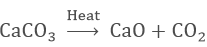






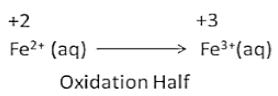
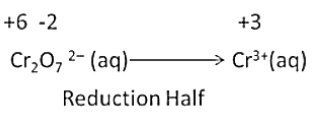





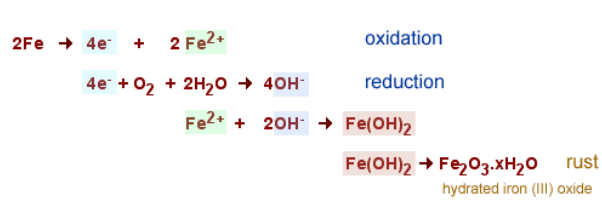


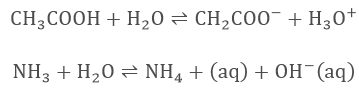
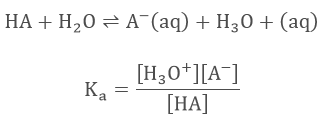
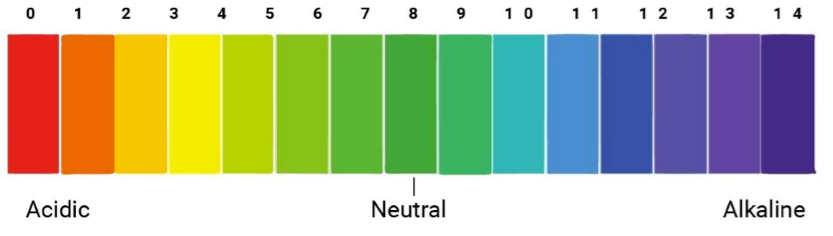
 2NaCl (Brine) + 2H2O 2NaOH (Caustic Soda) + Cl2 + H2At anode (+ve electrode): Cl2 is producedAt cathode (-ve electrode): H2 is producedIt is called chloro-alkali process because products formed are chlorine (Chloro) and NaOH (alkali).
 CaSO4.H2O (Plaster of Paris) +3/2 H2O* Heating of gypsum should not be done above 100oC as above that temperature, water of crystallisation will be eliminated and anhydrous CaSO4 will be obtained. This anhydrous CaSO4 is known as Dead Burnt Plaster.* CaSO4.1/2 H2O means that two molecules of CaSO4 share one molecule of water.PropertiesHas the remarkable property of setting into a hard mass on wetting with water, as gypsum is formed.CaSO4.1/2 H2O (P.O.P) + 1/2 H2O → CaSO4.2H2O (Gypsum set as hard mass)Hence, P.O.P should be stored in moisture-proof containers as moisture can cause slow setting of P.O.P by hydrating it.