Some objects can be charged by rubbing with other objects. There are two kinds of charges — positive charge and negative charge Like charges repel and unlike charges attract each other.
Study Tools
Audio, Visual & Digital Content
Static Electric Charges: The electric charges produced due to rubbing are called static electric charges. The electric charges constitute electric current during their motion.
An electroscope may be used to detect whether a body is charged or not.
An electroscope is a deviced used to detect the presence of electric charge.
earthing: The process of transfer of charge from a charged object to the earth is called earthing.
Lightning
Lightning is a sudden, natural and violent phenomenon of creating bright flashes during a thunderstorm.
Lightning occurs due to a high-voltage electric discharge between two clouds or a cloud and the ground, or within a single cloud during a thunderstorm.
The formation of clouds involves friction between water droplets in the atmosphere.
The friction charges the particles in the atmosphere. The negative charges accumulate at the bottom of the cloud and the positive charges at the top.
As the accumulation of the charges increases, the cloud will induce positive charges on the ground nearby.
As the amount of charge increases. This causes an imbalance of charges between a region of a cloud and gorund or another cloud (or in a cloud itself). This imbalance is significant enough to break through air resistance.
Lightning releases an average of one gigajoule of energy.
Lightning strike could destroy life and property.
Protective measures are of utmost importance during lightning strikes.
Taking shelter in interiors (house or other closed places) and vehicles (closed e.g. cars) are the most preferred measures.
Lightning conductors can protect buildings from the effects of lightning.
Earth Quake
A natural phenomenon that cannot be predicted is an earthquake.
The earth consists of three major layers, called the crust, the mantle and the core.
The core is further divided into the inner core and the outer core.
The mantle consists of semi-solid material above which the crust floats.
The crust consists of oceans and continents.
The crust is divided into several parts, called tectonic plates.
The regions where one tectonic plate slides against another are referred to as fault zones, and these are the regions where an earthquake is likely to occur.
Hence, these zones are referred to as seismic zones.
The place in the interior of the earth where an earthquake occurs is the focus, and the region on the surface of the earth that is the closest to focus is likely to experience the largest damage.
This region is called the epicenter of the earthquake.
The instrument that measures the severity of an earthquake is a seismograph.
It basically consists of a drum that rolls and a pendulum with a stylus that traces the waves of an earthquake on a sheet like a graph paper.
The energy released at the focus propagates outwardly in form of waves known as seismic waves. Destructive energy of an earthquake is measured on the Richter scale.
It is a logarithmic scale, ranging from 1 to 10 for indicating the intensity of an earthquake.
The earthquake measuring 7 or more on Richter scale can cause severe damage to life and property. Protective measures for earthquake:
If you are at home: Take shelter under a table and stay there till shaking stops.Stay away from tall and heavy objects that may fall on you. If you are in bed, do not get up. Protect your head with a pillow.
If you are outdoors: Find a clear spot, away from buildings, trees and overhead power lines. Drop to the ground. If you are in a car or a bus, do not come out. Ask the driver to drive slowly to a clear spot. Do not come out till the tremors stop. Moreover, it is advisable to make the structure of buildings simple so that they are ‘Quake Safe’.
Hindi Version
Dig Deep
Topic Level Resources
Sub – Topics
Select A Topic
Topic:
Chapters Index
Select Another Chapter
[display-posts category=”CBSE 8 – Science – Study – Premium” posts_per_page=”25″]
Light is the natural agent that stimulates sight and makes things visible. Light is reflected from all surfaces. It is a form of energy.
Reflection of Light: Bouncing back of light after striking any surface such as a rough surface, Smooth surfce, shiny surface or polished surface, into the same medium, is called reflection of light. (Scroll down to continue …)
Study Tools
Audio, Visual & Digital Content
luminous objects: Objects that give out light on their own are called luminous objects.
Examples: Flame, Sun, Glowing bulb
Non-luminous objects: Objects that do not give out light on their own are called non-luminous objects.
Examples: Rocks, Plasic Toys, Walls of room.
The Non – Luuminous objects, reflect light that falls on them.
When the reflected light enters into our eyes from the objects we could see them.
Types of Reflection: (i) Regular Reflection: When a beam of parallel light rays is incident on a smooth and plane surface, the reflected rays will also be parallel. This type of reflection is called Regular Reflection.
The reflection from a plane mirror is an example of regular reflection.
(ii) Diffused or Irregular Reflection: When a parallel beam of light is incident upon a rough or uneven surface, it is reflected in many directions due to presence of irregularities on that.
multiple reflections: If a reflected light ray is reflected again on being incident on another surface, it is termed as multiple reflections.
Multiple reflections are used in periscope, kaleidoscope etc.
Periscopes are used in submarines, war tanks and by soldiers in bunkers to see objects.
In a kaleidoscope, beautiful patterns are formed due to multiple reflections.
Laws of reflection of light:
(i) The angle of incidence is equal to the angle of reflection.
(ii) Incident ray, reflected ray and the normal drawn at the point of incidence to the reflecting surface, lie in the same plane.
Lateral inversion: Lateral inversion is the effect produced by a plane mirror in reversing images from left to right.
Example: Our left hand will appear as right and vice versa.
Characteristics of the image formed by a plane mirror
Size the image formed by a plane mirror is equal to the siz of the object.
The image formed by the plane mirror is left-right inverted.
The image formed by the plane mirror erect and virtual formed behind the mirror.
Since the distance of the object in front of the mirror two mirrors inclined to each other give multiple images.
Sunlight: Sunlight, called white light, consists of seven colours.
dispersion: Splitting of light into its constituent colours is known as dispersion.
Human Eye:
A normal eye can see nearby and distant objects clearly.
Visually challenged persons can read and write using Braille system.
Visually challenged persons develop their other senses more sharply to improve their interaction with their environment.
Parts of Human Eye: (i) Cornea: Transparent bulge on the front surface of the eyeball which protects the eye andhelps in refraction of light.
(ii) Iris: Coloured diaphragm behind the cornea which controls the amount of light entering the eye.
(iii) Pupil: Dark hole in the middle of iris through which light enters the eye. (iv) Eye lens: Transparent, crystalline structure behind pupil and iris. (v) Ciliary muscles: Hole the eye lens in position and control the focal length of the eye lens.
(vi) Retina: Surface of the rear part of the eyeball where the light entering the eye is focused.
(vii) Rods and Cones: Rod cells respond to the brightness of light while cone cells.
Hindi Version
Dig Deep
Topic Level Resources
Sub – Topics
Select A Topic
Topic:
Chapters Index
Select Another Chapter
[display-posts category=”CBSE 8 – Science – Study – Premium” posts_per_page=”25″]
Motion: An object is said to be in motion when its position changes with time.
Rest: An object is said to be at rest when its position does not change with respect to a reference point with time.
A specific point with respect to which we describe the location of an object is called a reference point.
The terms Rest and Motion are relative. (Scroll down to continue …)
Study Tools
Audio, Visual & Digital Content
Distance and Displacement
Distance:The total length of path covered by an object is said to be the distance travelled by it.
Displacement: Gap between the initial and final positions of an object is said to be its displacement. Or
The length of a line segment that joins the initial and final positions of an object is known as the displacement.
Difference Between Displacement and Displacement
Distance
Displacement
Distance is defined as the total length of the path travelled by an object to go from one point to another.
Displacement is defined as the length of the line segment that joins the initial and final positions of an object.
Since distance has only magnitude and its direction cannot be specified always, it is a scalar quantity.
Since displacement has magnitude and it is specified in a direction from initial position to final position, it is a vector quantity.
Distance can only have positive values.
Displacement can have both positive and negative values.
Distance depends on the length of the path travelled.
Displacement depends only on the initial and final point regardless of the path travelled.
Difference Between Displacement and Displacement
Speed And VelocitySpeed
Speed: The distance travelled by an object in unit time is referred to as speed.
Its S.I unit is m/s.
In general speed refers to average speed.
Average speed: For non-uniform motion, the average speed of an object is obtained by dividing the total distance travelled by an object by the total time taken.
For a uniform motion, the average speed of an object is equal to its instantaneous speed throughout the path.
Velocity
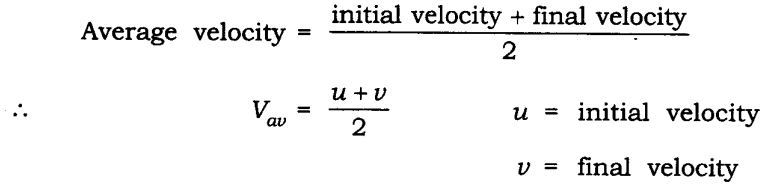
Average Velocity or Velocity : For a uniform motion in a straight path, the average velocity is equal to its instantaneous velocity throughout the path.
Velocity of an object is equal to the instantaneous velocity of an object.
Differences Between Speed and Velocity
SPEED
VELOCITY
It is defined as the rate of change of distance.
It is defined as the rate of change of net displacement.
It is a scalar quantity.
It is a vector quantity.
It can never be negative or zero.
It can be negative,zero or positive.
Speed is velocity without direction.
Velocity is directed speed.
Speed may or may not be equal to velocity.
A body may possess different velocities but the same speed.
Speed never decreases with time. For a moving body,
Velocity can decrease with time. For a moving body , it can be zero.
Speed is never zero.
Velocity can be zero.
Speed in SI is measured in ms-1
Velocity in SI, is measured in ms-1
Differences Between Speed and Velocity
Uniform And Non-Uniform motion
Uniform motion or non accelerated motion: When an object covers equal distances in equal intervals of time, it is said to be in uniform motion. Uniform motion is a non-accelerated motion.
Non-uniform motion or accelerated motion: Motions where objects cover unequal distances in equal intervals of time. Uniform motion is an accelerated motion.
Acceleration
Acceleration: Change in the velocity of an object per unit time.
Graphical representation of motions
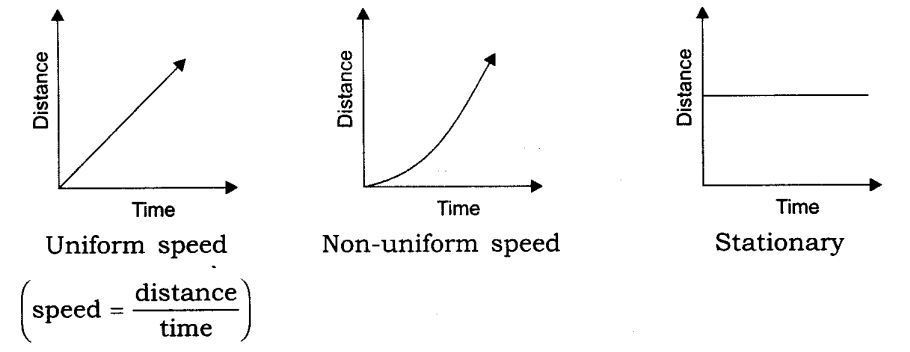
(i) Distance-time graph
For a distance-time graph, time is taken on x-axis and distance is taken on the y-axis.
[Note: All independent quantities are taken along the x-axis and dependent quantities are taken along the y-axis.]
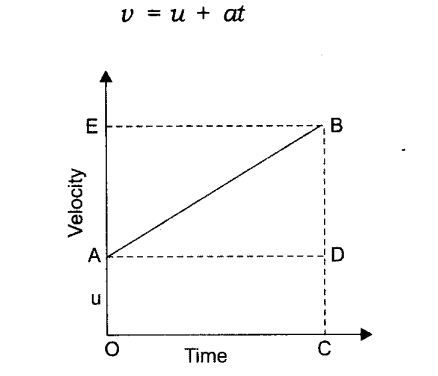
(ii)Velocity-time graph
Equation of motion by graphical methods
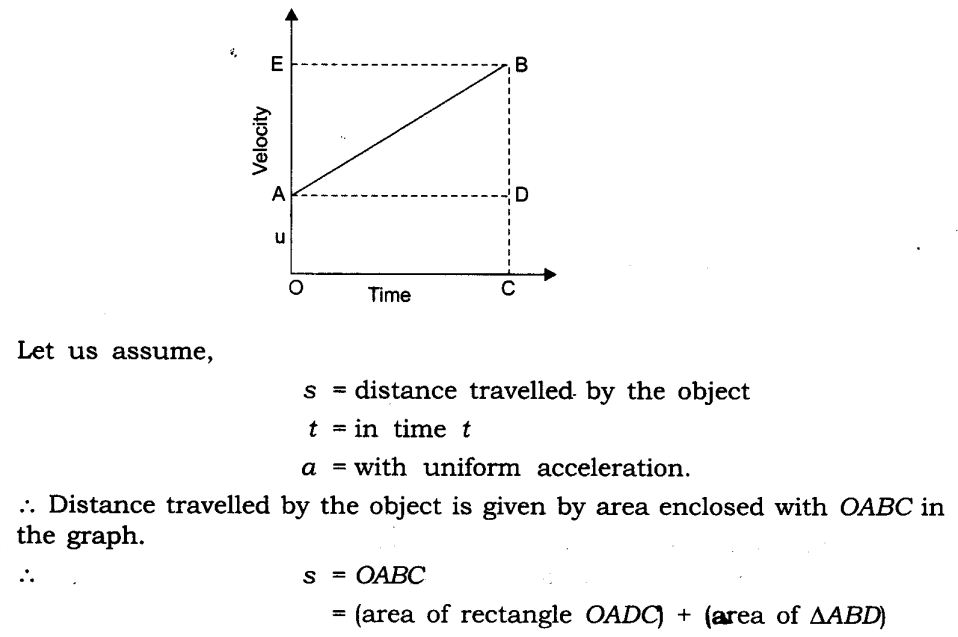
Derivation Of Equations Of Motion
Equations of motion can be derived by two methods. They are (i) Graphical Method. (ii) Algebraic Method
Derivation of The Equations of Motion By Algebraic Method:
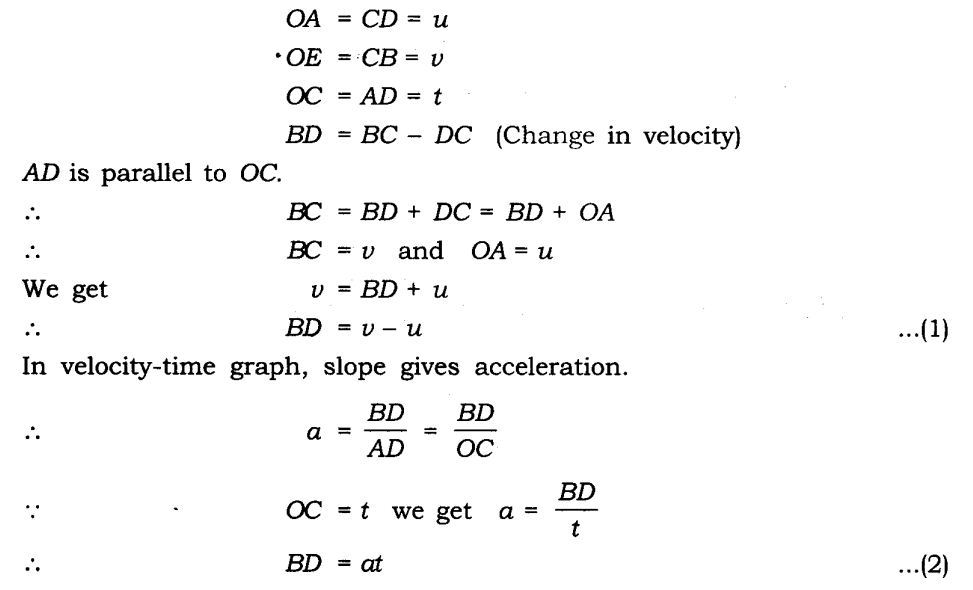
(a) Velocity-time relation:
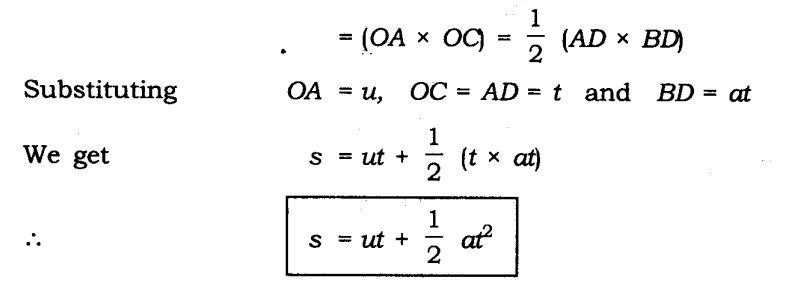
Derivation of S = ut + ½ at2
(ii) The equation for position-time relation:
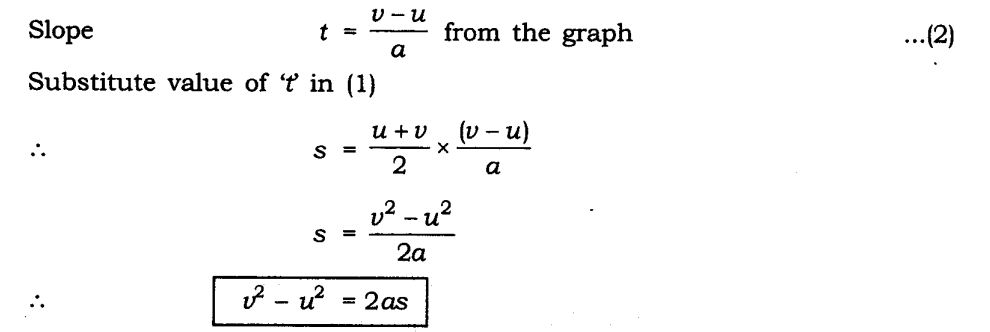
Derivation of v2 – u2 = 2as
(iii) Equation for position-velocity relation:
Conclusions From a Distance – Time Graph
Uniform Circular Motion
When a body moves in a circular path with uniform speed, its motion is called uniform circular motion.
Hindi Version
Dig Deep
Topic Level Resources
Sub – Topics
Select A Topic
Topic:
Chapters Index
Select Another Chapter
[display-posts category=”CBSE 9 – Science – Study – Premium” posts_per_page=”25″]
Electricity is a branch of physics that deals with the study of phenomena associated with stationary or moving electric charges.
Therefore, the various manifestations of electricity are the result of the accumulation or motion of electrons.
Electricity is classified into two types. They are Static Electricity and Current Electricity. (Scroll down to continue …)
Study Tools
Audio, Visual & Digital Content
ELECTRICITY
V-Lab
Book
Slides
V-Class
Quiz
Solutions
Resources of Electricity
Static Electricity
Static Electricity is a branch of physics that deals with the study of phenomena associated with stationary electric charges.
Current Electricity.
Current Electricity is a branch of physics that deals with the study of phenomena associated with moving electric charges.
Electric Charge
Electric charge is a fundamental property of matter.
Though we can’t say what is charge with certainty, we can study the properties and behaviour of charge.
Charge is defined as the property associated with matter due to which it produces and experiences electrical and magnetic effects.
The electric charge is caused by the elementary particles, electrons and protons.
Protons possess positive charge, electrons possess negative charge and Neutrons do not possess any charge.
Laws of Electric Charges:
Similar electric charges repel each other
Dissimilar (opposite) electric charges attract each other.
Conductors And Insulators
Conductors are the materials in which electrons move freely.
Example: All metals.
Insulators are the materials which do not have any free electrons to move.
Example: Wood and plastic.
Electric Circuit:
The path of flow of current is known as electric circuit.
Electric Potential Energy
Electric potential energy of a group of charges is defined as the amount of work done in bringing the charges to their respective positions in the system.
Electric Potential At A Point
The electric potential at a point, in an electric field, is defined as the amount of work done in moving a unit + ve charge from infinity to that point, without acceleration or without a change in K.E., against the electric force due to the electric field.
The potential at a point is given by the expression V = W/q
The S.I Unit of potential is mathematically written as 1 volt = 1 joule/1 coulomb.
Potential is a scalar quantity, therefore it is added algebraically.
For a positively charged body, potential is positive and for a negatively charged body potential is negative.
Electric current flows through a conductor only if there is a potential difference across its ends.
Work done in moving a charge in the electric field of another charge is given by:
W = Vq
More is the charge on a body, the more is its potential due to it.
Electric current flows through a conductor only if there is a potential difference across its ends.
Positive charge flows from a body at higher potential to a body at lower potential and negative charge flows from a body at a lower potential to a body at higher potential.
Potential difference
The work done in moving a unit positive charge from one point to another is known as Potential Difference between those points.
Example
The work done in moving a unit positive charge from point A to another point B is known as Potential Difference between the points A and B.
SI Unit: volt
The unit of potential difference is volt (V).
Volt
In other words, Volt is defined as the potential difference between two points, if 1 Joule of work is done in moving 1 coulomb charge from one point to another.
Potential difference between two points across a conductor is measured by using a voltmeter.
Voltmeter is always connected in parallel to the points across which potential difference is to be measured.
Battery:
Battery is an arrangement that creates a constant potential difference between its terminals.
Battery is defined as a combination of a number of cells in series.
Electric Current
The literary meaning of Electric Current isflow of electric charge.
Definition
Electric current is defined as the amount of charge passing a cross section of conductor per a unit time (second in SI Units).
Electric current is expressed mathematically in terms of rate of flow of charges as:
Electric Current =(Net Charge, Q)/(Time,t)
i =n.et , Where n = number of electrons, e = charge of one electron, t= time taken to flow,
Q = charge through the crosssection of the conductor.
The SI unit of electric current is Ampere (A).
Direction of electric current is the same as the direction of positive charges But it is opposite to the direction of flow of negative charges.
Potential difference, V between two points at a constant temperature is directly proportional to the current, I.
V ∝ I
⇒ V = lR
Where, R is a constant termed as ElectricResistance.
The SI unit of resistance is ohm (Ω)
Q.1. State Ohm’s law. How can it be verified?
Answer: It states “Physical conditions’ remaining same, the current flowing through a conductor is directly proportional to the potential difference across its two ends”.
i.e., V∞ I
or
V = IR, where, R is the constant of proportionality.
R is called the electrical resistance or resistance of the conductor.
Verification:
V∞ I or V = IR, where the constant of proportionality R is called the electrical resistance or resistance of the conductor.
The following circuit diagram is used to verify Ohm’s law.
Take a few cells; connect one cell across a nichrome wire AB, along with an ammeter and a voltmeter as shown in figure. Note the voltage and the current from the voltmeter and the
ammeter.
Now, connect two cells and again note the voltage and the current. Repeat the procedure for three cells and four cells. Calculate the ratio for each set.
You will find the ratio is nearly the same in all cases. If a graph of current against voltage is plotted, it will turn to be a straight line as shown in figure. This shows that the current is directly proportional to the potential difference.
Laws of Electric Resistance
Or
Factors Affecting Resistance
Resistance is directly proportional to length of conductor.
Resistance is inversely proportional to the area of cross-section.
Resistance is directly proportional to the temperature.
Depends on the nature of the material. This is determined by the resistivity of material.
Laws of Electric Resistance
The resistance of any substance depends on the following factors,
Length of the substance.
Cross sectional area of the substance.
The nature of material of the substance.
Temperature of the substance.
There are mainly four (4) laws of resistance from which the resistivity or specific resistance of any substance can easily be determined.
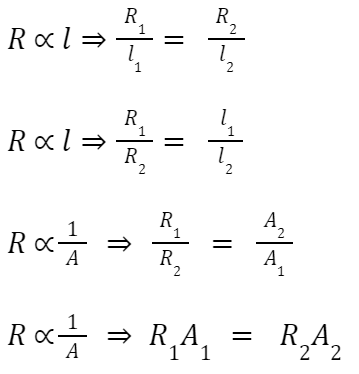
The resistance of a substance is directly proportional to the length of the substance. Electric resistance, R of a substance is written as
Where L is the length of the substance.
The resistance of a substance is inversely proportional to the cross-sectional area of the substance. Electrical resistance R of a substance is
Where A is the cross-sectional area of the substance.
Resistivity
Combining these two laws we get,
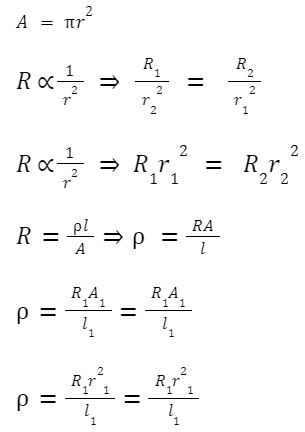
Where, ρ (rho) is the proportionality constant and known as resistivity or specific resistance of the material of the conductor or substance.
Now if we put L = 1 and A = 1 in the equation, we get, R = ρ.
That means resistance of a material of unit length having unit cross – sectional area is equal to its resistivity or specific resistance.
Resistivity of a material can alternatively be defined as the electrical resistance between opposite faces of a cube of unit volume of that material.
Unit of Resistivity
The unit of resistivity can be easily determined form its equation
The unit of resistivity is Ω – m in the MKS system and Ω – cm in the CGS system and 1 Ω – m = 100 Ω – cm.
Resistivity
Resistivity is the property of the material. It does depend on the length and area of the conductor.
Resistance = (Resistivity) x (Length of Conductor) / (Cross Sectional Area)
The SI unit of resistivity is ohm-metre.
Resistivity of metals varies from 10-8 to 10-6.
Resistivity of insulators varies from 1012 to 1017
Copper and aluminium are used in electrical transmission due to their low resistivity.
Net Resistance in Resistors In Series
When several resistors are joined in series, the resistance of the combination Rs equals the sum of their individual resistances, R1, R2, R3
It is mathematically expressed as: RS = R1 + R2 + R3
Thus greater than any individual resistance.
Derivation of Net Resistance of Resistors In Series
When two or more resistors are joined in series, then their total resistance is given by the formula:
⇒ RS = R1 + R2 + R3
The current will remain the same through all resistors.
Total voltage is given by: V = V1 + V2 + V3
Voltage across each resistor is given as: V1 = IR1, V2 = IR2, V3 = IR3
⇒ V = V1 + V2 + V3
But Total Voltage V = I × R, Here I = Current in electric circuit and R = Net Resistance in the circuit.
⇒ IR = IR1 + IR2 + IR3 ⇒ IR = I(R1 + R2 + R3) ⇒ R = R1 + R2 + R3
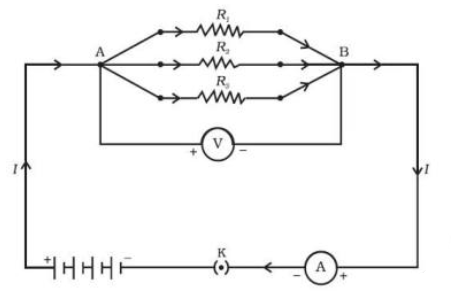
Resistors In Parallel
The reciprocal of the equivalent resistance of a group of resistances joined in parallel is equal to the sum of the reciprocals of the individual resistances.
(V/Rp) = (V/R1) + (V/R2) + (V/R3)
Derivation of Net Resistance of Resistors In Parallel
In this case, voltage is the same across each resistor and is equal to applied voltage.
Total current is given as:
I = I1 + I2 + I3
It is observed that the total current I, is equal to the sum of the separate currents through each branch of the combination.
I = I1 + I2 + I3 ————– (i)
Let Rp be the equivalent resistance of the parallel combination of resistors.
By applying Ohm’s law to the parallel combination of resistors, we have: I = V/Rp ————– (ii)
On applying Ohm’s law to each resistor, we have
I1= V /R1; I2= V /R2; and I3= V /R3 —————– (iii)
From Eqs. (ii) to (iii), we have
(V/Rp) = (V/R1) + (V/R2) + (V/R3)
⇒ V(1/Rp) = V[(1/R1) + (1/R2) + (1/R3)]
⇒ (1/Rp) = [(1/R1) + (1/R2) + (1/R3)] ————– ()
Thus, we may conclude that the reciprocal of the equivalent resistance of a group of resistances joined in parallel is equal to the sum of the reciprocals of the individual resistances.
Advantages of Parallel Combination over Series Combination:
If one component fails in series, then the complete circuit is broken and no component can work properly. Different appliances need different current, this can be met through parallel.
Heating effects of Electric Current
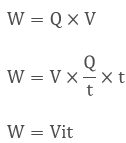
When charge Q moves against the potential difference V in time t, the amount of work is given by-
Joule’s Law of Heating
Heat produced in a resistor is directly proportional to square root of current.
It is also directly proportional to resistance for a given current.
Also, directly proportional to time
⇒ H = l2 Rt
Filament of an electric bulb is made up of tungsten because it has a very high melting point and also does not oxidise readily at a high temperature.
Electric fuse is a safety device to protect the electrical appliance from short circuits.
Electric Power
The rate at which electric energy is dissipated or consumed in an electric current. The SI unit of power is Watt.
⇒ P = Vl
⇒ P = l2 R = V2/R
The commercial unit of electric energy is kilowatt hour (KWh).
Formulae:
Cylindrical Conductor:
Hindi Version
Dig Deep
Topic Level Resources
Sub – Topics
Select A Topic
Topic:
Chapters Index
Select Another Chapter
[display-posts category=”CBSE 10 – Science – Study – Premium” posts_per_page=”25″]
[display-posts posts_per_page=”15″ tag=”CBSE, Class 9, Mathematics, Study, Premium”]
Watch In English & Hindi
Speed Notes
Notes For Quick Recap
Write An Article On Chandrayaan 3 with SEO For www.therightmentor.com
Chandrayaan 3: India’s Next Mission to the Moon
India is all set to launch its third lunar mission, Chandrayaan 3, in the near future. The Indian Space Research Organisation (ISRO) has been working tirelessly on this project since the success of Chandrayaan 2 in September 2019. This mission is expected to be a major milestone in India’s space exploration journey, and it has generated a lot of interest and excitement among space enthusiasts.
What is Chandrayaan 3?
Chandrayaan 3 is India’s third lunar mission, which aims to land a rover on the moon’s surface. The mission is a follow-up to Chandrayaan 2, which was partially successful. The main objective of Chandrayaan 3 is to conduct scientific experiments and collect data on the moon’s surface and atmosphere. The mission will also help India to develop its technological capabilities in space exploration.
What are the key features of Chandrayaan 3?
Chandrayaan 3 will consist of an orbiter, a lander, and a rover. The orbiter will be responsible for mapping the moon’s surface, while the lander will carry the rover to the moon’s surface. The rover will then explore the moon’s surface, collect data, and conduct experiments. Chandrayaan 3 will also carry a range of scientific instruments that will help in studying the moon’s geology, mineralogy, and atmosphere.
What are the challenges of Chandrayaan 3?
Chandrayaan 3 is a complex mission that involves several challenges. One of the biggest challenges is the landing of the rover on the moon’s surface. The lander has to be designed in such a way that it can withstand the harsh lunar environment and land safely on the moon’s surface. Another challenge is the communication between the lander and the orbiter. The lander has to communicate with the orbiter in order to transmit data back to Earth.
When will Chandrayaan 3 be launched?
The launch date for Chandrayaan 3 has not been announced yet. However, ISRO has stated that it is working towards launching the mission as soon as possible. The COVID-19 pandemic has delayed the mission’s progress, but ISRO is confident that it will be able to launch Chandrayaan 3 in the near future.
Conclusion
Chandrayaan 3 is an important mission for India’s space exploration journey. It will help India to develop its technological capabilities in space exploration and contribute to scientific research on the moon’s surface and atmosphere. The success of Chandrayaan 3 will be a major milestone for India and will inspire future generations of space enthusiasts.
Yoga is the perfect way to unite the mind, body, and spirit. It’s a practice that has been around for centuries, and each year we celebrate International Yogaday on June 21st.
Wrong shortcode initialized
Happy Yoga Day 2023
But in 2023, we’re taking things to the next level! Get ready to bend, stretch, and find your zen with Yogaday 2023. And to help you get inspired, we’ve created a blog post full of tips, tricks, and inspiration to get your yoga on!
Let’s Get Bending: Celebrate Yogaday 2023!
Yogaday is all about celebrating the benefits of yoga. From improving flexibility and strength to reducing stress and anxiety, there are countless reasons to get on your mat and start moving. And in 2023, we’re taking things to a whole new level. Whether you’re a seasoned yogi or a beginner, there are plenty of ways to celebrate Yogaday. Attend a local class, organize a community event, or simply take some time for yourself to practice in the comfort of your own home.
No matter how you choose to celebrate, one thing is for sure – you’re going to feel amazing. Yoga is not just a physical practice, it’s also a mental and emotional one. It’s a chance to connect with yourself, your breath, and the world around you. So, let’s get bending and celebrate Yogaday 2023!
Free Study Tools
Find Your Zen: Read Our Yogaday Inspo Blog Post!
If you’re looking for some inspiration to help you get your yoga on, look no further than our Yogaday Inspo Blog Post. We’ve compiled a list of tips and tricks to help you get the most out of your practice, as well as some inspiring quotes and stories from yogis around the world.
Whether you’re looking to improve your flexibility, reduce stress, or simply find a moment of peace in your busy day, our blog post has everything you need to get started. So, grab your mat, find a quiet space, and get ready to find your zen with Yogaday 2023.
Yoga is a practice that has been around for centuries, and it’s not hard to see why. From improving physical health to reducing stress and anxiety, there are countless benefits to getting your yoga on. And with Yogaday 2023 on the horizon, there’s never been a better time to get started.
So, whether you’re a seasoned yogi or a beginner, take some time to celebrate Yogaday 2023. Attend a local class, organize a community event, or simply take some time for yourself to practice. And don’t forget to check out our Yogaday Inspo Blog Post for some inspiration to help you get started. Let’s get bending, and find our zen with Yogaday 2023!
Empowering Teachers & Learners Through Innovative Educational Tools and Techniques
Welcome to The Right Mentor, the leading educational website dedicated to providing personalized education using cutting-edge pedagogy and advanced technologies such as Artificial Intelligence (AI). Our mission is to revolutionize the way we learn, teach, and train, offering a tailored learning experience that meets the unique needs and goals of every individual.
Why Choose The Right Mentor?
Personalized Education: We believe in the power of personalized learning. Our platform employs AI algorithms to create individualized learning paths, adapting to the specific strengths, weaknesses, and learning styles of each student. This ensures an engaging and efficient learning experience that maximizes knowledge retention and academic success.
21st Century Pedagogy: Our team of experienced educators and experts are dedicated to implementing the most effective pedagogical approaches of the 21st century. We combine the best practices of traditional education with innovative teaching methods, fostering critical thinking, creativity, collaboration, and problem-solving skills among learners.
Artificial Intelligence for Learning& Teaching: Harnessing the potential of AI, we integrate intelligent algorithms and machine learning models to analyze student data, track progress, and deliver personalized recommendations. Our AI-powered tutors provide real-time feedback, interactive lessons, and adaptive assessments, ensuring an immersive and effective learning experience.
Comprehensive Course Material: The Right Mentor offers a vast range of courses covering various subjects and disciplines. Our meticulously designed curriculum is created by subject matter experts and continuously updated to align with the latest educational standards. Students can access comprehensive course materials, including interactive videos, e-books, practice exercises, and more.
Study Tools and Interactive Resources: We provide a wide array of study tools and interactive resources to enhance the learning process. From virtual labs and simulations to educational games and multimedia content, our platform ensures a dynamic and engaging learning environment.
Assessment and Evaluation Tools: Our platform offers robust assessment and evaluation tools to monitor student progress and understanding. Interactive quizzes, assignments, and exams are designed to assess knowledge retention and provide valuable insights into individual performance. Real-time performance analytics and reports allow students, parents, and educators to track progress effectively.
Join The Right Mentor Today and Unleash Your Full Potential
At The Right Mentor, we believe that education should be a transformative and empowering journey for every learner. Our personalized approach, combined with the integration of AI and 21st-century pedagogy, ensures that students receive the best possible education tailored to their unique needs.
Visit our website, www.therightmentor.com, to explore our courses, educational tools, and resources. Join our growing community of learners, teachers, and trainers and unlock your full potential with The Right Mentor. Start your personalized educational journey today!
Free | Study Material | Assessments | Clear Doubts | Tuitions | Class 6 – 10.
Ultimate Educator With Tools And Tuitions For Students And Teachers. FInd Free Course Material. The Free Course Material Includes, Study Material & Quizzes, Assessments, Previous Papers etc. Access And Share Educational Resources For Class 6 – 10. Our Course Material For TSTET APTET CTET TGT PGT DSC. Best Tutors And Tutor Jobs. Study Visa Assistance & Career Guidance.
Free | Study Material | Assessments | Clear Doubts | Tuitions | Class 6 – 10.
Ultimate Educator With Tools And Tuitions For Students And Teachers. FInd Free Course Material. The Free Course Material Includes, Study Material & Quizzes, Assessments, Previous Papers etc. Access And Share Educational Resources For Class 6 – 10. Our Course Material For TSTET APTET CTET TGT PGT DSC. Best Tutors And Tutor Jobs. Study Visa Assistance & Career Guidance.
Free | Study Material | Assessments | Clear Doubts | Tuitions | Class 6 – 10.
Ultimate Educator With Tools And Tuitions For Students And Teachers. FInd Free Course Material. The Free Course Material Includes, Study Material & Quizzes, Assessments, Previous Papers etc. Access And Share Educational Resources For Class 6 – 10. Our Course Material For TSTET APTET CTET TGT PGT DSC. Best Tutors And Tutor Jobs. Study Visa Assistance & Career Guidance.
Study Material for Mathematics and Science for Classes 6 to 10
At The Right Mentor, we understand the importance of quality study material in shaping a student’s academic journey. That’s why we offer a comprehensive range of study material for Mathematics and Science for classes 6 to 10.
Chapter Summaries (Speed Notes)
Our study material includes concise and well-structured chapter summaries, also known as Speed Notes. These summaries provide a quick overview of the key concepts, formulas, and important points covered in each chapter. With Speed Notes, students can easily revise and reinforce their understanding of the subject matter.
Keywords
Our study material also includes a list of keywords for each chapter. These keywords help students in understanding the core concepts and facilitate better retention of information. By focusing on these keywords, students can grasp the fundamental ideas and build a strong foundation in Mathematics and Science.
Soft Copies of Textbooks
To make learning more accessible, we provide soft copies of the textbooks prescribed by various education boards such as CBSE, ICSE, Telangana State Board, and Andhra Pradesh State Board. These PDF versions of the textbooks can be easily downloaded and accessed on any device, allowing students to study anytime, anywhere.
Textbook Solutions
In addition to the textbooks, we offer comprehensive solutions for the exercises and problems present in the textbooks. Our experts have carefully crafted these solutions to provide step-by-step explanations and help students understand the concepts effectively. These solutions serve as a valuable resource for self-study and exam preparation.
NCERT Exemplar Solutions
We also provide NCERT Exemplar Solutions, which are specifically designed to enhance problem-solving skills. These solutions cover a wide range of challenging problems and offer detailed explanations, enabling students to develop a deeper understanding of the subject.
With our study material, including Speed Notes, chapter videos, NCERT Exemplar Solutions, NCERT Solutions, and PDFs of NCERT textbooks, students can strengthen their knowledge, improve their performance, and excel in their Mathematics and Science studies.
Assessment plays a crucial role in the education system as it allows educators to evaluate students’ knowledge and understanding of the subject matter. To ensure effective learning, it is essential to have reliable assessment tools in place. At Therightmentor.com, we understand the importance of accurate and comprehensive assessments, which is why we offer a range of assessment tools, including quizzes, assignments (worksheets), question banks, sample papers, and practice papers.
Quizzes
Quizzes are a popular assessment tool that allows educators to test students’ knowledge in a quick and interactive manner. Our quizzes cover various subjects and topics, providing students with an opportunity to assess their understanding and identify areas that require further attention. With a user-friendly interface and instant feedback, our quizzes create an engaging learning experience for students.
Assignments (Worksheets)
Assignments, also known as worksheets, are an effective way to assess students’ understanding of a particular topic or concept. Our assignments are carefully designed to encourage critical thinking and problem-solving skills. They provide students with an opportunity to apply their knowledge and demonstrate their understanding through practical exercises and questions. Our assignments cover a wide range of subjects and are aligned with the curriculum guidelines to ensure relevance and accuracy.
Question Bank
A question bank is a comprehensive collection of questions covering various topics and difficulty levels. It serves as a valuable resource for educators to create assessments that are diverse and challenging. Our question bank includes a wide range of multiple-choice, short answer, and essay questions, allowing educators to customize assessments according to their specific requirements. With our extensive question bank, educators can ensure that their assessments are well-balanced and cover all the essential learning objectives.
Sample Papers
Sample papers are an invaluable resource for students preparing for exams. Our sample papers are carefully crafted to reflect the format and difficulty level of the actual exams. They provide students with an opportunity to familiarize themselves with the exam pattern and practice solving questions within a time limit. Our sample papers are designed by subject matter experts and are based on the latest syllabus and exam guidelines released by the respective educational boards. By practicing with our sample papers, students can build confidence and improve their performance in exams.
Practice Papers
Practice papers are an essential tool for students to reinforce their learning and assess their readiness for exams. Our practice papers cover a wide range of topics and provide students with ample opportunities to practice solving questions under exam-like conditions. With detailed solutions and explanations, our practice papers help students identify their strengths and weaknesses, enabling them to focus their efforts on areas that require improvement. Our practice papers are designed to enhance students’ problem-solving skills and boost their overall performance in exams.
At Therightmentor.com, we understand the significance of reliable assessment tools in promoting effective learning. Our quizzes, assignments (worksheets), question banks, sample papers, and practice papers are designed to provide students with a comprehensive and engaging learning experience. Whether you are a student looking to assess your understanding or an educator seeking effective assessment resources, our assessment tools are here to support your academic journey.
Visit Therightmentor.com today and explore our wide range of assessment tools to enhance your learning experience!
No Matter Where You Start Among Study, Assess & Interact. But Your Course Will Be Completed Successfully.
Welcome to The Right Mentor, your trusted source for educational insights. In this article, we delve into the transformative role of artificial intelligence (AI) in school education. Discover how AI is reshaping traditional classrooms, providing personalized learning experiences, and revolutionizing teaching methods. Read on to explore the incredible potential of AI in education and its impact on student engagement and academic outcomes.
Indian Political System – Structure
Notes on the Indian political system to help you excel in Competitive exams.
Introduction to the Indian Political System:
The Indian political system is based on the principles of democracy,federalism, secularism, and social justice.
The Constitution of India is the supreme law of the land and provides the framework for the functioning of the political system.
Three Branches of Government:
The Indian political system consists of three branches of government: the Executive, the Legislative, and the Judiciary.
Each branch has distinct roles and functions, ensuring a system of checks and balances.
Executive Branch:
The Executive branch is responsible for implementing and enforcing laws.
It includes the President, who is the head of state, and the Prime Minister, who is the head of government.
The Council of Ministers assists the Prime Minister in the administration of the country.
Legislative Branch:
The Legislative branch is responsible for making laws.
It consists of the Parliament, which is further divided into two houses: the Rajya Sabha (Council of States) and the Lok Sabha (House of the People).
Members of Parliament (MPs) are elected by the people and represent their respective constituencies.
Judiciary:
The Judiciary is the guardian of the Constitution and ensures the rule of law.
The Supreme Court is the highest judicial authority in the country.
It interprets the Constitution, resolves disputes, and safeguards fundamental rights.
Hierarchy and Powers of Institutions:
The President is the head of the state and exercises ceremonial powers.
The Prime Minister is the head of the government and holds executive powers.
The Parliament has the power to make laws, approve budgets, and oversee the functioning of the government.
The Supreme Court has the authority to interpret the Constitution, protect fundamental rights, and provide justice.
Federal Structure:
India follows a federal system where powers are divided between the central government and the state governments.
The central government is responsible for national-level matters, while the state governments handle state-level affairs.
Local self-government bodies, such as Panchayats and Municipalities, exist at the grassroots level.
Significance of the Structure:
The structure of the Indian political system ensures a separation of powers, preventing the concentration of authority in a single entity.
It promotes accountability, transparency, and democratic governance.
The hierarchy and powers of institutions create a system where each branch has its own roles and functions.
Note: It is advisable to refer to official textbooks, previous question papers, and updated syllabus provided by the Telangana TGT jobs exam conducting authority for comprehensive and accurate information.