Assessment Tools
Assign | Assess | Analyse
Quick Quiz
Objective Assessment
Question Bank
List Of Questions With Key, Aswers & Solutions
Back To Learn
Re – Learn
Go Back To Learn Again
Class Level Content Of A Subject
Assign | Assess | Analyse
Objective Assessment
List Of Questions With Key, Aswers & Solutions
Back To Learn
Go Back To Learn Again
Assign | Assess | Analyse
Objective Assessment
List Of Questions With Key, Aswers & Solutions
Back To Learn
Go Back To Learn Again
Mind Map Overal Idea Content Speed Notes Quick Coverage Point: Point is an exact position in space with no dimensions, represented by a dot. Ray: Ray is a part of a line that starts at an endpoint and extends infinitely away from the end point in single direction. Line or Straight line: A line or readmore
Overal Idea
Content
Quick Coverage
Point: Point is an exact position in space with no dimensions, represented by a dot.
Ray: Ray is a part of a line that starts at an endpoint and extends infinitely away from the end point in single direction.
Line or Straight line: A line or straight line is perfectly straight and extends forever in both direction.
Line segment: A line segment is the part of a line between two points. (Scroll down till end of the page)
Audio, Visual & Digital Content
Intersecting lines: Two or more lines that have one and only one point in common.
Point of intersection: Point of intersection is a common point at which the intersecting lines meet.
Transversal: Transversal is a line that intersects two or more lines which lie in the same plane at distinct points.
Parallel lines: Parallel lines are the lines on a plane which never meet. They are at a distance apart.
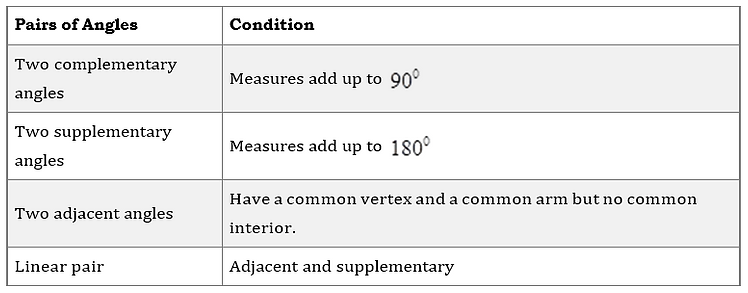
Complementary Angles: Complementary angles are the angles whose total is equal to 90o .
Supplementary Angles: Suplementary angles are the angles whose total is equal to 180o
Adjacent Angles: Adjacent Angles are the angles which have a common vertex and a common interior points.
Linear Pair of Angles: Linear pair of angles is a pair of adjacent angles whose non-common sides are opposite rays.
Vertically Opposite Angles: Vertically opposite angles are the angles formed by two intersecting lines which have the have common arms.
When two lines are intersecting by a transversal, eight angles are formed.
Transversal of Parallel Lines: If two parallel lines are intersected by a transversal, each pair of:
If the transversal is perpendicular to the parallellines, all of the angles formed are congruent to 90o angles.
If two parallel lines are intersected by a transversal then:
6. If two non-parallel lines are intersected by transversal then none of (i), (ii) and (iii) hold true in 5. 7.
If two lines are intersected by a transversal, then they are parallel if any one of the following is true:
Topic Terminology
Term
Table:
.
Test Your Learning
Mind Map Overal Idea Content Speed Notes Quick Coverage Content : (Scroll down till end of the page) Study Tools Audio, Visual & Digital Content Content … Key Terms Topic Terminology Term Important Tables Table: . Assessments Test Your Learning readmore
Overal Idea
Content
Quick Coverage
Content : (Scroll down till end of the page)
Audio, Visual & Digital Content
Content …
Topic Terminology
Term
Table:
.
Test Your Learning
Mind Map Overal Idea Content Speed Notes Quick Coverage Changes can be of two types, physical and chemical. Physical changes are changes in the physical properties of substances. Due to physical chages new substances are not formed. Physical changes may be reversible. Examples: crushing a can, glowing of an electric bulb, tearing of paper, mixing readmore
Overal Idea
Content
Quick Coverage
Changes can be of two types, physical and chemical.
Physical changes are changes in the physical properties of substances.
Due to physical chages new substances are not formed.
Physical changes may be reversible.
Examples: crushing a can, glowing of an electric bulb, tearing of paper, mixing of sand and water. (Scroll down till end of the page)
Audio, Visual & Digital Content
Chemical Changes are changes in which the composition and chemical properties of the substance get changed.
In chemical changes new substances are produced. The most of the chemical changes are irreversible and permanent.
Note: Some chemical changes are reversible, known as reversible chemical changes.
Example: burning of a candle, formation of curd from milk, ripening of fruits.
Some Chemical Reactions in daily life:
Rusting of Iron: Rusting is the process in which iron turns into iron oxide.
It happens when iron comes into contact with water and oxygen. The process is a type of corrosion that occurs easily under natural conditions.
Prevention of Rusting:
Cooking of food: Cooking causes breakdown of complex molecules of carbohydrates, fats and proteins into smaller molecules.
It is regarded as a decomposition reaction.
Cooked food is easier to digest than uncooked food.
3. Decay of Organic Substances: Microorganisms like fungi and bacteria produce enzymes which break down complex organic compounds into smaller substances.
It is also regarded as a decomposition reaction.
Some substances can be obtained in pure state from their solutions by crystallization.
Topic Terminology
Term
Table:
.
Test Your Learning
Assign | Assess | Analyse
Objective Assessment
List Of Questions With Key, Aswers & Solutions
Back To Learn
Go Back To Learn Again
Mind Map Overal Idea Content Speed Notes Quick Coverage Square: Number obtained when a number is multiplied by itself. It is the number raised to the power 2. 22 = 2 x 2=4(square of 2 is 4). If a natural number m can be expressed as n2, where n is also a natural number, then readmore
Overal Idea
Content
Quick Coverage
Square: Number obtained when a number is multiplied by itself. It is the number raised to the power 2. 22 = 2 x 2=4(square of 2 is 4).
If a natural number m can be expressed as n2, where n is also a natural number, then m is a square number. (Scroll down till end of the page)
Audio, Visual & Digital Content
All square numbers end with 0, 1, 4, 5, 6 or 9 at unit’s place. Square numbers can only have even number of zeros at the end. Square root is the inverse operation of square.
There are two integral square roots of a perfect square number.
Positive square root of a number is denoted by the symbol For example, 32=9 gives
Perfect Square or Square number: It is the square of some natural number. If m=n2, then m is a perfect square number where m and n are natural numbers. Example: 1=1 x 1=12, 4=2 x 2=22.
Properties of Square number:
triplet, if m2 + n2 = p2: 32 + 42 = 25 = 52
Topic Terminology
Term
Table:
.
Test Your Learning
Mind Map Overal Idea Content Speed Notes Quick Coverage Content : (Scroll down till end of the page) Study Tools Audio, Visual & Digital Content Content … Key Terms Topic Terminology Term Important Tables Table: . Assessments Test Your Learning readmore
Overal Idea
Content
Quick Coverage
Content : (Scroll down till end of the page)
Audio, Visual & Digital Content
Content …
Topic Terminology
Term
Table:
.
Test Your Learning
Mind Map Overal Idea Content Speed Notes Quick Coverage There are three types of Substances: Acids, Bases and Salts Acids: Acids are sour in taste. They are corrosive in nature. A concentrated acid cuts through clothes and eats away the wool. If it falls on the skin, it can cause burns. They are good conductors readmore
Overal Idea
Content
Quick Coverage
There are three types of Substances: Acids, Bases and Salts
Acids: Acids are sour in taste. They are corrosive in nature.
A concentrated acid cuts through clothes and eats away the wool.
If it falls on the skin, it can cause burns.
They are good conductors of electricity, as they allow the passage of electric current through them. (Scroll down till end of the page)
Audio, Visual & Digital Content
Types of Acids:
(i) Mineral Acids: These are acids prepared from minerals present in the earth’s crust.
(ii) Organic Acids: These are acids produced by plants and animals (except hydrochloric acid).
Neutralization: It is the reaction between an acid and a base which results in formation of salt and water.
Acid + Base ———-> Salt + Water
Example: HCl + NaOH ———-> NaCl + H2O
Neutralisation in Everyday Life:
Indigestion: Too much acid in stomach causes indigestion. It is neutralized by taking an antacid like milk of magnesia.
Ant sting: When an ant bites, it injects formic acid into the skin. The effect is neutralized by rubbing moist baking soda (sodium hydrogen carbonate) or calamine (containing zinc carbonate).
(iii) Soil treatment: When the soil is too acidic, it is neutralized by treating with
quicklime (calcium oxide) or slaked lime (calcium hydroxide).
Bases: Bases are bitter in taste and soapy to touch.
Types of Bases:
Substances which are neither acidic nor basic are called neutral.
An acid and a base neutralise each other and form a salt. A salt may be acidic, basic or neutral in nature.
Solutions of substances that show different colour in acidic, basic and neutral solutions are called indicators.
Indicators: It is special chemical that changes its colour to indicate the presence of a chemical substance.
It is used to confirm the presence of an acid, a base or a neutral solution.
Classification of Indicators:
Natural Indicators:
Other Indicators:
Topic Terminology
Term
Table:
.
Test Your Learning