Assessment Tools
Assign | Assess | Analyse
Quick Quiz
Objective Assessment
Question Bank
List Of Questions With Key, Aswers & Solutions
Back To Learn
Re – Learn
Go Back To Learn Again
Board Level
Assign | Assess | Analyse
Objective Assessment
List Of Questions With Key, Aswers & Solutions
Back To Learn
Go Back To Learn Again
Mind Map Overal Idea Content Speed Notes Quick Coverage Friction: Friction is the force that resists the motion of one object against another. It is the force felt between two surfaces when one attempts to slide against the other. Causes of Friction: Friction exists between two surfaces due to irregularities on the surfaces of the objects readmore
Overal Idea
Content
Quick Coverage
Friction:
Friction is the force that resists the motion of one object against another. It is the force felt between two surfaces when one attempts to slide against the other.
Causes of Friction: Friction exists between two surfaces due to irregularities on the surfaces of the objects in contact, interlocking of micro-level irregularities of the two surfaces and ploughing of harder surfaces into smoother surfaces.
Factors Affecting Friction:
(i) Roughness of the surface.
(ii) The extent to which the two surfaces press against each other.
(iii) Nature of the surface· (Scroll down till end of the page)
Audio, Visual & Digital Content
Types of Friction: Friction is classified into three types as: Static Friction, Sliding Friction, Rolling Friction.
(i) Static Friction: When a body is at rest, the force of friction is called the static friction and is always equal and opposite to the applied force.
limiting friction: The force of friction which acts when the body is just at the verge of sliding on the surface is called limiting friction.
Motion between two contacting surfaces
(ii) Sliding friction: The friction force which opposes the actual relative sliding motion between two contact surfaces.
Sliding friction is smaller than static friction.
(iii) Rolling Friction: The frictional force that exists between two surfaces when a body rolls over the other.
Rolling friction is smaller than sliding friction.
Static friction > Sliding friction > Rolling friction
Effects of Friction
(i) Friction produces heat.
(ii) Friction causes wear and tear.
(iii) Friction opposes motion.
Advantages of Friction
(i) Friction between pen and paper enables us to write on the paper.
(ii) Friction between our feet and the ground allows our movements like standing, walking and running.
(iii) Friction between the surface of the road and tyres of our vehicles allow the vehicles to move without slipping.
Disadvantages of Friction:
(i) Friction causes moving objects to stop or slow down.
(ii) Friction produces heat causing wastage of energy in machines.
(iii) Friction causes wear and tear of moving parts of machinery, soles of shoes, etc.
Friction is a necessary Evil:
As friction is advantageous to us it is considered as a friend but, due to its disadvantages it is a foe.
Depending on the circumstance, friction can be a help or a hindrance.
Thus it is a necessary evil.
Increasing Friction: By pressing the surfaces together more strongly.
For example, when brakes are applied on a bicycle or car, the brake pads press against a moving part of the wheel and the force of friction increases.
Friction can be increased by increasing the roughness of the surfaces in contact.
For example, treading of shoes and tyres is done to increase friction.
Reducing Friction: Friction between the sliding surfaces of two objects can be reduced by making the surfaces in contact smooth by polishing them.
Sliding friction between the moving parts of vehicles and machinery can be reduced by introducing oil, grease, graphite or any other lubricant.
Lubricant: A lubricant is a substance that reduces friction between surfaces in contact. This reduces the heat generated when the surfaces move. Lubricants can also transmit forces, transport foreign particles, or heat or cool the surfaces.
Rolling friction is less than sliding friction. Hence, sliding friction is replaced by rolling friction by using rollers, like ball bearings between the hub and the axles in the moving parts of machines and vehicles.
Friction is reduced by providing wheels,
Examples: suitcase, school bags of kids, etc.
Streamlined shape: Aeroplanes, boats, fishes and birds which move through fluids have bodies of special shape, called streamlined shape, The streamlined shape reduces the friction due to fluid and reduces the energy usage.
Topic Terminology
Term
Table:
.
Test Your Learning
Mind Map Overal Idea Content Speed Notes Quick Coverage Content Study Tools Audio, Visual & Digital Content Chapter 9 -Heredity and Evolution 1. Accumulation of variation during Reproduction. Variations in an individual may be an advantage or disadvantage for it. It may enable or disable it to cope with changes in the environment. Advantageous variations readmore
Overal Idea
Content
Quick Coverage
Content
Audio, Visual & Digital Content
Chapter 9 -Heredity and Evolution
1. Accumulation of variation during Reproduction. Variations in an individual may be an advantage or disadvantage for it. It may enable or disable it to cope with changes in the environment. Advantageous variations are selected by environmental factors. For example bacteria that can withstand heat will survive better in a heat wave. Such heritable variations lead tothe evolution andformation of newspecies. An advantage of sexual reproduction is that the variations accumulated in the gametes of each sex are combined when they fuse to form the zygote. Hence an offspring produced from the zygote receives and carries the variations of both the parents. On the other hand, in asexual reproduction there are minor differences among the offspring. These are due to small errors in DNA copying. As gametes and zygote formation are not involves the asexually produced offspring arequite similar. Theyhave fewer variations accumulated over generations.
2. Heredity: The process ofpassing traits fromparent to offspring is called heredity. Trait is any characteristic thatis transferred fromparent to offspring. e.g. height and colour. 2.1 inherited traits. In humans, eye color is an example of an inherited characteristic: an individual might inherit the brown-eye trait from one of the parents. Inherited traits are controlled by genes and the complete set of genes within an organism’s genome is called itsgenotype. 2.2 Rules for theInheritance of traits- Mendel’s contributions: Gregor Johann Mendel was a pioneer among geneticists who put forward the concept of inheritance of characteristics or traits from parent to offspring. Mendel proposed the principle of inheritance and is known as the “Father of Genetics”. Mendel has chosen pea plants for his experimentation and found variations among them. Gene is a structural and functional unit of heredity and variations. Gene is a DNA segment on the chromosome. Genes control the expression of characteristics. Mendel called the genes to be factors. Traits can be either dominant or recessive. Tallness in a plant is a dominant trait, controlled by a dominant allele and is represented by “T” (capital). Shortness in a plant is a recessive trait, controlled by a recessive allele and is represented by “t” (small). · Homozygous is a condition in which a gene possesses a pair ofthe same alleles (TT or tt)for a single characteristic. · Heterozygous is a condition in which a gene possesses a pair of different alleles (Tt) fora single characteristic. Phenotype is a morphological expression of a single character. For example, tallness or shortness represents the phenotype of the plant. Genotype is the genetic make-up of a cell, an organism, or an individual (i.e. the specific allele make-up of the individual), usually with
reference to a specific characteristic under consideration. Alleles combine to make agenotype, such as TT or Tt or tt. Punnettsquare is a statistical method that was usedby Mendel to predict thepossible genotypes andphenotypes of the offspring.
Monohybrid inheritance It is the inheritance ofa single characteristic controlled by different alleles of thesame gene. · F1 generation is thefirst filial generation offspring produced by crossing twoparental strains. visible. All the progeny of F1 generation weretall i.e. thetraits of onlyone parent were · generation isthe second filial generation offspring produced by crossing F2 F1’s. TheF2 progeny were not all tall. Instead, one quarter of themwas short indicating both the traits – that oftallness and shortness were inherited inthe F2 plants. · Genotypic ratio – 1:2:1, Phenotypic ratio – 3:1. Dihybrid inheritance It is thesimultaneous inheritance oftwo characters. Dihybrid inheritance is theexperimentation of twocharacteristics with their four contrasting traits. For instance, dihybrid inheritance involves a plant producing round and yellow seeds (RR and YY) crossing with a plant producing wrinkled green seeds(rr and yy). · · F1 progeny produces roundand yellow seeds(R and r, and Y and y)in which roundand · yellow are dominant traits. F2 progeny were similar to their parents and produced roundyellow seeds, whilesome of · them produced wrinkled green seeds. However, some plants of the progeny even showed new combinations, like round-green seedsand wrinkled-yellow seeds. Thus the tall/ shorttrait and theround seed/wrinkled seedtrait are independently inherited. F2
2.3 How do thesetraits get expressed? A section of DNA that provides information for one protein is called the gene for that protein. The proteins synthesized according to this information may be enzymes that catalyse biochemical reactions. Each trait is the outcome of several suchbiochemical reactions eachof this is controlled by a specific enzyme. Each parent contributes one copy of the gene for a particular character. Thus there are two genes for every character. In the gamete, however, only one copy is present because of reduction division and these may be either maternal or paternal origin. When two germ cells combine they will restore the normal number of gene copies in the progeny ensuring the stability of theDNA of thespecies.
2.4 Sex determination It is a mechanism which determines the individual to be a male or a female based on the sex chromosomes present in it. In human beings, sex is determined by genetic inheritance. Genes inherited fromthe parents determine whether an offspring will be a boy or a girl.Gene for all
the characters are linearly arrange on the chromosomes. The chromosomes that carry genes for sexual characters are called autosomes or sex chromosomes while those that carry genes for the vegetative characters are called autosomes ornon sex chromosomes. Women have XX chromosomes whilemen have XY. All the children will inherit an X chromosome from their mother regardless of whether they are boys or girls. Thus the sex of the children will be determined by what they inherit from their father.
3. Evolution: All the life on Earth has descended from a common ancestor. Evolution is the sequence of gradual changes over millions of years in which new species are produced. Charles Robert Darwin was an English naturalist who observed various species of life on the earth and put forward the idea of “evolution of species by natural selection.” He said that a species inherits its characters from its ancestors. Acquired and inherited traits: An acquired trait is not transmitted to the off spring. In sexually reproducing organisms germ cells are produced in the reproductive organs, while the rest of the body has somatic cells. Changes in somatic cells due to environmental factors are not transmitted to the offspring. This is because a change in a somatic organ caused by a physiological response by the body does not bringabout a corresponding changein reproduction organs. A trait or character that is genetically inherited or passed down from generation to generation is known as inherited trait. Hugo de Vries explained the mechanism of heritable variations. According to him heritable variations arise when there is a change in the genes of the germplasm. He called it mutation. If a particular trait spreads in the population, it means that is favuored by natural selection.
4. Speciation: Speciescan be defined as a group of individuals ofthe same kindthat can interbreed and produce fertile progeny. Speciation: It is an eventthat splits a population into two independent species which cannotreproduce among them.
· Process of speciation-Genetic drift: It occurs due to changes in thefrequencies of particular genes by chance alone. e.g. If a hurricane strikes the mainland, and bananas with beetle eggs on themare washed away to an island. Thisis called a genetic drift.
· Process of speciation – natural selection: These are the variations caused in individuals due to natural selection which lead to the formation of a new species. e.g. If the ecological conditions are slightly different on the island as compared to the mainland, it leads to a change in the morphology and food preferences in the organisms over the course of generations.
Process of speciation -splitting of population: A population splits into different sub- populations due to geographical isolation thatleads to theformation of a new species.
Natural selection: It explains that organisms that are physiologically or behaviourally betteradapted for theenvironment are selected. Selected organisms can survive and reproduce.
Genetic drift: It is the genetic variation in smallpopulations caused by a specific environmental factor. Gene flow: It is the transfer of genes from one population to another due to migration. Breeding between the brown and green beetles introduces new gene combinations into the population. Over generations, genetic drift will accumulate different changes in each sub population. Also, natural selection may also operate differently in the different geographic locations. Speciation due to inbreeding, genetic drift and natural selection will be applicable to all sexually reproducing organism. 5. Evolution and Classification: Characteristics are the hereditary traits transmitted from parent organisms to their offspring. These are details of appearance or behavior in other words a particular form or a particular function. It shows how closely organisms are related with respect to evolution. The more characteristics two species will have in common, the more closely they are related. And the more closely they are related, the more recently they will have had a common ancestor. For example, a brother and a sister are closely related. They have common ancestors in the first generation before them, namely their parents. A girl and her first cousin are also related, but less than the girl and her brother. This is because cousins have common ancestors, their grandparents in the second generation before them, not in the first one. 5.1 Tracing Evolutionary relationships: Characteristics are of two types namely, homologous characteristics or analogous characteristics. · Homologous characteristics are organs that have the same basic structure and origin, but different functions. For example, mammals, birds, reptiles and amphibians have four limbs with the same basic limb layout because they have inherited the limbs from a common ancestor. These limbshave been modified to perform different functions. · Analogous characteristics are organs that have different structures and are of different origin, but perform same functions. For example, the design of the wings of bats and the wings of birds look similar because they have a common purpose – to fly.
5.2 Fossils:
Usually, when organisms die, their bodies will decompose and be lost. But sometime some body parts may not decompose completely and they will eventually harden and retain the impression of the body parts. All such preserved traces of living organisms are called fossils. Fossils are the remains or traces of a plant or animal that existed in a past geological age, and that has been excavated from the soil. Fossilisation is the process in which an organism is converted into a fossil. Paleontology is the study of fossils.
There are two ways to determine the age of fossils. One way is to dig the earth and start finding fossils. The second way of dating fossils is by detecting the ratios of different isotopes of the same element in the fossil material.
5.3 Evolution by Stages:
Evolution is a gradual process- no organism evolved suddenly. Complex organs evolved in organisms gradually. The eyes of the octopus and the eyes of vertebrates have evolved independently. These similarities of structure, despite of different origins provide a classic example of biological convergence. Biological convergence is a phenomenon by which two unrelated organisms become quite alike after a period of time through few generations, if it is assumed that they have a common ancestor. A change that is useful for one property to start with can become useful for quite a different function. Forexample, long feathers were considered to provide insulation in cold weather. Some reptiles like the dinosaur had feathers but very few were adapted for flying. In the present day, birds use feathers for flight, which is an example of adaptation. It is a characteristic of a particular animal may, post-evolution be useful for performing a totally different function. It is all very well to say that very dissimilar looking structures evolve from a common ancestral design. It is true that analysis of the organ structure in fossils allow us to make estimates of how far back evolutionary relationships go. The wild cabbage plant is a good example. Broccoli, kohlrabi and kale areproduced from itsancestor wild cabbage by artificial selection. Another way of tracing evolutionary relationships depends on the changes in DNA during reproduction. Comparing the DNA of different species should give us a direct estimate of how much the DNA has changed during the formation of new species. This method is now extensively used to define evolutionary relationships.
6. Evolution should not beequated with progress.
Evolution is simply generation of diversity and the shaping of the diversity by environmental selection. It is not as if the newlygenerated species arein any way better than the olderone. It is just natural selection and genetic drift have together led to the formation of a population that cannot reproduce with the original one, as in case of the evolution of humans and chimpanzees froma common ancestor. In evolution thenew forms evolved are more complex than their ancestors. It is theadaptability of a species to the environment that supports its survival not the complexity of the species. Each species, whether complex or simple is subjected to natural selection. Each species hasto go through the process of natural selection to survive andreproduce. In evolutionary terms, we cannot say that a particular species has a better design than another. Each species is well suited and adapted to its environment and hence is good enough to live andreproduce.
6.1 Human Evolution: The tools used to traceevolutionary relationships are excavation, time-dating, studying fossils, and determining DNA sequences have been usedfor studying human evolution. All the human beings in the world, whether they are African or American, share the same gene pool and hence all modern humans belong to the same species- Homo sapiens. There are, however, a large number of genes in the gene pool that serve as the source of individual variations. It is forthis reason that no two individuals are identical in looks, abilities, behavior, etc. therefore, there is great diversity in human features such as skin colour, height, hair colour, and so on. But there is no biological basis for assuming that humans with different features belong to different races.
Content …
Topic Terminology
Term:
Topic Terminology
Term:
Test Your Learning
Mind Map Overal Idea Content Speed Notes Quick Coverage Introduction to Euclid Geometry The necessity of geometry had been felt from ancient times in different parts of the world. The practical problems faced by people of ancient civilization had developed this branch of mathematics. Let us cite few examples. With floods in the river, the readmore
Overal Idea
Content
Quick Coverage
Introduction to Euclid Geometry The necessity of geometry had been felt from ancient times in different parts of the world. The practical problems faced by people of ancient civilization had developed this branch of mathematics.
Let us cite few examples.
With floods in the river, the demarcations of land owners on the river-side land were used to wipe out (Scroll down till end of the page)
Audio, Visual & Digital Content
In order to redraw the boundaries, the idea of area was introduced, the idea of area was introduced.
The volumes of granaries could be measured by using geometry.
The existence of Egyptian pyramids indicates the use of geometry from olden times.
In Vedic period, there was a manual of geometrical construction, known as Sulbasutra’s.
Different geometrical shapes were constructed as altars to perform various Vedic rites.
The word Geometry originates from the green word ‘Geo’ (earth) and metrein (to measure) Through Geometry was developed and applied from ancient time in various part the world, it was not presented in a systematic manner.
Later in 300 BC, the Egyptian mathematician Euclid, collected all the known work and arranged it in a systematic manner.
‘Elements’ is a classic treatise in geometry which was written by Euclid.
This was the most influential book. The ‘element’ was used as a text book for several years in western Europe.
The ‘elements’ started with 28 definitions, five postulates and five common notions and systematically built the rest of plane and solid geometry.
The geometrical approach given by Euclid is known as Euclid method.
The Euclid method consists of making a small set of assumptions and then proving many other proposition from these assumptions.
The assumptions, made were obvious universal truth. The two types of assumption, made were ‘axioms’ and ‘postulates’.
Euclid’s Definitions Euclid listed 23 definitions in book 1 of the ‘elements’.
We list a few of them: 1) 2) 3) 4) 5) 6) 7) A point is that which has no part A line is a breadth less length The ends of a line are points A straight line is a line which lies evenly with the points on itself. A surface is that which has length and breadth only.
The edges of a surface are lines A plane surface is surface which lies evenly with straight lines on its self. Starting with these definitions, Euclid assumed certain assumptions, known as axioms and postulates.
Euclid’s Axioms Axioms were assumptions which were used throughout mathematics and are not specifically linked to geometry.
Few of Euclid’s axioms are:
1) Things which are equal to the same thing are equal to one another.
2) It equals are added to equals; the wholes are equal.
3) 4) 5) 6) 7) If equals are subtracted from equals, the remainders are equal.
Things which coincide one another are equal to one another.
The whole is greater than the part Things which are double of the same thing are equal to one another.
Things which are half of the same things are equal to one another.
All these axioms refer to magnitude of same kind.
Axiom – 1 can be written as follows: If x = Z and y = Z, then x = y
Axiom – 2 explains the following: If x = y, then x + Z = y + Z According to axiom – 3, If x = y, then x – Z = y – Z Axiom – 4 justifies the principle of superposition that every thing equals itself.
Axiom – 5, gives us the concept of comparison. If x is a part of y, then there is a quantity Z such that x = y + Z or x > y Note that magnitudes of the same kind can be added, subtracted or compared.
Euclid’s Postulates Euclid used the term postulate for the assumptions that were specific to geometry. Euclid’s five postulates are as follows: Postulate 1: A straight line may be drawn from any one point to any other point. Same may be stated as axiom 5.1 Given two distinct points, there is a unique line that passes through them.
Postulate 2: A terminated line can be produced indefinitely. Postulate 3: A circle can be drawn with any centre and any radius. Postulate 4: All right angles are equal to one another. Postulate 5: If a straight line falling on two straight lines makes the interior angle on the same side of it taken together less than two right angles, then two straight lines, if produced indefinitely, meet on that side on which the sum of the angles is less than two right angles. Postulates 1 to Postulates 4 are very simple and obvious and therefore they are taken a ‘self evident truths’. Postulates 5 is complex and it needs to be discussed. Suppose the line XY falls on two lines AB and CD such that ∠1 + ∠2 < 180°, then the lines AB and CD will intersect at a point. In the given figure, they intersect on left side of PQ, if both are produced. Note: In mathematics the words axiom and postulate may be used interchangeably, though they have distinct meaning according to Euclid. System of Consistent Axioms A system of axioms is said to be consistent, if it is impossible to deduce a statement from these axioms, which contradicts any of the given axioms or proposition. Proposition or Theorem The statement or results which were proved by using Euclid’s axioms and postulates are called propositions or Theorems. Theorem: Two distinct lines cannot have more than one point in common. Proof: Given: AB and CD are two lines. To prove: They intersect at one point or they do not intersect. Proof: Suppose the lines AB and CD intersect at two points P and Q. This implies the line AB passes through the points P and Q. Also the line CD passes through the points P and Q. This implies there are two lines which pass through two distinct point P and Q. But we know that one and only one line can pass through two distinct points. This axiom contradicts out assumption that two distinct lines can have more than one point in common. The lines AB and CD cannot pass through two distinct point P and Q. Equivalent Versions of Euclid’s Fifth Postulate The two different version of fifth postulate a) For every line l and for every point P not lying on l, there exist a unique line m passing through P and parallel to l. b) Two distinct intersecting lines cannot be parallel to the same line.


Topic Terminology
Term
Table:
.
Test Your Learning
Assign | Assess | Analyse
Objective Assessment
List Of Questions With Key, Aswers & Solutions
Back To Learn
Go Back To Learn Again
Assign | Assess | Analyse
Objective Assessment
List Of Questions With Key, Aswers & Solutions
Back To Learn
Go Back To Learn Again
Mind Map Overal Idea Content Speed Notes Quick Coverage Perimeter: Length of boundary of a simple closed figure. Perimeter of Rectangle = 2(l +b)Perimeter of Square = 4aPerimeter of Parallelogram = 2(sum of two adjacent sides)Area: The measure of region enclosed in a simple closed figure. Area of a trapezium = half of the sum readmore
Overal Idea
Content
Quick Coverage
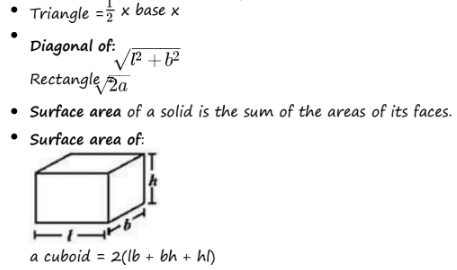
Perimeter: Length of boundary of a simple closed figure.
Perimeter of Rectangle = 2(l +b)
Perimeter of Square = 4a
Perimeter of Parallelogram = 2(sum of two adjacent sides)
Area: The measure of region enclosed in a simple closed figure.
Area of a trapezium = half of the sum of the lengths of parallel sides × perpendiculardistance between them.
Area of a rhombus = half the product of its diagonals. (Scroll down till end of the page)
Audio, Visual & Digital Content
Topic Terminology
Term
Table:
.
Test Your Learning
Mind Map Overal Idea Content Speed Notes Quick Coverage Rest And Motion The terms Rest and Motion are relative. Motion: An object is said to be in motion when its position changes with time. Rest: An object is said to be at rest when its position does not change with respect to a reference point readmore
Overal Idea
Content
Quick Coverage
Rest And Motion
The terms Rest and Motion are relative.
Motion: An object is said to be in motion when its position changes with time.
Rest: An object is said to be at rest when its position does not change with respect to a reference point with time.
A specific point with respect to which we describe the location of an object is called a reference point. (Scroll down till end of the page)
Audio, Visual & Digital Content
| Distance | Displacement |
| Distance is defined as the total length of the path travelled by an object to go from one point to another. | Displacement is defined as the length of the line segment that joins the initial and final positions of an object. |
| Since distance has only magnitude and its direction cannot be specified always, it is a scalar quantity. | Since displacement has magnitude and it is specified in a direction from initial position to final position, it is a vector quantity. |
| Distance can only have positive values. | Displacement can have both positive and negative values. |
| Distance depends on the length of the path travelled. | Displacement depends only on the initial and final point regardless of the path travelled. |

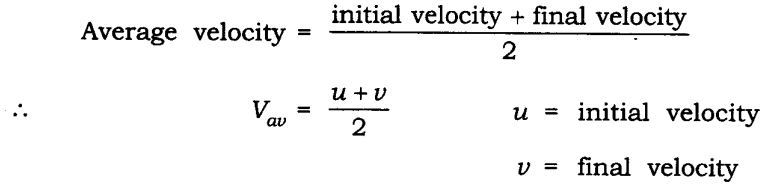
| SPEED | VELOCITY |
| It is defined as the rate of change of distance. | It is defined as the rate of change of net displacement. |
| It is a scalar quantity. | It is a vector quantity. |
| It can never be negative or zero. | It can be negative,zero or positive. |
| Speed is velocity without direction. | Velocity is directed speed. |
| Speed may or may not be equal to velocity. | A body may possess different velocities but the same speed. |
| Speed never decreases with time. For a moving body, | Velocity can decrease with time. For a moving body , it can be zero. |
| Speed is never zero. | Velocity can be zero. |
| Speed in SI is measured in ms-1 | Velocity in SI, is measured in ms-1 |

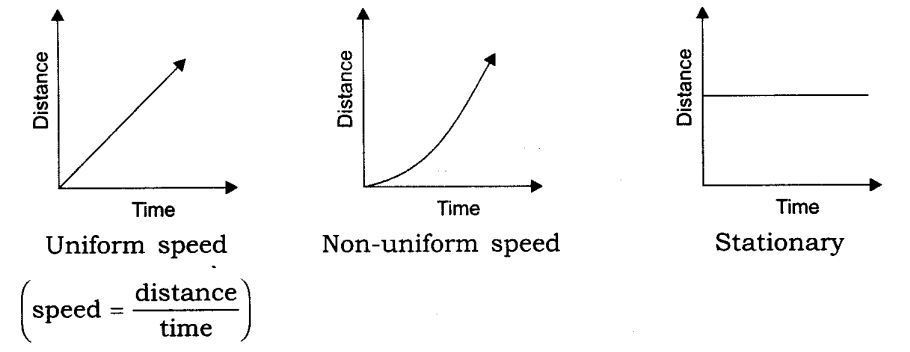

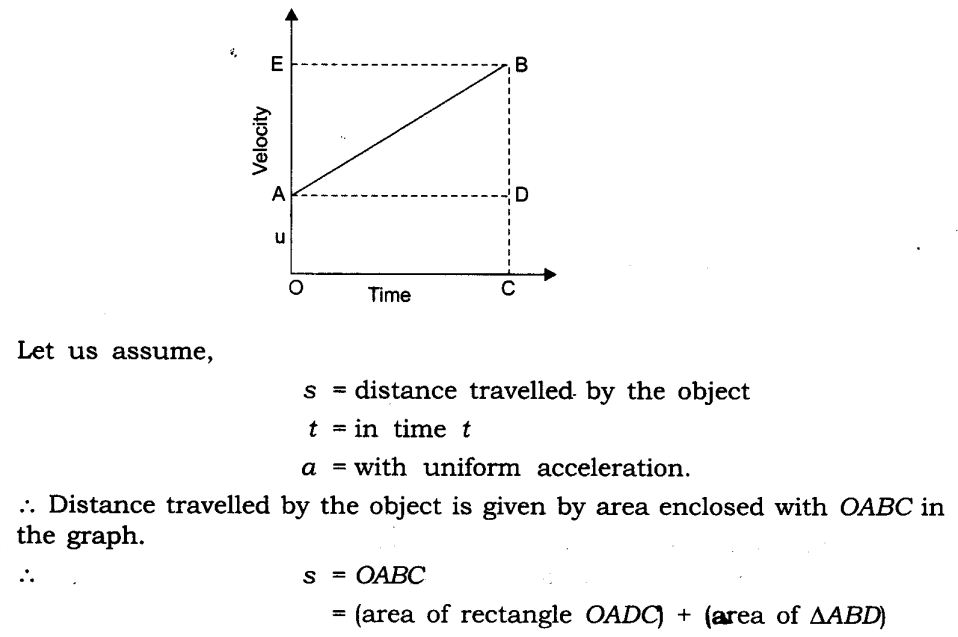
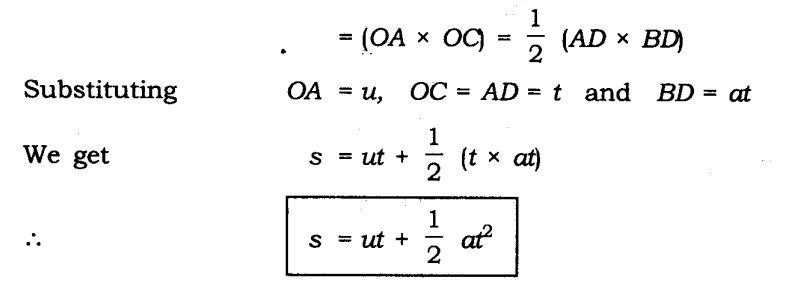
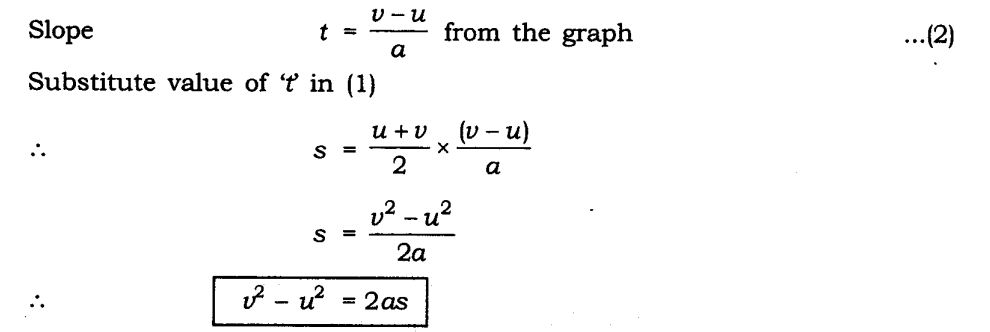
Equations of motion can be derived by two methods. They are (i) Graphical Method. (ii) Algebraic Method
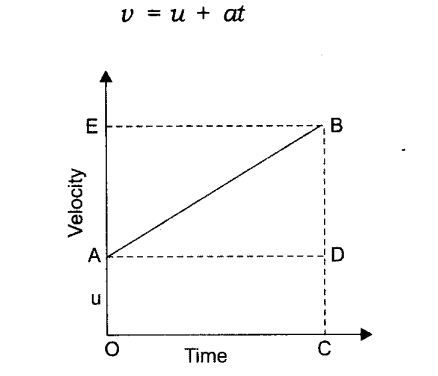
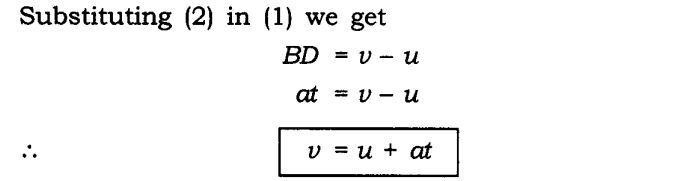
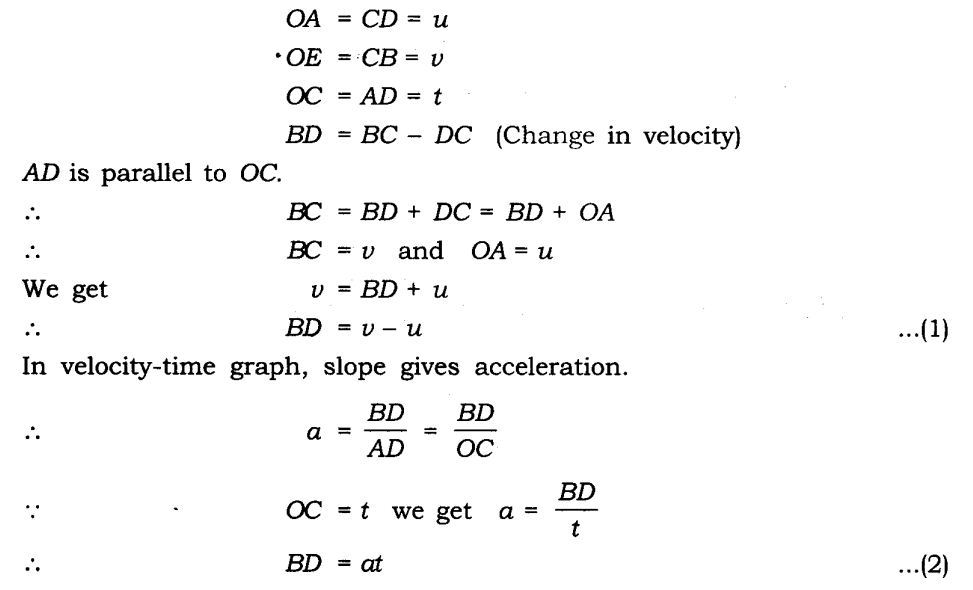
Derivation of v2 – u2 = 2as

Conclusions From a Distance – Time Graph


Topic Terminology
Term
Table:
.
Test Your Learning
Assign | Assess | Analyse
Objective Assessment
List Of Questions With Key, Aswers & Solutions
Back To Learn
Go Back To Learn Again