Assessment Tools
Assign | Assess | Analyse
Quick Quiz
Objective Assessment
Question Bank
List Of Questions With Key, Aswers & Solutions
Back To Learn
Re – Learn
Go Back To Learn Again
Board Level
Assign | Assess | Analyse
Objective Assessment
List Of Questions With Key, Aswers & Solutions
Back To Learn
Go Back To Learn Again
Mind Map Overal Idea Content Speed Notes Quick Coverage Any process that involves the rearrangement of structure of the substance or conversion of reactants into products is defined as Chemical Reaction. For a Chemical Reaction to occur, the change can be observed in the form of – Content Study Tools Audio, Visual & Digital Content readmore
Overal Idea
Content
Quick Coverage
Any process that involves the rearrangement of structure of the substance or conversion of reactants into products is defined as Chemical Reaction.
For a Chemical Reaction to occur, the change can be observed in the form of –
Content
Audio, Visual & Digital Content
Any process that involves the rearrangement of structure of the substance or conversion of reactants into products is defined as Chemical Reaction.
For a Chemical Reaction to occur, the change can be observed in the form of –

Exothermic Reactions: Those reactions in which energy is released in the form of heat are called Exothermic Reactions.
Examples –
(1) All combustion reactions e.g.
CH4+ 2O2 —> CO2 + 2H2O + Heat
(2) Thermite reactions e.g.
2A1 + Fe2O3 —> 2Fe + Al2O3 + Heat
Combinations are generally exothermic in nature. The decomposition of organic matters into compost is an example of exothermic reaction.
Endothermic Reactions: Those reactions in which energy is absorbed are called Endothermic Reactions.
Examples –
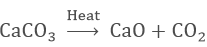
also, the reaction of photosynthesis –

Zn + H2 SO4 → ZnSO4 + H2
Formation of Precipitate: When a soluble carbonate reacts with Barium, Barium Carbonate precipitate can be observed.
Some chemical reactions are characterised by a change in state.

The symbolic representation of chemical reaction using symbols and formulae is known as Chemical Equation. For this, reactants are written on the left hand side whereas products are written on the right.
A balanced chemical equation is the one where the number of atoms involved in reactants side is equal to number of atoms on product side.

Eq.1. Example of Balanced Chemical Equation
To show how to balance the equation, the following equation is used-
Fe + H2O → Fe3O4 + H2
Step 1: First of all, draw the boxes around each formula as shown below-

Step 2: Find out the number of atoms of each element. For Example, on reactant side, 1 for Fe, 2 H, and 1 O and on product side we have, 3 for Fe, 4 for O and 2 for H.
Step 3: Start to balance the equation with the compound having maximum number of atoms. While balancing does not alter the formula of the compound.
Step 4: One by one balance each element on reactant and product side.

Step 5: After balancing number of atoms on both the side of the equation, finally check the correctness of the balanced equation.

Step 6: then write the symbols of the physical state of reactants and products as shown below-
3Fe(s) + 4H2O (g) → Fe3O4 (s) + 4H2 (g)
This above equation represents the balanced equation.
The basic ionic form of the equation is-
Fe2+ + Cr2O72- → Fe3+ + Cr3+
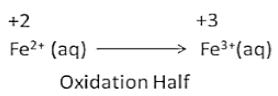
Oxidation half reaction is-
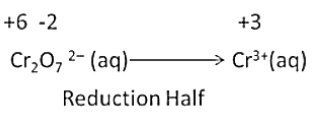
Reduction half reaction is-
Use the reduction half method to balance the equation. Balance the atoms in each half of the reaction except H and O atoms.
Cr2O72- (aq) → 2 Cr3+(aq)
Add water molecules as the reaction is taking place in acidic solution. This is to balance the O atoms and hydrogen ions.
Cr2O72- (aq) + 14 H+(aq) → 2 Cr3+(aq) + 7H2O (I)
Then balance the charges in both half reactions.
Fe2+(aq) → Fe3+(aq) + e–
Cr2O72- (aq) + 14 H+ + 6e– → 2 Cr3+ + 7H2O
6 Fe2+(aq) → 6 Fe3+(aq) + 6e–
Two half of the equations are added to get the overall reaction
6Fe2+(aq) + Cr2O72-(aq) + 14H+(aq) → 6Fe3+(aq) + 2Cr3+(aq) + 7H2O (I)
Eq.2. Example of Combination Reaction
Reactions can be exothermic as well as endothermic. Exothermic reaction release heats and raises the temperature of the surroundings. For Example, Respiration is an example of exothermic reaction.

Eq.3. Example of Exothermic Reaction
Endothermic reaction involved the absorption of the heat and thus it cools the surrounding. The decomposition of dead organic material is an endothermic reaction.

Eq.4. Example of Decomposition Reaction

Eq. 5. Example of Displacement Reaction

Eq. 6. Example of Double Displacement Reaction

Eq.7. Example of Redox Reaction
Metals are prone to corrosion. It is a slow conversion of metals into some undesirable compounds. This occur may be due to reaction with oxygen, gases, acids etc. When irons reacts with atmospheric oxygen and moisture, a red layer is formed on the surface of the iron, this process is known as Rusting.
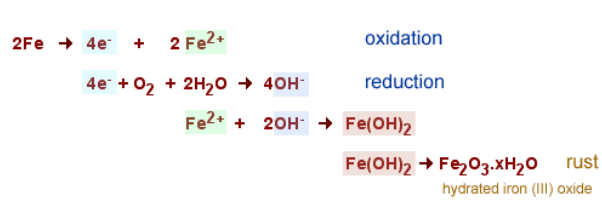
Eq. 8. Equation for Iron Rusting
When food containing fats and oils are exposed to the atmosphere, the oxidation of fat and oil occurs, this is known as Rancidity.
Topic Terminology
Term:
Topic Terminology
Term:
Test Your Learning

Mind Map Overal Idea Content Speed Notes Quick Coverage In order to provide food for a large population – regular production, proper management and distribution of food is necessary. (Scroll down till end of the page) Study Tools Audio, Visual & Digital Content Crop : When plants of the same kind are grown and cultivated readmore
Overal Idea
Content
Quick Coverage
In order to provide food for a large population – regular production, proper management and distribution of food is necessary. (Scroll down till end of the page)
Audio, Visual & Digital Content
Crop : When plants of the same kind are grown and cultivated at one place on a large scale,
it is called a crop.
In India, crops can be broadly categorised into two types based on seasons – Rabi and Kharif crops. Sowing of seeds at appropriate depths and distances gives good yield.
Good variety of seeds are sown after selection of healthy seeds.
Sowing is done by seed drills.
Soil needs replenishment and enrichment through the use of organic manure introduction of new crop varieties.
Basic practices of crop production:
(i) Preparation of Soil: One of the most important tasks in agriculture is to
turn the soil and loosen it.
The process of loosening and turning of the soil is
called tilling or ploughing.
(ii) Sowing: Sowing of seeds at appropriate depths and distances gives good yield.
Good variety of seeds is sown after selection of healthy seeds. Sowing is done by seed
drills.
(iii) Adding Manure and Fertilisers Soil needs replenishment and enrichment through the use of organic manure and fertilisers.
Use of chemical fertilisers
fertilisers has increased tremendously with the introduction of new crop varieties.
Fertiliser: The inorganic compounds containing nutrients such as nitrogen, potassium and phosphorus. They are made in the factories.
Example: ammonium sulphate, potash, etc.
Manure: A natural substance prepared from decomposition of plant and animal wastes (cow dung, animal bones, dead leaves, dead insects and vegetable wastes) by t(he action of microbes.
iv) Irrigation : Supply of water to crops at appropriate intervals is called
irrigation. Method of Irrigation:
(a)Tradition methods of Irrigation: Moat, Chain pump, Dheki, Rahat.
(b) Modern methods of Irrigation: Sprinkler system, Drip
(v) Protection from Weeds: Weeding involves removal of unwanted and
uncultivated plants called weeds.
(vi) Harvesting: Harvesting is the cutting of the mature crop manually or by
machines.
(vii) Storage Proper storage of grains is necessary to protect them from pests
and microorganisms.
Harvested food grains normally contain more moisture than
required for storage.
Large scale of storage of grains is done in silos and granaries to
pest like rats and insects.
Farmers store grains in jute bags or metallic bins.
Food is also obtained from animals for which animals are reared.
Topic Terminology
Term
Table:
.
Test Your Learning
Assign | Assess | Analyse
Objective Assessment
List Of Questions With Key, Aswers & Solutions
Back To Learn
Go Back To Learn Again
Mind Map Overal Idea Content Speed Notes Quick Coverage (Scroll down till end of the page) Study Tools Audio, Visual & Digital Content Fractions: 4. A fraction whose numerator is less than the denominator is called a proper fraction. 5. A fraction whose numerator is more than or equal to the denominator is called animproper readmore
Overal Idea
Content
Quick Coverage

(Scroll down till end of the page)
Audio, Visual & Digital Content
Fractions:
4. A fraction whose numerator is less than the denominator is called a proper fraction.
5. A fraction whose numerator is more than or equal to the denominator is called animproper fraction.
6. A combination of a whole number and a proper fraction is called a mixed fraction.
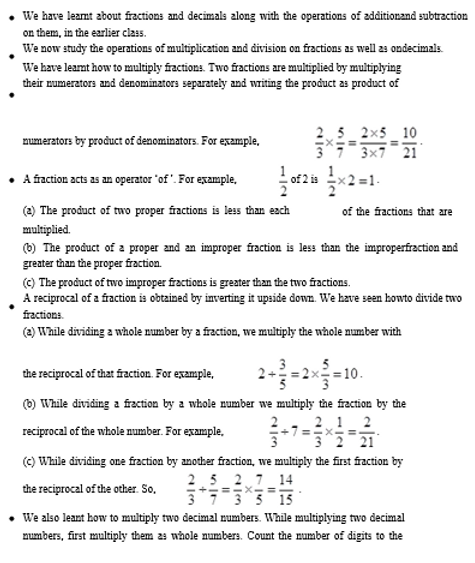
7. To get a fractionequivalent to a given fraction,we multiply (or divide) its numerator and denominator by the same non-zero number.
8. Fractions having the same denominators are called like fractions. Otherwise, they are calledunlike fractions.
9. A fraction is said to be in its lowest termsif its numerator and denominator have no commonfactor other than 1.
10. To compare fractions, we use the followingsteps:
Step I Find the LCMof the denominators of the given fractions.
Step II Converteach fraction to itsequivalent fraction with denominator equal to the LCM obtained in step I.
Step Ill Arrangethe fractions in ascending or descending order byarranging numerators in ascending or descending order.
11. To convert unlike fractions into like fractions, we use the following steps:Step I Find the LCM of the denominators of the given fractions.
Step II Convert each of the given fractions into an equivalent fraction having denominator equal to the LCM obtained in step I.
12. To add (or subtract)fractions, we may use the following steps:Step I Obtain the fractionsand their denominators.
Step II Find the LCMof the denominators.
Step III Convert each fraction into an equivalent fraction having its denominator equal to the LCM obtainedin step II.
Step IV Add (or subtract) like fractions obtained in Step Ill.
Step III Convert each fraction into an equivalent fraction having its denominator equal to the LCM obtainedin step II.
Step IV Add (or subtract) like fractions obtained in Step Ill.

14. Two fractions are said to be reciprocal of each other, if their product is 1. The reciprocal of a non zero fraction a/b is b/a.
15. The divisionof a fraction a/b by a non-zero fraction c/d is the product of a/b with the
reciprocal of c/d.
Decimals:
1. Decimals are an extension of our number system.
2. Decimals are fractionswhose denominators are 10, 100, 1000 etc.
3. A decimal has two parts, namely, the whole numberpart and decimal part.
4. The number of digits containedin the decimal part of a decimal number is known as the numberof decimal places.
5. Decimals having the same number of places are called like decimals, otherwise they are knownas unlike decimals.
6. We have, 0.1 = 0.10 = 0.100 etc, 0.5 = 0.50 = 0.500 etc and so on. That is by annexing zeros on the right side of the extreme right digit of the decimalpart of a number does not alterthe value of the number.
7. Unlike decimals may be converted into like decimals by annexing the requisite numberof zeros on the right side of the extreme right digit in the decimal part.
8. Decimal numbers may be convertedby using the following steps.Step I Obtain the decimalnumbers
Step II Compare the whole partsof the numbers. The number with greater whole part will be greater. If the whole parts are equal, go to next step.
Step Ill Compare the extreme left digits of the decimal parts of two numbers. The number with greater extreme left digit will be greater. If the extreme left digits of decimal parts are equal,then compare the next digits and so on.
9. A decimal can be converted into a fractionby using the following steps:Step I: Obtain the decimal.
Step II: Take the numerator as the number obtained by removing the decimal point from the given decimal.
Step III: Take the denominator as the number obtainedby inserting as many zeros with 1 (e.g.10, 100 or 1000 etc.)as there are number of places in the decimal part.
10. Fractions can be converted into decimals by using the following steps:
Step I: Obtain the fractionand convert it into an equivalent fraction with denominator 10 or 100 or 1000 if it is not so.
Step II: Write its numeratorand mark decimal point after one place or two places or threeplaces from right towards left if the denominator is 10 or 100 or 1000 respectively. If the numerator is short of digits, insert zeros at the left of the numerator.
11. Decimals can be added or subtracted by using the following steps:Step I: Convert the given decimals to like decimals.
Step II: Write the decimals in columns with their decimal pointsdirectly below each other so that tenthscome under tenths, hundredths come and hundredths and so on.
Step III: Addor subtract as we add or subtract whole numbers.
Step IV: Place the decimal point, in the answer, directly below the other decimal points.
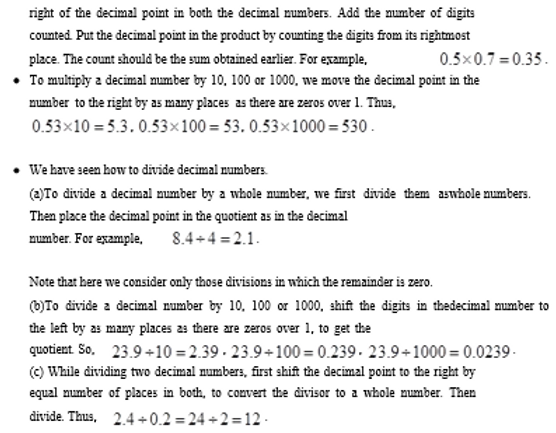
12. In order to multiply a decimal by 10, 100, 1000 etc., we use the following rules:
Rule I: On multiplying a decimal by 10, the decimalpoint is shiftedto the right by one place.
Rule II: On multiplying a decimal by 100, the decimal point is shiftedto the right by two places.
Rule III: On multiplying a decimal by 1000, the decimal point is shiftedto the right by threeplaces, and so on.
13. A decimal can be multiplied by a whole number by using following steps:
Step I: Multiply the decimal without the decimalpoint by the given whole number.
Step II: Mark the decimal point in the product to have as many placesof decimal as are there in the given decimal.
14. To multiply a decimal by another decimal, we follow following steps:
Step I: Multiply the two decimalswithout decimal point just like whole numbers.
Step II: Insert the decimal point in the product by countingas many places from the right to left as the sum of the number of decimalplaces of the given decimals.
15. A decimal can be dividedby 10, 100, 1000 etc by using the followingrules:
Rule I When a decimal is divided by 10, the decimal point is shifted to the left by one place.
Rule II When a decimal is divided by 100, the decimal point is shifted to the left by two places.
Rule III When a decimal is divided by 1000, the decimal point is shiftedto the left by threeplaces.
16. A decimal can be divided by a whole number by using the following steps:Step I: Check the whole number part of the dividend.
Step II: If the wholenumber part of the dividend is less than the divisor,then place a 0 in the onesplace in the quotient. Otherwise, go to step Ill.
Step III: Divide the whole number part of the dividend.
Step IV: Place the decimal point to the right of ones place in the quotient obtained in step I.
Step V: Divide the decimal part of the dividend by the divisor. If the digits of the dividend are exhausted, then place zeros to the right of dividendand remainder each time and continue the process.
17. A decimal can be divided by a decimal by using the following steps:
Step 1 Multiple the dividend and divisor by 10 or 100 or 1000 etc. to convert the divisor into a whole number.
Step II Divide the new dividendby the whole number obtainedin step I.
Extra:
Topic Terminology
Term
Table:
.
Test Your Learning
Assign | Assess | Analyse
Objective Assessment
List Of Questions With Key, Aswers & Solutions
Back To Learn
Go Back To Learn Again
Mind Map Overal Idea Content Speed Notes Quick Coverage Linear Equation in One variable: The expressions which form the equation that contain single variable and the highest power of the variable in the equation is one. (Scroll down till end of the page) Study Tools Audio, Visual & Digital Content Linear Equations in One Variable readmore
Overal Idea
Content
Quick Coverage
Linear Equation in One variable: The expressions which form the equation that contain single variable and the highest power of the variable in the equation is one. (Scroll down till end of the page)
Audio, Visual & Digital Content
Linear Equations in One Variable
An algebraic equation is an equality involving variables. It says that the value of the expression on one side of the equality sign is equal to the value of the expression on the other side.
The equations we study in Classes VI, VII and VIII are linear equations in one variable. In such equations, the expressions which form the equation contain only one variable. Further, the equations are linear, i.e., the highest power of the variable appearing in the equation is 1.
A linear equation may have for its solution any rational number.
An equation may have linear expressions on both sides. Equations that we studied in Classes VI and VII had just a number on one side of the equation.
Just as numbers, variables can, also, be transposed from one side of the equation to the other.
Occasionally, the expressions forming equations have to be simplified before we can solve them by usual methods. Some equations may not even be linear to begin with, but they can be brought to a linear form by multiplying both sides of the equation by a suitable expression.
The utility of linear equations is in their diverse applications; different problems on numbers, ages, perimeters, combination of currency notes, and so on can be solved
using linear equations.
Topic Terminology
Term
Table:
.
Test Your Learning
Assign | Assess | Analyse
Objective Assessment
List Of Questions With Key, Aswers & Solutions
Back To Learn
Go Back To Learn Again
Mind Map Overal Idea Content Speed Notes Quick Coverage Classification based on Eating Habits: Herbivorous: Animals that eat plants or plant products. Example: Cow, sheep, goat, deer, elephant, kangaroo, giraffe, etc. Carnivorous: Animals that eat only flesh of other animals. They never eat plants. Examples: Tiger, lizard, lion, etc. Omnivorous: Animals consume plants as well readmore
Overal Idea
Content
Quick Coverage
Classification based on Eating Habits:
Herbivorous: Animals that eat plants or plant products.
Example: Cow, sheep, goat, deer, elephant, kangaroo, giraffe, etc.
Carnivorous: Animals that eat only flesh of other animals. They never eat plants.
Examples: Tiger, lizard, lion, etc.
Omnivorous: Animals consume plants as well as other animals as their food.
Examples: Bear, dog, human being, etc.
Parasites: Organisms that obtain their food from other animals either by living inside (endoparasites) or outside (ectoparasites) their body.
Examples: Tapeworm and roundworm (inside body), tick and lice (outside body).
Scavengers: Animals which feed on the remains of dead animals preyed by predators. Example: vulture, crows, jackal, etc. (Scroll down till end of the page)
Audio, Visual & Digital Content
The main digestive glands which secrete digestive juices are:
(iii) the pancreas.
The human digestive system consists of the alimentary canal and secretory glands.
It consists of:
Animal nutrition includes nutrient requirement, mode of intake of food and its utilisation in the body.
The stomach wall and the wall of the small intestine also secrete digestive juices.
The modes of feeding vary in different organisms.
Nutrition is a complex process involving:
Digestion of carbohydrates, like starch, begins in the buccal cavity.
The digestion of protein starts in the stomach.
Bile secreted from the liver, the pancreatic juice from the pancreas and the digestive juice from the intestinal wall complete the digestion of all components of food in the small intestine.
The digested food is absorbed in the blood vessels from the small intestine.
The absorbed substances are transported to different parts of the body.
Water and some salts are absorbed from the undigested food in the large intestine.
The undigested and unabsorbed residues are expelled out of the body as faeces through the anus.
The grazing animals like cows, buffaloes and deer are known as ruminants.
They quickly ingest, swallow their leafy food and store it in the rumen.
Later, the food returns to the mouth and the animal chews it peacefully.
Amoeba ingests its food with the help of its false feet or pseudopodia.
The food is digested in the food vacuole.
It pushes out finger-like pseudopodia which engulf the prey.
Topic Terminology
Term
Table:
.
Test Your Learning