
Assessment Tools
Assign | Assess | Analyse
Quick Quiz
Objective Assessment
Question Bank
List Of Questions With Key, Aswers & Solutions
Back To Learn
Re – Learn
Go Back To Learn Again
Board Level
Assign | Assess | Analyse
Objective Assessment
List Of Questions With Key, Aswers & Solutions
Back To Learn
Go Back To Learn Again
Mind Map Overal Idea Content Speed Notes Quick Coverage The taste of the food is due to the presence of acids and bases in them. Acids Content Study Tools Audio, Visual & Digital Content ACIDS, BASES AND SALTS | FULL NOTES The taste of the food is due to the presence of acids and bases… readmore
Overal Idea
Content
Quick Coverage
The taste of the food is due to the presence of acids and bases in them.
Content
Audio, Visual & Digital Content
The taste of the food is due to the presence of acids and bases in them.
1. Reaction of Acid with Metal
Acid + Metal → Salt + Hydrogen gas
Mg + H2SO4 → H2 + MgSO4
2. Reaction of Acid with Carbonates
Na2CO3 (s) + 2 HCl (aq) → 2NaCl (aq) + H2O(l) + CO2(g)
3. Reaction of Acid with Bicarbonates
NaHCO3 (s) + HCl (aq) → NaCl(aq) + H2O (l) + CO2 (g)
Acids are classified as Organic Acids and Mineral Acids. Acids which are derived from plants and animals, they are known as Organic Acids.
Example, Citric Acid from fruit.
Mineral acids are inorganic acids such as Sulphuric Acid. They are dangerous to be used, so need more precautions.
Acids are also classified as Strong Acids or Weak Acids. Strong acid is an acid that completely dissociates into ions in aqueous solutions. For Example, Sulphuric Acid, Hydrochloric Acid.

Weak acid is the one which does not dissociate completely into ions in aqueous solutions. For Example, Acetic Acid.

Acids can also be as Dilute Acid and Concentrated Acids. The one which has low concentration of acids in aqueous solution, they are known as Dilute Acids whereas the one which has high concentration of acids in aqueous solution, are known as Concentrated Acids.
It is advisable to add acid to water and not vice versa because a large amount of heat is released if water is added to acid. This released heat is large enough to cause harm.
Acids can also be classified based on the number of hydrogen ions. Monoprotic acid is the one which gives one mole of hydrogen ions per mole of acid, such as HCl. Diprotic Acid is the one which produces two mol of hydrogen ions per mole of acid. For Example, H2SO4.
1. Reaction with Metals
Base reacts with metals and produces hydrogen gas.
2NaOH + Zn → Na2 → Na2ZnO2 + H2
2. Reaction with Acids
Base reacts with acids to form salts. For Example,
KOH + HCl → KCl + H2O
3. Reaction with Non-metallic Oxides
Base reacts with non-metallic oxides to form salt and water.
2NaOH + CO2 → CO2 → Na2CO3 + H2O
Bases are classified as Strong Base and Weak Base. Strong base is the one which dissociates completely into its ions in aqueous solution. For Example, NaOH.
Weak base is the one which does not dissociate completely into its ions in aqueous solutions. For Example, Ammonium Hydroxide, NH4OH
Bases are also classified as Dilute Base and Concentrated Base. The solution which has low concentration of base in aqueous solution is defined as Dilute Base whereas the one which has high concentration of base in aqueous solution is known as Concentrated Base.
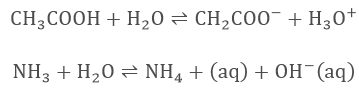
The dissociation constant of weak acid or weak base can be represented as-
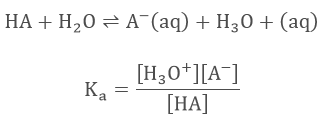
Suppose HA is weak acid, then dissociation constant is represented as-
Strength of an acid or base can be determined using a pH scale. It is a scale to measure the hydrogen ion concentration in a solution. The p stands for ‘potenz’, it is a German word which means power.
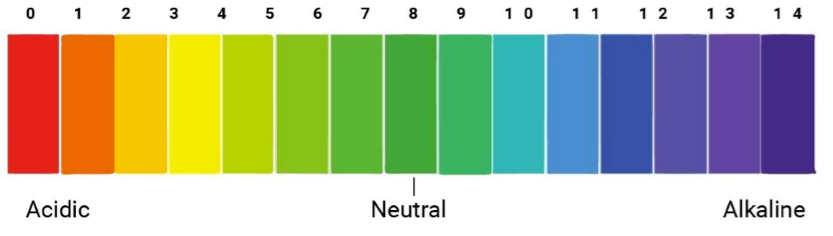
Fig.1. pH scale
When acid and base neutralise, salts are formed. Strong acid and strong base combine to form neutral salt.
NaOH + HCl → NaCl + H2O
Eq.1. Formation of Neutral Salt
Strong acid and weak base combine to form acidic salt. For Example, Hydrochloric Acid and ammonium hydroxide combine to form ammonium chloride. Other examples, sodium hydrogen carbonate, sodium hydrogen sulphate etc.
HCl + NH4OH → NH4Cl + H2O
Eq.2. Formation of Acidic Salt
Similarly, weak acid and strong base combine to form basic salt. For Example, Acetic Acid and sodium hydroxide combine to form sodium acetate. Other examples are calcium carbonate, potassium cyanide etc.
CH3COOH + NaOH → CH3COONa + H2O
Eq.3. Formation of Basic Salt
The most common salt is table salt or sodium chloride (NaCl).
They are the substances that indicate acidic or basic nature of the solution using colour change. For Example, litmus solution, methyl orange, phenolphthalein, methyl red etc. Acids convert blue litmus paper red in colour. Bases turn red litmus blue. Phenolphthalein remains colourless in presence of acids but turns pink in presence of bases.
| Salt | Preparation | Uses |
| Common Salt (Sodium Chloride) (NaCl) | 1. NaOH + HCl → NaCl + H2O2. From sea water by evaporation3. From underground deposit{Large crystals of common salt found in underground deposits which are brown due to presence of impurities in it. It is mined from underground deposits like coal.} | 1. Raw material for making large numbers of useful chemicals in industry. Eg: NaOH (caustic soda), Na2CO3 (washing soda), NaHCO3 (baking soda).2. Preservative in pickle and curing meat and fish.3. To melt ice and clear roads in winters in cold countries.4. Used in the manufacturing of soap. |
| Caustic Soda (NaOH)(Sodium Hydroxide) | Passing electricity through concentrated solution of NaCl (called ‘brine’) 2NaCl (Brine) + 2H2O 2NaOH (Caustic Soda) + Cl2 + H2At anode (+ve electrode): Cl2 is producedAt cathode (-ve electrode): H2 is producedIt is called chloro-alkali process because products formed are chlorine (Chloro) and NaOH (alkali). 2NaCl (Brine) + 2H2O 2NaOH (Caustic Soda) + Cl2 + H2At anode (+ve electrode): Cl2 is producedAt cathode (-ve electrode): H2 is producedIt is called chloro-alkali process because products formed are chlorine (Chloro) and NaOH (alkali). | Uses of H21. Hydrogenation of oil to get vegetable ghee (margarine)2. To make ammonia for fertilisers3. In fuel for rockets.Uses of Cl21. In water treatment2. To clean water in swimming pools3. To make plastic, e.g. PVC4. To make CFCs, chloroform, dyes etc.Uses of NaOH1. Used in making soap and detergent.2. Used in manufacturing of paper3. De-greasing metals4. Refining oil5. Making dyes and bleachesUses of HCl1. Cleaning steel2. Preparation of chloride, e.g. NH4Cl3. In making medicines and cosmetics4. In making plastics, PVC etc. |
| Baking Soda (NaHCO3)(Sodium Hydrogen Carbonate) | NaCl + NH3 + H2O + CO2 → NaHCO3 + NH4ClPropertiesAction of Heat: | 1. Used as antacid in medicine to remove acidity of the stomach2. Used in making baking powder (Basic soda + tartaric acid)NaHCO3 + H⊕ (from mild acid) → Na⊕ (sodium salt of acid) + CO2 + H2OThe CO2 produced during the process gets trapped in wet dough and bubbles out slowly to make the cake ‘rise’ so that it becomes soft and spongy.Tartaric acid neutralises it, and so it has a pleasant taste.3. Used in soda-acid fire extinguisher |
| Washing Soda (Na2CO3.10H2O)(Sodium Carbonate) | Na2CO3 + 10 H2O → Na2CO3.10H2OPreparation of Na2CO3{NaCl + NH3 + H2O + CO2 NaHCO3 + NH4ClNaHCO3 → Na2CO3 + CO2 + H2O} | 1. Used in glass, soap and paper industries2. Used in manufacturing of sodium compounds such as Borax3. Cleaning agent for domestic purpose4. Remove permanent hardness of water |
| Bleaching Powder (CaOCl2)Calcium Oxychloride | Ca(OH)2 + Cl2 → CaOCl2 + H2OSlaked Lime Calcium OxychloridePropertiesCaOCl2 + H2SO4 → CaSO4 + Cl2 + H2OThe Cl2 produced by action of dilute acid acts as a bleaching agent. | 1. For bleaching cotton and linen in textile industry, for bleaching wood pulp in paper factories, for bleaching washed clothes in laundry2. Oxidising agent in chemical industries3. Disinfecting drinking water |
| Plaster of Paris (P.O.P) (CaSO4.1/2 H2O)(Calcium Sulphate Hemihydrate) |  CaSO4.H2O (Plaster of Paris) +3/2 H2O* Heating of gypsum should not be done above 100oC as above that temperature, water of crystallisation will be eliminated and anhydrous CaSO4 will be obtained. This anhydrous CaSO4 is known as Dead Burnt Plaster.* CaSO4.1/2 H2O means that two molecules of CaSO4 share one molecule of water.PropertiesHas the remarkable property of setting into a hard mass on wetting with water, as gypsum is formed.CaSO4.1/2 H2O (P.O.P) + 1/2 H2O → CaSO4.2H2O (Gypsum set as hard mass)Hence, P.O.P should be stored in moisture-proof containers as moisture can cause slow setting of P.O.P by hydrating it. CaSO4.H2O (Plaster of Paris) +3/2 H2O* Heating of gypsum should not be done above 100oC as above that temperature, water of crystallisation will be eliminated and anhydrous CaSO4 will be obtained. This anhydrous CaSO4 is known as Dead Burnt Plaster.* CaSO4.1/2 H2O means that two molecules of CaSO4 share one molecule of water.PropertiesHas the remarkable property of setting into a hard mass on wetting with water, as gypsum is formed.CaSO4.1/2 H2O (P.O.P) + 1/2 H2O → CaSO4.2H2O (Gypsum set as hard mass)Hence, P.O.P should be stored in moisture-proof containers as moisture can cause slow setting of P.O.P by hydrating it. | 1. Used in hospital for setting fractured bones in the right position to ensure correct healing.2. Making toys, decorative materials, cheap ornaments, and casts of statues.3. Used as fire-proofing material4. Used in chemistry labs for setting air gaps in apparatus.5. Making smooth surfaces, such as For making ornamental designs on ceilings of houses and other buildings |
Topic Terminology
Term:
Topic Terminology
Term:
Test Your Learning
Assign | Assess | Analyse
Objective Assessment
List Of Questions With Key, Aswers & Solutions
Back To Learn
Go Back To Learn Again
Assign | Assess | Analyse
Objective Assessment
List Of Questions With Key, Aswers & Solutions
Back To Learn
Go Back To Learn Again
Mind Map Overal Idea Content Speed Notes Quick Coverage The collection, recording and presentation of data help us organiseour experiences and draw inferences from them. Before collecting data we need to know what we would use it for. The data that is collected needs to be organised in a propertable, so that it becomeseasy to… readmore
Overal Idea
Content
Quick Coverage
The collection, recording and presentation of data help us organiseour experiences and draw inferences from them.
Before collecting data we need to know what we would use it for.
The data that is collected needs to be organised in a propertable, so that it becomeseasy to understand and interpret (Scroll down till end of the page)
Audio, Visual & Digital Content
Average is a numberthat represents or shows the central tendencyof a group of observations or data.
Arithmetic mean is one of the representative values of data.
Mean = sum of all observations/ Number of observations.
Mode is another form of central tendency or representative value.
The mode of a set of observations is the observation that occurs most often.
If each of the value in a data is occurring one time, then all are mode.
Sometimes we also say that this data has no mode since none of them is occurring frequently.
Median is also a form of representative value.
It refers to the value which lies in the middle of the data with half of the observations above it and the other half below it.

.
A bar graph is a representation of numbers using bars of uniform widths.
Double bar graphshelp to comparetwo collections of data at a glance.
Double bar graphshelp to comparetwo collections of data at a glance.
There are situations in our life, that are certain to happen, some that are impossible and some that may or may not happen.
The situation that may or may not happen has a chanceof happening.
Probability: A branch of mathematics that is capable of calculating the chance or likelihood of an event taking place (in percentage terms).
If you have 10 likelihoods and you want to calculate the probability of 1 event taking place,it is said that its probability is 1/10 or event has a 10% probability of taking place.
Events that have many possibilities can have probability between 0 and 1.
Important Formulae – Data Handling
1. A trial is anaction which results in one or several outcomes. 2. An experiment in whichthe result ofa trial cannot be predicted inadvance is called a random experiment.
3. An event associated to a random experiment is thecollection of someoutcomes of theexperiment.
4. An event associated witha random experiment is said tohappen if anyone of theoutcomes satisfying thedefinition of theevent is anoutcome of theexperiment when it is performed.
5. The Empirical probability ofhappening of an event E is defined as: P(E)= Number of trials in which the event happened/ Total number of trials.
Topic Terminology
Term
Table:
.
Test Your Learning
Assign | Assess | Analyse
Objective Assessment
List Of Questions With Key, Aswers & Solutions
Back To Learn
Go Back To Learn Again
Mind Map Overal Idea Content Speed Notes Quick Coverage Heat: It is a form of energy, which makes any object hot or cold. The materials which allow heat to pass through them easily are conductors of heat. The materials which do not allow heat to pass through them easily are called insulators. Temperature: The degree… readmore
Overal Idea
Content
Quick Coverage
Heat: It is a form of energy, which makes any object hot or cold.
The materials which allow heat to pass through them easily are conductors of heat.
The materials which do not allow heat to pass through them easily are called insulators.
Temperature: The degree of hotness of an object is called temperature.
Heat is the cause of temperature.
Our sense of touch is not reliable to measure the temperature. (Scroll down till end of the page)
Audio, Visual & Digital Content
Heat:
It is a form of energy, which makes any object hot or cold.
Temperature: The degree of hotness of an object is called temperature. Our sense of touch is not reliable to measure the temperature.
Thermometer is a device used for measuring temperatures.
Heat is the cause of temperature.
Clinical thermometer is used to measure our body temperature.
Transfer of Heat: Heat flows from a hotter object to a colder object until both objects reach the same temperature.
The heat flows from a body at a higher temperature to a body at a lower temperature.
There are three ways in which heat can flow from one object to another.
These are conduction, convection and radiation.
Conduction: It is the process by which heat is transferred from the hotter end to the colder and end of an object.
Convection: It is the flow of heat through a fluid from places of higher temperature to places of lower temperature by movement of the fluid itself.
Radiation: It is the mode of transfer of heat in which energy is directly transferred from one place to another.
It does not need any material medium.
Dark-coloured objects absorb radiation better than the light-coloured objects.
That is the reason we feel more comfortable in light-coloured clothes in the summer.
Woollen clothes keep us warm during winter.
It is so because wool is a poor conductor of heat and it has air trapped in between the fibres.
Thermometer:
Thermometer is a device used for measuring temperatures.
Clinical thermometer:
Clinical thermometer is used to measure our body temperature.
A thermometer used to measure the temperature of our body is called a clinical thermometer.
For other purposes, we use the laboratory thermometers.
The range of these thermometers is usually from –10°C to 110°C.
The normal temperature of the human body is 37°C.
It consists of a long, narrow, uniform glass tube with a bulb containing mercury at one end.
There is a kink near the bulb.
The range of clinical thermometer is from 35°C to 42°C. (Or from 94°F to 108°F).
Laboratory Thermometer:
Laboratory Thermometer: It is a thermometer used to measure the temperature of objects other than our body.
It consists of a column of mercury enclosed in a glass casing.
The column is continuous without any kink.
It measures a range of temperature from -10˚C to 110˚C.
Sea Breeze:
Sea Breeze: Durign the day, the land heats up faster than the sea.
Warm air above the land rises and cold air from sea takes its place.
Warm air from the land moves towards the sea to compele the cycle.
This produces a sea breeze from the sea to the land.
Land Breeze:
Land Breeze: At night the land cools faster than sea.
The warm air above the sea rises.
This warm air is replaced by colder air from the land producing a land breeze.
Topic Terminology
Term
Table:
.
Test Your Learning
Assign | Assess | Analyse
Objective Assessment
List Of Questions With Key, Aswers & Solutions
Back To Learn
Go Back To Learn Again
Mind Map Overal Idea Content Speed Notes Quick Coverage Micro-organisms: Micro-organisms are too small and are not visible to the un aided eye. They can survive under all types of environment, ranging from ice cold climate to hot springs and deserts to marshy lands. They are also found inside the bodies of animals including humans.… readmore
Overal Idea
Content
Quick Coverage
Micro-organisms: Micro-organisms are too small and are not visible to the un aided eye.
They can survive under all types of environment, ranging from ice cold climate to hot springs and deserts to marshy lands.
They are also found inside the bodies of animals including humans. (Scroll down till end of the page)
Audio, Visual & Digital Content
Micro-organisms are found in air, water and in the bodies of plants and animals.They may be unicellular or multicellular.
Micro-organisms are classified into four major groups. These groups are bacteria,fungi, protozoa and some algae.
Viruses are quite different from other micro-organisms. They reproduce only inside
Micro-organisms: Friend and Foe
Based on the significance, micro-organisms can be useful or harmful.


Uses Of Microorganisms
Protozoan cause serious diseases like dysentery and malaria.
Some bacteria and blue green algae present in the soil fix nitrogen from the atmosphere and convert into nitrogenous compounds.
Certain bacteria convert compounds of nitrogen present in the soil into nitrogen gas which is released to the atmosphere.
Pathogens: Some of the microorganisms cause diseases animals. Such disease causing microorganisms are called pathogens.
Cleaning of Environment: The microorganisms decompose dead organic waste
of plants and animals converting them into simple substances. These substances are again used by other plants and animals.
Microorganisms can be used to degrade theharmful and smelly substances and thereby clean up the environment.
Topic Terminology
Term
Table:
.
Test Your Learning