
Assessment Tools
Assign | Assess | Analyse
Quick Quiz
Objective Assessment
Question Bank
List Of Questions With Key, Aswers & Solutions
Back To Learn
Re – Learn
Go Back To Learn Again
Board Level
Assign | Assess | Analyse
Objective Assessment
List Of Questions With Key, Aswers & Solutions
Back To Learn
Go Back To Learn Again
Assign | Assess | Analyse
Objective Assessment
List Of Questions With Key, Aswers & Solutions
Back To Learn
Go Back To Learn Again
Mind Map Overal Idea Content Speed Notes Quick Coverage Elements are classified as metals and non-metals based on different properties. The properties of metals and non-metals are given in the form of table below- Metals Non-metals Metals are lustrous, that is, they have a property to shine. They are not lustrous, that is, they do… readmore
Overal Idea
Content
Quick Coverage
Elements are classified as metals and non-metals based on different properties. The properties of metals and non-metals are given in the form of table below-
| Metals | Non-metals |
| Metals are lustrous, that is, they have a property to shine. | They are not lustrous, that is, they do not have shining surface. except, graphite and iodine |
| All metals exist as solids except mercury which is liquid at room temperature. | They are generally soft, except diamond. |
| They can be drawn into wires, this is known as Ductility. | They are non-ductile. |
| Metals can be converted into sheets, this is known as Malleability, except mercury | They are non-malleable |
| They are good conductors of electricity and heat. Except Lead and mercury. | They are poor conductors of electricity and heat. Exception-graphite is good conductor of electricity |
| They have high density and high melting point. Exception-sodium and potassium have low melting points | They have low density compared to metals and low melting point except Diamond which has high melting point |
Audio, Visual & Digital Content
Elements are classified as metals and non-metals based on different properties. The properties of metals and non-metals are given in the form of table below-
| Metals | Non-metals |
| Metals are lustrous, that is, they have a property to shine. | They are not lustrous, that is, they do not have shining surface. except, graphite and iodine |
| All metals exist as solids except mercury which is liquid at room temperature. | They are generally soft, except diamond. |
| They can be drawn into wires, this is known as Ductility. | They are non-ductile. |
| Metals can be converted into sheets, this is known as Malleability, except mercury | They are non-malleable |
| They are good conductors of electricity and heat. Except Lead and mercury. | They are poor conductors of electricity and heat. Exception-graphite is good conductor of electricity |
| They have high density and high melting point. Exception-sodium and potassium have low melting points | They have low density compared to metals and low melting point except Diamond which has high melting point |
For Example, Copper reacts with oxygen to form copper oxide.
Metal + O2 → Metal oxide
2Cu + O2 → 2CuO
4Al + 3O2 → 2Al2O3
Al2O3 + 6HCl → 2AlCl3 + H2O

2Na + 2H2O → 2NaOH + 1H2
2Al + 3H2O → Al2O3 + 3H2
Metal + Acid → Metal Salt + Hydrogen
Mg + 2HCl → MgCl2 + H2
Non-metal + Oxygen → Non-metal oxide
C + O2 → CO2
2 NaBr (aq) + Cl2(aq) → 2NaCl (aq) + Br2 (aq)
H2(g) + S(l) → H2S(g)
The series in which metals are arranged in the decreasing order of reactivity, it is known as Reactivity Series.

Fig.1. Reactivity Series
Compounds formed due to the transfer of electrons from a metal to a non-metal are known as Ionic Compounds.

Bond formed by sharing of electrons between the two atoms. They share their valence electrons to gain stability.
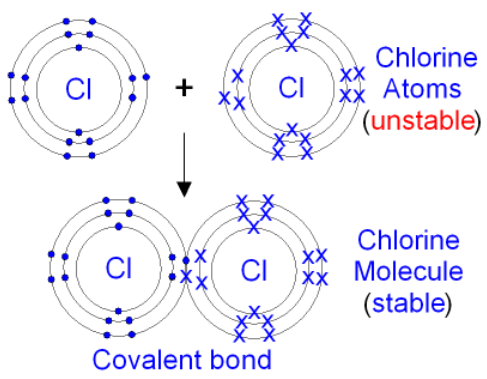
Elements or compounds which occur naturally in earth crust are known as Minerals. Minerals from which pure metals can be extracted are known as Mineral Ores.
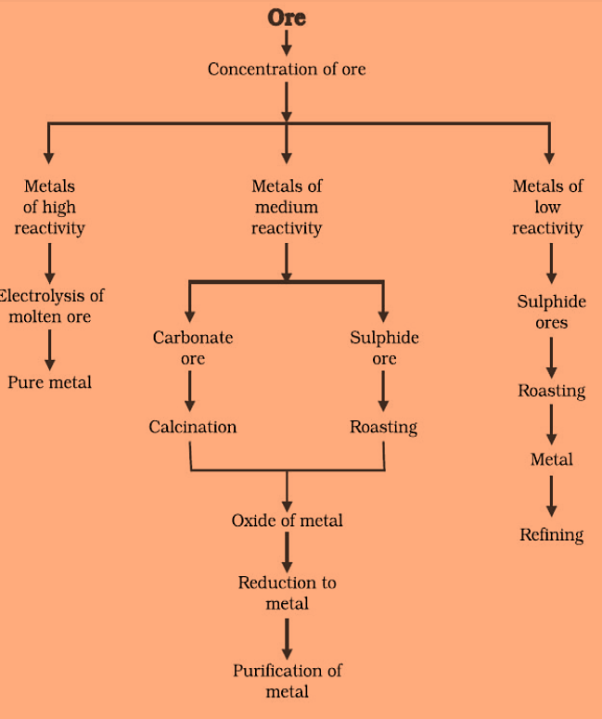
Extraction of pure metals from its ores/steps for extraction of metals from its ore
Gangue – Ores contain different impurities in it such as sand, soil etc. These impurities are known as Gangue.
Extracting Metals which are low in activity series
Metals which are low in activity series are unreactive. The oxides of such metals can be reduced to metals by heating alone. For Example, Cinnabar (HgS)
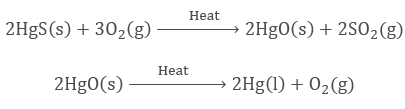
Extracting Metals in the middle of the Activity Series
These metals are moderately reactive. They exists as sulphides or carbonates in nature. Before reduction, metal sulphides and carbonates must be converted into metal oxides. Sulphide ores are converted into oxides by heating strongly in presence of excess air, this is known as Roasting. Carbonate ores are converted into oxides by heating in limited air. This is known as Calcination.
Roasting

Calcination

Reduction-metal oxides can be reduced to metals using reducing agent such as such as Carbon.
Extracting metals towards the top of the activity series
The metals are highly reactive. They cannot be obtained by heating. For Example, Sodium, magnesium and calcium are obtained by the electrolysis of their molten chlorides.
At cathode Na+ + e– → Na
At anode 2Cl– → Cl2 + 2e–
Refining of impure metal is done using electrolytic refining. Impure copper is used as anode and strip of pure copper is used as Cathode. Acidified copper sulphate is used as electrolyte. When electric current is passed through this, impure metal from the anode gets deposited in the electrolyte solution, whereas pure metal from the electrolyte is deposited at cathode.
Deposition of insoluble residue formed from the dissolution of anode during commercial electrolysis.
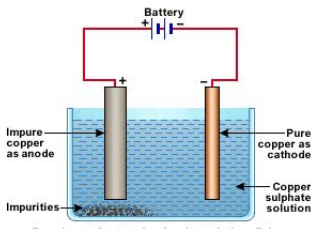
Electrolytic refining
Metals when exposed to moist air for a long period of time, they become corroded. This is known as Corrosion. For Example, Silver reacts with moist air and becomes black in colour due to silver sulphide coating.
Iron + oxygen → Iron (III) oxide
Fe + O 2 → Fe2O3
Mixture of two or more metals or metal and non-metal is known as Alloy. For Example,
Topic Terminology
Term:
Topic Terminology
Term:
Test Your Learning
Assign | Assess | Analyse
Objective Assessment
List Of Questions With Key, Aswers & Solutions
Back To Learn
Go Back To Learn Again
Assign | Assess | Analyse
Objective Assessment
List Of Questions With Key, Aswers & Solutions
Back To Learn
Go Back To Learn Again
Assign | Assess | Analyse
Objective Assessment
List Of Questions With Key, Aswers & Solutions
Back To Learn
Go Back To Learn Again
Mind Map Overal Idea Content Speed Notes Quick Coverage Content : (Scroll down till end of the page) Study Tools Audio, Visual & Digital Content Content … Key Terms Topic Terminology Term Important Tables Table: . Assessments Test Your Learning readmore
Overal Idea
Content
Quick Coverage
Content : (Scroll down till end of the page)
Audio, Visual & Digital Content
Content …
Topic Terminology
Term
Table:
.
Test Your Learning
Assign | Assess | Analyse
Objective Assessment
List Of Questions With Key, Aswers & Solutions
Back To Learn
Go Back To Learn Again
Mind Map Overal Idea Content Speed Notes Quick Coverage An equation isa condition ona variable suchthat two expressions in the variable should have equalvalue. Thevalue of thevariable for whichthe equation issatisfied is called the solution ofthe equation. An equation remains the same if the LHSand the RHSare interchanged. (Scroll down till end of the page)… readmore
Overal Idea
Content
Quick Coverage
An equation isa condition ona variable suchthat two expressions in the variable should have equalvalue.
Thevalue of thevariable for whichthe equation issatisfied is called the solution ofthe equation.
An equation remains the same if the LHSand the RHSare interchanged. (Scroll down till end of the page)
Audio, Visual & Digital Content
In case ofthe balanced equation, if we add the same number to both thesides, or subtract the same number from both the sides,
or
multiply both sidesby the same number, or divide both sidesby the samenumber, the balance remains un disturbed,
i.e.,the value of the LHS remains equal to the value of the RHS The above property gives a systematic method of solving an equation.
We carry out a series of identical mathematical operations on the two sides of the equation in such a waythat on oneof the sides we get justthe variable. Thelast step isthe solution of the equation.
Transposing means moving to the other side.
Transposition of a number has the same effect as adding same number to (or subtracting the same number from) both sides of the equation.
Whenyou transpose a number fromone side ofthe equation tothe other side, you change itssign.
For example, transposing +3 fromthe LHS tothe RHS in equation x + 3 = 8 gives x = 8 – 3 (= 5).
We can carry out the transposition of an expression in thesame way as the transposition of a number.
We havelearnt how to construct simple algebraic expressions corresponding to practical situations.
Wealso learnt how,using the technique of doing thesame mathematical operation (for example adding the samenumber) on bothsides, we could build an equation starting fromits solution.
Further, we also learnt that we could relate a given equation tosome appropriate problem/puzzlefrom the equation. practical situation and build a practical word.
Topic Terminology
Term
Table:
.
Test Your Learning