Mind Map Overal Idea Content Speed Notes Quick Coverage Micro-organisms: Micro-organisms are too small and are not visible to the un aided eye. They can survive under all types of environment, ranging from ice cold climate to hot springs and deserts to marshy lands. They are also found inside the bodies of animals including humans. readmore
Mind Map
Overal Idea
Content
Speed Notes
Quick Coverage
Micro-organisms: Micro-organisms are too small and are not visible to the un aided eye.
They can survive under all types of environment, ranging from ice cold climate to hot springs and deserts to marshy lands.
They are also found inside the bodies of animals including humans. (Scroll down till end of the page)
Study Tools
Audio, Visual & Digital Content
Micro-organisms are found in air, water and in the bodies of plants and animals.They may be unicellular or multicellular.
Micro-organisms are classified into four major groups. These groups are bacteria,fungi, protozoa and some algae.
Viruses are quite different from other micro-organisms. They reproduce only inside
Micro-organisms: Friend and Foe
Based on the significance, micro-organisms can be useful or harmful.
Uses Of Microorganisms
Protozoan cause serious diseases like dysentery and malaria.
Some bacteria and blue green algae present in the soil fix nitrogen from the atmosphere and convert into nitrogenous compounds.
Certain bacteria convert compounds of nitrogen present in the soil into nitrogen gas which is released to the atmosphere.
Pathogens: Some of the microorganisms cause diseases animals. Such disease causing microorganisms are called pathogens.
Cleaning of Environment: The microorganisms decompose dead organic waste of plants and animals converting them into simple substances. These substances are again used by other plants and animals.
Microorganisms can be used to degrade theharmful and smelly substances and thereby clean up the environment.
Mind Map Overal Idea Content Speed Notes Quick Coverage Content : (Scroll down till end of the page) Study Tools Audio, Visual & Digital Content Content … Key Terms Topic Terminology Term Important Tables Table: . Assessments Test Your Learning readmore
Mind Map Overal Idea Content Speed Notes Quick Coverage Content Study Tools Content … Key Terms Topic Terminology Term: Important Tables Topic Terminology Term: Assessments Test Your Learning readmore
Mind Map Overal Idea Content Speed Notes Quick Coverage Plane figure The figures which we can be drawn on a flat surface or that lie on a plane are called Plane Figure. Example – Circle, Square, Rectangle etc. Solid figures The 3D shapes which occupy some space are called Solid Figures. Example – Cube, Cuboid, readmore
Mind Map
Overal Idea
Content
Speed Notes
Quick Coverage
Plane figure
The figures which we can be drawn on a flat surface or that lie on a plane are called Plane Figure.
Example – Circle, Square, Rectangle etc.
Solid figures
The 3D shapes which occupy some space are called Solid Figures.
Example – Cube, Cuboid, Sphere etc. (Scroll down the till the end of the page)
Study Tools
Volume
Space occupied by any solid shape is the capacity or volume of that figure. The unit of volume is a cubic unit.
Surface Area
The area of all the faces of the solid shape is its total surface area. The unit of surface area is a square unit.
Lateral or Curved Surface Area
The surface area of the solid shape after leaving the top and bottom face of the figure is called the lateral surface of the shape. The unit of lateral surface area is a square unit.
Surface Area and Volume of a Cube
Cube is a solid shape having 6 equal square faces.
Lateral surface area of a cube
4s2
Total surface area of a cube
6s2
The volume of a cube
s3
Diagonal
√3 s, s = edge of the cube = side length of face of cube
Surface Area and Volume of a Cube
Example
What is the capacity of a cubical vessel having each side of 8 cm?
Solution
Given side = 8 cm So, Volume of the cubical vessel = l3 = (8)3 = 256 cm3.
Surface Area and volume of a Cuboid
Cuboid is a solid shape having 6 rectangular faces at a right angle.
Lateral surface area of a cuboid
2h(l + b)
Total surface area of a cuboid
2(lb + bh + lh)
Volume of a cuboid
lbh
Diagonal
l = length, b = breadth, h = height
Surface Area and volume of a Cuboid
Example
What is the surface area of a cereal box whose length, breadth and height is 20 cm, 8 cm and 30 cm respectively?
Solution
Given, length = 20 cm, breadth = 8 cm, Height = 30 cm
Total surface area of the cereal box = 2(lb + bh + lh)
= 2(20 × 8 + 8 × 30 + 20 × 30)
= 2(160 + 240 + 600)
= 2(1000) = 2000 cm2.
Surface Area and Volume of a Right Circular Cylinder
If we fold a rectangular sheet with one side as its axis then it forms a cylinder. It is the curved surface of the cylinder. And if this curved surface is covered by two parallel circular bases then it forms a right circular cylinder.
Curved surface area of a Right circular cylinder
2πrh
Total surface area of a Right circular cylinder
2πr2 + 2πrh = 2πr(r + h)
The volume of a Right circular cylinder
πr2h
r = radius, h = height
Surface Area and Volume of a Right Circular Cylinder
Surface Area and Volume of a Hollow Right Circular Cylinder
If a right circular cylinder is hollow from inside then it has different curved surface and volume.
Curved surface area of a Right circular cylinder
2πh (R + r)
Total surface area of a Right circular cylinder
2πh (R + r) + 2π(R2 – r2)
R = outer radius, r = inner radius, h = height
Surface Area and Volume of a Hollow Right Circular Cylinder
Example
Find the Total surface area of a hollow cylinder whose length is 22 cm and the external radius is 7 cm with 1 cm thickness. (π = 22/7)
Solution
Given, h = 22 cm, R = 7 cm, r = 6 cm (thickness of the wall is 1 cm).
Total surface area of a hollow cylinder = 2πh(R + r) + 2π(R2 – r2)
= 2(π) (22) (7+6) + 2(π)(72 – 62)
= 572 π + 26 π = 598 π
= 1878.67 cm2
Surface Area and Volume of a Right Circular Cone
If we revolve a right-angled triangle about one of its sides by taking other as its axis then the solid shape formed is known as a Right Circular Cone.
Curved surface area of a Right Circular Cone
πrl = πr[√(h2 + r2)]
Total surface area of a Right Circular Cone
πr2 + πrl = πr(r + l)
The volume of Right Circular Cone
(1/3) πr2h
r = radius, h = height, l = slant height
Surface Area and Volume of a Right Circular Cone
Surface Area and Volume of a Sphere
A sphere is a solid shape which is completely round like a ball. It has the same curved and total surface area.
Curved or Lateral surface area of a Sphere
4πr2
Total surface area of a Sphere
4πr2
Volume of a Sphere
(4/3) πr3
R = radius
Surface Area and Volume of a Sphere
Surface Area and Volume of a Hemisphere
If we cut the sphere in two parts then is said to be a hemisphere.
Curved or Lateral surface area of a Sphere
2πr2
Total surface area of a Sphere
3πr2
Volume of a Sphere
(2/3) πr3
r = radius
Surface Area and Volume of a Hemisphere
Example
If we have a metal piece of cone shape with volume 523.33 cm3 and we mould it in a sphere then what will be the surface area of that sphere?
Mind Map Overal Idea Content Speed Notes Quick Coverage A quadrilateral has 10 parts – 4 sides, 4 angles and 2 diagonals. Five measurements can determine a quadrilateral uniquely. (Scroll down till end of the page) Study Tools Audio, Visual & Digital Content Practical Geometry Five measurements can determine a quadrilateral uniquely. A quadrilateral can readmore
A quadrilateral has 10 parts – 4 sides, 4 angles and 2 diagonals. Five measurements can determine a quadrilateral uniquely. (Scroll down till end of the page)
Study Tools
Audio, Visual & Digital Content
Practical Geometry
Five measurements can determine a quadrilateral uniquely.
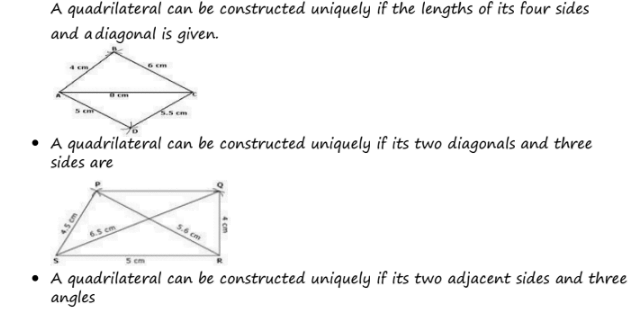
A quadrilateral can be constructed uniquely if the lengths of its four sides and a diagonal is given.
A quadrilateral can be constructed uniquely if its two diagonals and three sides are
known.
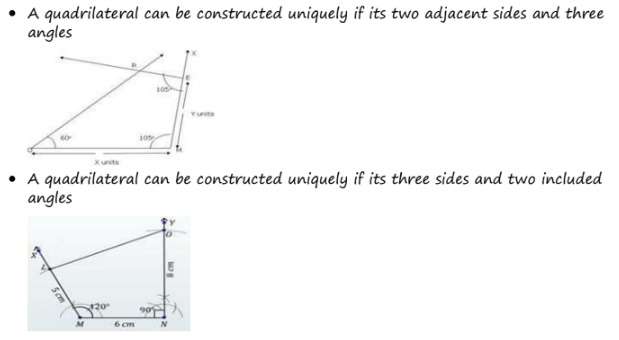
A quadrilateral can be constructed uniquely if its two adjacent sides and three angles
are known.
A quadrilateral can be constructed uniquely if its three sides and two included angles