Tool : Study

Study Toools

  • Heridity | Study

  • INTRODUCTION TO EUCLID’S GEOMETRY | Study

  • Mensuration | Study

  • MOTION | Study

  • Motion and Time | Study

  • Perimeter and Area | Study

  • Perimeter and Area | Study

  • Some Applications of Trigonometry | Study

  • Temperature and its Measurement | Study

  • Heridity | Study

    Mind Map Overal Idea Content Speed Notes Quick Coverage Content Study Tools Audio, Visual & Digital Content Chapter 9 -Heredity and Evolution 1. Accumulation of variation during Reproduction. Variations in an individual may be an advantage or disadvantage for it. It may enable or disable it to cope with changes in the environment. Advantageous variations readmore

    Mind Map

    Overal Idea

    Content

    Speed Notes

    Quick Coverage

    Content

    Study Tools

    Audio, Visual & Digital Content

    Hindi Version

    Content …

    Key Terms

    Topic Terminology

    Term:

    Important Tables

    Topic Terminology

    Term:

    Thumbnail - Study, Assess, Interact
    Advanced Tools For Study Assess Interact
    • INTRODUCTION TO EUCLID’S GEOMETRY | Study

      Mind Map Overal Idea Content Speed Notes Quick Coverage Introduction to Euclid Geometry The necessity of geometry had been felt from ancient times in different parts of the world. The practical problems faced by people of ancient civilization had developed this branch of mathematics. Let us cite few examples. With floods in the river, the readmore

      Mind Map

      Overal Idea

      Content

      Speed Notes

      Quick Coverage

      Introduction to Euclid Geometry The necessity of geometry had been felt from ancient times in different parts of the world. The practical problems faced by people of ancient civilization had developed this branch of mathematics.

      Let us cite few examples.

      With floods in the river, the demarcations of land owners on the river-side land were used to wipe out (Scroll down till end of the page)

      Study Tools

      Audio, Visual & Digital Content

      In order to redraw the boundaries, the idea of area was introduced, the idea of area was introduced.

      The volumes of granaries could be measured by using geometry.

      The existence of Egyptian pyramids indicates the use of geometry from olden times.

      In Vedic period, there was a manual of geometrical construction, known as Sulbasutra’s.

      Different geometrical shapes were constructed as altars to perform various Vedic rites.

      The word Geometry originates from the green word ‘Geo’ (earth) and metrein (to measure) Through Geometry was developed and applied from ancient time in various part the world, it was not presented in a systematic manner.

      Later in 300 BC, the Egyptian mathematician Euclid, collected all the known work and arranged it in a systematic manner.

      ‘Elements’ is a classic treatise in geometry which was written by Euclid.

      This was the most influential book. The ‘element’ was used as a text book for several years in western Europe.

      The ‘elements’ started with 28 definitions, five postulates and five common notions and systematically built the rest of plane and solid geometry.

      The geometrical approach given by Euclid is known as Euclid method.

      The Euclid method consists of making a small set of assumptions and then proving many other proposition from these assumptions.

      The assumptions, made were obvious universal truth. The two types of assumption, made were ‘axioms’ and ‘postulates’.

      Euclid’s Definitions Euclid listed 23 definitions in book 1 of the ‘elements’.

      We list a few of them: 1) 2) 3) 4) 5) 6) 7) A point is that which has no part A line is a breadth less length The ends of a line are points A straight line is a line which lies evenly with the points on itself. A surface is that which has length and breadth only.

      The edges of a surface are lines A plane surface is surface which lies evenly with straight lines on its self. Starting with these definitions, Euclid assumed certain assumptions, known as axioms and postulates.

      Euclid’s Axioms Axioms were assumptions which were used throughout mathematics and are not specifically linked to geometry.

      Few of Euclid’s axioms are:

      1) Things which are equal to the same thing are equal to one another.

      2) It equals are added to equals; the wholes are equal.

      3) 4) 5) 6) 7) If equals are subtracted from equals, the remainders are equal.

      Things which coincide one another are equal to one another.

      The whole is greater than the part Things which are double of the same thing are equal to one another.

      Things which are half of the same things are equal to one another.

      All these axioms refer to magnitude of same kind.

      Axiom – 1 can be written as follows: If x = Z and y = Z, then x = y

      Axiom – 2 explains the following: If x = y, then x + Z = y + Z According to axiom – 3, If x = y, then x – Z = y – Z Axiom – 4 justifies the principle of superposition that every thing equals itself.

      Axiom – 5, gives us the concept of comparison. If x is a part of y, then there is a quantity Z such that x = y + Z or x > y Note that magnitudes of the same kind can be added, subtracted or compared.

      Euclid’s Postulates Euclid used the term postulate for the assumptions that were specific to geometry. Euclid’s five postulates are as follows: Postulate 1: A straight line may be drawn from any one point to any other point. Same may be stated as axiom 5.1 Given two distinct points, there is a unique line that passes through them.

      Postulate 2: A terminated line can be produced indefinitely. Postulate 3: A circle can be drawn with any centre and any radius. Postulate 4: All right angles are equal to one another. Postulate 5: If a straight line falling on two straight lines makes the interior angle on the same side of it taken together less than two right angles, then two straight lines, if produced indefinitely, meet on that side on which the sum of the angles is less than two right angles. Postulates 1 to Postulates 4 are very simple and obvious and therefore they are taken a ‘self evident truths’. Postulates 5 is complex and it needs to be discussed. Suppose the line XY falls on two lines AB and CD such that ∠1 + ∠2 < 180°, then the lines AB and CD will intersect at a point. In the given figure, they intersect on left side of PQ, if both are produced. Note: In mathematics the words axiom and postulate may be used interchangeably, though they have distinct meaning according to Euclid. System of Consistent Axioms A system of axioms is said to be consistent, if it is impossible to deduce a statement from these axioms, which contradicts any of the given axioms or proposition. Proposition or Theorem The statement or results which were proved by using Euclid’s axioms and postulates are called propositions or Theorems. Theorem: Two distinct lines cannot have more than one point in common. Proof: Given: AB and CD are two lines. To prove: They intersect at one point or they do not intersect. Proof: Suppose the lines AB and CD intersect at two points P and Q. This implies the line AB passes through the points P and Q. Also the line CD passes through the points P and Q. This implies there are two lines which pass through two distinct point P and Q. But we know that one and only one line can pass through two distinct points. This axiom contradicts out assumption that two distinct lines can have more than one point in common. The lines AB and CD cannot pass through two distinct point P and Q. Equivalent Versions of Euclid’s Fifth Postulate The two different version of fifth postulate a) For every line l and for every point P not lying on l, there exist a unique line m passing through P and parallel to l. b) Two distinct intersecting lines cannot be parallel to the same line.

      Key Terms

      Topic Terminology

      Term

      Important Tables

      Table:

      .

      Thumbnail - Study, Assess, Interact
      Advanced Tools For Study Assess Interact
      • Mensuration | Study

        Mind Map Overal Idea Content Speed Notes Quick Coverage Perimeter: Length of boundary of a simple closed figure. Perimeter of Rectangle = 2(l +b)Perimeter of Square = 4aPerimeter of Parallelogram = 2(sum of two adjacent sides)Area: The measure of region enclosed in a simple closed figure. Area of a trapezium = half of the sum readmore

        Mind Map

        Overal Idea

        Content

        Speed Notes

        Quick Coverage

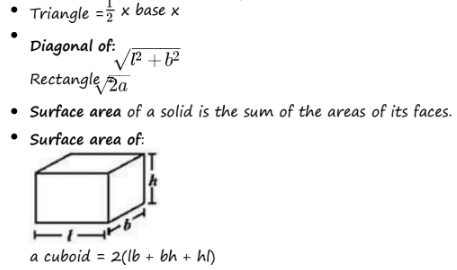
        Perimeter: Length of boundary of a simple closed figure.

        Perimeter of Rectangle = 2(l +b)
        Perimeter of Square = 4a
        Perimeter of Parallelogram = 2(sum of two adjacent sides)
        Area: The measure of region enclosed in a simple closed figure.

        Area of a trapezium = half of the sum of the lengths of parallel sides × perpendiculardistance between them.

        Area of a rhombus = half the product of its diagonals. (Scroll down till end of the page)

        Study Tools

        Audio, Visual & Digital Content

        Hindi Version

        Key Terms

        Topic Terminology

        Term

        Important Tables

        Table:

        .

        Thumbnail - Study, Assess, Interact
        Advanced Tools For Study Assess Interact
        • MOTION | Study

          Mind Map Overal Idea Content Speed Notes Quick Coverage Rest And Motion The terms Rest and Motion are relative. Motion: An object is said to be in motion when its position changes with time. Rest: An object is said to be at rest when its position does not change with respect to a reference point readmore

          Mind Map

          Overal Idea

          Content

          Speed Notes

          Quick Coverage

          Rest And Motion

          The terms Rest and Motion are relative.

          Motion: An object is said to be in motion when its position changes with time.

          Rest: An object is said to be at rest when its position does not change with respect to a reference point with time.

          A specific point with respect to which we describe the location of an object is called a reference point. (Scroll down till end of the page)

          Study Tools

          Audio, Visual & Digital Content

          Distance and Displacement

          • Distance: The total length of path covered by an object is said to be the distance travelled by it.
          • Displacement: Gap between the initial and final positions of an object is said to be its displacement. Or
          • The length of a line segment that joins the initial and final positions of an object is known as the displacement.

          Difference Between Displacement and Displacement

          DistanceDisplacement
          Distance is defined as the total length of the path travelled by an object to go from one point to another.Displacement is defined as the  length of the line segment that joins the initial and final positions of an object.
          Since distance has only magnitude and its direction cannot be specified always, it  is a scalar quantity.Since displacement has magnitude and it  is specified in a direction  from initial position to final position, it is a vector quantity.
          Distance can only have positive values.Displacement can have both positive and negative values.
          Distance depends on the length of the path travelled.Displacement depends only on the initial and final point regardless of the path travelled.
          Difference Between Displacement and Displacement

          Speed And Velocity Speed

          • Speed: The distance travelled by an object in unit time is referred to as speed. 
          • Its S.I unit is m/s. 
          • In general speed refers to average speed.
          • Average speed: For non-uniform motion, the average speed of an object is obtained by dividing the total distance travelled by an object by the total time taken.

          motion-cbse-notes-class-9-science-1

          • For a uniform motion, the average speed of an object is equal to its instantaneous speed throughout the path.

          Velocity

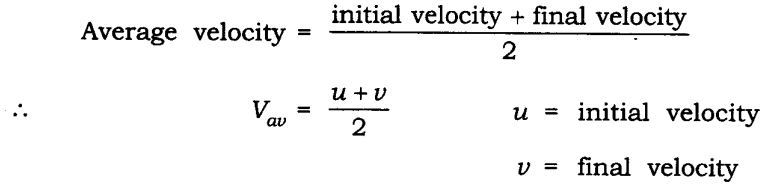
          • Average Velocity or Velocity : For a uniform motion in a straight path, the average velocity is equal to its instantaneous velocity throughout the path.


          motion-cbse-notes-class-9-science-2

          • Velocity of an object is equal to the instantaneous velocity of an object.

          Differences Between Speed and Velocity

                            SPEED                VELOCITY
          It is defined as the rate of change of distance.It is defined as the rate of change of net displacement.
          It is a scalar quantity.It is a vector quantity.
          It can never be negative or zero.It can be negative,zero or positive.
          Speed is velocity without direction.Velocity is directed speed.
          Speed may or may not be equal to velocity.A body may possess different velocities but the same speed.
          Speed never decreases with time. For a moving body,Velocity can decrease with time. For a moving body , it can be zero.
          Speed is never zero.Velocity can be zero.
          Speed in SI is measured in ms-1Velocity in SI, is measured in ms-1
          Differences Between Speed and Velocity

          Uniform And Non-Uniform motion

          • Uniform motion or non accelerated motion: When an object covers equal distances in equal intervals of time, it is said to be in uniform motion. Uniform motion is a non-accelerated motion.
          • Non-uniform motion or accelerated motion: Motions where objects cover unequal distances in equal intervals of time. Uniform motion is an accelerated motion.

          Acceleration

          Acceleration: Change in the velocity of an object per unit time.


          motion-cbse-notes-class-9-science-3

          Graphical representation of motions

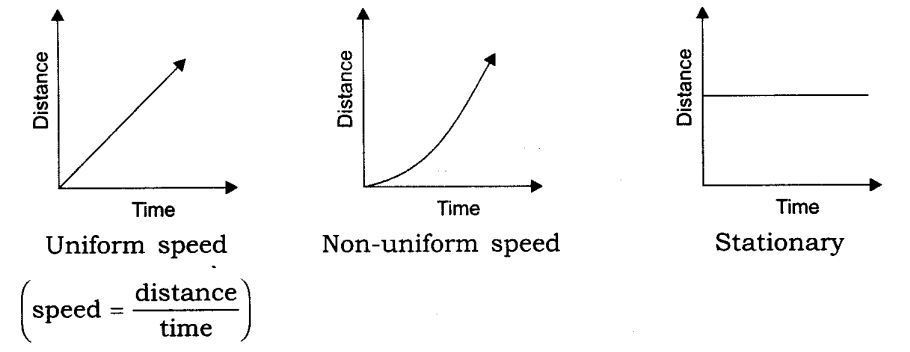
          (i) Distance-time graph

          For a distance-time graph, time is taken on x-axis and distance is taken on the y-axis.


          motion-cbse-notes-class-9-science-4

          [Note: All independent quantities are taken along the x-axis and dependent quantities are taken along the y-axis.]


          motion-cbse-notes-class-9-science-5

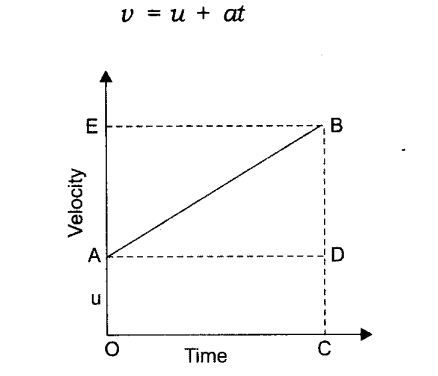
          (ii) Velocity-time graph

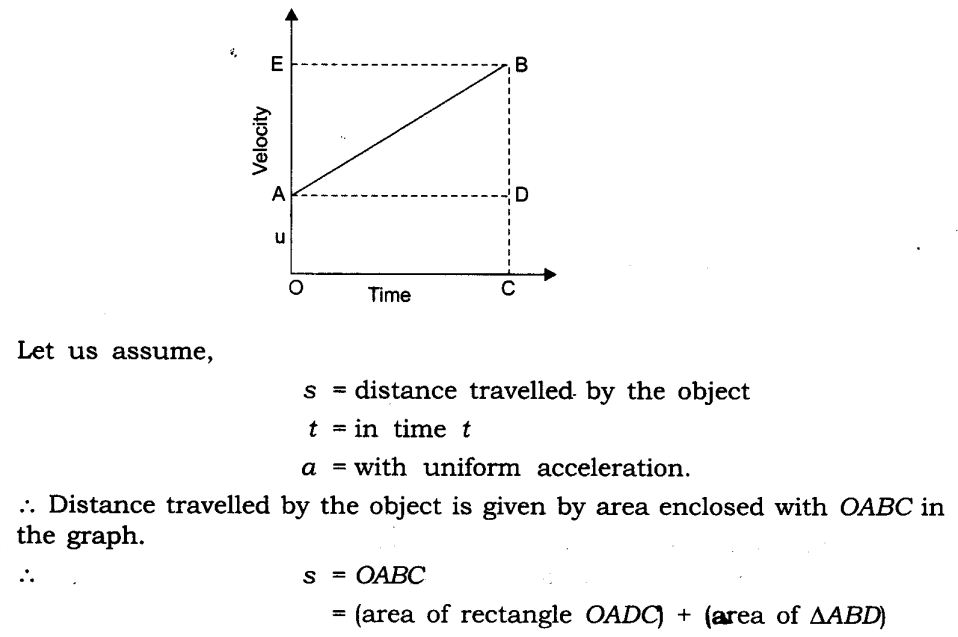
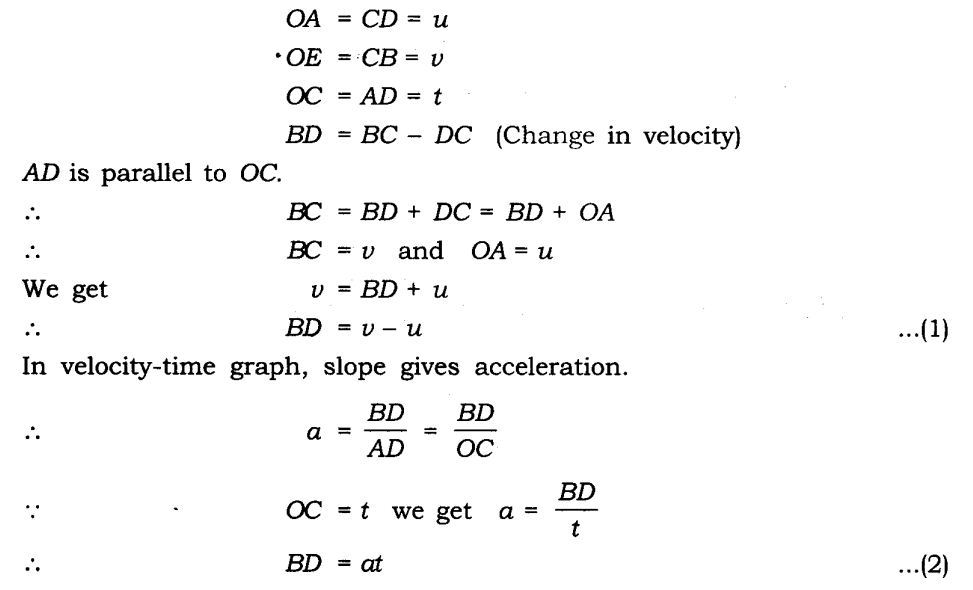
          Equation of motion by graphical methods

          Derivation Of Equations Of Motion

          Equations of motion can be derived by two methods. They are (i) Graphical Method. (ii) Algebraic Method

          Derivation of The Equations of Motion By Algebraic Method:

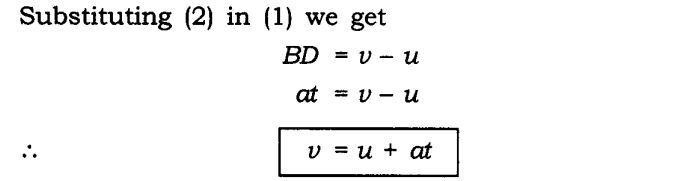
          (a) Velocity-time relation:


          motion-cbse-notes-class-9-science-6


          motion-cbse-notes-class-9-science-8

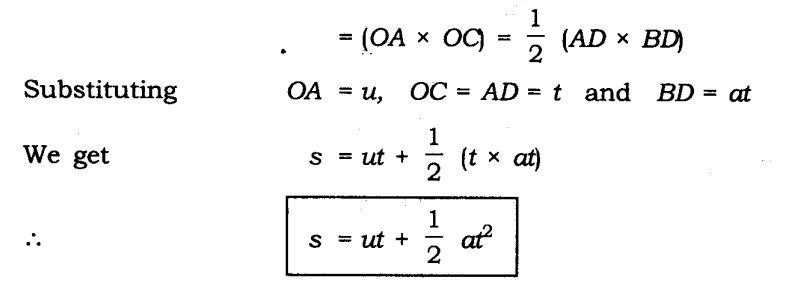
          Derivation of S = ut + ½ at2

          (ii) The equation for position-time relation:

          motion-cbse-notes-class-9-science-9
          motion-cbse-notes-class-9-science-10motion-cbse-notes-class-9-science-7

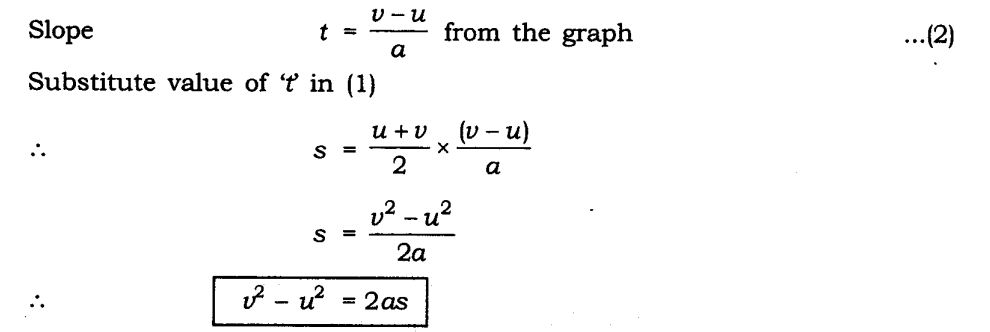
          Derivation of v2 – u2  = 2as

          (iii) Equation for position-velocity relation:


          motion-cbse-notes-class-9-science-11

          motion-cbse-notes-class-9-science-12

          Conclusions From a Distance – Time Graph


          Uniform Circular Motion

          When a body moves in a circular path with uniform speed, its motion is called uniform circular motion.

          Hindi Version

          Key Terms

          Topic Terminology

          Term

          Important Tables

          Table:

          .

          Thumbnail - Study, Assess, Interact
          Advanced Tools For Study Assess Interact
          • Motion and Time | Study

            Mind Map Overal Idea Content Speed Notes Quick Coverage Motion: The action or process of moving or being moved. The distance moved by an object in a unit time is called its speed. Speed of objects help us to decide which one is moving faster than the other. The speed of an object is the readmore

            Mind Map

            Overal Idea

            Content

            Speed Notes

            Quick Coverage

            Motion: The action or process of moving or being moved.

            The distance moved by an object in a unit time is called its speed.

            Speed of objects help us to decide which one is moving faster than the other.

            The speed of an object is the distance travelled divided by the time taken to cover that distance.

            Its basic unit is mere per second (m/s). (Scroll down till end of the page)

            Study Tools

            Audio, Visual & Digital Content

            Periodic events are used for the measurement of time.

            Periodic motion of a pendulum has been used to make clocks and watches.

            Motion of objects can be presented in pictorial form by their distance-time graphs.

            The distance-time graph for the motion of an object moving with a constant speed is a straight line.

            Uniform Motion ANd Non – Uniform Motion:

            1. Uniform motion: An object moving with a constant speed is said to be in uniform motion. The average speed is the same as the actual speed.
            2. Non-Uniform motion: If the speed of a moving object keeps changing, the object is said to be in non-uniform motion.

            Speed: It is the distance covered by an object in a unit time.

            Speed = Total distance/ Total Time

            Basic unit of speed is m/s.

            Distance-Time Graph: Motion of objects can be presented in pictorial form by their distance-time graphs.

            The distance-time graph for the motion of an object moving with a constant speed is a straight line.

            Hindi Version

            Key Terms

            Topic Terminology

            Term

            Important Tables

            Table:

            .

            Thumbnail - Study, Assess, Interact
            Advanced Tools For Study Assess Interact
            • Perimeter and Area | Study

              Mind Map Overal Idea Content Speed Notes Quick Coverage Perimeter is the distance around a closed figure whereasarea is the part of plane occupied by the closedfigure. Area is the measure of the part of plane or regionenclosed by it. (Scroll down till end of the page) Study Tools Audio, Visual & Digital Content We readmore

              Mind Map

              Overal Idea

              Content

              Speed Notes

              Quick Coverage

              Perimeter is the distance around a closed figure whereasarea is the part of plane occupied by the closedfigure.

              Area is the measure of the part of plane or regionenclosed by it. (Scroll down till end of the page)

              Study Tools

              Audio, Visual & Digital Content

              We have learnt how to find perimeter and area of a squareand rectangle earlierclass.

              They are:

              (a) Perimeter of a square = 4 × side

              (b) Perimeter of a rectangle = 2 × (length + breadth)

              (c) Area of a square = side × side

              (d) Area of a rectangle = length × breadth Areaof a parallelogram = base × height

              Hindi Version

              Key Terms

              Topic Terminology

              Term

              Important Tables

              Table:

              .

              Thumbnail - Study, Assess, Interact
              Advanced Tools For Study Assess Interact
              • Perimeter and Area | Study

                Mind Map Overal Idea Content Speed Notes Quick Coverage Content : (Scroll down till end of the page) Study Tools Audio, Visual & Digital Content Content … Key Terms Topic Terminology Term Important Tables Table: . Assessments Test Your Learning readmore

                Mind Map

                Overal Idea

                Content

                Speed Notes

                Quick Coverage

                Content : (Scroll down till end of the page)

                Study Tools

                Audio, Visual & Digital Content

                Content …

                Key Terms

                Topic Terminology

                Term

                Important Tables

                Table:

                .

                Thumbnail - Study, Assess, Interact
                Advanced Tools For Study Assess Interact
                • Some Applications of Trigonometry | Study

                  Mind Map Overal Idea Content Speed Notes Quick Coverage One of the main applications of trigonometry is to find the distance between two or more than two places or to find the height of the object or the angle subtended by any object at a given point without actually measuring the distance or heights or readmore

                  Mind Map

                  Overal Idea

                  Content

                  Speed Notes

                  Quick Coverage

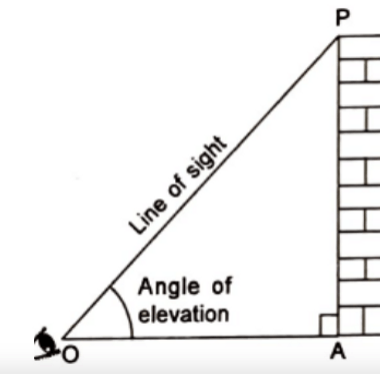
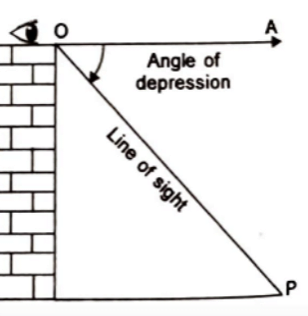
                  One of the main applications of trigonometry is to find the distance between two or more than two places or to find the height of the object or the angle subtended by any object at a given point without actually measuring the distance or heights or angles. (Scroll down till end of the page)

                  Study Tools

                  Audio, Visual & Digital Content

                  One of the main applications of trigonometry is to find the distance between two or more than two places or to find the height of the object or the angle subtended by any object at a given point without actually measuring the distance or heights or angles.

                  Hindi Version

                  Key Terms

                  Topic Terminology

                  Term

                  Important Tables

                  Table:

                  .

                  Thumbnail - Study, Assess, Interact
                  Advanced Tools For Study Assess Interact
                  • Temperature and its Measurement | Study

                    Mind Map Overal Idea Content Speed Notes Quick Coverage Content : (Scroll down till end of the page) Study Tools Audio, Visual & Digital Content Content … Key Terms Topic Terminology Term Important Tables Table: . Assessments Test Your Learning readmore

                    Mind Map

                    Overal Idea

                    Content

                    Speed Notes

                    Quick Coverage

                    Content : (Scroll down till end of the page)

                    Study Tools

                    Audio, Visual & Digital Content

                    Content …

                    Key Terms

                    Topic Terminology

                    Term

                    Important Tables

                    Table:

                    .

                    Thumbnail - Study, Assess, Interact
                    Advanced Tools For Study Assess Interact
                    wpChatIcon
                      wpChatIcon
                      Optimized by Optimole
                      error: Content is protected !!
                      Scan the code