Tool : Study

Study Toools

  • Rational Numbers | Study

  • Reproduction in Plants | Study

  • TISSUES | Study

  • Comparing Quantities | Study

  • Comparing Quantities | Study

  • Control and Coordination | Study

  • Coordinate Geometry | Study

  • Data Handling and Presentation | Study

  • Exploring Magnets | Study

  • Rational Numbers | Study

    Mind Map Overal Idea Content Speed Notes Quick Coverage Rational Number: A number that can be expressed in the form (Scroll down till end of the page) Study Tools Audio, Visual & Digital Content 14. Every positive rational number is greater than zero. 15. Every negative rational number is less than zero. 16. The rational readmore

    Mind Map

    Overal Idea

    Content

    Speed Notes

    Quick Coverage

    Rational Number: A number that can be expressed in the form (Scroll down till end of the page)

    Study Tools

    Audio, Visual & Digital Content

    14. Every positive rational number is greater than zero.

    15. Every negative rational number is less than zero.

    16. The rational numbers can be represented on the number line.

    Hindi Version

    Key Terms

    Topic Terminology

    Term

    Important Tables

    Table:

    .

    Thumbnail - Study, Assess, Interact
    Advanced Tools For Study Assess Interact
    • Reproduction in Plants | Study

      Mind Map Overal Idea Content Speed Notes Quick Coverage All organisms multiply or reproduce offspring of their own kind. In plants there are two modes of reproduction, namely (a) Asexual reproduction and (b) Sexual reproduction. There are several methods of asexual reproduction such as fragmentation, budding, spore formation and vegetative propagation. Sexual reproduction involves the readmore

      Mind Map

      Overal Idea

      Content

      Speed Notes

      Quick Coverage

      All organisms multiply or reproduce offspring of their own kind.

      In plants there are two modes of reproduction, namely (a) Asexual reproduction and (b) Sexual reproduction.

      There are several methods of asexual reproduction such as fragmentation, budding, spore formation and vegetative propagation.

      Sexual reproduction involves the fusion of male and female gametes. (Scroll down till end of the page)

      Study Tools

      Audio, Visual & Digital Content

      In vegetative propagation new plants are produced from different vegetative parts such as leaves, stems and roots.

      Flower is the reproductive part of a plant.

      A flower may be unisexual with either the male or the female reproductive parts.

      A bisexual flower has both the male and the female reproductive parts.

      The male gametes are found inside the pollen grains and female gametes are found in the ovule.

      Pollination is the process of transfer of pollen grains from the anther of one flower to the stigma of the same or another flower.

      Pollination is of two types, self-pollination and cross-pollination.

      In self-pollination, pollen grains are transferred from the anther to the stigma of the same flower.

      In cross-pollination, pollen grains are transferred from the anther of one flower to the stigma of another flower of the same kind.

      Pollination takes place in plants with the help of wind, water and insects.

      The fusion of male and female gametes is called fertilization.

      Fertilized egg is called zygote.

      Zygote develops into an embryo.

      Fruit is the mature ovary whereas ovule develops into a seed, which contains the developing embryo.

      Seed dispersal is aided by wind, water and animals.

      Seed dispersal helps the plants to:

      1. prevent overcrowding,
      2. avoid competition for sunlight, water and minerals
      3. invade new habitats.
      Hindi Version

      Key Terms

      Topic Terminology

      Term

      Important Tables

      Table:

      .

      Thumbnail - Study, Assess, Interact
      Advanced Tools For Study Assess Interact
      • TISSUES | Study

        Mind Map Overal Idea Content Speed Notes Quick Coverage Are plants and Animals made of same types of tissues?Plants are stationary, and hence are provided with some tissues made up of dead cells, which provide mechanical strength. They have to withstand unfavourable conditions like strong winds, storms, floods etc. Animals on other hand move around readmore

        Mind Map

        Overal Idea

        Content

        Speed Notes

        Quick Coverage

        Are plants and Animals made of same types of tissues?
        Plants are stationary, and hence are provided with some tissues made up of dead cells, which provide mechanical strength. They have to withstand unfavourable conditions like strong winds, storms, floods etc. Animals on other hand move around in search of food, mates, shelter. (Scroll down till end of the page)

        Study Tools

        Audio, Visual & Digital Content

        They consume more energy as compared to plants. Most of the tissues they contain are living.

        Cell growth in animas is more uniform.

        The structural organisation of organs and organ systems is far more specialized and localised in complex animals than even in very complex plants.

        Plant tissues:

        Meristematic Tissue: The growth of plants occurs only in certain specific regions. This is because the dividing tissue
        also known as meristematic tissue is the region where they are present, meristematic tissues are classified as apical, lateral and intercalary. Apical meristem is present at the apical or growing tips of stems and roots. Apical meristem
        increases the length of the plant. Lateral meristem is present in the radial portion of the stem or root. Lateral meristem increases the girth of the plant.

        Intercalary meristem occurs at the base of the leaves or at the internodes. Intercalary meristem increases the length of the internode. Permanent Tissue Old meristematic cells lose the capacity to divide and transform into permanent tissues.

        This process of taking up a permanent shape, size, and function is called differentiation. These are cells which have lost their capacity to divide but are specified to provide strength, flexibility and elasticity to the plant. These tissues can be further classified into simple permanent, complex permanent and special tissues. Simple permanent can be categorized into parenchyma, collenchyma and sclerenchyma based on their function. Parenchyma- they are live cells. They are usually loosely packed. This tissue provides support to plants and also stores food. In some situations it contains chlorophyll and performs photosynthesis and then it is called chlorenchyma. Parenchyma which contains large air cavities in aquatic plants is called aerenchyma. The aerenchyma helps in buoyancy. Collenchyma – These are elongated living cells with small intercellular spaces. Their cell walls
        are made up of cellulose and pectin. Collenchyma occurs in the peripheral regions of stems and
        leaves to provide mechanical support and flexibility in plants. Sclerenchyma – These are long, dead cells with a deposit of lignin in their cell wall. They have no intercellular spaces. Sclerenchyma occurs around the vascular tissues in stems, in the veins of leaves, and in the hard covering of seeds and nuts. They provide strength to the plant.

        Epidermis aids in protection against loss of water, mechanical injury and invasion by parasitic
        fungi. Since it has a protective role to play, cells of epidermal tissue form a continuous layer
        without intercellular spaces. Epidermis of the leaf contains small pores called stomata. These are
        necessary for gases exchange and transpiration. Cork – This is the outer protective tissue which replaces the epidermal cells in older roots and stems. Cork cells are dead and lack intercellular spaces. Their cell walls are thickened by suberin
        which makes them impermeable to water and gas molecules.

        Complex permanent tissue:
        Complex permanent tissue comprises of conducting tissues called xylem and phloem. Xylem is useful in transport of water and soluble substances. Xylem consists of tracheids, vessels, fibres and xylem parenchyma. Transport of minerals and water is unidirectional in xylem. Phloem is useful in transport of food molecules. Phloem comprises of sieve tubes, sieve cells, companion cells, phloem fibres and phloem parenchyma. Phloem is unlike xylem in that materials can move in both directions in it.

        Animal Tissues:

        These are the tissues present only in animals. Different types of animal tissues are epithelial tissue, connective tissue, muscle tissue and nervous tissue.

        Epithelial Tissue:
        Epithelial tissue forms a lining all over the body of the organism. It protects the inner lying
        parts.

        It is also secretory in function to secrete sebum and excrete wastes along with sweat.

        Sometimes it is absorptive in nature. Epithelial tissues act like a barrier to keep the different body systems separate. These are tightly packed and form a continuous sheet without intercellular spaces.

        Squamous epithelium has flat and thin cells with no intercellular spaces.

        Squamous epithelium provides is found in the outer layer of the skin, lining the cavities of blood vessels, lung alveoli, lining of oesophagus and the lining of the mouth. Stratified epithelium has epithelial cells lined up one over another. It is found in the epidermis of the skin.

        It helps to prevent wear and tear of tissue. Columnar epithelium consists of cylindrical cells. It is found in the lining of the stomach and intestines, and facilitates the movement across the epithelial barrier.

        Columnar epithelial tissue with cilia is known as ciliated epithelium. These cilia push the mucus forward into the nasal tract to clear it. Cuboidal epithelium consists of cubical cells. It is found in the lining of the kidney tubules, salivary glands and thyroid glands, where it provides mechanical support. Glandular epithelium consists of modified columnar cells, and is found in the sweat glands and tear glands to produce secretions.

        Connective tissue :
        Connective tissues are fibrous in nature.

        They include blood, bone, ligament, cartilage, areolar and adipose tissues.

        These help in binding other tissues together. They also provide support to other tissues.

        Blood has plasma and blood cells.

        The blood cells suspended in the plasma include RBC’s, WBC’s and platelets.

        Blood flows within blood vessels, and transports gases, digested food, hormones and waste materials to different parts of the body. Bone cells are embedded in a hard matrix composed of calcium and phosphorus compounds.

        Bones anchor the muscles and support the main organs of the body. Two bones can be connected to each other by another type of connective tissue called ligament. Ligaments are tough and elastic. They provide strength and flexibility. Tendons connect muscles to bones and are another type of connective tissue. Tendons are tough and non-elastic, and provide great strength and limited flexibility. Cartilage has widely spaced cells suspended in a matrix of proteins and sugars. It is found in the nose, ears, and the rings of the trachea to give flexibility. Areolar connective tissue is found between the skin and muscles, around blood vessels and nerves
        and in the bone marrow. It helps in repair of tissues. Adipose tissue contains cells filled with fat globules. It is found below the skin and acts as an
        insulator.

        Muscular Tissue:
        Muscle tissues consists of elongated cells also called muscle fibres.

        This tissue is responsible for movement.

        Muscles contain special proteins called contractile proteins which contract and relax to cause movement.

        These are elastic in nature they have tensile strength.

        These muscles can be
        voluntary or involuntary in function. Muscular tissues are of three kinds namely striated muscles, unstriated muscles and cardiac muscles. Striated muscle cells are long, cylindrical, unbranched and multinucleate.

        These are voluntary muscles.

        Smooth muscles or involuntary muscles are found in the iris of the eye, in ureters and in the bronchi of the lungs.

        These are also called unstriated muscles. The cells are long with pointed ends and uninucleate.

        Hear muscles or cardiac muscles are cylindrical, branched and uninucleate.

        Nervous Tissue
        Nervous tissues are found in the brain, spinal cord and nerves.

        Nervous tissue is the tissue which works in coordinating the organs of the body by generating impulses.

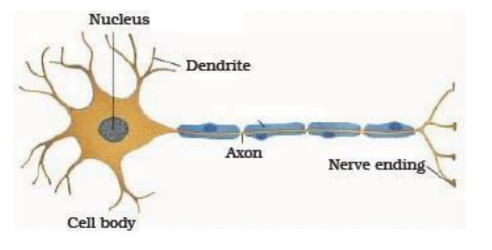
        It is made up of special cells called as neurons.

        Each neuron consists of a cell body, which contains a nucleus, cytoplasm, called cyton, from which long thin hair like parts arise.

        Usually each neuron has a single long part, called the axon, and many short branched parts called dendrites.
        Hindi Version

        Key Terms

        Topic Terminology

        Term

        Important Tables

        Table:

        .

        Thumbnail - Study, Assess, Interact
        Advanced Tools For Study Assess Interact
        • Comparing Quantities | Study

          Mind Map Overal Idea Content Speed Notes Quick Coverage Ratio: Comparing by division is called ratio. Quantities written in ratio have the sameunit. Ratio has no unit. (Scroll down till end of the page) Study Tools Audio, Visual & Digital Content Equality of two ratios is called proportion. Product of extremes = Product of meansPercentage: readmore

          Mind Map

          Overal Idea

          Content

          Study Tools

          Audio, Visual & Digital Content

          Equality of two ratios is called proportion. Product of extremes = Product of means
          Percentage: Percentage means for every hundred. The result of any division in
          whichthe divisor is 100 is a percentage. The divisor is denoted by a special
          symbol %, read as percent. Profit and Loss:
          (i) Cost Price (CP): The amount for which an article is bought. (ii) Selling Price (SP): The amount for which an article is sold. Additional expenses made after buying an article are included in the cost price
          and are known as overhead expenses. These may include expenses like amount
          spent onrepairs, labour charges, transportation, etc. Discount is a reduction given on marked price. Discount = Marked Price – Sale
          Price. Discount can be calculated when discount percentage is given. Discount

          Hindi Version

          Key Terms

          Topic Terminology

          Term

          Important Tables

          Table:

          .

          Thumbnail - Study, Assess, Interact
          Advanced Tools For Study Assess Interact
          • Comparing Quantities | Study

            Mind Map Overal Idea Content Speed Notes Quick Coverage Comparing Quantities: Weare often requiredto compare two quantities, in our dailylife. They may be heights, weights, salaries, marks etc. To compare two quantities, their units must be the same. We are often required to compare two quantities in our daily life. They may be heights, weights,salaries, readmore

            Mind Map

            Overal Idea

            Content

            Speed Notes

            Quick Coverage

            Comparing Quantities: Weare often requiredto compare two quantities, in our dailylife. They may be heights, weights, salaries, marks etc. To compare two quantities, their units must be the same.

            We are often required to compare two quantities in our daily life. They may be heights, weights,salaries, marks etc. (Scroll down till end of the page)

            Study Tools

            Audio, Visual & Digital Content

            While comparing heights of two persons with heights150 cm and 75 cm, we write it as the ratio 150 : 75 or 2 : 1.

            Ratio: A ratio compares two quantities using a particular operation.

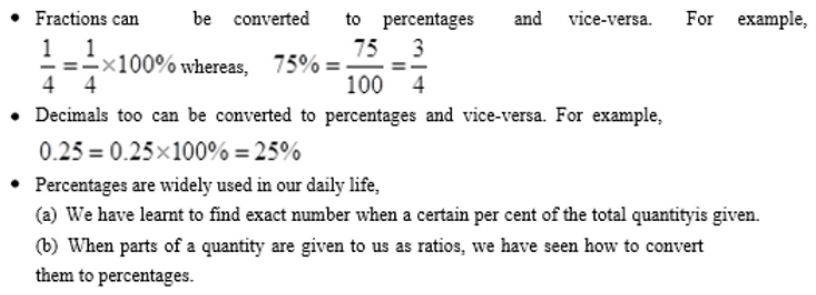
            Percentage: Percentage are numerators of fractions with denominator 100. Percent is represent by the symbol% and means hundredth too.

            Two ratios can be compared by converting them to like fractions. If the two fractions are equal,we say the two given ratios are equivalent.

            If two ratios are equivalent then the four quantities are said to be in proportion. For example, the ratios 8 : 2 and 16 : 4 are equivalent therefore 8, 2, 16 and 4 are in proportion.

            A way of comparing quantities is percentage. Percentages are numerators of fractions with denominator 100. Per cent means per hundred. For example 82% marks means

            82 marks out of hundred.

            Percentages are widely used in our daily life,

            (a) We have learnt to find exact number when a certain per cent of the total quantity is given.

            (b) When parts of a quantityare given to us as ratios, we have seen how to convert

            them to percentages.

            (c) The increase or decrease in a certainquantity can also be expressed as percentage.

            (d) The profit or loss incurredin a certain transaction can be expressedin terms of percentages.

            (e) While computing intereston an amount borrowed, the rate of interest is given in terms of per cents. For example, ` 800 borrowed for 3 years at 12% per annum. Simple Interest:Principal means the borrowed money.

            The extra money paid by borrower for using borrowedmoney for given time is called interest(I).

            The period for which the money is borrowed is called ‘TimePeriod’ (T).

            Rate of interestis generally given in percentper year.

            Interest, I = PTR/100

            Total money paid by the borrower to the lenderis called the amount.

            Hindi Version

            Key Terms

            Topic Terminology

            Term

            Important Tables

            Table:

            .

            Thumbnail - Study, Assess, Interact
            Advanced Tools For Study Assess Interact
            • Control and Coordination | Study

              Mind Map Overal Idea Content Speed Notes Quick Coverage Nervous system is the organ system present in the animals to control and coordinate different activities of the body. Nervous system comprises ofthe brain, thespinal cord, anda huge network of nerves thatare spread throughout the body. The nervous system is responsible for sending, receiving and processing readmore

              Mind Map

              Overal Idea

              Content

              Speed Notes

              Quick Coverage

              Nervous system is the organ system present in the animals to control and coordinate different activities of the body.

              Nervous system comprises ofthe brain, thespinal cord, anda huge network of nerves thatare spread throughout the body.

              The nervous system is responsible for sending, receiving and processing messages in the form of chemical signals called as impulses. (Scroll down till end..)

              Study Tools

              Audio, Visual & Digital Content

              Hindi Version

              Key Terms

              Topic Terminology

              Term:

              Important Tables

              Topic Terminology

              Term:

              Thumbnail - Study, Assess, Interact
              Advanced Tools For Study Assess Interact
              • Coordinate Geometry | Study

                Mind Map Overal Idea Content Speed Notes Quick Coverage Cartesian System A plane formed by two number lines, one horizontal and the other vertical, such that they intersect each other at their zeroes, and then they form a Cartesian Plane. (Scroll down till end of the page) Study Tools Audio, Visual & Digital Content Coordinate readmore

                Mind Map

                Overal Idea

                Content

                Speed Notes

                Quick Coverage

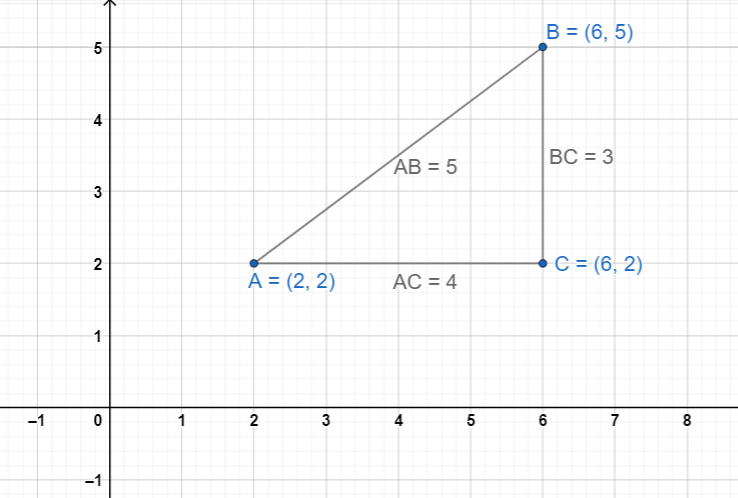
                Cartesian System

                Cartesian Plane

                A plane formed by two number lines, one horizontal

                and the other vertical, such that they intersect each

                other at their zeroes, and then they form a Cartesian

                Plane. (Scroll down till end of the page)

                Study Tools

                Audio, Visual & Digital Content

                Hindi Version

                Key Terms

                Topic Terminology

                Term

                Important Tables

                Table:

                .

                Thumbnail - Study, Assess, Interact
                Advanced Tools For Study Assess Interact
                • Data Handling and Presentation | Study

                  Mind Map Overal Idea Content Speed Notes Quick Coverage Data: A collection of numbers gathered to give someinformation. Recording Data:Data can becollected from different sources. Pictograph: The representation of data through pictures of objects. It helps answer the questions onthe data ata glance. (Scroll down till end of the page) Study Tools Audio, Visual & readmore

                  Mind Map

                  Overal Idea

                  Content

                  Speed Notes

                  Quick Coverage

                  Data: A collection of numbers gathered to give someinformation. Recording Data:Data can becollected from different sources. Pictograph: The representation of data through pictures of objects. It helps answer the questions onthe data ata glance. (Scroll down till end of the page)

                  Study Tools

                  Audio, Visual & Digital Content

                  Bar Graph: Pictorial representation of numerical datain the formof bars (ractangles) of equal width and varying heights. We have seen that data is a collection of numbers gathered to give some information.

                  To get a particular information from the givendata quickly, thedata can be arranged ina tabular formusing tally marks. We learnt how a pictograph represents data in the formof pictures, objects or parts ofobjects.

                  We have also seen how to interpret a pictograph and answer the related questions.

                  We havedrawn pictographs using symbols to represent a certain number of items orthings.

                  We havediscussed how torepresent data byusing a bardiagram or abar graph.

                  Ina bar graph, bars of uniform width are drawn horizontally or vertically with equal spacing between them.

                  Thelength of eachbar gives therequired information.

                  To do this we also discussed the process of choosing a scale for the graph. For example, 1unit = 100students.

                  We havealso practised reading a given bargraph.

                  We have seen howinterpretations from thesame can bemade.

                  Hindi Version

                  Key Terms

                  Topic Terminology

                  Term

                  Important Tables

                  Table:

                  .

                  Thumbnail - Study, Assess, Interact
                  Advanced Tools For Study Assess Interact
                  • Exploring Magnets | Study

                    Mind Map Overal Idea Content Speed Notes Quick Coverage Content : (Scroll down till end of the page) Study Tools Audio, Visual & Digital Content Content … Key Terms Topic Terminology Term Important Tables Table: . Assessments Test Your Learning readmore
                    Mind Map

                    Overal Idea

                    Content

                    Speed Notes

                    Quick Coverage

                    Content : (Scroll down till end of the page)

                    Study Tools

                    Audio, Visual & Digital Content

                    Content …

                    Key Terms

                    Topic Terminology

                    Term

                    Important Tables

                    Table:

                    .

                    Thumbnail - Study, Assess, Interact
                    Advanced Tools For Study Assess Interact
                    wpChatIcon
                      wpChatIcon
                      Optimized by Optimole
                      error: Content is protected !!
                      Scan the code